


Posted: 7/29/2005 1:03:08 PM EDT
|
Redid the entire garage last weekend. Part of the rebuild was because my former workbench top was a plain white countertop from the home store. It was initially appealing, because it had a raised bullnose front to keep stuff from rolling off the front, and a molded in backsplash to keep stuff from rolling off the back. Then I got into reloading, and the single stage and Dillon won’t mount properly with the raised, rounded front edge. The top needs to span 10 feet, as it sits on 3 2 foot wide cabinet bases and a space for my compressor. This span rules out ( I think) easily making a laminated melamine (sp) top, simply because I’d need to seam it. I looked at two different home stores for a premade, in stock counter top with a simple 90 degree plain fron, but they are all bullnosed. Suggestions, techniques, and materials? Uses, other than as a mount for the presses–I’ll probably mount a vice, and use the top as a wrok area, nothing involving forming horseshoes or anything. Thanks in advance. |
|
Here's what I did, but I tend to overengineer: I got 19 2x4s, laid them on the narrow edge, drilled three holes through all of them, got some 3/8" threaded rod and put them thru the holes. I then put two washers and a nut on either end of the rod and tightened like crazy. Voila, a poor man's butcher block workbench top. My workbench top is only 6' long, but it's so sturdy I can resize belted magnum calibers and the thing doesn't even budge. I've mounted a Dillon 650 on one end, using 4" x 1/4" bolts, and a Lee turret press, a 5" vise, or a case trimmer on the other side, using only six other holes. |
This sounds interesting. Did you plane or belt sand the edges so that the surface is smooth? |
|
The 2x4 laminate sounds like a good solution. I think you could probably get Melamine (or similar) laminate up to 12' width. If you don't get any love on that from Lowes/Home Depot/Menard's, call a local cabinet shop and see if they will sell you some. They may have a piece of scrap or leftover that they will let you buy for a good price, if you don't mind the color. If you go with the 2x4 laminate, you could belt sand the top, then put about 1/4" thick poluyurethane. Do like bars do, and cast interesting stuff into the polyurethane. (reloading tables, cartridge box ends, magazine articles, etc.) |
|
I made my countertop 30" and 16' long. Took 4 sheets of 3/4" ply, and ripped lengthwise, to end up with 4 pc 8' x 30". The 8' x 18" pieces became shelves under the bench. So, I put down the first layer, screwed down with drywall screws, driven just below flush. Then squeegied carpenters glue all over the top, put on the second layer of ply, and attached that to the first, again with drywall screws driven just below flush. Then sanded and put on the surface. BTW, the understructure was built of 2x4's all assembled with deck screws and Simpson Strong-Tie connectors. This is a solid workbench and great for any vise work. No matter how big or strong the vise, if not solidly mounted, it is not going to work well for you. |
So did you stagger the seams top and bottom? How hard is it to put on a decent laminate onto sanded ply? Or did you use a different surface? |
|
There are 2x4's running the length of the bench on the front edge, and back against the wall. There are 2x4's running front to back between the lengthwise 2x4's, hung with Simpson brackets, every 16". Where the two 8' x 30" ply tops meet in the middle they are directly over a 2x4, and the two edges screw to it. There are long screws securing the first layer of ply to the understructure about every 6" - 8" to both the lengthwise and front to back 2x4's. Nothing is moving! and I had the whole thing built in about 4 or 5 hours. I used two drills and 4 battery packs for everything, easy assembly. BTW, everything is screwed to the wall and the floor, so it is very solid. Simpson even offers plans and a kit for a nice workbench. I looked at it, thought, too short, and expanded the basic idea. I put the work surface at 40", but you need to decide what is best for you. I have a runner of some gray foam stuff, locks together at the edges like a jigsaw puzzle, and that really helps the feet. Three 4' fluorescent light fixtures overhead, and every 4' there are GFI outlets. The outlets run on alternate circuits, that is, 1st and 3rd are on one breaker, 2nd and 4th on another. For the surface itself, I used press and place floor tiles, the same ones I used on the floor of the workshop. Then a metal L strip on the edge. If one is damaged, I'll heat it with the heat gun, pull it up, and replace. I am mostly working on electronics and guns. |
|
I'll post pics when I get a chance. I use MDF 3/4" thick, two layers cemented with construction adhesive. I screw them together with zinc general purpose (like drywall) screws, counter sunk. I then laminate the top with 1/4" oak veneer and then biscuit a milled oak edge to the front. Looks great in the ranch house. |
I thought about it, but I got lazy and haven't done it yet. I spent a lot of time in the store getting straight 2x4s, so there's not too much of a problem. There's another problem, though--this sucker is HEAVY. Combined with the legs I built for it (4x4s with 1x6s for cross-braces) the thing easily weighs in the 75lb range, and that's just a 6ft table. |
|
Try these websites for more ideas.... workbenchmagazine.com woodmagazine.com woodworkingtips.com finewoodworking.com |
| I used a solid core industrial door that was discarded at the hospital I was working at for my reloading bench . 7' x 32" x 2" thick. , I have a 4x8 table on casters in my shop made from 2x6's and 3/4 ply on the top and 1/2 ply for the second shelf which is used for storing frequently used tools and nails ect.... .There is another bench along the back wall that is 10' x 30" wide with a 3/4 ply bottom layer and 1/2 osb on top, I used the osb with the intention of just replacing when it gets beat up. all benches are at exactly the same height so I can use the bench on casters as an extended surface area if needed. If you make one with casters on it make sure at least 2 of them will lock. |
|
I'd just mill the hump off the bullnose with a router and home-made jig, so the presses could be mounted. My own bench is 2x4 framework, lag-bolted together and to the wall. Strong enough to climb like a jungle-gym. Work surface is 5/8" melamine-coated particle board. The press and vise are bolted into the studs. Been using it for years with no trouble. 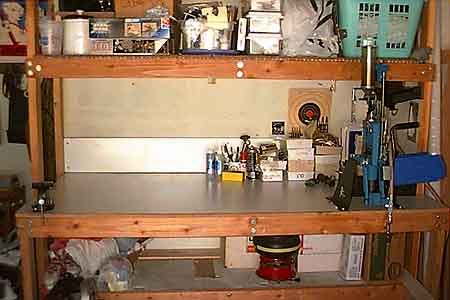
|
Very nice!  I'm building one in my garage this weekend, that photo gives me some ideas. Thanks. I'm building one in my garage this weekend, that photo gives me some ideas. Thanks.
|
