Warning


Close
Confirm Action

Are you sure you wish to do this?

Cancel Confirm
AR15.COM
2/15/2005 12:13:31 PM EDT
I would love to work at the large array of radio telescopes that we have some were after I graduate.  So I'm looking for info.

Where is the really large array also known as the really big array?

Does anyone here acually work there?

I believe it is owned by the miitary but Nasa and other research groups use it.  I think we only have one but I guess there could be others.  Anyone know if there is a site that lists what groups are using the really large array and why?
2/15/2005 12:16:00 PM EDT
[#1]


Did you mean the Very Large Array?

It's in New Mexico
2/15/2005 12:21:10 PM EDT
[#2]

Quoted:
www.vla.nrao.edu/images/tightcenter.small.jpg

Did you mean the Very Large Array?

It's in New Mexico


Yes thats exactly what I mean
2/15/2005 12:23:45 PM EDT
[#3]
That array is in the shape of a peace sign, something very unpatriotic given the current war on terror.  Not only should you not work there, it should be dismantled and reshaped into a "W" format, and all the America haters there should be shown footage of  911 until they get with the program...

2/15/2005 12:24:13 PM EDT
[#4]
It's way better than the Pretty Large Array, or even the Big Ol' Dang Array (in Arlen, Texas, where Boomhauer must work).
2/15/2005 12:24:32 PM EDT
[#5]

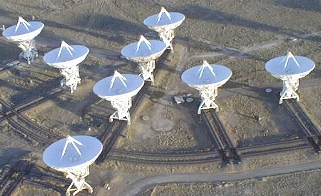
An Overview of the Very Large Array
History of the VLA:  
1972 August: approved by Congress
1973 April: construction started
1975 September 22: first antenna put in place
1976 February 18: first fringes
1980: formal dedication of the VLA

The total cost was $78,578,000 (in 1972 dollars), roughly $1 per taxpayer at the time; the project was completed nearly one year early, and within the allotted budget.

How Does it Work?  
The VLA is an interferometer; this means that it operates by multiplying the data from each pair of telescopes together to form interference patterns. The structure of those interference patterns, and how they change with time as the earth rotates, reflect the structure of radio sources on the sky: we can take these patterns and use a mathematical technique called the Fourier transform to make maps.  

Who Uses It?  
The VLA is used primarily by astronomers from around the world. It's also occasionally used for atmospheric/weather studies, satellite tracking, and other miscellaneous science.  
Location: Plains of San Agustin, west of Socorro, New Mexico.  

latitude = 34°04'43.497" north
longitude = 107°37'03.819" west
elevation = 2124 m (6970 ft)

Size:  
Each antenna: 25 m (82 ft) in diameter, 230 tons.

The array: there are four configurations: A array, with a maximum antenna separation of 36 km; B array -- 10 km; C array -- 3.6 km; and D array -- 1 km. The telescopes are switched between these configurations every four months or so.  
Resolution: 0.04 arcseconds  

The resolution of the VLA is set by the size of the array -- up to 36 km (22 miles) across. At our highest frequency (43 GHz) this gives a resolution of 0.04 arcseconds: sufficient to see a golf ball held by a friend 150 km (100 miles) away. Of course, very few golf balls contain high-power radio transmitters...  

Misc. antenna information:  
Slew rates: 40° per minute in azimuth, 20° per minute in elevation
Minimum elevation angle: 8° above the horizon
Frequency coverage: 74 to 50,000 MHz (400 to 0.7 cm)


Info from Here
2/15/2005 12:36:57 PM EDT
[#6]
If you can't even find out what it's named, good luck getting a job there!

Job listings:

www.nrao.edu/administration/personnel_office/careers.shtml
2/15/2005 12:43:33 PM EDT
[#7]

Quoted:
If you can't even find out what it's named, good luck getting a job there!

Job listings:

www.nrao.edu/administration/personnel_office/careers.shtml


I was wondering the same thing, but hey...

TRG
2/15/2005 12:53:22 PM EDT
[#8]
have you seen this big array?

int x[32000]
2/15/2005 1:02:21 PM EDT
[#9]
What about Goldstone?
2/15/2005 1:06:43 PM EDT
[#10]
The girl who was in charge of my first wife's floor in her dorm when she was a freshman was really fat. I guess she was a Very Large R.A.
2/15/2005 1:11:23 PM EDT
[#11]
You can build yer own two...

Better buy more tinfoil though...
2/15/2005 1:22:14 PM EDT
[#12]
Yes, but can you use it to watch the race?
2/15/2005 1:37:12 PM EDT
[#13]

Quoted:
have you seen this big array?

int x[32000]


ETA: You forgot the semicolon!!  Compile error!!!!
2/15/2005 2:17:32 PM EDT
[#14]

Quoted:
What about Goldstone?


Goldstone is cool.  I rode onto it and didnt know it.  We were on quads riding from Rainbow Basin near Barstow.  Very cool site.
2/15/2005 2:20:20 PM EDT
[#15]
Is that anything like the really big rack?
2/15/2005 2:20:43 PM EDT
[#16]

Quoted:
have you seen this big array?

int x[32000];


2/15/2005 2:26:23 PM EDT
[#17]
The Really Large Array Gun
2/15/2005 2:33:07 PM EDT
[#18]

Quoted:

Quoted:
have you seen this big array?

int x[32000]


ETA: You forgot the semicolon!!  Compile error!!!!


Damn semicolon! I have been using VB lately and it has corrupted me!
2/15/2005 3:03:16 PM EDT
[#19]
www.schlockmercenary.com/d/20030624.html


Try this for a Very Large Array, which is also a Very Dangerous Array!