


[ARCHIVED THREAD] - D-Day (Page 1 of 2)
Posted: 6/6/2013 1:37:33 AM EDT
|
Thank you to all the men and women who served in World War II. Only one of the three WWII vets from my family is still alive. Say "thank you" while you still can. 
|
|
This is the History of my old Unit in Canada... My service 1986-1996
69 Years ago today the 10th Canadian Armoured Regiment, The Fort Garry Horse, Stormed the beaches of Normandy. 'C' Squadron, Fort Garry Horse landed at 'Nan Red' beach near St. Aubin in support of the North Shore (New Brunswick) Regiment. At 8:05 the LCT's came inshore and the order was given to launch. On their way into shore 4 tanks were knocked out in the water. One LCT was hit with the tanks still onboard and one sank in deep water. When the tanks landed they gave supporting fire in all directions from their beach positions, waiting for the AVRE's to clear an exit through a minefield. The squadron had lost 4 tanks and were down to 16 tanks remaining. There was a great deal of confusion and still no beach exit for the tanks. The squadron leader, Major William Bray made the decision to push through the minefield himself. He pointed his tank at the minefield and ordered the squadron to follow him. They lost 3 more tanks in the process but the remaining tanks got into St Aubin and were able to support the infantry there. Major Bray won the Distinguished Service Order for his determination to get the Canadians ashore that day. By late morning the North Shores had cleared all of St.Aubin except a strong-point. In the afternoon two Sherman tanks blew up two 75mm and two anti-aircraft guns and destroyed the strong-point. The North Shores asked for tank support to take Tailleville and a tank troop from 'C' Squadron was sent up. The tanks advanced with the North Shores and gave them necessary fire and moral support to attack Tailleville. The tanks shot up a platoon of German infantry and destroyed a 75mm and an 88mm gun emplacement. Then the tanks attacked the strong German headquarters position within the village itself. In the afternoon a tank penetrated into the position and shot up the trenches and their defenders with high explosive shells at point blank range. By 1700 hours the remnants of the garrison, about 30 all ranks surrendered and the North Shores consolidated the position. At 23:30 'C' Squadron moved into position with the North Shores in Tailleville. Here in the dark the squadron laagered and passed an uncomfortable night constantly on the alert in expectation of a German counter attack. 'B' Squadron, Fort Garry Horse, commanded by Major J.A. Meindl landed at 'Nan White' beach near Bernières in support of the Queen's Own Rifles. The high waves forced the tanks to be brought in closer to shore by the LCT's, thus delaying the landing. The 'B' Squadron Shermans touched down on the sand and maneuvered their way through the belt of booby-trapped stakes and obstacles just off the beach. The DD's deflated their canvas screens and brought their 75mm guns and machine guns into action. They fired their 75mm guns steadily from their beach positions at the German pillboxes and strong-points. One company of the QOR suffered severely from enemy fire until 'B' Squadron arrived and provided supporting fire. 'B' Squadron remained on the beach until 9:30 when the Royal Engineers cleared a gap in the seawall. Then 'B' squadron moved up into Bernières in support of the QOR. After Bernières was taken, the QOR and 'B' squadron tanks formed up and moved south towards Beny-sur-Mer. The tanks took out several machine guns and two 88 mm guns to the southwest of Bernières. The LCT carrying Regimental Headquarters hit a mine damaging the ramp and the craft had to be put to sea again. It was not able to beach again until 1000 hours. The 'A' Squadron tanks landed at 900 hours and formed up with Le Régiment de la Chaudière. 'A' Squadron and the Chaudière's advanced to Beny-sur-Mer where they encountered considerable resistance. The 8th Brigade advanced up the Brigade center line in the following order: 'A' Squadron FGH, Le Régiment de la Chaudière, FGH Regimental Headquarters, 'B' Squadron FGH, the QOR and tactical H.Q. 8th Canadian Infantry Brigade. At noon Brigadier Blackader ordered a right flank guard. 'B' Squadron were taken away temporarily from the QOR and ordered to advance and converge on Colomby-sur-Thaon from the west. There were more German guns and well concealed defences inland than expected and these positions soon disclosed themselves. Sgt John Shineton, 'B' Squadron: "The road was very congested with all kinds of traffic, including infantry on foot and on bicycles. After sizing things up the only thing I could see possible was to break through the hedge on the narrow road just past Beny-sur-Mer. We did and were then in the open fields. We pushed on with full speed heading for a height of land known on our maps as Hill 70, and because of the speed in which we broke into the open fields, we were able to surprise the Germans dug in along the hedgerows, causing them to panic. The first four troops were able to get through into the open fields without any problems, but by this time, the Germans were laying down some heavy shell fire catching 5th troop and HQ Troops just coming through." Wes Lane, 'B' Squadron: "There were three tanks in a troop. My troop leader's tank was hit and Lieutenant Brown was killed. This was the first tank in our squadron to be knocked out. We saw the gun flash from a nearby bush. We aimed all our tank guns at the location and fired. We knocked out several enemy guns here. On D-Day we fired at anything we thought might be enemy gun positions." Major Meindl's tank was also shelled and he was badly wounded. The 'B' Squadron Shermans did a loop back patrol from Beny-sur-Mer past Fontaine Henri down to near Thaon and then back east to Anguerny. At about 15:00 they reached Hill 70 and could see the Carpiquet airfield. While holding the high ground here, they caught a group of German half-tracks trying to escape down the road toward Caen. They had a field day firing and setting them on fire. At 1400 hours the 'A' Squadron Shermans were on the Brigade objective at Anguerny and were prowling about mopping up enemy resistance. They requested infantry support as soon as possible and shortly the QOR arrived and consolidated the position. That afternoon plenty of skirmishes went on as the QOR rifles mopped up in Anguerny and the Chaudière's moved up to Colomby-sur-Thaon. By nightfall 'A' and 'B' squadrons had assisted their battalions on to their positions and were supporting them as well as doing patrol work. The QOR history pays tribute to the Garry's: "The tanks ranged far and wide and did valuable work in locating and destroying pockets of the enemy. It was a tank-infantry fight against scattered nests of enemy resistance and never did the cooperation work more smoothly". The Fort Garry Horse regiment was ordered back for rest and vehicle replenishment in Beny-sur-Mer, but the tanks stayed with their infantry late into the night. It wasn't until 01:00 the following morning that 'B' squadron made it back to Beny-sur-Mer while 'C' squadron stayed with the North Shores in Tailleville until the following afternoon. The Fort Garry Horse suffered 13 killed and 12 wounded casualties on D-Day. |

|
My Dad is a WWII vet.He joined the Navy in '43.He got his High School Diploma in one hand and his induction papers in the other.(not literally,but close).My Mom worked in a munitions plant (making.50 aircraft ammo).Mom had a brother who was a P-51 crew chief and a brother in North Africa.My first wife's Dad was a tank driver in North Africa and the only survivor of his tank crew.He spent 27 months in Germany as a POW.
When I was a kid in rural Indiana going to town on Saturday was like a history lesson................Mom would speak to someone and after he walked away she would say "He was a soldier in the Philippines and was on the Bataan Death March".............or maybe point someone out saying " her brother was killed on Omaha Beach"...........or " that woman's son was killed in Germany" or "that man flew B17's" ......."Bob was a ball turret gunner and shot down on his very first mission". Mom and Dad are still living........ |
|
My cousin, Trevor Beattie, a remarkable character, successful businessman & an all round good guy is holding a Gala event to raise money to send the D-Day Veterans back to Normandy next year.
Jack & Ada Beattie Foundation "Heroes of Normandy" 
|


|
.......Remember the fallen!
|
|
Quoted:
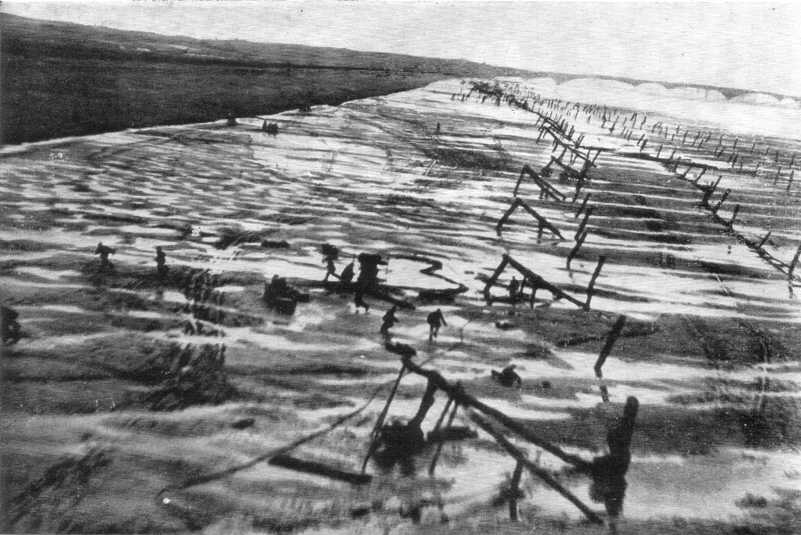
Man that's a lot of open ground to cross. God bless them all. Never forget. http://www.historyofwar.org/Pictures/beach_obstructions_normandy.jpg IIRC, those are Germans, pic taken by US recon plane, a day or two prior. But regardless, yes, a lot of land to cross
|
|
I have much respect for all those veteran thrown into D-Day.
A store I frequent was located in such a way that there was a small shady area near the entrance and some old guys used to hang out there. The one gentleman I had a bit of contact with was somehow related to the owners and I would chat him up whenever I saw him because we had had some similar medical problems. One day there was a bigger than usual group of old guys (with a couple of real big mouths) and they were mostly going on about the hotshot vacations they had taken their wife's on . One bigmouth was pestering the quiet old guy with lines like "I remember you saying you had been to France , what airport did you fly into?" Reply- "I didn't fly into any airport" "Well then , did you take a cruise to Europe then? What port?" "Nope no cruise" On and on with the big mouth getting more personal with the questions as if he was accusing the old gentleman of bullshitting about spending time in France. Situation was getting pretty tense with mean questions and the old gent getting pretty quiet with short answers and the loudmouths getting louder and more insistent. Finally The old gent said " look you guys , I really don't want to talk about it but the way I spent time in France and Europe was by wading ashore on June 6th" |
|
that picture always stirs me. I cannot imagine |
|
Soldiers, Sailors and Airmen of the Allied Expeditionary Force! You are about to embark upon a great crusade, toward which we have striven these many months. The eyes of the world are upon you. The hopes and prayers of liberty loving people everywhere march with you. In company with our brave Allies and brothers in arms on other fronts, you will bring about the destruction of the German war machine, the elimination of Nazi tyranny over the oppressed peoples of Europe, and security for ourselves in a free world. Your task will not be an easy one. Your enemy is well trained, well equipped and battle hardened, he will fight savagely. But this is the year 1944! Much has happened since the Nazi triumphs of 1940-41. The United Nations have inflicted upon the Germans great defeats, in open battle, man to man. Our air offensive has seriously reduced their strength in the air and their capacity to wage war on the ground. Our home fronts have given us an overwhelming superiority in weapons and munitions of war, and placed at our disposal great reserves of trained fighting men. The tide has turned! The free men of the world are marching together to victory! I have full confidence in your courage, devotion to duty and skill in battle. We will accept nothing less than full victory! Good Luck! And let us all beseech the blessings of Almighty God upon this great and noble undertaking. -- Gen. Dwight D. Eisenhower |
|
The Allied casualties figures for D-Day have generally been estimated at 10,000, including 2500 dead. Broken down by nationality, the usual D-Day casualty figures are approximately 2700 British, 946 Canadians, and 6603 Americans. However recent painstaking research by the US National D-Day Memorial Foundation has achieved a more accurate - and much higher - figure for the Allied personnel who were killed on D-Day. They have recorded the names of individual Allied personnel killed on 6 June 1944 in Operation Overlord, and so far they have verified 2499 American D-Day fatalities and 1915 from the other Allied nations, a total of 4414 dead (much higher than the traditional figure of 2500 dead). Further research may mean that these numbers will increase slightly in future. The details of this research will in due course be available on the Foundation's website at www.dday.org. This new research means that the casualty figures given for individual units in the next few paragraphs are no doubt inaccurate, and hopefully more accurate figures will one day be calculated. Casualties on the British beaches were roughly 1000 on Gold Beach and the same number on Sword Beach. The remainder of the British losses were amongst the airborne troops: some 600 were killed or wounded, and 600 more were missing; 100 glider pilots also became casualties. The losses of 3rd Canadian Division at Juno Beach have been given as 340 killed, 574 wounded and 47 taken prisoner. The breakdown of US casualties was 1465 dead, 3184 wounded, 1928 missing and 26 captured. Of the total US figure, 2499 casualties were from the US airborne troops (238 of them being deaths). The casualties at Utah Beach were relatively light: 197, including 60 missing. However, the US 1st and 29th Divisions together suffered around 2000 casualties at Omaha Beach. |
| My Dad and Uncles all were there in one way or another. Tough men. They , during their lives after the war, did very well because they did not have the word "quit" in their vocabularies. My favorite uncle told me that later in the war the Germans resorted to firing `88s at INDIVIDUAL solders. He told me of being in a foxhole with his buddy and " when I turned around he was just GONE". My Dad was in a B-24 and had nightmares for many years after the war. He didn`t talk much about it but our neighbor told me about the nightmares. Another uncle was on the USS Missouri and made it home. God bless them and all the many many others. |
