


[ARCHIVED THREAD] - Stopping Power (Page 1 of 2)
Posted: 5/31/2012 12:05:06 PM EDT
|
Link to data here.
This may be a dupe, but it was the first time I had seen it. Make of it what you will. Thanks to the author for putting it together. |
|
He contradicts his own data.
" One can reasonable expect that FMJ ammo will not stop as well as a state of the art expanding bullet. I personally believe that the 9mm is a better stopper than the numbers here indicate," He didn't take into consideration self defense ammo? I know that would be hard to do considering how he collected the data, but... Oh will guess I gotta conduct my own tests now. |
|
Quoted:
According to the statistics from that link... A .22 has a higher percentage of one-shot kills than 9mm. Hmm.... And therein lies the problem with "anecdotal data". It is made up of second-hand reports, and we do not know anything about where the subject was hit, their mental and physical state, or anything like that. It makes the data almost meaningless. |
|
Quoted:
Quoted:
According to the statistics from that link... A .22 has a higher percentage of one-shot kills than 9mm. Hmm.... And therein lies the problem with "anecdotal data". It is made up of second-hand reports, and we do not know anything about where the subject was hit, their mental and physical state, or anything like that. It makes the data almost meaningless. "If the .22 is so lethal, shouldn't every cop just carry .22, and practice head shots..." Yeah, the data is meaningless... It isn't even interesting, just confusing when you look at it from an analytical standpoint... |
|
Quoted:
It has been posted and discussed for many pages. Nice job of gathering all that data, but doesn't really tell us much. The best ballisticians do not agree with his conclusions. Agreed. While it may be true that, statistically speaking, there isn't a whole lot of difference between common handgun calibers in determining the outcome of a conflict, there's no doubt that some calibers have the potential to cause more tissue damage than others. Whether or not this potential is realized in a shooting is determined by any number of factors (shot placement/wound angle/clothing/distance/etc/etc/etc). But it still makes sense to me to stack the odds in your favor by carrying the most effective caliber practical. One thing that did stand out to me was the performance of the .357, which seems to coincide with the findings I've read by experts in the field. I've always believed that the temporary wound cavity caused by high-vel handgun ammunition is underestimated in its ability to cause or hasten incapacitation. |
|
Quoted:
That was a long read. What I gathered is that when compared to center fire rifle rounds, all handguns rounds are pretty much equal. I could have told you that without reading the article...  
The truth is, "carry" calibers (9mm, .45, .40) all reach vital organs with a sizeable hole created along the way. But to get to real results you need to jump to long-guns... But statistically stating that a .22 has a better percentage of "one shot kills..." That right there shows a slanted statistical data pool... And brings into question the accuracy of the data to begin with, and brings into question how the data can be interpreted accurately... |
|
9mm Luger
# of people shot - 456 # of hits - 1121 % of hits that were fatal - 24% Average number of rounds until incapacitation - 2.45 % of people who were not incapacitated - 13% One-shot-stop % - 34% Accuracy (head and torso hits) - 74% % actually incapacitated by one shot (torso or head hit) - 47% .32 (both .32 Long and .32 ACP) # of people shot - 25 # of hits - 38 % of hits that were fatal - 21% Average number of rounds until incapacitation - 1.52 % of people who were not incapacitated - 40% One-shot-stop % - 40% Accuracy (head and torso hits) - 78% % actually incapacitated by one shot (torso or head hit) - 72% 9mm beat out by .32 
|
|
Quoted:
It has been posted and discussed for many pages. Nice job of gathering all that data, but doesn't really tell us much. The best ballisticians do not agree with his conclusions. This particular data has been discussed? To me, it looks made up. Also, I recall some actual data from real shootings several years back. 12 gage had a fatality rate of about 50%, 7.62x39 was about 0% with each having roughly equal numbers of victims. Any talk about "one shot stops" is an indication of fake data. How do you collect one shot stop data in any meaningfull way? |
|
Quoted:
But statistically stating that a .22 has a better percentage of "one shot kills..." That right there shows a slanted statistical data pool... And brings into question the accuracy of the data to begin with, and brings into question how the data can be interpreted accurately... If you read the article you'd understand where he was coming from on this. And if (I said 'if') his assumptions are correct, that would explain the surprising performance of the .22. BTW - they weren't kills. Nor were they incapacitations. They were stops. Again, this was explained in the article. |

|
The basic issue with OSS data is data selectivity. OSS data would have you believe that if you shoot someone with a 9mm FMJ round, 63% (that's the data I recall from over a decade ago) of the time you'll get a stop. That's s simply not true. They do not consider shootings that required more than one round, which are the majority. Furthermore, they don't have repeatable criteria as to what defines a "stop." Someone who is shot once, but fully capable of functioning, that decides to surrender because he is surrounded counts equally with someone shot in the heart who is DRT. simply put,you can't repeat the circumstances surrounding the so-called stop because it is highly variable.
It's junk science. |

|
Quoted:
Quoted:
But statistically stating that a .22 has a better percentage of "one shot kills..." That right there shows a slanted statistical data pool... And brings into question the accuracy of the data to begin with, and brings into question how the data can be interpreted accurately... If you read the article you'd understand where he was coming from on this. And if (I said 'if') his assumptions are correct, that would explain the surprising performance of the .22. BTW - they weren't kills. Nor were they incapacitations. They were stops. Again, this was explained in the article.
One shot stop. My bad. The data still sucks. And any interpretation from the weird data needs to be taken with a grain of salt... |
|
Quoted: BTW - they weren't kills. Nor were they incapacitations. They were stops. Again, this was explained in the article. If the bullet "stopped" someone other than by incapacitating them, the incapacitation would have to be a result of the mental state of the person being shot. Are you saying that the caliber has an effect on their mental state? |
|
Quoted:
Quoted:
BTW - they weren't kills. Nor were they incapacitations. They were stops. Again, this was explained in the article. If the bullet "stopped" someone other than by incapacitating them, the incapacitation would have to be a result of the mental state of the person being shot. Are you saying that the caliber has an effect on their mental state? Arrrrrrrrrrrrrrgggggggggggghhhhhhhhhhhhhh.... AGAIN, it was explained in the article. And no - I'm not saying anything. It's not my report. It's not my data. I don't have a dog in this fight. I'm just trying to clear up misconceptions for those who didn't bother to read the article before commenting. Why? Because I'm a moron, it would appear. 
|
|
Quoted: Quoted: If the bullet "stopped" someone other than by incapacitating them, the incapacitation would have to be a result of the mental state of the person being shot. Are you saying that the caliber has an effect on their mental state? Arrrrrrrrrrrrrrgggggggggggghhhhhhhhhhhhhh.... AGAIN, it was explained in the article. Sorry - I should have said that HE made that connection, not you. |
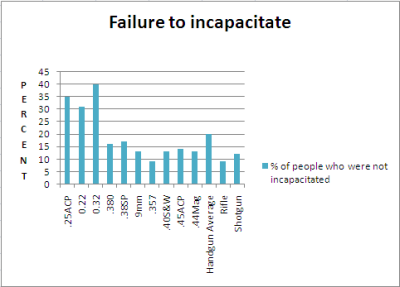

|
Quoted: The Secret Service carry the 357 Sig for a reason. This is why I carry a Glock 33  http://www.buckeyefirearms.org/publicfiles/Ellifritz_Failure_to_Incap.png They got a deal from the manufacturer? |


|
Quoted:
The Secret Service carry the 357 Sig for a reason. This is why I carry a Glock 33
http://www.buckeyefirearms.org/publicfiles/Ellifritz_Failure_to_Incap.png That chart is meaningless, just like the article. According to that chart, a .357 is just as effective as a rifle and more so than a shotgun. As Troy Landry would say, "I don't tink so." |
|
Quoted:
Quoted:
The Secret Service carry the 357 Sig for a reason. This is why I carry a Glock 33
http://www.buckeyefirearms.org/publicfiles/Ellifritz_Failure_to_Incap.png That chart is meaningless, just like the article. According to that chart, a .357 is just as effective as a rifle and more so than a shotgun. As Troy Landry would say, "I don't tink so." And WTF is a "rifle" The 20mm Anti-tank rifle is a rifle. So is a .218 bee. So WTF is a "rifle"? All center fire? really? |
|
Quoted: Quoted: The Secret Service carry the 357 Sig for a reason. This is why I carry a Glock 33 http://www.buckeyefirearms.org/publicfiles/Ellifritz_Failure_to_Incap.png That chart is meaningless, just like the article. According to that chart, a .357 is just as effective as a rifle and more so than a shotgun. As Troy Landry would say, "I don't tink so." I would say the only meaning is showing that sub .380 guns are significantly worse than others. That's really the only statistically significant finding he has. |
|
Quoted:
Quoted:
The Secret Service carry the 357 Sig for a reason. This is why I carry a Glock 33
http://www.buckeyefirearms.org/publicfiles/Ellifritz_Failure_to_Incap.png That chart is meaningless, just like the article. According to that chart, a .357 is just as effective as a rifle and more so than a shotgun. As Troy Landry would say, "I don't tink so." The only thing this article proves to me is that shooting an attacker bent on causing serious injury or death is generally a good way to defend ones life when other options don't exist. 
|
|
Quoted:
Quoted:
Quoted:
Quoted:
In before all the butt hurt 9mm guys So you actually believe that crap?  No, I could care less , but I know some people really take this stuff real Serious.http://nullbits.foxxz.net/albums/Icons/caring.png http://images.wikia.com/reddithistory/images/1/10/3-rage-face.png  where the heck you guys come up with these things? where the heck you guys come up with these things?
|
|
Quoted:
Quoted:
Quoted:
BTW - they weren't kills. Nor were they incapacitations. They were stops. Again, this was explained in the article. If the bullet "stopped" someone other than by incapacitating them, the incapacitation would have to be a result of the mental state of the person being shot. Are you saying that the caliber has an effect on their mental state? Arrrrrrrrrrrrrrgggggggggggghhhhhhhhhhhhhh.... AGAIN, it was explained in the article. And no - I'm not saying anything. It's not my report. It's not my data. I don't have a dog in this fight. I'm just trying to clear up misconceptions for those who didn't bother to read the article before commenting. Why? Because I'm a moron, it would appear.
It's always worth bringing up the issue of "psychological" stops. There is no way to accurately separate the people who decided to stop from those who physically HAD to stop. The reason it's so important is that statistically, psychological factors are probably a larger effect than physiologic factors. This renders all data collected on this subject practically irrelevant. |
|
Quoted: Quoted: The Secret Service carry the 357 Sig for a reason. This is why I carry a Glock 33 http://www.buckeyefirearms.org/publicfiles/Ellifritz_Failure_to_Incap.png They got a deal from the manufacturer? The .gov doesn't look for deals. Ya'll are butt-hurt because the mighty 357 Sig stomps the shit out of the 9mm/.40/.45 |
|
Quoted: It's always worth bringing up the issue of "psychological" stops. There is no way to accurately separate the people who decided to stop from those who physically HAD to stop. The reason it's so important is that statistically, psychological factors are probably a larger effect than physiologic factors. This renders all data collected on this subject practically irrelevant. You could technically do it with a large-enough sample size. Set your null and alternate hypothesis, come up with a confidence interval, and use a paired-sample t-test for the analysis. |
|
Quoted:
Quoted:
Quoted:
The Secret Service carry the 357 Sig for a reason. This is why I carry a Glock 33
http://www.buckeyefirearms.org/publicfiles/Ellifritz_Failure_to_Incap.png They got a deal from the manufacturer? The .gov doesn't look for deals. Ya'll are butt-hurt because the mighty 357 Sig stomps the shit out of the 9mm/.40/.45
Not really. The .357 Sig is a fine pistol round, but it is really no more effective than the others you mention. Pistols are pistols and cannot compete with rifles or shotguns. Look here, and especially at the 5th illustration down the page. There is no real difference. Best Defensive Ammo |
|
Quoted: Quoted: Quoted: Quoted: The Secret Service carry the 357 Sig for a reason. This is why I carry a Glock 33 http://www.buckeyefirearms.org/publicfiles/Ellifritz_Failure_to_Incap.png They got a deal from the manufacturer? The .gov doesn't look for deals. Ya'll are butt-hurt because the mighty 357 Sig stomps the shit out of the 9mm/.40/.45 Not really. The .357 Sig is a fine pistol round, but it is really no more effective than the others you mention. Pistols are pistols and cannot compete with rifles or shotguns. Look here, and especially at the 5th illustration down the page. There is no real difference. Best Defensive Ammo I did my own mud-bank-o'truth .45 v 357 Sig comparison test a few years ago. The 357 Sig poked a bigger deeper hole than the .45 Then I did the hard-pack-clay-o'truth and once again the 357 Sig kicked up a lot more dust than the .45 I also like the 357 Sig because it's loud and has a lot of muzzle flash. |