


Posted: 3/19/2011 5:48:29 PM EDT
| Without a brain? |
|
While it doesn't necessarily have a brain... it does have a "nerve net".
They don't need a whole lot of brain power. If they can swim toward something that "smells" like food, then that covers most of their behavior. And keep in mind that some single-celled organisms can do as much, just a feedback loop between chemical receptors and the flagellum. |
|
The nervous system's primary job is to coordinate wide ranges of biological activities. The more complex an organism is the more complex of a nervous system it is likely to have. Jellyfish are very simple, they only have one method of movement (contraction of the bell) and no organism level homeostatic functions to speak of. Their most notable feature, their stinging cells, operate on a cellular level... meaning they do their thing without direction from the whole organism. Jellyfish have a fairly unique multi polar (non directional) nervous system that is well suited for causing the muscles to contract the way they need to. EDIT: On a side note the cnidocyte, the jellyfish stinging cell, is perhaps the most fascinating and specialized cell type in the animal kingdom. |


|
That's actually a comb jelly, different beast from a jellyfish. A jellyfish has a bell like shape.
 |
|
Quoted: Via conjunction. http://www.youtube.com/watch?v=mkO87mkgcNo |

|
Quoted:
The nervous system's primary job is to coordinate wide ranges of biological activities. The more complex an organism is the more complex of a nervous system it is likely to have. Jellyfish are very simple, they only have one method of movement (contraction of the bell) and no organism level homeostatic functions to speak of. Their most notable feature, their stinging cells, operate on a cellular level... meaning they do their thing without direction from the whole organism. Jellyfish have a fairly unique multi polar (non directional) nervous system that is well suited for causing the muscles to contract the way they need to. EDIT: On a side note the cnidocyte, the jellyfish stinging cell, is perhaps the most fascinating and specialized cell type in the animal kingdom. Wow. They're like taser-cells: 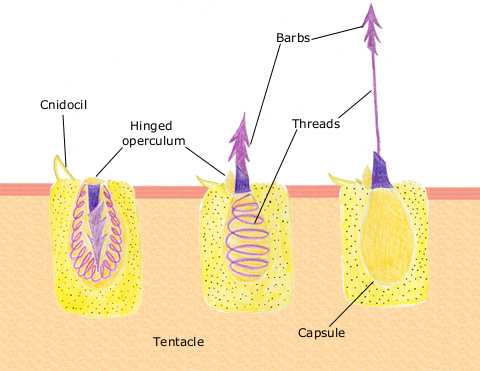
|

|
Quoted: That's actually a comb jelly, different beast from a jellyfish. Good Lord that is a big jellyfish.  |

|
Quoted:
This.
While it doesn't necessarily have a brain... it does have a "nerve net". They don't need a whole lot of brain power. If they can swim toward something that "smells" like food, then that covers most of their behavior. And keep in mind that some single-celled organisms can do as much, just a feedback loop between chemical receptors and the flagellum. Even really simple neural networks can produce surprisingly complex behavior. |
|
Quoted: That's actually a comb jelly, different beast from a jellyfish. I'll take your word for it |
