


Posted: 12/3/2010 4:33:47 PM EDT
|
Need some help from you guys in-the-know with regards to 12vdc power.
Let's say I have a device that draws 3.75w @ 5vdc. I want to use a power converter to connect it to a 12vdc source (let's say a car or motorcycle batter) First of all, how can I calculate how long a fully charged battery will power this device, in hours? Secondarily, other than the "cold cranking amps" rating, is there something I can look for in a battery that will tell me whether or not it has more "capacity" or time until discharge at the currenty draw level of my 5v device? Thanks. |
|
does the battery still have to start a car or motorcycle after running your device for a while? If so, you can only plan to use 30 percent of the AH rating before your vehicle wont start. Its arithmetic to determine the power available in 12 v. If you are reducing it to 5v there are losses in that move I dont know about. Probably small, but give us more info about the proposed battery and the whole set up.
|
|
Quoted:
Need some help from you guys in-the-know with regards to 12vdc power. Let's say I have a device that draws 3.75w @ 5vdc. I want to use a power converter to connect it to a 12vdc source (let's say a car or motorcycle batter) First of all, how can I calculate how long a fully charged battery will power this device, in hours? Secondarily, other than the "cold cranking amps" rating, is there something I can look for in a battery that will tell me whether or not it has more "capacity" or time until discharge at the currenty draw level of my 5v device? Thanks. First question-you say the device uses 3.75 W @5 volts DC. Are you certain that it is spec'd in W (watts) and not A (amps)? Second, the power converter efficiency is critical. What converter are you talking about? This and the answer to the first question tell us how many amperes the battery has to provide. Third, batteries typically have two ratings: CCA (cold cranking amps) which is completely irrelevant in this case (it only means something if you are cranking an engine) and reserve capacity (typically given in amp-hours). Reserve capacity is the spec that matters for your battery. This is the number of minutes that the battery will run a 25 amp load at warm temps until it is dead. Note that it will not start a car, run a radio, or anything else at that point, it is effectively dead and in need of a recharge. The basic model here is that if you run a load of 12.5 amps the battery will run it for twice as long, and if the load is 6.25 amps it will run 4 times as long, etc. ( Also, for the typical battery, running it down to dead more than a few times will definitely reduce it's charge capacity. So the calculations above give a starting point but it's wise to go for a battery rated at 1.5 to 2 times higher than what you think you need. Since I don't know yet what the converter is like, I'm going for a near-worst case result here. 3.75 watts at 5 volts gives .75 amps. A crappy converter will consume about that many amps (but a decent converter will be more efficient) So, assuming that, you will draw .75 amps from the battery. A battery rated at 120 minutes reserve capacity will power that for (25/.75)*120 minutes or 4000 minutes (66 hours) at 80 degrees Fahrenheit. At lower tempertures, the available capacity is lower. At 32 F, it's something like 1/2 of that but depends on the specific battery design and chemistry. One last point-if you run your game cam or whatever in the field, and run the battery down, then what is left in it is mainly water, which freezes. So if you run it dead, and it sits in the cold and freezes, the battery is going to be toast. |
|
I'll try to clarify this. No "converter" is needed, only a "series regulator" that will handle .75 amps AND dissipate the waste heat from dropping 12V-13V down to 5V. That's 12 - 5 = 7 volts dropped, 7 volts x .75 amps = 5.25 watts of waste heat. What you're looking for is a National LM309K 5VDC 1.5A regulator in a TO-3 package.  It needs a fairly large heatsink to dissipate the waste heat. 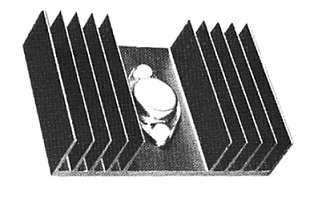 Also needed are some electrolytic filter capacitors on the input and output to stabilize the regulator, to keep it from oscillating. It's a very simple circuit - 12V in on the left, 5V regulated out on the right. Ignore the part number difference - the circuit is the same and just that simple.  You end up with something like this, just the heat sink mounted regulator with the caps underneath, and minus all the surrounding crap in this particular picture. 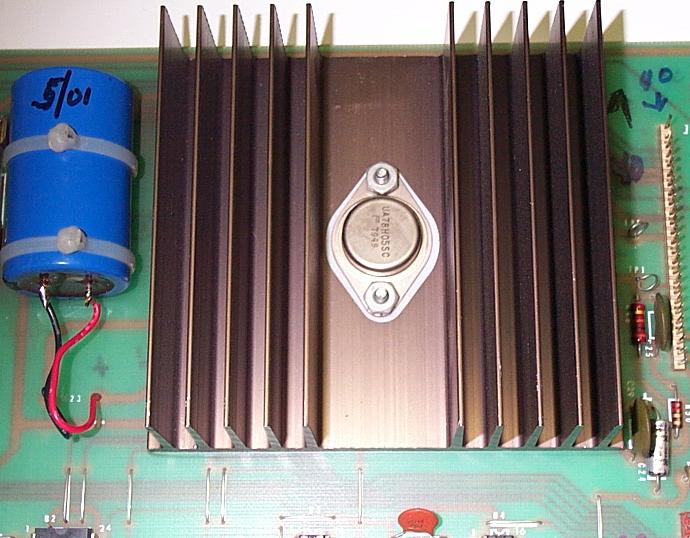 Here's a simple power supply powered by the AC line - eliminate everything from the rectifier to the left and substitute your battery.  These parts are available from a wide variety of new and surplus electronic parts dealers online. Digikey, Mouser, BGMicro, MPJA, Jameco, AllElectronics, etc. I don't think Radio Shack still carries anything this "exotic" because home building is a dying art. Battery life can be roughly calculated by dividing "amp hours" by .75 amps. If the battery is rated 100 amp hours you'll get roughly 150-200 hours before the voltage drops too low. What's "too low"? The LM309 regulator requires a minimum of 7.1V input to deliver 5V on the output. |
|
Thanks to all for the quick replies.
Essentially I want to place a small, portable device (one is 5v @ 3.75w and the alternative device is 15v, 1.2a, 18w) in a location to collect data. Solar is out. Well, let me put it this way: if I were to use solar to trickle-charge, the panels would have to be really, really, really small, and I'm not sure how much good it would do. I can use motorcycle batteries in series, or whatever batteries you all feel would be best suited for the task. I chose an automotive battery thinking it would have the most capacity, but then all I really know about batteries is that some are round and some are square 
|
|
In order to reduce the voltage from 12V to 5V you will need a sufficiently sized (both in power and ohms) resistor in series. A 5W resistor will be big enough. The problem, now, is to find the required ohm rating of the resistor. Then once that is found, then one may find how long a battery can run the whole circuit if you know the amp-hour rating of the battery you want to use.
Use Ohm's law where V=IR and P=VI, where V is the voltage, I is the current in amperes, R is the resistance in Ohms, and P is power in watts. As posted above, the amperage is 0.75A, while the resistance of the device you are running is R=V/I or 5/0.75=6.67 ohms. The next step is to apply Kirchhoff's Voltage law which basically states that the sum of the voltages in a closed loop must equal zero. Also, the current in a simple circuit will be constant. That is the current of 0.75A will be the same, through the resistor that you put in and the device you wish to run. Again, Ohm's Law comes into play. Find the total resistance of the circuit R=V/I =12/0.75=16 ohms. Resistors are additive in series, so that R1+R2=R total. Therefore, you get 12 - 6.67 = 5.33 ohms. Go to Radio Shack or other such supplier and buy a 5.5 ohm 5 watt resistor, and connect it in series with your device and 12V battery. Your new circuit will use 12V * 0.75A = 9 watts. If you have a 12V 10 A-hour battery, it will run for 10 A-hours / 0.75 A or 13.3 hours. I hope this is what you needed without being too terribly technical. |
|
Quoted: Thanks to all for the quick replies. Essentially I want to place a small, portable device (one is 5v @ 3.75w and the alternative device is 15v, 1.2a, 18w) in a location to collect data. Solar is out. Well, let me put it this way: if I were to use solar to trickle-charge, the panels would have to be really, really, really small, and I'm not sure how much good it would do. I can use motorcycle batteries in series, or whatever batteries you all feel would be best suited for the task. I chose an automotive battery thinking it would have the most capacity, but then all I really know about batteries is that some are round and some are square There you move out of the realm of battery power. A motorcycle battery will have an amp-hour rating of about 10-20 AH. It will run your small device for a day or less, but no more. A typical car battery will run it much longer, but at the cost of size and weight. Your current drain on the smaller device pretty much rules out solar panels unless you could use a pretty good sized one that could supply about 1 amp or more to keep the battery charged up as the device drained it at .75 amp. |
|
Quoted:
I'll try to clarify this. No "converter" is needed, only a "series regulator" that will handle .75 amps AND dissipate the waste heat from dropping 12V-13V down to 5V. That's 12 - 5 = 7 volts dropped, 7 volts x .75 amps = 5.25 watts of waste heat. What you're looking for is a National LM309K 5VDC 1.5A regulator in a TO-3 package. http://media.digikey.com/photos/National%20Semi%20Photos/LM309K%20STEEL%5ENOPB.JPG It needs a fairly large heatsink to dissipate the waste heat. http://www.johnhearfield.com/Eng/HS_TO-3.gif Also needed are some electrolytic filter capacitors on the input and output to stabilize the regulator, to keep it from oscillating. It's a very simple circuit - 12V in on the left, 5V regulated out on the right. Ignore the part number difference - the circuit is the same and just that simple. http://www.national.com/images/pf/LM309/00713802.jpg You end up with something like this, just the heat sink mounted regulator with the caps underneath, and minus all the surrounding crap in this particular picture. http://www.bigdaddy-enterprises.com/common/b-solehv3.jpg Here's a simple power supply powered by the AC line - eliminate everything from the rectifier to the left and substitute your battery. http://www.eleccircuit.com/wp-content/uploads/2009/09/5-volt-regulator-by-lm309.jpg These parts are available from a wide variety of new and surplus electronic parts dealers online. Digikey, Mouser, BGMicro, MPJA, Jameco, AllElectronics, etc. I don't think Radio Shack still carries anything this "exotic" because home building is a dying art. Battery life can be roughly calculated by dividing "amp hours" by .75 amps. If the battery is rated 100 amp hours you'll get roughly 150-200 hours before the voltage drops too low. What's "too low"? The LM309 regulator requires a minimum of 7.1V input to deliver 5V on the output. 1. "Too low" means low enough to significantly affect the life of the battery. I thought we were talking lead-acid (car) batteries here, but maybe I assumed something...drawing a 12 V nominal lead-acid battery to anything near 7.1 volts is likely to damage it permanently. Maybe not ruin it, but it won't take many cycles for it to lose a lot of capacity. 2. The converter you present would likely work just fine but isn't very efficient. I'd like to know more about the converter the OP has in mind since newer switch mode DC-DC converters can have very high efficiencies compared to linear regulator based designs. (aside from the lower mass, size, and cost). |
|
Quoted:
Thanks to all for the quick replies. Essentially I want to place a small, portable device (one is 5v @ 3.75w and the alternative device is 15v, 1.2a, 18w) in a location to collect data. Solar is out. Well, let me put it this way: if I were to use solar to trickle-charge, the panels would have to be really, really, really small, and I'm not sure how much good it would do. I can use motorcycle batteries in series, or whatever batteries you all feel would be best suited for the task. I chose an automotive battery thinking it would have the most capacity, but then all I really know about batteries is that some are round and some are square You didn't say how long it has to run before charging which is a key question. When it comes to lead-acid batteries, a good rule of thumb is that heavier=more capacity. It's a rough guide but I can tell you that two or three motorcyle batteries aren't going to have the capacity of one large car/truck battery. For that matter, you could consider somthing like a forklift battery.... Need more info-budget, weight and size limits, endurance limits, etc. We might be able to give you some ideas but you can't get definite answers without specific questions 
|
|
Holy antique semiconductor Batman!
For the OP: You need .75a @ battery voltage. Most wet cell car batteries do not tolerate discharge below 50% on a regular basis. Some AGM type batteries (Kinetik, Odyssey, etc.) will take a 80% discharge without harm. Pick a battery big enough, by looking at the amp-hours. A 105 ah battery @ 50% discharge is 52.5 ah, divided by .75 = 70 That means you can run for 70 hours straight, and still have 50% battery capacity. If you used an Odyssey PC2150 battery, you could run for 115 hours straight. Actually much longer than that, as battery voltage can drop all the way to 8v & still run that load through a regulator Use an LM7805 voltage regulator to get to 5v. You will need a small hat sink - like a 4 inch piece of 1.5x1.5x.062 aluminum angle. That regulator will not need an input capacitor if fed from a battery, and depending on the device you are running an output capacitor may no be needed either. If the device ran from a wall wart originally, no cap should be needed. You can buy an LM7805 from Radio Shack, or Mouser online. Lem |