


[ARCHIVED THREAD] - General Relativity Physics Question (Page 1 of 2)
Posted: 11/9/2010 7:43:18 AM EDT
|
My understanding of general relativity is that no two objects can be moving faster than the speed of light relative to each other.
My question is, take three objects starting out from the same point: object A, B, C. object A shoots off in one direction at .99C. object C shoots off in an opposite direction also at .99C. Object B remains motionless. From Object B's perspective, A & C should be receding from each other at superluminal velocities. From Object C's perspective, object B is receding from it at .99C. But at what velocity is Object A receding from C? Clearly, can't be >C, but what is it? What formula is used to calculate this? |
|
Quoted:
A moving from C appears to be moving faster than the speed of light but it is relative relationship Yup, it doesn't break the rules. From A's perspective, C is moving at subluminal velocity and likewise for C and A. Nothing is moving faster than light from B's perspective. |
|
Quoted:
Quoted:
A moving from C appears to be moving faster than the speed of light but it is relative relationship Yup, it doesn't break the rules. From A's perspective, C is moving at subluminal velocity and likewise for C and A. Nothing is moving faster than light from B's perspective. Not saying it breaks the rules. But I am wondering from the perspective of C, what are the velocities of B & A relative to each other? What is the absolute relative velocity between A & C? How is this calculated? |
|
Quoted:
Quoted:
Quoted:
A moving from C appears to be moving faster than the speed of light but it is relative relationship Yup, it doesn't break the rules. From A's perspective, C is moving at subluminal velocity and likewise for C and A. Nothing is moving faster than light from B's perspective. Not saying it breaks the rules. But I am wondering from the perspective of C, what are the velocities of B & A relative to each other? What is the absolute relative velocity between A & C? How is this calculated? Here you go: Einstein Velocity Addition You just have to switch how you think of things: Using your labels, C is the stationary observer, B is the moving observer and A is the projectile. u' and v are both 0.99c in your example. From C's perspective, B is moving at .99c and A is moving at (0.999949....)c |

|
If you put two cars on a street tail to tail and they both start off going X mph in opposite directions then aren’t they separating at a speed of 2X? For instance, if X is 30 mph then doesn’t that mean in one hour they will be 60 miles apart?
If the objects are celestial bodies and X is the speed of light then what is the difference? |

|
Quoted: If you put two cars on a street tail to tail and they both start off going X mph in opposite directions then aren’t they separating at a speed of 2X? For instance, if X is 30 mph then doesn’t that mean in one hour they will be 60 miles apart? If the objects are celestial bodies and X is the speed of light then what is the difference? You are both right and wrong at the same time there partner. At the speeds that we are used to in our every day experience the separating speed would be VERY CLOSE to 2X, so close that we just call it 2X. However (take a closer look at the equations in the link provided above) as those speeds become faster the difference between "2X" and reality increases. Once you get close to light speed saying that it would be simply 2X is completely wrong. |
|
im not a physicist or master of relativity, but i question your first paragraph stating no two objects can move faster than the speed of light relative to each other. i question this, because i can imagine two objects moving in opposite directions starting from the same point with a light source at the starting point. each object can still be travelling less than the speed of light, but if the frame of reference is moved to one of the moving bodies then the other is traveling faster than the speed of light.
in otherwords, lets say a source emits light in a vaccuum, do light waves/particles move only at half light speed, because theyre traveling in oppositie directions from the same source? Posted Via AR15.Com Mobile |
|
Quoted: I'm not a physicist or master of relativity, but I question your first paragraph stating no two objects can move faster than the speed of light relative to each other. I question this, because I can imagine two objects moving in opposite directions starting from the same point with a light source at the starting point. Each object can still be traveling less than the speed of light, but if the frame of reference is moved to one of the moving bodies then the other is traveling faster than the speed of light. In other words, lets say a source emits light in a vacuum, do light waves/particles move only at half light speed, because they're traveling in opposite directions from the same source? Posted Via AR15.Com Mobile Really? You seem to get the concept pretty well. |
|
Two things: 1. This is Special Relativity. The General theory of Relativity had to do with gravity. 2. Remember that all sorts of whacky things happen as we approach the speed of light (weight and length increases, time slow down, etc.) Point is we move away from Newtonian physics as we approach the speed of light. For example. If two cars drive at 50 mph in opposite directions, then from either of the car's perspective, the other is moving away at 100 mph. Now say that those two cars are moving at 80% of the speed of light. From either car's point of view, the other car still will not be going faster than the speed of light. I confess that the detailed explanation starts to make my head hurt as this point. |
|
There you go.
Just like turning on your headlights in a car traveling near the speed of light, it seems that things have different speeds at the same time. Newtonian explanations make sense to most people today but Einsteinian physics are still poorly understood by the majority. We can easily tell each other what will happen, but the why is difficult to get across without a good understanding of the equations. Without the math it's like trying to describe Mozart - the violin ... swelled ... and the brass ... uh... lifted the soul of the woodwinds. "When you are courting a nice girl an hour seems like a second. When you sit on a red-hot cinder a second seems like an hour. That's relativity." Einstein |

|
Quoted:
This is the reason I didn't go to college. I was afraid someone would ask me something like this on the very first day.  They usually ask this on the mid term and when you realize that it was never discussed in class and you are pass the Drop deadline then you start to wonder why the hell you are in college. |
|
Quoted:
Quoted:
Quoted:
Then you form a pulsar.What if C is on a treadmill that is on a turntable?  http://www.lghsales.com/pulsar-pf8177-mens-chronograph-watch.jpg 
yes, that.
|
|
Quoted: Two things: 1. This is Special Relativity. The General theory of Relativity had to do with gravity. 2. Remember that all sorts of whacky things happen as we approach the speed of light (weight and length increases, time slow down, etc.) Point is we move away from Newtonian physics as we approach the speed of light. For example. If two cars drive at 50 mph in opposite directions, then from either of the car's perspective, the other is moving away at 100 mph. Now say that those two cars are moving at 80% of the speed of light. From either car's point of view, the other car still will not be going faster than the speed of light. I confess that the detailed explanation starts to make my head hurt as this point. The part in bold is where time dilation comes in. The other car appears to be going near the speed of light, but time and space around it will be deformed. In science fiction stories, where folk go near the speed of light they age less than those "stationary". Go near light speed to Alpha Centari and back so distance in light years x 2... that time passes for the traveler, but a whole lot more time passes for those left on Earth. This is what causes the two objects A and C to be able to do that, they separate from one another in the "time" dimension not the "space" dimension. Do that faster than light and they get a blue event horizon between one another. IF you read "A Brief History of Time" you are familiar with the "light cone" graphing concept. Superluminar speeds will put one object outside the light cone of another when they previously were in the same one. The best way to think about this stuff is to get the numbers into the equations and try not to model it in your head too hard, the theories have been tested pretty well so rely on the numbers not what your brain tries to tell you will happen. It's not built for relativity.
|
|
Quoted:
Quoted:
If you put two cars on a street tail to tail and they both start off going X mph in opposite directions then aren’t they separating at a speed of 2X? For instance, if X is 30 mph then doesn’t that mean in one hour they will be 60 miles apart? If the objects are celestial bodies and X is the speed of light then what is the difference? You are both right and wrong at the same time there partner. At the speeds that we are used to in our every day experience the separating speed would be VERY CLOSE to 2X, so close that we just call it 2X. However (take a closer look at the equations in the link provided above) as those speeds become faster the difference between "2X" and reality increases. Once you get close to light speed saying that it would be simply 2X is completely wrong. I am just a dumbass Cracker engineer and while I studied a little physics I don’t understand what you just said. Talk a little slower so that we poor Cracker boys with a MS in Engineering from UCF can understand what you are saying. Where precisely does my model fail? If you are separating at the speed of 2X then why do you say that you are not separating at the speed of 2X? Humor my ignorance and ‘splain it to me. |
|
Quoted:
v(A) + v(B) = ––––––––- 1 + v(A)V(B)/c^2 btw, special... not general relativity This. Plug in 1000 m/s,the velocity of a rifle bullet, and you see that the bottom term is 1.00000000011111111111111111111... In other words, the error in assuming the velocities add is ten parts per trillion. The error is smaller for slower things. |
|
Quoted:
Quoted:
v(A) + v(B) = ––––––––- 1 + v(A)V(B)/c^2 btw, special... not general relativity This. Plug in 1000 m/s,the velocity of a rifle bullet, and you see that the bottom term is 1.00000000011111111111111111111... Pretty close to one. Check your units...you need to put 1000m/s in terms of c to work out. |
|
Think of it like this: You get in a plane and fly 400mph in one direction A friend gets in another plane and flies 400mph in the opposite direction Did either of you break the sound barrier? Your speed relative to your friend was 800mph, but you're still sub-sonic in the frame of reference that actually matters... |
|
Quoted:
Quoted:
Quoted:
v(A) + v(B) = ––––––––- 1 + v(A)V(B)/c^2 btw, special... not general relativity This. Plug in 1000 m/s,the velocity of a rifle bullet, and you see that the bottom term is 1.00000000011111111111111111111... Pretty close to one. Check your units...you need to put 1000m/s in terms of c to work out. or you could just plug in c in m/s. 1+ 1000*1000/(3e8)^2 = 1+ 1.1111111...e-11 = 1.0000000001111111111... |
|
Quoted:
Think of it like this: You get in a plane and fly 400mph in one direction A friend gets in another plane and flies 400mph in the opposite direction Did either of you break the sound barrier? Your speed relative to your friend was 800mph, but you're still sub-sonic in the frame of reference that actually matters... We had a thread on this... there were people who expected sonic booms. |
|
Quoted: Quoted: I am just a dumbass Cracker engineer and while I studied a little physics I don’t understand what you just said.Quoted: You are both right and wrong at the same time there partner.If you put two cars on a street tail to tail and they both start off going X mph in opposite directions then aren’t they separating at a speed of 2X? For instance, if X is 30 mph then doesn’t that mean in one hour they will be 60 miles apart? If the objects are celestial bodies and X is the speed of light then what is the difference? At the speeds that we are used to in our every day experience the separating speed would be VERY CLOSE to 2X, so close that we just call it 2X. However (take a closer look at the equations in the link provided above) as those speeds become faster the difference between "2X" and reality increases. Once you get close to light speed saying that it would be simply 2X is completely wrong. Talk a little slower so that we poor Cracker boys with a MS in Engineering from UCF can understand what you are saying. Where precisely does my model fail? If you are separating at the speed of 2X then why do you say that you are not separating at the speed of 2X? Humor my ignorance and ‘splain it to me. 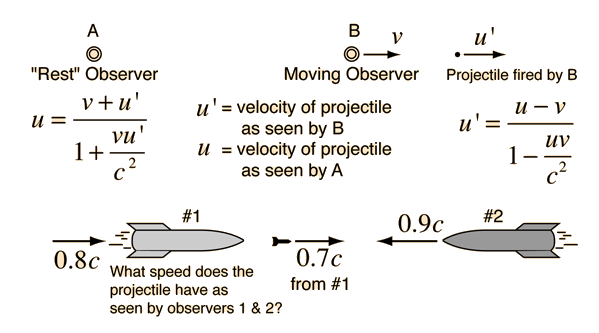 Two vehicles on earth traveling apart from a center point at 25 meters per second: v = 25mps u' = 25 mps u = 50 / 1.0000000000000069540628503351152 u = 49.999999999999652296857483246668 mps Pretty close to 50 mps right? Two spacecraft traveling apart from a center point at 200 million meters per second: v = 200 000 000 mps u' = 200 000 000 mps u = 400 000 000 / 1.4450600224214473728696359859392 u = 276 805 111.0636435647967428229074 mps It's never exactly 2X but when things are moving "slowly" the approximation is close enough. |
|
Quoted: What if a plane flying 500mph catches a jet stream and is pushed along to 700mph by a 200mph tailwind? Is there a sonic boom?Quoted: We had a thread on this... there were people who expected sonic booms.Think of it like this: You get in a plane and fly 400mph in one direction A friend gets in another plane and flies 400mph in the opposite direction Did either of you break the sound barrier? Your speed relative to your friend was 800mph, but you're still sub-sonic in the frame of reference that actually matters... The speed of sound is also relative  |
|
Quoted:
Quoted:
What if a plane flying 500mph catches a jet stream and is pushed along to 700mph by a 200mph tailwind? Is there a sonic boom?
Quoted:
We had a thread on this... there were people who expected sonic booms.Think of it like this: You get in a plane and fly 400mph in one direction A friend gets in another plane and flies 400mph in the opposite direction Did either of you break the sound barrier? Your speed relative to your friend was 800mph, but you're still sub-sonic in the frame of reference that actually matters... The speed of sound is also relative
The tailwind doesn't change the speed of sound, just the relative velocity of the plane with respect to the ground required to break it. The speed of sound is only dependent upon the temperature and composition of the air. |
|
Quoted: Quoted: What if a plane flying 500mph catches a jet stream and is pushed along to 700mph by a 200mph tailwind? Is there a sonic boom?Quoted: We had a thread on this... there were people who expected sonic booms.Think of it like this: You get in a plane and fly 400mph in one direction A friend gets in another plane and flies 400mph in the opposite direction Did either of you break the sound barrier? Your speed relative to your friend was 800mph, but you're still sub-sonic in the frame of reference that actually matters... The speed of sound is also relative Not to get off topic but you need to be going faster than sound through THE AIR to create a sonic boom. Your speed relative to the ground is completely irrelevant. |
|
Quoted: Quoted: Quoted: What if a plane flying 500mph catches a jet stream and is pushed along to 700mph by a 200mph tailwind? Is there a sonic boom?Quoted: We had a thread on this... there were people who expected sonic booms.Think of it like this: You get in a plane and fly 400mph in one direction A friend gets in another plane and flies 400mph in the opposite direction Did either of you break the sound barrier? Your speed relative to your friend was 800mph, but you're still sub-sonic in the frame of reference that actually matters... The speed of sound is also relative Not to get off topic but you need to be going faster than sound through THE AIR to create a sonic boom. Your speed relative to the ground is completely irrelevant. Exactly like i said, the frame of reference is important, which in this case is the windspeed relative to the 200mph air in the jetstream ETA: re-read |
|
Quoted:
Quoted:
Quoted:
I am just a dumbass Cracker engineer and while I studied a little physics I don’t understand what you just said.
Quoted:
You are both right and wrong at the same time there partner.
If you put two cars on a street tail to tail and they both start off going X mph in opposite directions then aren’t they separating at a speed of 2X? For instance, if X is 30 mph then doesn’t that mean in one hour they will be 60 miles apart? If the objects are celestial bodies and X is the speed of light then what is the difference? At the speeds that we are used to in our every day experience the separating speed would be VERY CLOSE to 2X, so close that we just call it 2X. However (take a closer look at the equations in the link provided above) as those speeds become faster the difference between "2X" and reality increases. Once you get close to light speed saying that it would be simply 2X is completely wrong. Talk a little slower so that we poor Cracker boys with a MS in Engineering from UCF can understand what you are saying. Where precisely does my model fail? If you are separating at the speed of 2X then why do you say that you are not separating at the speed of 2X? Humor my ignorance and ‘splain it to me. http://hyperphysics.phy-astr.gsu.edu/hbase/relativ/imgrel/evel1.gif Two vehicles on earth traveling apart from a center point at 25 meters per second: v = 25mps u' = 25 mps u = 50 / 1.0000000000000069540628503351152 u = 49.999999999999652296857483246668 mps Pretty close to 50 mps right? Two spacecraft traveling apart from a center point at 200 million meters per second: v = 200 000 000 mps u' = 200 000 000 mps u = 400 000 000 / 1.4450600224214473728696359859392 u = 276 805 111.0636435647967428229074 mps It's never exactly 2X but when things are moving "slowly" the approximation is close enough. I understand the equation but as I get older I question things that I would not have questioned at a younger age. Is that equation theoretical or has it actually been proven in models? I ask that because at the end of the day it really doesn’t make sense. If you are separating at a speed of 30 MPH then at the end of an hour you should be 60 miles apart. If your measurements of speed and time are precise and no error then you should be exactly 60 miles apart. If the two space vehicles are separating at exactly the speed of light then at the end of a year they should be exactly two light years apart. I may be questioning some basic Physics law that everybody else understands very well but it does not make sense to me. As an Engineer I understand what I can actually measure, not what someone tells me I should be able to measure. |
|
Remember Harry Callahan's catchphrase in Magnum Force? "A man's got to know his limitations.". My Magnum Force moment was in Physics 21 when we did the section on relativity. I simply cannot understand relativistic physics the way I can everything else. I can do the math, and pretty much get the right answer, but I just can't grasp it. I've been able to get a working understanding of EVERYTHING I've put my mind to, except this. (Well, and women).
When I realized that I couldn't understand relativity, it was sort of a shock. I'd never really hit so hard against my limitations before. Orbital mechanics was another tough one, so I had to give up my dream of being a starship pilot (only half kidding). Oh, and IBT relativity troofers. |
|
Quoted:
Quoted:
Quoted:
Quoted:
I am just a dumbass Cracker engineer and while I studied a little physics I don’t understand what you just said.
Quoted:
You are both right and wrong at the same time there partner.
If you put two cars on a street tail to tail and they both start off going X mph in opposite directions then aren’t they separating at a speed of 2X? For instance, if X is 30 mph then doesn’t that mean in one hour they will be 60 miles apart? If the objects are celestial bodies and X is the speed of light then what is the difference? At the speeds that we are used to in our every day experience the separating speed would be VERY CLOSE to 2X, so close that we just call it 2X. However (take a closer look at the equations in the link provided above) as those speeds become faster the difference between "2X" and reality increases. Once you get close to light speed saying that it would be simply 2X is completely wrong. Talk a little slower so that we poor Cracker boys with a MS in Engineering from UCF can understand what you are saying. Where precisely does my model fail? If you are separating at the speed of 2X then why do you say that you are not separating at the speed of 2X? Humor my ignorance and ‘splain it to me. http://hyperphysics.phy-astr.gsu.edu/hbase/relativ/imgrel/evel1.gif Two vehicles on earth traveling apart from a center point at 25 meters per second: v = 25mps u' = 25 mps u = 50 / 1.0000000000000069540628503351152 u = 49.999999999999652296857483246668 mps Pretty close to 50 mps right? Two spacecraft traveling apart from a center point at 200 million meters per second: v = 200 000 000 mps u' = 200 000 000 mps u = 400 000 000 / 1.4450600224214473728696359859392 u = 276 805 111.0636435647967428229074 mps It's never exactly 2X but when things are moving "slowly" the approximation is close enough. I understand the equation but as I get older I question things that I would not have questioned at a younger age. Is that equation theoretical or has it actually been proven in models? I ask that because at the end of the day it really doesn’t make sense. If you are separating at a speed of 30 MPH then at the end of an hour you should be 60 miles apart. If your measurements of speed and time are precise and no error then you should be exactly 60 miles apart. If the two space vehicles are separating at exactly the speed of light then at the end of a year they should be exactly two light years apart. I may be questioning some basic Physics law that everybody else understands very well but it does not make sense to me. As an Engineer I understand what I can actually measure, not what someone tells me I should be able to measure. The hour you specify passes more slowly for an observer in the car than one on the ground. Who's hour are you using for timing? In reality you aren't going to notice the 0.01 ppt difference. This is not true for objects traveling at higher velocities. This is not just some theoretical mumbo jumbo. It has been measured; in fact the theory is incredibly precise. As I showed earlier, when comparing objects moving at the speed of rifle bullets, there is an error of about 10 parts per trillion versus the classical "velocities just add" model. Satellites travel even faster than that, so the error is even greater. Without correcting for relativistic effects GPS navigation wouldn't work. The GPS satellites are nothing but fancy clocks that send out a signal that says "I am at such and such coordinates at such and such time." Using that information from several satellites, you can pin down your location very precisely. However, because the satellites are moving so quickly, they need to adjust for the fact that time passes slower for the satellites than it does for an observer on Earth. Without that correction, the time data would not be precise enough to fix your position on Earth. As an analogy, you might tell a freshman engineer that on Earth falling bodies accelerate at about 10m/s regardless of mass. This makes sense intuitively since you can drop a bowling ball and quarter and watch them fall at the same rate. But it's only true under special circumstances. A paperclip and a feather won't fall at the same speed, because the feather has a much larger drag to weight ratio. This is like the classical Newtonian model vs the relativistic one, except that it requires very precise instruments and/or very high speed to notice the difference. Basically you don't notice the difference under "normal" circumstances (quarter vs bowling ball) but you will notice the difference at extreme velocities or very precise measurements (paperclip vs feather). |
|
Quoted: Quoted: Quoted: Quoted: I am just a dumbass Cracker engineer and while I studied a little physics I don’t understand what you just said.Quoted: You are both right and wrong at the same time there partner.If you put two cars on a street tail to tail and they both start off going X mph in opposite directions then aren’t they separating at a speed of 2X? For instance, if X is 30 mph then doesn’t that mean in one hour they will be 60 miles apart? If the objects are celestial bodies and X is the speed of light then what is the difference? At the speeds that we are used to in our every day experience the separating speed would be VERY CLOSE to 2X, so close that we just call it 2X. However (take a closer look at the equations in the link provided above) as those speeds become faster the difference between "2X" and reality increases. Once you get close to light speed saying that it would be simply 2X is completely wrong. Talk a little slower so that we poor Cracker boys with a MS in Engineering from UCF can understand what you are saying. Where precisely does my model fail? If you are separating at the speed of 2X then why do you say that you are not separating at the speed of 2X? Humor my ignorance and ‘splain it to me. http://hyperphysics.phy-astr.gsu.edu/hbase/relativ/imgrel/evel1.gif Two vehicles on earth traveling apart from a center point at 25 meters per second: v = 25mps u' = 25 mps u = 50 / 1.0000000000000069540628503351152 u = 49.999999999999652296857483246668 mps Pretty close to 50 mps right? Two spacecraft traveling apart from a center point at 200 million meters per second: v = 200 000 000 mps u' = 200 000 000 mps u = 400 000 000 / 1.4450600224214473728696359859392 u = 276 805 111.0636435647967428229074 mps It's never exactly 2X but when things are moving "slowly" the approximation is close enough. I understand the equation but as I get older I question things that I would not have questioned at a younger age. Is that equation theoretical or has it actually been proven in models? I ask that because at the end of the day it really doesn’t make sense. If you are separating at a speed of 30 MPH then at the end of an hour you should be 60 miles apart. If your measurements of speed and time are precise and no error then you should be exactly 60 miles apart. If the two space vehicles are separating at exactly the speed of light then at the end of a year they should be exactly two light years apart. I may be questioning some basic Physics law that everybody else understands very well but it does not make sense to me. As an Engineer I understand what I can actually measure, not what someone tells me I should be able to measure. If you are measuring time from the point of origin, then they will be, and relativity is still intact. However, if you are measuring time from one of the space vehicles travelling at relativistic velocity, they won't be. Do some reading about time distortion in space flights that HAVE been measured. |