


Posted: 8/22/2011 7:34:08 PM EDT
Stumbled across this the other day. The pi = 4 proof did, indeed, spread in to real life, but only to the unenlightened 
A professor of mine used this particular proof to dispel the confusion. A few days ago, I ran across this in a math comics website. Hilarious, especially the QED http://www.mathfail.com/math-rage-22.jpg |

|
Quoted:
Quoted:
The hell is going on here, what pi=4 thing? Posted Via AR15.Com Mobile http://www.lolblog.co.uk/wp-content/uploads/2010/11/1290616506315.jpg Problem is that non-diagonal lines will never be diagonal, no matter how long you divide them up. That is somewhat clever. |
|
Quoted:
Quoted:
Quoted:
The hell is going on here, what pi=4 thing? Posted Via AR15.Com Mobile http://www.lolblog.co.uk/wp-content/uploads/2010/11/1290616506315.jpg Problem is that non-diagonal lines will never be diagonal, no matter how long you divide them up. That is somewhat clever. Our calculus teacher in high school used a model similar to that to show integral calculus. 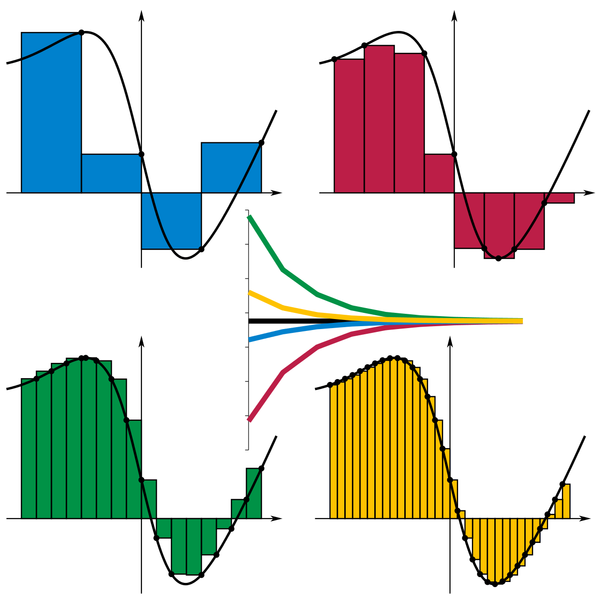
As the width of the rectangles got smaller they would become more "accurate" in getting to the surface area. As they approached infinity, they would become very accurate. He used a tool for measuring the shape of baseboards and edging to demonstrait this. It was just a bunch of cylindrical metal pins in a holder that you'd form around the object you'd cut a piece of wood for. (Cylindrical is rectangular when looked at from the side.) Wonder if anyone can use the Riemann formula to see if the circle is 3.14. |
|
Quoted:
Quoted:
Quoted:
Quoted:
The hell is going on here, what pi=4 thing? Posted Via AR15.Com Mobile http://www.lolblog.co.uk/wp-content/uploads/2010/11/1290616506315.jpg Problem is that non-diagonal lines will never be diagonal, no matter how long you divide them up. That is somewhat clever. Our calculus teacher in high school used a model similar to that to show integral calculus. http://upload.wikimedia.org/wikipedia/commons/thumb/2/2a/Riemann_sum_convergence.png/600px-Riemann_sum_convergence.png As the width of the rectangles got smaller they would become more "accurate" in getting to the surface area. As they approached infinity, they would become very accurate. He used a tool for measuring the shape of baseboards and edging to demonstrait this. It was just a bunch of cylindrical metal pins in a holder that you'd form around the object you'd cut a piece of wood for. (Cylindrical is rectangular when looked at from the side.) Wonder if anyone can use the Riemann formula to see if the circle is 3.14. Not by integration. Pi was obtained through experimentation. There really is no way to derive pi. For example, in an arc length integral, you'd need to assume the value of pi, especially in polar coordinates (as polar coordinates are entirely based on pi) |
|
I may or may not be using the term "derive" correctly. After a brief research, I now see there are some series that converge to values very close to pi, but I still think these series were built only as a model representing pi, not as a solution to another problem which gave rise to pi.
There are many ways to represent it, but I have not yet found an alternate method of representing pi that gives rise to the constant itself. Basically, pi must be known before it can be modeled mathematically. |
|
Quoted:
I may or may not be using the term "derive" correctly. After a brief research, I now see there are some series that converge to values very close to pi, but I still think these series were built only as a model representing pi, not as a solution to another problem which gave rise to pi. There are many ways to represent it, but I have not yet found an alternate method of representing pi that gives rise to the constant itself. Basically, pi must be known before it can be modeled mathematically. The square root of the sum of 6/(n^2) as n goes from 1 to infinity is EXACTLY equal to pi. Not close, EXACT. |
|
Math is not hard. Many people just never paid attention, got left behind and never caught up.
Reading is not hard. Many people just never paid attention, got left behind and never caught up. Writing is not hard. Many people just never paid attention, got left behind and never caught up. |
|
Quoted:
Math is not hard. Many people just never paid attention, got left behind and never caught up. Reading is not hard. Many people just never paid attention, got left behind and never caught up. Writing is not hard. Many people just never paid attention, got left behind and never caught up. Oh, Me too. Surgery is not hard. Many people just never paid attention, got left behind and never caught up. |

|
Wikipedia says...
http://en.wikipedia.org/wiki/Approximations_of_%CF%80#20th_century "In 1910, the Indian mathematician Srinivasa Ramanujan found several rapidly converging infinite series of pi, including 
which computes a further eight decimal places of pi with each term in the series. His series are now the basis for the fastest algorithms currently used to calculate pi." http://en.wikipedia.org/wiki/Srinivasa_Ramanujan#Mathematical_achievements I'll ask my code-monkey friend the next time I see him, too. I imagine there's probably shortcuts for use in work that doesn't require a very precise value for pi. |
|
I asked my friend about the pi in practical computer usage thing (he makes video games). Names have been changed to protect the innocent:
Baker: Foxtrot Baker: someone on arfcom asked Baker: how do computers calculate pi? Baker: I linked to some stuff from wikipedia which is apparently how they do it when they want to calculate lots of digits Baker: but in practical usage (i.e., usage not requiring a million digits) how do you 'get' a value for pi? is it just stored someplace? Foxtrot: you store an approximation of it Foxtrot: like Foxtrot: const double PI = 3.141592653589793238462643383279502884; Foxtrot: and that is more decimals of pi than most platforms will EVER manage to store Foxtrot: a double is 64 bit Foxtrot: float 32 bit |
|
Quoted:
I asked my friend about the pi in practical computer usage thing (he makes video games). Names have been changed to protect the innocent: Baker: Foxtrot Baker: someone on arfcom asked Baker: how do computers calculate pi? Baker: I linked to some stuff from wikipedia which is apparently how they do it when they want to calculate lots of digits Baker: but in practical usage (i.e., usage not requiring a million digits) how do you 'get' a value for pi? is it just stored someplace? Foxtrot: you store an approximation of it Foxtrot: like Foxtrot: const double PI = 3.141592653589793238462643383279502884; Foxtrot: and that is more decimals of pi than most platforms will EVER manage to store Foxtrot: a double is 64 bit Foxtrot: float 32 bit Yeah, PI is already a pre-defined constant in some IDEs. Let's say you have pi to 39 digits. Let's say you have a circle with the diameter of the universe. You can calculate the circumference of that circle to within the radius of a hydrogen atom. |
|
Quoted: Quoted: The hell is going on here, what pi=4 thing? Posted Via AR15.Com Mobile http://www.lolblog.co.uk/wp-content/uploads/2010/11/1290616506315.jpg Problem is that non-diagonal lines will never be diagonal, no matter how long you divide them up. It's using Archimedes principle for determining Pi, but he used an inner and outer polygon to inscribe a circle. A 96gon will give 3.14 This example is using a 4gon but it requires and inner and outer 4gon |