


Posted: 4/3/2013 5:57:07 PM EDT
|
First Reading:
Acts of the Apostles 5:12-16 12 And through the hands of the Apostles many signs and wonders were accomplished among the people. And they all met with one accord at Solomon’s portico. 13 And among the others, no one dared to join himself to them. But the people magnified them. 14 Now the multitude of men and women who believed in the Lord was ever increasing, 15 so much so that they laid the infirm in the streets, placing them on beds and stretchers, so that, as Peter arrived, at least his shadow might fall upon any one of them, and they would be freed from their infirmities. 16 But a multitude also hurried to Jerusalem from the neighboring cities, carrying the sick and those troubled by unclean spirits, who were all healed. Psalm: Psalms 118:2-4,13-15,22-24 R. (1) Give thanks to the Lord for he is good, his love is everlasting. or: R.Alleluia. Let the house of Israel say, “His mercy endures forever.” Let the house of Aaron say, “His mercy endures forever.” Let those who fear the LORD say, “His mercy endures forever.” R. (1) Give thanks to the Lord for he is good, his love is everlasting. or: R.Alleluia. I was hard pressed and was falling, but the LORD helped me. My strength and my courage is the LORD, and he has been my savior. The joyful shout of victory in the tents of the just: R. (1) Give thanks to the Lord for he is good, his love is everlasting. or: R.Alleluia. The stone which the builders rejected has become the cornerstone. By the LORD has this been done; it is wonderful in our eyes. This is the day the LORD has made; let us be glad and rejoice in it. R. (1) Give thanks to the Lord for he is good, his love is everlasting. or: R.Alleluia. Second Reading: Revelation 1:9-11a, 12-13, 17-19 9 I, John, your brother, and a sharer in the tribulation and in the kingdom and in patient endurance for Christ Jesus, was on the island which is called Patmos, because of the Word of God and the testimony to Jesus. 10 I was in the Spirit on the Lord’s day, and I heard behind me a great voice, like that of a trumpet, 11a saying, 12 And I turned around, so as to see the voice which was speaking with me. And having turned around, I saw seven golden lampstands. 13 And in the midst of the seven golden lampstands was one resembling the Son of man, clothed to the feet with a vestment, and wrapped to the breast with a wide belt of gold. 17 And when I had seen him, I fell at his feet, like one who is dead. And he laid his right hand upon me, saying: “Do not be afraid. I am the First and the Last. 18 And I am alive, though I was dead. And, behold, I live forever and ever. And I hold the keys of death and of Hell. 19 Therefore, write the things which you have seen, and which are, and which must occur afterward: Gospel: John 20:19-31 19. On the evening of that day, the first day of the week, the doors being shut where the disciples were, for fear of the Jews, Jesus came and stood among them and said to them, "Peace be with you." The Doubting of St.Thomas 20. When he had said this, he showed them his hands and his side. Then the disciples were glad when they saw the Lord. 21. Jesus said to them again, "Peace be with you. As the Father has sent me, even so I send you." 22. And when he had said this, he breathed on them, and said to them, "Receive the Holy Spirit. 23. If you forgive the sins of any, they are forgiven; if you retain the sins of any, they are retained." 24. Now Thomas, one of the twelve, called the Twin, was not with them when Jesus came. 25. So the other disciples told him, "We have seen the Lord." But he said to them, "Unless I see in his hands the print of the nails, and place my finger in the mark of the nails, and place my hand in his side, I will not believe." 26. Eight days later, his disciples were again in the house, and Thomas was with them. The doors were shut, but Jesus came and stood among them, and said, "Peace be with you." 27. Then he said to Thomas, "Put your finger here, and see my hands; and put out your hand, and place it in my side; do not be faithless, but believing." 28. Thomas answered him, "My Lord and my God!" 29. Jesus said to him, "Have you believed because you have seen me? Blessed are those who have not seen and yet believe." 30. Now Jesus did many other signs in the presence of the disciples, which are not written in this book; 31. but these are written that you may believe that Jesus is the Christ, the Son of God, and that believing you may have life in his name. ++++++++++++++++++++++++++++++++++++++++++++++++++++++++++++++++++++++++++++++++++++++++ Overview of the Gospel: • This Sunday’s reading begins on the evening of Easter Sunday and continues one week later—the second Sunday of Easter. Every resurrection appearance of Jesus dated in the gospels occurs on a Sunday. This Sunday is also Divine Mercy Sunday, declared by Pope John Paul II on April 30, 2000. • Jesus appears to his fearful disciples as they cowered behind locked doors. He bears in his glorified body the scars of his Passion, showing he has the same body he was buried with and is not, as the disciples fear, a ghost (Luke 24:36-40). • Jesus reassures them by saying “Peace” (Shalom). Jesus breathes on them, imparting the Holy Spirit upon them. This anticipates the gift of the Spirit to be given to the Church 50 days later on Pentecost. It also institutes the sacrament of Penance, by which the apostles are empowered to forgive sins in Jesus’ name. • The apostle Thomas is not present at this first appearance and expresses his disbelief. Jesus returns, however, and Thomas has a drastic change of heart. Questions: • Of who or what are the disciples afraid? Of all the things Jesus must have said, why does St. John record “Peace be with you” three times (verses 19, 21, 26)? How does this relate to their fears? To their being sent (verse 21)? • Compared to their fearfulness at the beginning of the Gospel Reading, how does the First Reading show how they were later transformed by the experience of Christ’s Resurrection? From where does the power for this transformation come from (see Second Reading, verses 17-18)? • How does Thomas’ personality compare with Mary Magdalene’s (verse 13)? To the other disciples (verses 9, 19)? How does Jesus deal with Thomas’ doubt (verse 29)? • Under what circumstances are you liable to exclaim, “My Lord and my God!” along with Thomas? How might that prayer become more that a mere formula? • Where could you use Jesus’ “peace” right now: in some relationship? In some inner fear? In your work? What doubts or questions about God are you struggling with? What have you found helpful in dealing with doubts? |
|
• Of who or what are the disciples afraid? Of all the things Jesus must have said, why does St.
John record “Peace be with you” three times (verses 19, 21, 26)? How does this relate to their fears? To their being sent (verse 21)? The Apostles are afraid of what had happened to our Blessed Lord may happen to them as well! Will they be hunted down or turned in? Scary stuff. No wonder they met behind locked doors. But on another level, can't it be said they were afraid for their own lack of faith? Could not it be said that their desertion of our Lord during his passion may have been one of the most worst sins imaginable? To behold the living God in your presence, and then abandon Him in his hour of greatest need? Their fear was also that Jesus would no longer be with them. Yet look at what Jesus does: loves them with all his heart, soul and being, reassures them, and gives them forgiveness. He imparts to them the power to forgive sins. Jesus' admonition to the Apostles, given three times no less, "Shalom," or peace be with you reassures them greatly. Jesus is back--he's beaten death itself! It shows with great force that what Jesus said he was, the Prince of Peace, the Messiah, the anointed son of God, was true. Now, the same forgiveness and mercy Jesus poured out upon them will be spread and poured out worldwide. 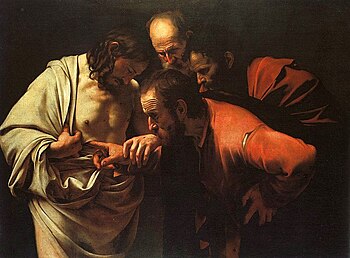
|