


Posted: 5/3/2012 6:25:17 PM EDT
|
First Reading:
Acts 9:26-31 26 And when he had come to Jerusalem he attempted to join the disciples; and they were all afraid of him, for they did not believe that he was a disciple. 27 But Barnabas took him, and brought him to the apostles, and declared to them how on the road he had seen the Lord, who spoke to him, and how at Damascus he had preached boldly in the name of Jesus. 28 So he went in and out among them at Jerusalem, 29 preaching boldly in the name of the Lord. And he spoke and disputed against the Hellenists; but they were seeking to kill him. 30 And when the brethren knew it, they brought him down to Caesare'a, and sent him off to Tarsus. 31 So the church throughout all Judea and Galilee and Sama'ria had peace and was built up; and walking in the fear of the Lord and in the comfort of the Holy Spirit it was multiplied. Psalm: Psalm 22:26-28, 30-32 R. (26a) I will praise you, Lord, in the assembly of your people. or: R. Alleluia. I will fulfill my vows before those who fear the LORD. The lowly shall eat their fill; they who seek the LORD shall praise him: "May your hearts live forever!" R. I will praise you, Lord, in the assembly of your people. or: R. Alleluia. All the ends of the earth shall remember and turn to the LORD; all the families of the nations shall bow down before him. R. I will praise you, Lord, in the assembly of your people. or: R. Alleluia. To him alone shall bow down all who sleep in the earth; before him shall bend all who go down into the dust. R. I will praise you, Lord, in the assembly of your people. or: R. Alleluia. And to him my soul shall live; my descendants shall serve him. Let the coming generation be told of the LORD that they may proclaim to a people yet to be born the justice he has shown. R. I will praise you, Lord, in the assembly of your people. or: R. Alleluia. Second Reading: 1 John 3:18-24 18 Little children, let us not love in word or speech but in deed and in truth. 19 By this we shall know that we are of the truth, and reassure our hearts before him 20 whenever our hearts condemn us; for God is greater than our hearts, and he knows everything. 21 Beloved, if our hearts do not condemn us, we have confidence before God; 22 and we receive from him whatever we ask, because we keep his commandments and do what pleases him. 23 And this is his commandment, that we should believe in the name of his Son Jesus Christ and love one another, just as he has commanded us. 24 All who keep his commandments abide in him, and he in them. And by this we know that he abides in us, by the Spirit which he has given us. Gospel: John 15:1-8 1 "I am the true vine, and my Father is the vinedresser. 2 Every branch of mine that bears no fruit, he takes away, and every branch that does bear fruit he prunes, that it may bear more fruit. 3 You are already made clean by the word which I have spoken to you. 4 Abide in me, and I in you. As the branch cannot bear fruit by itself, unless it abides in the vine, neither can you, unless you abide in me. 5 I am the vine, you are the branches. He who abides in me, and I in him, he it is that bears much fruit, for apart from me you can do nothing. 6 If a man does not abide in me, he is cast forth as a branch and withers; and the branches are gathered, thrown into the fire and burned. 7 If you abide in me, and my words abide in you, ask whatever you will, and it shall be done for you. 8 By this my Father is glorified, that you bear much fruit, and so prove to be my disciples. ++++++++++++++++++++++++++++++++++++++++++++++++++++++++++++++++++++++++++++++++++ Overview of the Gospel: The setting for this Sunday’s Gospel is just after the Last Supper discourse in the upper room (John 13:1—14:31). It is speculated that, after leaving the upper room, this part of Jesus’ discourse may have been delivered at the Temple gates (where there was an elaborate engraving of grapes and vines), or in the vineyard near the Kidron Valley, on the way to the Mount of Olives, where the Garden of Gethsemane was located. In the Old Testament, the nation of Israel is often spoken of as a vine or a vineyard (Isaiah 5:1-7; Psalm 80:9-17; Jer 2:21, 5:10-11; Ez 15:2-8, 17:5-10; 19:10-14; Hosea 10:1, etc.), as did Jesus (Mt 21:33-46). This Gospel reading, however, is much more personal than previous uses of this figure since Jesus speaks of himself as the vine and we, his members, as the branches. St. Paul also uses a similar idea in his description of the true Israel as the body of Christ (Rom 12:4-5; 1 Cor 3:9, 12:12-26; Eph 4:15-16). Thus our spiritual survival is dependent upon our connection to him—and to one another. Jesus is talking about two kinds of branches with a different kind of pruning for each. Those branches that are not bearing fruit are to be cut off all together, as they are useless and only serve to draw nourishment away from the fruitful branches. The fruitful branches are also pruned, but it is because they are already productive and pruning makes then even more so. Questions: If the fruitful vine branches were human lives, what kinds of things are being pruned away? What pain would be associated with pruning? What tools? What spiritual fruit? Jesus repeats “remain in me”, “love” and “bear fruit”. How are these words related? What is the “fruit that will remain” (verse 16)? How do verses 9 and 12 tie together? How is love the essential dynamic of the Christian life (1 Cor 13)? How does your relationship with Jesus change once you start practicing his example of love? What is the link between obedience and prayer (verses 7 and 16. See also John 14:13-14)? As a branch on Christ’s vine, how would you describe the fruit in your life: Grade A-1? Juicy? Green? Wormy? Why? Specifically, how would you rate yourself on laying down your life for your friends (verse 13)? |
|
A single hexagonal nut holds the whirling rotors of a helicopter in place. That nut is called the ‘Jesus nut.’ (Illustrated Sunday Homilies Year B Series II by Mark Link S.J. published by Tabor Publishing) That reminds me of our Gospel today (John 15:1-8) where Jesus describes himself as the true vine and we are the branches feeding from the vine. Just as the ‘Jesus nut’ is the center of the rotary blades holding them together, Jesus is the center of our lives holding us together. We are branches all around Jesus the vine. We were grafted onto the vine, Jesus, on the day we were baptized. We draw the sap from Jesus to give us the energy to live Christian lives. We draw this sap from Jesus when we pray, when we gather here every Sunday to celebrate the Eucharist, every time we receive the sacraments, every time we read the Bible.
Read the rest of this homily by Fr. Tommy Lane here. |
|
Last week we heard about the marvelous gift of divine filiation. Because of this gift
we can call ourselves “children of God.” Today we hear about living out this divine filiation to the fullest – by expressing our brotherly love in word and deed. 18 Children, let us love not in word or speech but in deed and truth. How we live the life of charity is an indication, not only to others but to ourselves as well, of our Christian commitment. “It is not enough to have good intentions. You must also put them into effect with genuine willingness and a happy heart.” [Saint John Chrysostom (ca. A.D. 388), Catena] 19 (Now) this is how we shall know that we belong to the truth Jesus is the truth, the way, and the life. If we are committed to the truth, we are committed to God. and reassure our hearts before him 20 in whatever our hearts condemn, for God is greater than our hearts and knows everything. The omniscient God who knows us far better than our own conscience is rich in mercy to forgive one who is truly His own. 21 Beloved, if (our) hearts do not condemn us, we have confidence in God 22 and receive from him whatever we ask, If we are not conscious of having sinned, so much the more will we be confident of God’s favor. because we keep his commandments and do what pleases him. If we are keeping His commandments, we are doing what is pleasing in His sight. “Our conscience gives us a true answer, that we love and that genuine love is in us, not feigned but sincere, seeking our brother’s salvation and expecting nothing from him except his salvation.” [Saint Augustine of Hippo (A.D. 416), Homilies on the Epistle to the Parthians 6,4] 23 And his commandment is this: we should believe in the name of his Son, Jesus Christ In Semitic usage, “name” is equivalent to the person. Faith is not simply the acceptance of a proposition, but a commitment to a person. Jewish practice was to call Yahweh “the Name” and this has been carried over into Christian references to Christ. and love one another just as he commanded us. 24 Those who keep his commandments remain in him, and he in them, and the way we know that he remains in us is from the Spirit that he gave us. Obedience to the commandments guarantees continued communion with God. A further guarantee of the divine presence is the possession of the Holy Spirit. Bible Study on the Second Reading. |
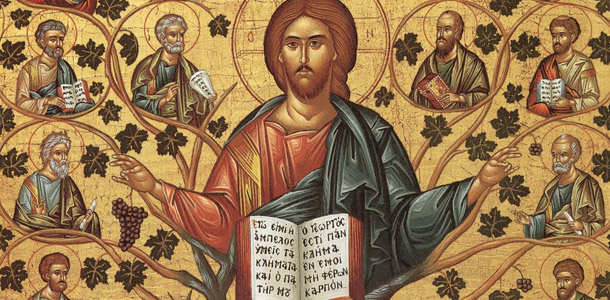
If the fruitful vine branches were human lives, what kinds of things are being pruned away? What pain would be associated with pruning? What tools? What spiritual fruit?
Of course, the most obvious things to be "pruned away" in our lives is sin. Disobedience to God. Plain and simple. And we can sin by committing acts or neglecting to act. The pain associated with this "pruning" would be our natural reaction to having these sinful things removed from our lives. And the tools used for "pruning" us? The tools are many: God's grace and mercy, his continual love for us and our own willingness and obedience to God's word. This involves our mind and will (tools themselves, if you think about it) to act and place our conduct within God's parameters, not ours. It's not enough to think or say: "I'm a Christian." We have to grow and live out our lives in Christ. As a retired farmer and still an avid gardener, I just love our blessed Lord's imagery of the vine and branches. So natural––so powerful. Old Testament traditions spoke of pruning fruitless vines (Jeremiah 5:10; Ezekiel 17:7). The branches of the vine are Jesus’ followers––His disciples: if they remain fruitless the Father will remove them; in turn, it is by His power that they can produce fruit. Even the fruitful are trimmed –no one escapes suffering. |