


Posted: 2/29/2012 6:01:43 PM EDT
|
March 4, 2012
First Reading: Genesis 22:1-2, 9-13, 15-18 1 After these things God tested Abraham, and said to him, "Abraham!" And he said, "Here am I." 2 He said, "Take your son, your only son Isaac, whom you love, and go to the land of Mori'ah, and offer him there as a burnt offering upon one of the mountains of which I shall tell you." 9 When they came to the place of which God had told him, Abraham built an altar there, and laid the wood in order, and bound Isaac his son, and laid him on the altar, upon the wood. 10 Then Abraham put forth his hand, and took the knife to slay his son. 11 But the angel of the LORD called to him from heaven, and said, "Abraham, Abraham!" And he said, "Here am I." 12 He said, "Do not lay your hand on the lad or do anything to him; for now I know that you fear God, seeing you have not withheld your son, your only son, from me." 13 And Abraham lifted up his eyes and looked, and behold, behind him was a ram, caught in a thicket by his horns; and Abraham went and took the ram, and offered it up as a burnt offering instead of his son. 15 And the angel of the LORD called to Abraham a second time from heaven, 16 and said, "By myself I have sworn, says the LORD, because you have done this, and have not withheld your son, your only son, 17 I will indeed bless you, and I will multiply your descendants as the stars of heaven and as the sand which is on the seashore. And your descendants shall possess the gate of their enemies, 18 and by your descendants shall all the nations of the earth bless themselves, because you have obeyed my voice." Responsorial Psalm: Psalm 116:10, 15, 16-17, 18-19 R. (116:9) I will walk before the Lord, in the land of the living. I believed, even when I said, "I am greatly afflicted." Precious in the eyes of the LORD is the death of his faithful ones. R. I will walk before the Lord, in the land of the living. O LORD, I am your servant; I am your servant, the son of your handmaid; you have loosed my bonds. To you will I offer sacrifice of thanksgiving, and I will call upon the name of the LORD. R. I will walk before the Lord, in the land of the living. My vows to the LORD I will pay in the presence of all his people, In the courts of the house of the LORD, in your midst, O Jerusalem. R. I will walk before the Lord, in the land of the living. Second Reading: Romans 8:31-34 31 What then shall we say to this? If God is for us, who is against us? 32 He who did not spare his own Son but gave him up for us all, will he not also give us all things with him? 33 Who shall bring any charge against God's elect? It is God who justifies; 34 who is to condemn? Is it Christ Jesus, who died, yes, who was raised from the dead, who is at the right hand of God, who indeed intercedes for us? Gospel: Mark 9:2-10 2 And after six days Jesus took with him Peter and James and John, and led them up a high mountain apart by themselves; and he was transfigured before them, 3 and his garments became glistening, intensely white, as no fuller on earth could bleach them. 4 And there appeared to them Eli'jah with Moses; and they were talking to Jesus. 5 And Peter said to Jesus, "Master, it is well that we are here; let us make three booths, one for you and one for Moses and one for Eli'jah." 6 For he did not know what to say, for they were exceedingly afraid. 7 And a cloud overshadowed them, and a voice came out of the cloud, "This is my beloved Son; listen to him." 8 And suddenly looking around they no longer saw any one with them but Jesus only. 9 And as they were coming down the mountain, he charged them to tell no one what they had seen, until the Son of man should have risen from the dead. 10 So they kept the matter to themselves, questioning what the rising from the dead meant. ++++++++++++++++++++++++++++++++++++++++++++++++++++++++++++++++++++++++++ Additional Study Resources Overview of the Gospel: This Sunday’s Gospel relates what is traditionally called the Transfiguration of Jesus (from the Latin: trans = radical change; figur = appearance. The Greek word is metamorphothe). This event is recounted in all three synoptic gospels (Matthew, Mark and Luke). It is mentioned by Peter in his second epistle (2 Peter 1:16-19) and we may even see a possible allusion to it in John 1:14. In Mark’s gospel, the Transfiguration takes place six days after Jesus first predicts his Passion to the disciples and presents to them the demands of the Cross (Mark 8:31-38). Luke adds the fact that he took his three disciples to the top of the mountain to pray (Luke 9:28). The three that Jesus took with him—Peter, James, and John—formed sort of an “inner circle” among Jesus’ disciples and were present at key events in his ministry (Mark 5:21-43; 14:33). The traditional location of the Transfiguration is Mount Tabor. In Christianity, Mt. Tabor has been seen as the counterpart to the Old Testament Mt. Sinai, where Moses received the Jewish Law (Exodus 19) and Elijah the Prophet had an encounter with God in “a still, small, voice (1 Kings 19). Moses and Elijah were thought to epitomize, respectively, the Law and the Prophets. They also were thought to have both been assumed (taken bodily) into heaven. At the end of this encounter, the Law (Moses) and the Prophets (Elijah) disappear (verse 8) but Jesus, who is the fulfillment of them both (Matthew 5:17; 7:12; 22:34-40; Luke 16:16-17) remains. Questions: In the 1st reading, in what ways is the story of “the binding of Isaac” a foreshadowing—or type—of Christ’s sacrifice on the cross? What is the difference? In the 2nd reading what does Paul tell us that God did for us? What results from this? What confidence and trust should we have in God as a result of this? What is the connection between Mark 9:1 and the Transfiguration? What do you imagine this scene was like? What is the significance of Moses’ and Elijah’s presence? Of the voice (see Mark 1:11)? Why would this event be important for the disciples? Who played the role of Elijah (see Matthew 17:10-13)? With what result (Mark 6:14-29)? How could John the Baptist’s fate help the disciples understand the nature of Jesus’ messiahship?” Where have you grasped a bit of Jesus’ glory in a special way? How does the picture of a suffering Messiah shape your view of what the Christian life is all about? |
|
Bible Study
1st Reading - Genesis 22:1b-2, 9a, 10-13, 15-18
Today as we enter the second Sunday of Lent, a time in which we concentrate on building our faith through penance and sacrifice (what have you offered up for Lent?), we hear of Abraham=s faith and the test to which God put that faith. This story is the tenth and greatest trial of Abraham=s trials; the number ten in Hebrew numerology being the number of testimony (law and responsibility). It is the trial of offering his son as sacrifice. Recall that the tenth trial of the pharaoh and Egypt was also the offering of the first born as sacrifice. This story shows that God is Lord whose demands are absolute, whose will is inscrutable, and whose final word is grace. Abraham shows the moral grandeur of the founder of Israel, facing God, willing to obey God's word in all its mysterious harshness. The father's very life is bound up with that of his son and heir; Abraham entrusts his life and his future unconditionally to the God who calls him. Rather than just the selected verses for today's reading, we will read the entire story. 2:1b God put Abraham to the test. We, as readers, have an advantage over Abraham, who doesn't look at it as a test, but rather as a command. He called to him, "Abraham!" "Ready!" he replied. 2 Then God said: "Take your son Isaac, your only one, whom you love, The name Isaac means "laughter", for the reason for this name, see Genesis 18:10-15. God identifies the son as his "only son" because Ishmael has already been lost in Abraham's eyes because he and his mother have been sent away (Genesis 21:10) and are living in the desert of Beersheba (the northern Sinai peninsula). Isaac is from Sara, Abraham's wife while Ishmael (the firstborn) is from Hagar, the Egyptian maidservant. and go to the land of Moriah. 2 Chronicles 3:1 tells us that in the time of king Solomon the temple was built upon Moriah. Hebrew legend tells us this of Moriah: "When Noah the righteous left the ark, after the waters of the flood had receded and the face of the earth was revealed, he came with his sons first to Mount Moriah. There they sacrificed a thank offering to the Lord, on the same spot where Adam had sacrificed and where Abraham, generations later, bought his offering. It is told that when Abraham and Isaac reached Mount Moriah, the Holy One, blessed be He, pointed out the altar to Abraham and said : 'There is the altar! Upon this altar did Adam, Cain, and Abel place their offerings! Upon this altar did Noah and his sons place their offerings!' On a nearby hill, Shem, the son of Noah, interred the skull of Adam, which he had taken with him into the ark and guarded during the flood. Since then the hill is called Golgotha - the Skull" (Zev Vilnay, Legends of Jerusalem, Jewish Publication Society of America, Philadelphia, 1973, page 70). There you shall offer him up as a holocaust on a height that I will point out to you." A holocaust is a whole burned sacrifice; it was irrevocable. Isaac must have been at least a teenager at this point because, as we learn in a few verses, he carried the wood up the mountain (a figure of Christ carrying His cross) while Abraham carried the fire (matches hadn't been invented yet) and the knife. 3 Early the next morning Abraham saddled his donkey, took with him his son Isaac, and two of his servants as well, and with the wood that he had cut for the holocaust, set out for the place of which God had told him. 4 On the third day Abraham got sight of the place from afar. 5 Then he said to his servants: "Both of you stay here with the donkey, while the boy and I go on over yonder. We will worship and then come back to you." 6 Thereupon Abraham took the wood for the holocaust and laid it on his son Isaac's shoulders, while he himself carried the fire and the knife. 7 As the two walked on together, Isaac spoke to his father Abraham. "Father!" he said. "Yes, son," he replied. Isaac continued, "Here are the fire and the wood, but where is the sheep for the holocaust?" 8 "Son," Abraham answered, "God himself will provide the sheep for the holocaust." Then the two continued going forward. 9 When they came to the place of which God had told him, Abraham built an altar there and arranged the wood on it. This was a three-day journey at the end of which a type of resurrection takes place. Isaac has been dead in Abraham's eyes since the journey began. When the sacrifice is halted, he lives again. Next he tied up his son Isaac, and put him on top of the wood on the altar. 10 Then he reached out and took the knife to slaughter his son. 11 But the LORD'S messenger called to him from heaven, "Abraham, Abraham!" "Yes, Lord," he answered. 12 "Do not lay your hand on the boy," said the messenger. "Do not do the least thing to him. I know now how devoted you are to God, since you did not withhold from me your own beloved son." He has obeyed perfectly. Abraham truly fears (reverential awe, not terror) God. He has learned to give up control over his own life that he might receive it as a grace. 13 As Abraham looked about, he spied a ram The ram was, in later times, the usual victim for a holocaust offering (Leviticus 1:10-13). caught by its horns in the thicket. Hebrew legend says that one horn was cut off to free the ram and this became the first shofar (the trumpet used to call the people to prayer and to war). So he went and took the ram and offered it up as a holocaust in place of his son. 14 Abraham named the site Yahweh-yireh; hence people now say, "On the mountain the LORD will see." Abraham called this place "Yahweh-jireh" which means "God will provide" (will see to it). This place is known today as jireh-shalom (Jerusalem). 15 Again the LORD'S messenger called to Abraham from heaven 16 and said: "I swear by myself, declares the LORD, that because you acted as you did in not withholding from me your beloved son, 17 I will bless you abundantly and make your descendants as countless as the stars of the sky and the sands of the seashore; your descendants shall take possession of the gates of their enemies, 18 and in your descendants all the nations of the earth shall find blessing––all this because you obeyed my command." God is making a covenant with Abraham by swearing the oath. Since there is no one higher, He must swear by Himself. In swearing the oath, God pronounces curses upon Himself if He doesn't keep the covenant. This is the third covenant God makes with Abraham. In Genesis 12:2-3 God promised Abram (his name before it was changed to Abraham) three things: 1) Land (nation). This was the subject of the covenant of Genesis 15 and was fulfilled in Moses. 2) Royal dynasty (name). This was the subject of the covenant of Genesis 17:1-19 and was fulfilled in David. 3) Worldwide blessing. This was the subject of the covenant made here and was fulfilled in Jesus the Christ. |
|
Read more at Catholic Matters.
SECOND READING: Romans 8: 31-34. If God is for us, who is against us? He who did not spare his own Son but gave him up for us all, will he not also give us all things with him? Who shall bring any charge against God's elect? It is God who justifies; who is to condemn? Is it Christ Jesus, who died, yes, who was raised from the dead, who is at the right hand of God, who indeed intercedes for us?
EXPLANATION: Unlike his other Epistles, which were letters written by Paul to churches that he, or one of his assistants, had evangelized, this letter is to a church that he had not even visited. It is, therefore, less personal and more in the form of an exposition of part (not all) of the Christian message which he had preached in Asia Minor and Greece, and was now anxious to preach to the Romans also. In the section of the letter from which this extract is taken, St. Paul is emphasizing the indwelling of the Spirit in Christians and their freedom from sin, eternal death and the Jewish law. The liberating act of Christ had made them children of God, destined for glory. The Christian is a freeman who lives in hope. His hope is founded on the infinite love of God for men. That love was made manifest in Christ Jesus. If God...us: He has demonstrated that God is clearly on the side of man. The salvific plan of God which Paul has expounded so far is sufficient proof of this. who...us: With God on our side, all enemies are powerless against us. who did...Son: What greater proof of his love for us could God have given us than this, that he handed over his own Son to the death of the cross for our sakes (see 5: 5-8). all things with him: If he gave his beloved Son to us and for us, he will give everything else that is necessary for our eternal salvation. bring...against: Christians are God's chosen ones. God is the supreme Judge, who shall dare to bring any charge against them in God's court? It is God who justifies: The same idea is here repeated. Is...Jesus: Christ who has made us his brothers by his incarnation, and died on the cross for our sins will not bring a charge against us. raised...intercedes: Christ who died has been raised from the dead and is now in his glorified humanity in the principal place in heaven. He is interceding for us, that is, he is continuing his activity as Savior. Could he then become our opponent? The answer, of course, is "no." APPLICATION: These four short verses of St. Paul's letter to the Romans are among the most encouraging and consoling scripture passages in the whole Bible. He tells us God and Christ are entirely in favor of admitting us to heaven. He admits that there are some enemies who would try to prevent us from getting there, but he logically concludes: what can any enemy or number of enemies do if God and Christ are our defending Counsels and Judges? In brief "if God is for us who is against us?" Paul's whole letter is full of proofs that God is for us, the greatest proof of all being the fact of the incarnation and crucifixion of his Son, for us sinners. If God went to those lengths in order to bring us to heaven it is more than logical that he will give us the lesser gifts and the assistance that each one of us needs in order to get there. The Christian who keeps vivid this consoling knowledge of God's love for him and God's interest in his eternal welfare should never have a sad moment in his life. The things that cause us worry and trouble in life are trifles, when compared with the assurance and certainty we have of final triumph. That assurance comes from God's infinite love, so definitely proved to us by the incarnation. St. Paul goes on in the very next verse after the text which is read today (8: 35): "who shall separate us from the love of Christ? Shall tribulation, or distress or persecution or famine or nakedness or peril or sword". . . No, in all these things we are more than conquerors through him who loved us. . . no created thing can ever come between us and the love of God made visible in Christ Jesus our Lord." This is the assurance that St. Paul gives the newly converted Christians of Rome and it was not based on any speculation or wishful thinking, but on the solid proofs of God's love for us which the incarnation so definitely demonstrated. Let no one say: this might be all very true as regards the early Christians, they were full of zeal and full of the love of God; they were not likely to feel all the weaknesses of the flesh and all the attractions of the world which we feel today; life was easier then, they could give more time to the things of God than we can today, the struggle for existence was not so hard for them. St. Paul who knew human nature very well and who had dealt with thousands of converts would deny such statements absolutely. He knew the Roman converts were subject to the same human weaknesses as are all men of all ages. He knew they could, and very likely did, sin occasionally but he also knew that they had been instructed on how to repent of their sins and had enough interest in their eternal welfare to do so. They had the same weakness that we have, they had the same enemies opposing their salvation. We have the same remedies and protections as they had; they used these remedies and were saved. Shall we not be as active in our own best interests as they were? God is as much for us as he was for the Romans, he wants us in heaven and he has done all that was necessary (and much more) to get us there. If we fail in our final examination one of our greatest causes of grief will be that the fault is completely and entirely our own. We can blame no person or thing in heaven or on earth for our dreadful failure except ourselves. Pray God today, that you shall avoid such grief. You will, if you try always to keep before your mind what God, the Father, Son and Holy Spirit, has done and continues to do daily for you. "If God is with us who is against us?" God is ever with us if we do not deliberately and seriously separate ourselves from him. |
|
Meditation by Don Schwager:
What can blind us or keep us from recognizing God’s glory in our lives? Sin and unbelief for sure! Faith enables us to see what is hidden or unseen to the naked eye. Through the eyes of faith Abraham recognized God and God’s call on his life. He saw from afar not only what God intended for him, but for his descendants as well – an everlasting covenant of friendship and peace with the living God. Abraham is the father of faith because he put his hope in the promises of God. Faith makes us taste in advance the light of God’s glory when we shall see him face to face (1 Corinthians 13:12) as he is (1 John 3:2).
Are you prepared to see God's glory? God is eager to share his glory with us! We get a glimpse of this when the disciples see Jesus transfigured on the mountain. Jesus' face changed in appearance and his clothing became dazzling white. When Moses met with God on Mount Sinai the skin of his face shone because he had been talking with God (see Exodus 34:29). Paul says that the Israelites could not look at Moses' face because of its brightness (2 Corinthians 3:7). In this incident Jesus appeared in glory with Moses, the great lawgiver of Israel, and with Elijah, the greatest of the prophets, in the presence of three of his beloved apostles. What is the significance of this mysterious appearance? Jesus went to the mountain knowing full well what awaited him in Jerusalem – his betrayal, rejection and crucifixion. Jesus very likely discussed this momentous decision to go to the cross with Moses and Elijah. God the Father also spoke with Jesus and gave his approval: This is my beloved Son; listen to him. The cloud which overshadowed Jesus and his apostles fulfilled the dream of the Jews that when the Messiah came the cloud of God's presence would fill the temple again (see Exodus 16:10, 19:9, 33:9; 1 Kings 8:10; 2 Maccabees 2:8). While this transpired Peter, James, and John were asleep! Upon awakening they discovered the transfiguration of Jesus along with Moses and Elijah. How much do we miss of God's glory and action because we are asleep spiritually? There are many things which can keep our minds asleep to the things of God: Mental lethargy and the "unexamined life" can keep us from thinking things through and facing our doubts and questions. The life of ease can also hinder us from considering the challenging or disturbing demands of Christ. Prejudice can make us blind to something new the Lord may have for us. Even sorrow can be a block until we can see past it to the glory of God. Are you spiritually awake? Peter, James, and John were privileged witnesses of the glory of Christ. We, too, as disciples of Christ are called to be witnesses of his glory. We all, with unveiled face, beholding the glory of the Lord, are being changed into his likeness from one degree of glory to another; for this comes from the Lord who is the Spirit (2 Corinthians 3:18). The Lord wants to reveal his glory to us, his beloved disciples. Do you seek his presence with faith and reverence? “Lord Jesus, keep me always alert and awake to you, to your word, your action, and your daily presence in my life. Let me see your glory.” |
|
Listen to the audio of Bonds Loosed by Dr. Scott Hahn.
The Lenten season continues with another story of testing. Last Sunday, we heard the trial of Jesus in the desert. In this week’s First Reading, we hear of how Abraham was put to the test.
The Church has always read this story as a sign of God’s love for the world in giving His only begotten son. In today’s Epistle, Paul uses exact words drawn from this story to describe how God, like Abraham, did not withhold His only Son, but handed Him over for us on the cross (see Romans 8:32; Genesis 22:12,16). In the Gospel today, too, we hear another echo. Jesus is called God’s “beloved Son” - as Isaac is described as Abraham’s beloved firstborn son. These readings are given to us in Lent to reveal Christ’s identity and to strengthen us in the face of our afflictions. Jesus is shown to be the true son that Abraham rejoiced to see (see Matthew 1:1; John 8:56). In His transfiguration, He is revealed to be the “prophet like Moses” foretold by God - raised from among their own kinsmen, speaking with God’s own authority (see Deuteronomy 18:15,19). Like Moses, He climbs the mountain with three named friends and beholds God’s glory in a cloud (see Exodus 24:1,9,15). He is the one prophesied to come after Elijah’s return (see Sirach 48:9-10; Malachi 3:1,23-24). And, as He discloses to the apostles, He is the Son of Man sent to suffer and die for our sins (see Isaiah 53:3). As we sing in today’s Psalm, Jesus believed in the face of His afflictions, and God loosed Him from the bonds of death (see Psalm 116:3). His rising should give us the courage to face our trials, to offer ourselves totally to the Father - as He did, as Abraham and Isaac did. Freed from death by His death, we come to this Mass to offer the sacrifice of thanksgiving, and to renew our vows - as His servants and faithful ones. |
|
What do you imagine this scene was like? What is the significance of Moses’ and Elijah’s presence? Of the voice (see Mark 1:11)? Why would this event be important for the disciples?
How can mortal eyes and ears recount a true vision of the glorified Christ? Awfully tough. It must have been the most marvellous, and yet frightening thing that Peter, James and John had ever seen. Quite frankly, I don't think humans could take it all in. But Peter, James and John did. 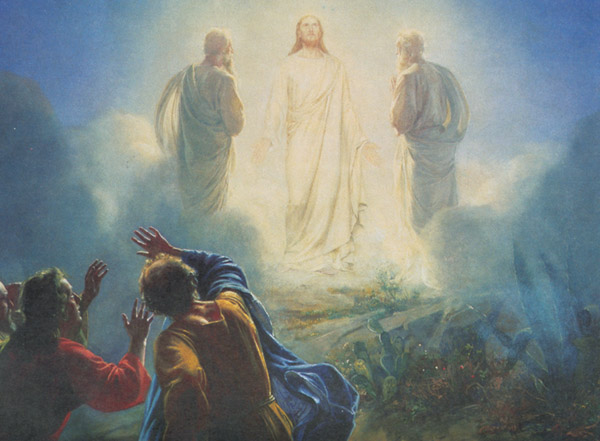
Moses signifies "the law," while Elijah signifies "the prophets." We remember that in Judaism, Elijah was to precede Messiah's coming. Well, here it is! ("...I have come to fulfill every part of the law, not one tittle nor jot shall be lost...") And, of course, the Apostles hear God's voice! Just as when Jesus was baptized, God's voice was heard. The importance of this entire event to the disciples are many: Jesus is seen as a prophet like Moses whose teaching must be heeded under penalty of separation from God's people. The words from God: "Listen to him!" can't be any clearer. Finally, we see Moses and Elijah have relinquished their place to Jesus alone. Wow! Talk about "primacy of person and place." The descent from Mt. Tabor, the mountain, and the command to secrecy are elements of Old Testament theophany patterns [Exodus 32:15 (coming down); Daniel 12:4, 9 (silence)]. Now the "inner circle" of Jesus, Peter, James and John, are beginning to really understand who Jesus is, the Messiah––their Lord. |