


Posted: 11/6/2014 7:02:52 PM EDT
|
Is there a 'sweet spot'?
The torque range is rather wide, low to high. The question is, is there a torque 'number' or trend as to how much (or how little) works best? |
|
I don't think so. Torque three times and back off each (using a breaker bar) and the correct grease. Note each ft.lb. the wrench 'broke' at.
Then do it again until the gas tube lines up. The only time I had a problem with this was a MEGA side-charger. I had to re-grease everything each time to get it together. The second I did the same recipe and it was a snap. |
|
55 ft/lbs seems to be a sweet spot many builders shoot for.
Bring to torque 3 times on DRY threads to burnish the threads(anodizing is actually quite rough and imparts a lot of friction) Bring to final torque with lubed threads. Use a non graphite grease or antisieze. |
|
Quoted:
55 ft/lbs seems to be a sweet spot many builders shoot for. Bring to torque 3 times on DRY threads to burnish the threads(anodizing is actually quite rough and imparts a lot of friction) Bring to final torque with lubed threads. Use a non graphite grease or antisieze. Huh? The whole point in grease, or anti-seize is so you DON'T gall the threads up. Why would you purposely gall the threads up by torquing the barrel nut down dry three times? This sounds like a great way to seize a barrel nut before it's fully torqued! I gotta wonder how many uppers you've wasted. Thread: I normally put white lithium grease on the threads. Then torque to 35, loosen, torque to 35, loosen, and final torque to 50. Unless there's gas tube aligning to do. At which point I continue to torque until the next hole is lined up correctly. If you have to go over 60-65, you should get a shim kit. |
|
Quoted:
Huh? The whole point in grease, or anti-seize is so you DON'T gall the threads up. Why would you purposely gall the threads up by torquing the barrel nut down dry three times? This sounds like a great way to seize a barrel nut before it's fully torqued! I gotta wonder how many uppers you've wasted. Thread: I normally put white lithium grease on the threads. Then torque to 35, loosen, torque to 35, loosen, and final torque to 50. Unless there's gas tube aligning to do. At which point I continue to torque until the next hole is lined up correctly. If you have to go over 60-65, you should get a shim kit. Quoted:
Quoted:
55 ft/lbs seems to be a sweet spot many builders shoot for. Bring to torque 3 times on DRY threads to burnish the threads(anodizing is actually quite rough and imparts a lot of friction) Bring to final torque with lubed threads. Use a non graphite grease or antisieze. Huh? The whole point in grease, or anti-seize is so you DON'T gall the threads up. Why would you purposely gall the threads up by torquing the barrel nut down dry three times? This sounds like a great way to seize a barrel nut before it's fully torqued! I gotta wonder how many uppers you've wasted. Thread: I normally put white lithium grease on the threads. Then torque to 35, loosen, torque to 35, loosen, and final torque to 50. Unless there's gas tube aligning to do. At which point I continue to torque until the next hole is lined up correctly. If you have to go over 60-65, you should get a shim kit. Nobody said a thing about galling threads. There is a difference between burnishing threads and galling. "Bringing up to torque" is tightening as you do to 35 ft/lbs, generally considered the minimum for an AR15 platform. I guess I should have clarified that to avoid any confusion. As previously stated, Anodizing is quite a rough surface and imparts a tremendous amount of friction in a threaded fastener. You cannot burnish the threads correctly if they are lubricated. Oh, and I did "waste" one upper. One rifle that was built by a local "Teir One Custom AR Builder"(who is no longer in business) because they had used red Loctite on the barrel nut. My bench is made of 4x4"s, 2x6"s, a solid core exterior door and 3/4" particle board and weighs in excess of 300#'s. I damn near tipped it over trying to break the barrel nut loose on it. I gave the wrench a good whack after heating it to smoking hot and SNAP! The receiver ring snapped right off. |
|
Quoted:
Nobody said a thing about galling threads. There is a difference between burnishing threads and galling. "Bringing up to torque" is tightening as you do to 35 ft/lbs, generally considered the minimum for an AR15 platform. I guess I should have clarified that to avoid any confusion. As previously stated, Anodizing is quite a rough surface and imparts a tremendous amount of friction in a threaded fastener. You cannot burnish the threads correctly if they are lubricated. Oh, and I did "waste" one upper. One rifle that was built by a local "Teir One Custom AR Builder"(who is no longer in business) because they had used red Loctite on the barrel nut. My bench is made of 4x4"s, 2x6"s, a solid core exterior door and 3/4" particle board and weighs in excess of 300#'s. I damn near tipped it over trying to break the barrel nut loose on it. I gave the wrench a good whack after heating it to smoking hot and SNAP! The receiver ring snapped right off. Quoted:
Quoted:
Quoted:
55 ft/lbs seems to be a sweet spot many builders shoot for. Bring to torque 3 times on DRY threads to burnish the threads(anodizing is actually quite rough and imparts a lot of friction) Bring to final torque with lubed threads. Use a non graphite grease or antisieze. Huh? The whole point in grease, or anti-seize is so you DON'T gall the threads up. Why would you purposely gall the threads up by torquing the barrel nut down dry three times? This sounds like a great way to seize a barrel nut before it's fully torqued! I gotta wonder how many uppers you've wasted. Thread: I normally put white lithium grease on the threads. Then torque to 35, loosen, torque to 35, loosen, and final torque to 50. Unless there's gas tube aligning to do. At which point I continue to torque until the next hole is lined up correctly. If you have to go over 60-65, you should get a shim kit. Nobody said a thing about galling threads. There is a difference between burnishing threads and galling. "Bringing up to torque" is tightening as you do to 35 ft/lbs, generally considered the minimum for an AR15 platform. I guess I should have clarified that to avoid any confusion. As previously stated, Anodizing is quite a rough surface and imparts a tremendous amount of friction in a threaded fastener. You cannot burnish the threads correctly if they are lubricated. Oh, and I did "waste" one upper. One rifle that was built by a local "Teir One Custom AR Builder"(who is no longer in business) because they had used red Loctite on the barrel nut. My bench is made of 4x4"s, 2x6"s, a solid core exterior door and 3/4" particle board and weighs in excess of 300#'s. I damn near tipped it over trying to break the barrel nut loose on it. I gave the wrench a good whack after heating it to smoking hot and SNAP! The receiver ring snapped right off. |
|
Quoted:
Nobody said a thing about galling threads. There is a difference between burnishing threads and galling. "Bringing up to torque" is tightening as you do to 35 ft/lbs, generally considered the minimum for an AR15 platform. I guess I should have clarified that to avoid any confusion. As previously stated, Anodizing is quite a rough surface and imparts a tremendous amount of friction in a threaded fastener. You cannot burnish the threads correctly if they are lubricated. Oh, and I did "waste" one upper. One rifle that was built by a local "Teir One Custom AR Builder"(who is no longer in business) because they had used red Loctite on the barrel nut. My bench is made of 4x4"s, 2x6"s, a solid core exterior door and 3/4" particle board and weighs in excess of 300#'s. I damn near tipped it over trying to break the barrel nut loose on it. I gave the wrench a good whack after heating it to smoking hot and SNAP! The receiver ring snapped right off. Quoted:
Quoted:
Quoted:
55 ft/lbs seems to be a sweet spot many builders shoot for. Bring to torque 3 times on DRY threads to burnish the threads(anodizing is actually quite rough and imparts a lot of friction) Bring to final torque with lubed threads. Use a non graphite grease or antisieze. Huh? The whole point in grease, or anti-seize is so you DON'T gall the threads up. Why would you purposely gall the threads up by torquing the barrel nut down dry three times? This sounds like a great way to seize a barrel nut before it's fully torqued! I gotta wonder how many uppers you've wasted. Thread: I normally put white lithium grease on the threads. Then torque to 35, loosen, torque to 35, loosen, and final torque to 50. Unless there's gas tube aligning to do. At which point I continue to torque until the next hole is lined up correctly. If you have to go over 60-65, you should get a shim kit. Nobody said a thing about galling threads. There is a difference between burnishing threads and galling. "Bringing up to torque" is tightening as you do to 35 ft/lbs, generally considered the minimum for an AR15 platform. I guess I should have clarified that to avoid any confusion. As previously stated, Anodizing is quite a rough surface and imparts a tremendous amount of friction in a threaded fastener. You cannot burnish the threads correctly if they are lubricated. Oh, and I did "waste" one upper. One rifle that was built by a local "Teir One Custom AR Builder"(who is no longer in business) because they had used red Loctite on the barrel nut. My bench is made of 4x4"s, 2x6"s, a solid core exterior door and 3/4" particle board and weighs in excess of 300#'s. I damn near tipped it over trying to break the barrel nut loose on it. I gave the wrench a good whack after heating it to smoking hot and SNAP! The receiver ring snapped right off. Show me, anywhere, in any manual, again anywhere. That you should "burnish" AR-15 barrel nut threads without using grease, anti-seize, or just some kind of lube in general. You're the only person, gunsmith or not, that I have ever heard say NOT to use lube on the barrel nut while torquing it down. So there must be some kind of writing on this somewhere, right? You seem like you know something everyone else doesn't. I've seen you preach this method multiple times in several threads. But you never back it up. So here's your chance, back it up, or stop spreading poison! You said it yourself "(anodizing is actually quite rough and imparts a lot of friction)". So why would you "Impart a lot of friction" onto your threads without lube? Red loctite has a heat strength of over 500 degrees Fahrenheit. It's no surprise you twisted the threads off of your aluminum receiver. If in fact it actually had red loctite on it to begin with. |
|
Threads are threads. They don't know if they're on a rifle or a railroad car. Threads should not be torqued dry unless for some specific reason it's specified.
The ideal way to tighten a threaded fastener is to measure the stretch (or preload) since that's what we're essentially doing is stretching the fastener like a rubber band. Since we can't always measure stretch, we have torque values that have been assigned to different threads basically telling us we've "stretched" them far enough to get the proper preload without damaging them. Torque, as you can imagine, is very friction sensitive. You can have several different stretch values (and remember, stretch is what's critical) with the same amount of torque, but different levels of friction. This is why there are different torque values given for the same thread based on what lubrication you use. The better the lube, the lower the friction, and the more preload and stretch you get with the same amount of torque. With new threads, the surfaces are rough from machining, and they need "mating" before you can get an accurate torque measurement. This is why we cycle the threads a few times before taking a final torque reading. As we cycle the threads they will smooth out and "mate", BUT!...you never want to do this dry! As said several times above, you will risk galling the threads and only increasing the friction, not reduce it. Always use, at a minimum, a light coating of motor oil on the threads. Anti seize works better, and there are many high pressure moly greases on the market, any one of which will work just fine. I would say that after cycling the threads a few times and with a good moly grease, 55# would be MAX I would torque the barrel nut. I use 45# on my rifles FWIW. |
|
Quoted:
Quoted:
Quoted:
Quoted:
Quoted:
55 ft/lbs seems to be a sweet spot many builders shoot for. Bring to torque 3 times on DRY threads to burnish the threads(anodizing is actually quite rough and imparts a lot of friction) Bring to final torque with lubed threads. Use a non graphite grease or antisieze. Huh? The whole point in grease, or anti-seize is so you DON'T gall the threads up. Why would you purposely gall the threads up by torquing the barrel nut down dry three times? This sounds like a great way to seize a barrel nut before it's fully torqued! I gotta wonder how many uppers you've wasted. Thread: I normally put white lithium grease on the threads. Then torque to 35, loosen, torque to 35, loosen, and final torque to 50. Unless there's gas tube aligning to do. At which point I continue to torque until the next hole is lined up correctly. If you have to go over 60-65, you should get a shim kit. Nobody said a thing about galling threads. There is a difference between burnishing threads and galling. "Bringing up to torque" is tightening as you do to 35 ft/lbs, generally considered the minimum for an AR15 platform. I guess I should have clarified that to avoid any confusion. As previously stated, Anodizing is quite a rough surface and imparts a tremendous amount of friction in a threaded fastener. You cannot burnish the threads correctly if they are lubricated. Oh, and I did "waste" one upper. One rifle that was built by a local "Teir One Custom AR Builder"(who is no longer in business) because they had used red Loctite on the barrel nut. My bench is made of 4x4"s, 2x6"s, a solid core exterior door and 3/4" particle board and weighs in excess of 300#'s. I damn near tipped it over trying to break the barrel nut loose on it. I gave the wrench a good whack after heating it to smoking hot and SNAP! The receiver ring snapped right off. |
So much consertation over tightening a nut.
I think some folks need to drink a bit less coffee 
We are all achieving the same thing, which is a properly installed barrel on a precision AR platform rifle. While the TM is an excellent guide for unit level armorers work it does not expound on precision rifles and the work involved to make the rifle perform at its best. Just because the TM doesnt address receiver face truing, trigger work etcetera does that mean it is wrong if we do? Of course not. Nowhere in my posts will you find that the final installation and torque of the barrel nut is performed dry, it is clearly stated to use a non graphite based grease or antiseize. I merely prefer to do the initial snug ups of the nut dry, I think it it torques up smoother than if I do the snug ups lubed. When you clean the threads before final assembly the dry threads show a better and smoother finish on them than the lubed threads. I have been a machinist for over 30 years and have a little faith, I believe I have learned just a smidge about material, thread fitment, design and fabrication. I realize most threads should not be dry but I also realize there are times when a dry thread is beneficial. Why does the TM state to torque 3 times before final assembly? Because they knew there was a friction issue with the barrel nut causing false torque values. I am not aware of any other fixture on a firearm that requires 3 torque, loosen, repeat cycles. Aircraft, Aerospace and Naval yes but not firearm related items. Firearm anodizing is typically a fairly rough finish as is the parkerizing of a typical barrel nut. Unless high fastener speed or excessive torque is applied anodized/parkerized fitment is not going to seize/gall. I feel that friction of the two surfaces is beneficial on the dry runs to assist in the "wearing in" of the threads. Just a little different way of acheiving the same thing. The stongest conventional thread is a rolled and burnished thread. I am not aware of any manufacturer that provides an upper that is rolled and burnished. As we cant roll the threads why not do what you can to burnish the threads? Take a look at thread burnishing, enough there to at least make you go: Hmm. If thinking outside the box makes one "not capable of fixing a bowling ball  ", how did we ever get past the matchlock? ", how did we ever get past the matchlock?
Merry Christmas 
|
|
Quoted:
So much consertation over tightening a nut.
I think some folks need to drink a bit less coffee
We are all achieving the same thing, which is a properly installed barrel on a precision AR platform rifle. While the TM is an excellent guide for unit level armorers work it does not expound on precision rifles and the work involved to make the rifle perform at its best. Just because the TM doesnt address receiver face truing, trigger work etcetera does that mean it is wrong if we do? Of course not. Nowhere in my posts will you find that the final installation and torque of the barrel nut is performed dry, it is clearly stated to use a non graphite based grease or antiseize. I merely prefer to do the initial snug ups of the nut dry, I think it it torques up smoother than if I do the snug ups lubed. When you clean the threads before final assembly the dry threads show a better and smoother finish on them than the lubed threads. I have been a machinist for over 30 years and have a little faith, I believe I have learned just a smidge about material, thread fitment, design and fabrication. I realize most threads should not be dry but I also realize there are times when a dry thread is beneficial. Why does the TM state to torque 3 times before final assembly? Because they knew there was a friction issue with the barrel nut causing false torque values. I am not aware of any other fixture on a firearm that requires 3 torque, loosen, repeat cycles. Aircraft, Aerospace and Naval yes but not firearm related items. Firearm anodizing is typically a fairly rough finish as is the parkerizing of a typical barrel nut. Unless high fastener speed or excessive torque is applied anodized/parkerized fitment is not going to seize/gall. I feel that friction of the two surfaces is beneficial on the dry runs to assist in the "wearing in" of the threads. Just a little different way of acheiving the same thing. The stongest conventional thread is a rolled and burnished thread. I am not aware of any manufacturer that provides an upper that is rolled and burnished. As we cant roll the threads why not do what you can to burnish the threads? Take a look at thread burnishing, enough there to at least make you go: Hmm. If thinking outside the box makes one "not capable of fixing a bowling ball ", how did we ever get past the matchlock?
Merry Christmas |
|
Quoted:
And yet, you actuality broke a receiver. You're not thinking "outside the box", you're just a hack. Maybe you should switch to blacksmithing. Quoted:
Quoted:
So much consertation over tightening a nut.
I think some folks need to drink a bit less coffee
We are all achieving the same thing, which is a properly installed barrel on a precision AR platform rifle. While the TM is an excellent guide for unit level armorers work it does not expound on precision rifles and the work involved to make the rifle perform at its best. Just because the TM doesnt address receiver face truing, trigger work etcetera does that mean it is wrong if we do? Of course not. Nowhere in my posts will you find that the final installation and torque of the barrel nut is performed dry, it is clearly stated to use a non graphite based grease or antiseize. I merely prefer to do the initial snug ups of the nut dry, I think it it torques up smoother than if I do the snug ups lubed. When you clean the threads before final assembly the dry threads show a better and smoother finish on them than the lubed threads. I have been a machinist for over 30 years and have a little faith, I believe I have learned just a smidge about material, thread fitment, design and fabrication. I realize most threads should not be dry but I also realize there are times when a dry thread is beneficial. Why does the TM state to torque 3 times before final assembly? Because they knew there was a friction issue with the barrel nut causing false torque values. I am not aware of any other fixture on a firearm that requires 3 torque, loosen, repeat cycles. Aircraft, Aerospace and Naval yes but not firearm related items. Firearm anodizing is typically a fairly rough finish as is the parkerizing of a typical barrel nut. Unless high fastener speed or excessive torque is applied anodized/parkerized fitment is not going to seize/gall. I feel that friction of the two surfaces is beneficial on the dry runs to assist in the "wearing in" of the threads. Just a little different way of acheiving the same thing. The stongest conventional thread is a rolled and burnished thread. I am not aware of any manufacturer that provides an upper that is rolled and burnished. As we cant roll the threads why not do what you can to burnish the threads? Take a look at thread burnishing, enough there to at least make you go: Hmm. If thinking outside the box makes one "not capable of fixing a bowling ball ", how did we ever get past the matchlock?
Merry Christmas Yes I broke a receiver. On disassembly. After the owner had basically destroyed the barrel nut and receiver in an attempt to swap out a fore end without the correct tooling. We had no idea the barrel nut had been red Loctited until the ring snapped. So a receiver/barrel assembly that had been incorrectly assembled with red Loctite broke upon disassembly. And that makes me the "hack"?
I will have to look and see if I still have the pics of it and it's sister rifle which had also been red Loctited(disassembled without damage). Get over yourself, you have certainly broken something as well. But at least I can admit it. |
Guys, guys... I didn't mean to start a pissin' match
I suppose I should've initially stated that I always torque load-sensitive fasteners WITH an anti-seize. Having assembled competition engines, I fully understand and appreciate torque load/fastener stretch. Incorrect preload/stretch on a connecting rod fastener can have catastrophic consequences at 8000 rpm. Thanks all for your input 
|
|
Quoted:
Guys, guys... I didn't mean to start a pissin' match
I suppose I should've initially stated that I always torque load-sensitive fasteners WITH an anti-seize. Having assembled competition engines, I fully understand and appreciate torque load/fastener stretch. Incorrect preload/stretch on a connecting rod fastener can have catastrophic consequences at 8000 rpm. Thanks all for your input I build race engines for a living and you're absolutely right. Unfortunately it's the same in that industry; Internet is full of "experts" giving bad advice. The reason there is so much latitude in the tq spec for an AR barrel nut is to allow for clocking/alignment of the gas tube. Start at the low end of the spec and if you need, tighten more to align the gas tube. ARP Ultra Lube makes a great lube for the barrel nut. ;) |
|
What the real travesty is that so many knowledgable people are so close minded to think that one way is the only way.
Somebody comes along with a different method of acheiving the same end result, you don't agree with it and they are an "Idiot" and "Hack". Here is a pic of the sister rifle to the one that the receiver broke: What appears to be "string" is actually a curl of red Loctite. You can clearly see the amount of Loctite that was used on assembly of the barrel nut. 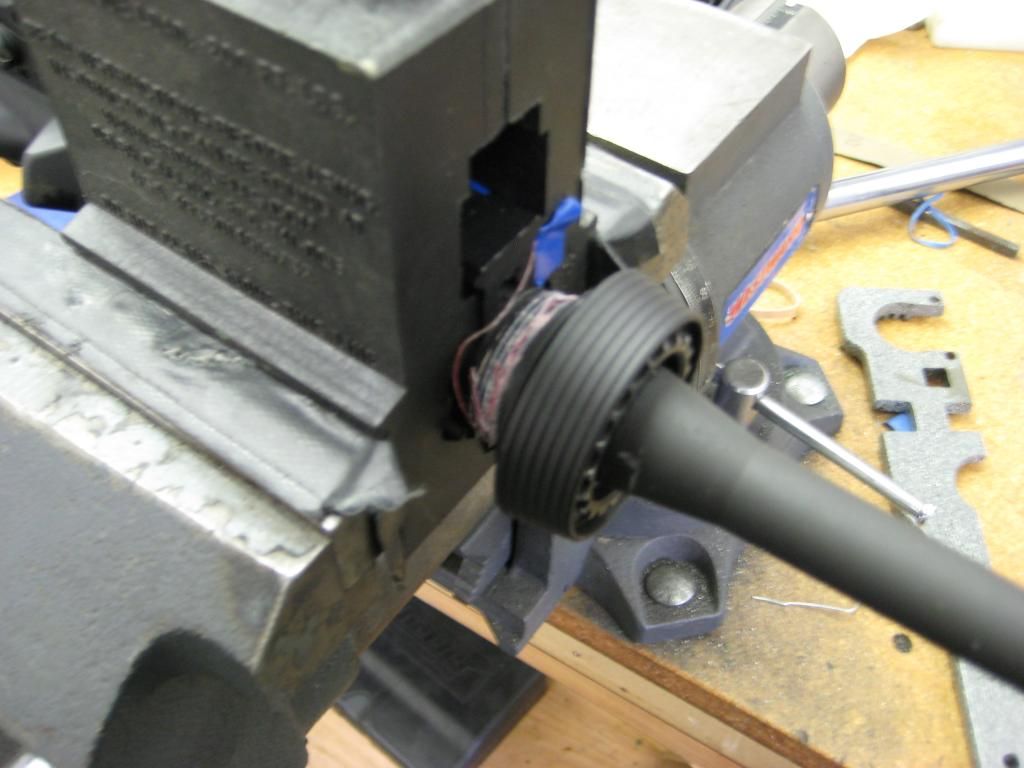 " /> " />
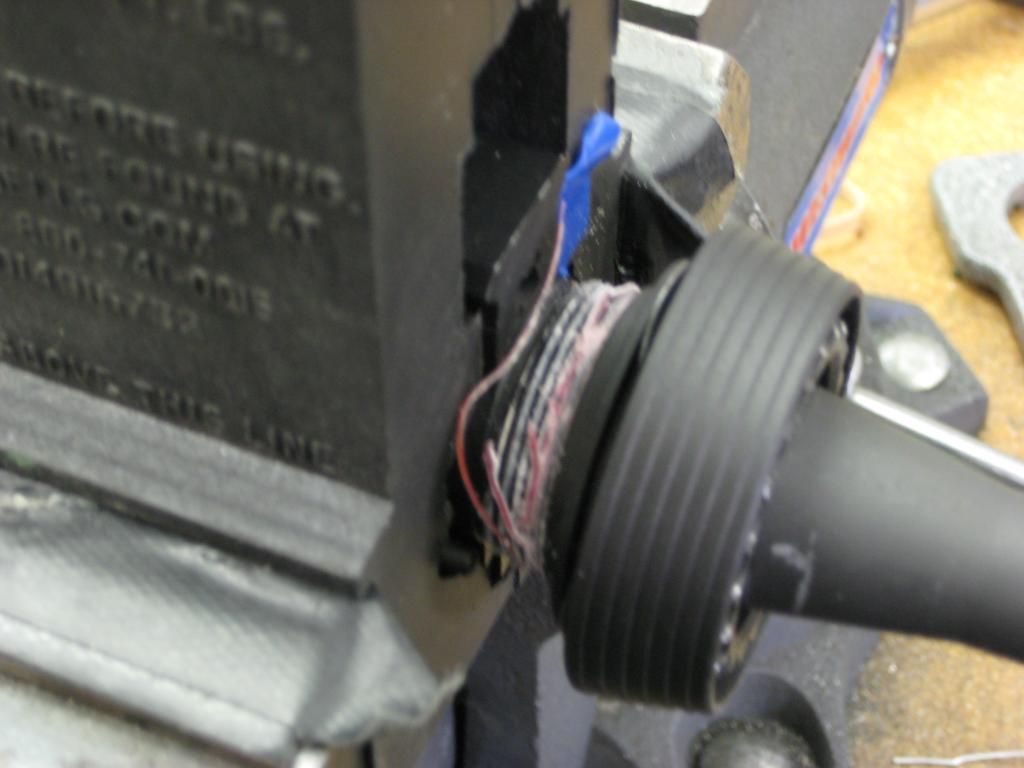 " /> " />
|
|
Quoted:
What the real travesty is that so many knowledgable people are so close minded to think that one way is the only way. Somebody comes along with a different method of acheiving the same end result, you don't agree with it and they are an "Idiot" and "Hack". I'm not gonna call you an idiot, just mis-informed. Either way, just because you do it YOUR way. Doesn't mean you run around the interwebz telling other folks to do it that way. How would you feel if you were new to this, and some dude on the internet said to do it YOUR way. So you do, and you break your new $300 billet receiver? I'm sure you wouldn't be too happy about it, would ya? That's why so many knowledgeable people are so close minded to "out of the box" ways of barreling an AR-15. Why change something that's worked for decades? Better yet, why run around telling folks to do it the way the TM specifically states NOT to do it? If it works for you, happy trails. But that is NOT the correct procedure! For any new guys reading this; NEVER put loctite on you barrel threads, and NEVER torque your barrel nut without lube........ |
|
Now that the smoke has (basically) cleared,
Here's why I posted the question in the first place. I've about completed a 223-chambered precision AR project, and initial testing is very promising. With 77 grain handloads leaving at just over 2700fps, I'm seeing consistent 0.6-ish MOA out to 200 yards (haven't shot this one any farther yet) Final barrel nut torque (after multiple mock-up preloads) with anti-seized threads was 66 ft/lbs. Some in this thread have suggested around 50 ft/lbs is an ideal number. Now I'm trying to decide whether or not I have anything to gain by tearing it all back down and trying a different nut, or maybe square another thousandth off the front of the receiver, to get it closer to that 50 ft/lb spot. Considering its (quite good IMO) accuracy, and consistency thereof, I'm leaning towards leaving it the hell alone |
|
Quoted:
Now that the smoke has (basically) cleared, Here's why I posted the question in the first place. I've about completed a 223-chambered precision AR project, and initial testing is very promising. With 77 grain handloads leaving at just over 2700fps, I'm seeing consistent 0.6-ish MOA out to 200 yards (haven't shot this one any farther yet) Final barrel nut torque (after multiple mock-up preloads) with anti-seized threads was 66 ft/lbs. Some in this thread have suggested around 50 ft/lbs is an ideal number. Now I'm trying to decide whether or not I have anything to gain by tearing it all back down and trying a different nut, or maybe square another thousandth off the front of the receiver, to get it closer to that 50 ft/lb spot. Considering its (quite good IMO) accuracy, and consistency thereof, I'm leaning towards leaving it the hell alone |

|
I've always used the minimum amount of torque necessary for the gas tube to line up with a notch in the barrel nut. If I went much past 50 ft/lbs, I would try another nut.
I always use some grease both on the upper threads and the barrel but, taking care to " pack" the threads with grease. I would never thread them together without lube. |
| I use a soldering iron (or a heat gun on larger objects) to heat up red Loctite and have never had a problem removing it. Yellow Loctite that Ford uses on driveshaft bolts... That may be another story, but red Loctite, never. If you broke it still after heating it "smoking hot" I would blame you not the Loctite that may have been on it. Sorry dude. |