


Posted: 7/18/2017 9:30:07 PM EDT
I posted a few years ago about this receiver originally built by my father in 1967.

A co-worker of mine with better soldering skills than me replaced the main capacitor and brought it back to life. 
The round white thing with wire wrapped around it is a tuning coil. To switch bands you swap out the coils. I currently have one for 40M in the radio but have others around here somewhere that I need to find. I fired it up tonight for the first time since getting it back and was able to pull in a shortwave station from South Carolina, some Spanish language broadcasts, what must've been distant AM stations (judging by them playing Phil Collins and Manfred Mann), and finally, China Plus News from Beijing. Tuning in a station required you to futz with all the knobs on the front. It makes you appreciate modern digital tuning. Heck, it makes you appreciate superheterodyne receivers! The antenna I have it connected to the Ultimax-100 40-6M end fed on my roof, which is setup as a N-S sloper. I cut a piece of lamp cord, stripped the ends, and put an alligator clip on one end. I connected the bare end to the Fahnstock clip on the radio and the alligator clip to the center conductor of my antenna feed coax. Fun stuff. |
 Anything with tubes fascinates me, but to have a receiver your Dad built restored to useful function is just wonderful!
|
That is a very clean 'ginny! You did a good job bringing it back to life.
That you were able to use it right off the bat is a testament of your operating skills. Many people have trouble getting used to a regenerative detector. They are a tad touchy. It's amazing what two tubes can do. Regenerative detectors were use in spy transceivers that MI6 agents used during WWII. They were called "Parasets" and were based on what many hams started out with in those days. The transmitter portion was a one stage crystal controlled oscillator. http://www.qsl.net/ik0moz/paraset_eng.htm 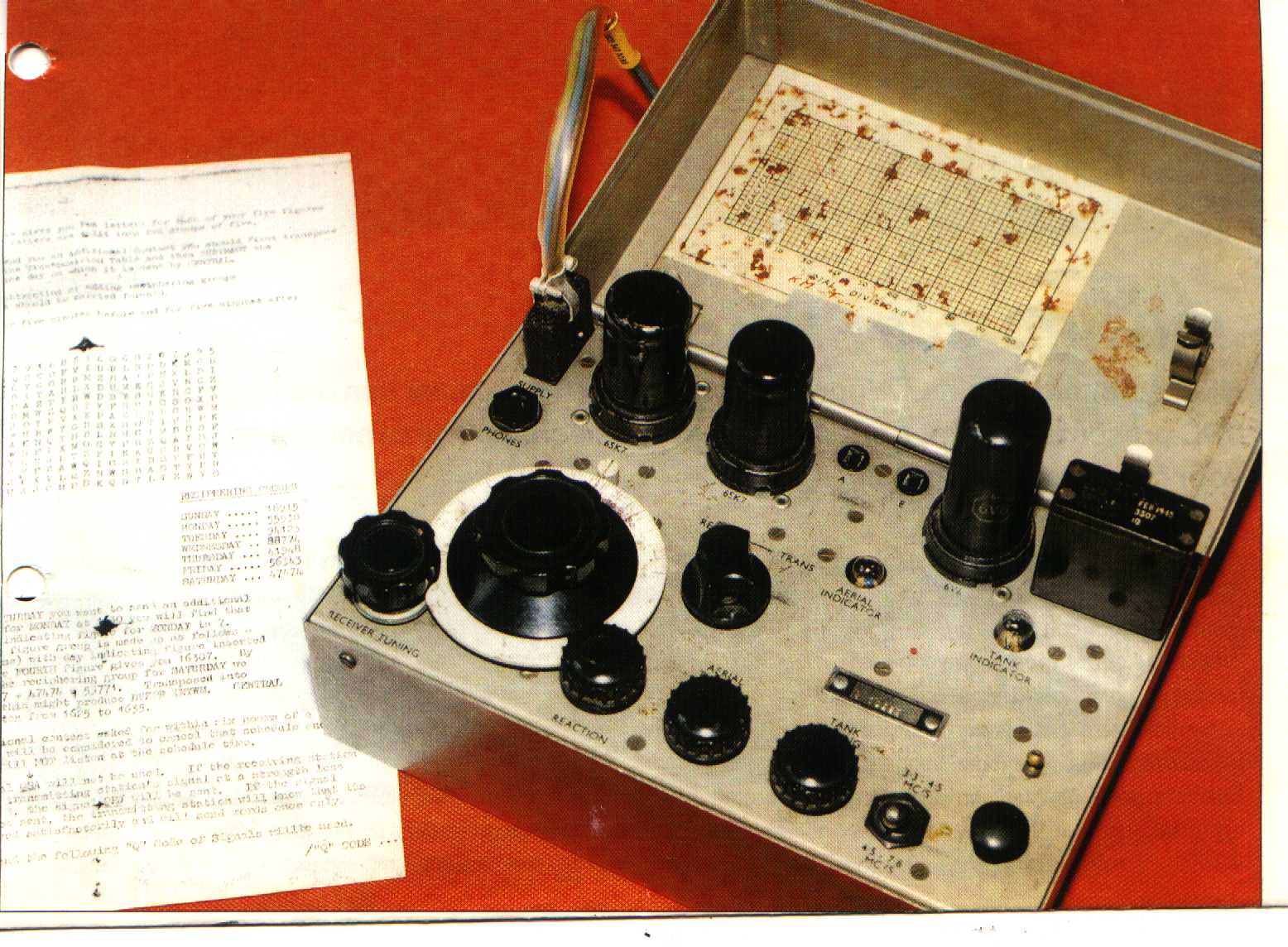
|

|
Thanks, guys. It's so clean is because when not in use it's been kept in the original shipping box. I have the manual, as well, which helped me properly use all the controls.
Dad lives around the block so one of these when he's over for a drink I'll have him give it a whirl. |
|
Quoted:
That is a very clean 'ginny! You did a good job bringing it back to life. That you were able to use it right off the bat is a testament of your operating skills. Many people have trouble getting used to a regenerative detector. They are a tad touchy. It's amazing what two tubes can do. Regenerative detectors were use in spy transceivers that MI6 agents used during WWII. They were called "Parasets" and were based on what many hams started out with in those days. The transmitter portion was a one stage crystal controlled oscillator. http://www.qsl.net/ik0moz/paraset_eng.htm http://www.qsl.net/ik0moz/Pa0se.jpg |
|
Quoted:
That is a very clean 'ginny! You did a good job bringing it back to life. That you were able to use it right off the bat is a testament of your operating skills. Many people have trouble getting used to a regenerative detector. They are a tad touchy. It's amazing what two tubes can do. Regenerative detectors were use in spy transceivers that MI6 agents used during WWII. They were called "Parasets" and were based on what many hams started out with in those days. The transmitter portion was a one stage crystal controlled oscillator.  but I knew a lot of guys (including myself) who built and ran them. but I knew a lot of guys (including myself) who built and ran them. Power output was around 3 Watts max. The coil was made on a piece of wood. Some used a 12 Ga shell. LOL. It worked to about 20-50 miles during day time and up to 1,000 miles at night, with proper antennas of course. I ran a full size "delta-loop" at about 120 ft. above ground. The antenna was horizontal, hung between several 9 story apartment buildings. It operated at around 2 Mhz and could be "fine tuned" to +/- 500 Khz. Power output was around 3 Watts max. The coil was made on a piece of wood. Some used a 12 Ga shell. LOL. It worked to about 20-50 miles during day time and up to 1,000 miles at night, with proper antennas of course. I ran a full size "delta-loop" at about 120 ft. above ground. The antenna was horizontal, hung between several 9 story apartment buildings. It operated at around 2 Mhz and could be "fine tuned" to +/- 500 Khz. The transmitter can be built in several hours to make it look nice or within minutes for testing. Back then ham radio was all about home brewing. The transmitter can be built in several hours to make it look nice or within minutes for testing. Back then ham radio was all about home brewing.
You know, I love ham radio but these days it's so easy to pull out a credit card and have a state of the art transceiver on your doorsteps 2 days later. Somehow this takes a lot of excitement out of the hobby. It's just too easy but to be honest, I don't have the patience to built a new radio, like I did 30 years ago. Building radios can be frustrating. I've done things I was not proud of. It;s when you turn around and make sure nobody saw what you just did. LOL. I always found errors in my wiring, especially it it involved designing and etching a circuit board. If I could only have a dollar for each component I burnt in my radios. LOL. Thankfully the components were free or almost free back them and there.
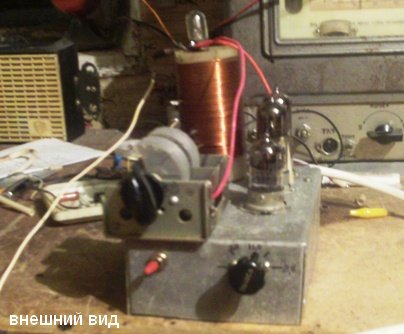
Here I found a schematic of the transmitter similar to what I built when I was about 12 years old. The picture is not mine. Like I said above, a shortwave tube receiver was used to receive. And, lets just say that harmonics were irrelevant with that gismo. It was my "gateway drug" that got me into ham radio. My friend lived about 12 miles from me and we had our own communication channel. Back then it was way cooler than iPhones these days. 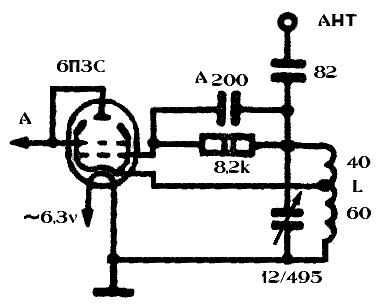
|
This is a replica of my first Novice transmitter. The original was made from parts stripped from a defunct table radio and was built on pieces of wood from an orange crate. The original tube was a 6V6 and the signal was chirpy so a friend gave me 6AG7, which solved the problem. No wattmeters back then, but this replica will put out a clean 4 Watts. It'll also ring your bell if you touch the wrong places.

I had a Motel T spark coil which I conected to an antenna late one night. The guy I later got my license with heard me all over 160 Meters about 3 miles away. We didn't do it again. |
| If you want to find active shortwave stations, or look up which ones are on a known frequency, try this site: http://shortwaveschedule.com/index.php?now=true. |