


Posted: 7/2/2016 5:21:24 PM EDT
|
What I'm trying to do should be retarded simple but apparently not...
I have a wifi client device attached to a generator and the wifi client can't go offline otherwise I don't get notifications. The wifi client requires ~24v DC @ ~0.25a (There is some wiggle room in the voltage but it uses around 6w). For that I have an any volt device that will take 3-30v DC and put out 24v DC. I have two power sources - a 12v lead acid battery and 120vac. The 12v battery is used for starting the generator and has its own charger. Using the battery for the short duration before the generator fires up is no problem. Originally I just ran my any volt straight off the battery. That worked for like a year and then the battery literally exploded due to over charging because I was constantly pulling power and the charger was constantly trying to juice up the battery. Acid and battery case everywhere. No problem I thought.... I got an outdoor rated 12v wall wart. Hooked that and the battery into a 12v relay. When the wall wart looses power the relay clicks over to the battery until power comes back. Well no good because apparently the relay doesn't click over fast enough. The wifi client loses power and reboots. I either need something solid state that can switch between the battery and wall wart quickly - or better yet just has a small battery that can supply me with power and charge back up the battery itself using 120vac. It would need to be small (4x4x2) and be ok with being outdoors in an enclosure that could heat up to 150 degrees F. I know I'm missing the obvious. Just need to see whats out there. |
|
Do like a low loss power gate - a couple of schottky diodes. Need a wall wart with a voltage slightly higher than the battery resting voltage. See thread here:
https://www.ar15.com/archive/topic.html?b=10&f=22&t=682250 First pdf reference probably pretty close to what you want (w/out the batt. charge resistor). Nick |
|
Quoted:
How big of a cap did you use? You'd think one of those auto sound system 1 farad caps would run it for several seconds. Quoted:
Quoted:
Quoted:
Add a capacitor and a diode? Did that originally and it was of no help. How big of a cap did you use? You'd think one of those auto sound system 1 farad caps would run it for several seconds. I think it was 330uf. Don't have room for anything that big. |
|
Just get a UPS to run the wall wart. < $100 Self-contained battery, charger, 120 volt inverter, fast switch over on power loss, easy to add more / bigger batteries, for longer life, and alarm circuitry. here. 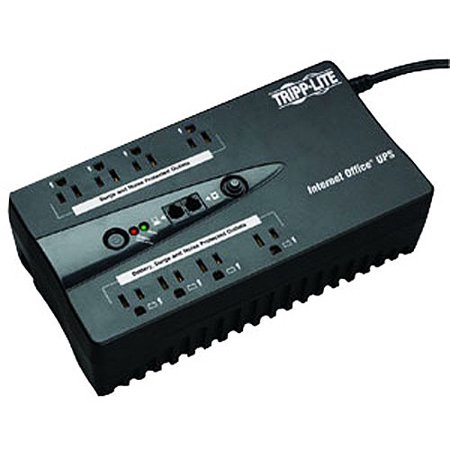 |
|
I think you were on the right track with your first setup -- you just had the voltage too high.
Lead acid batteries have different voltages depending on if you're doing an on-line float or not. The recommended float voltage of most flooded lead acid batteries is 2.25V per cell, though that should be derated at higher temps. So the fix would be to use a power supply set to 13.5V and float the battery across that, rather than a charger. A charger will, as you noted, put a higher voltage into the battery due to the load. Also, the kaboom spray acid thing is a known failure mode lead acid batteries. While old and low-capacity, most NiCd batteries carry a float voltage spec as well, if you wanted to switch to a less dramatic battery chemistry. As others noted, there's products that manage all this, the powergate being the most noted one -- they're pretty much doing the same thing here, but use diodes to isolate the battery when the system has power. |
|
Quoted:
Just get a UPS to run the wall wart. < $100 Self-contained battery, charger, 120 volt inverter, fast switch over on power loss, easy to add more / bigger batteries, for longer life, and alarm circuitry. here. http://i5.walmartimages.com/asr/ea54d32e-b87a-4100-9988-c94ddfd17af7_1.9682784efcc296dae1e8ac5343916020.jpeg?odnHeight=450&odnWidth=450&odnBg=FFFFFF Quoted:
Just get a UPS to run the wall wart. < $100 Self-contained battery, charger, 120 volt inverter, fast switch over on power loss, easy to add more / bigger batteries, for longer life, and alarm circuitry. here. http://i5.walmartimages.com/asr/ea54d32e-b87a-4100-9988-c94ddfd17af7_1.9682784efcc296dae1e8ac5343916020.jpeg?odnHeight=450&odnWidth=450&odnBg=FFFFFF This is an outdoor automatic standby generator. Not enough room to fit something like that in it let alone its not going to work well outdoors. Quoted:
I think you were on the right track with your first setup -- you just had the voltage too high. Lead acid batteries have different voltages depending on if you're doing an on-line float or not. The recommended float voltage of most flooded lead acid batteries is 2.25V per cell, though that should be derated at higher temps. So the fix would be to use a power supply set to 13.5V and float the battery across that, rather than a charger. A charger will, as you noted, put a higher voltage into the battery due to the load. Also, the kaboom spray acid thing is a known failure mode lead acid batteries. While old and low-capacity, most NiCd batteries carry a float voltage spec as well, if you wanted to switch to a less dramatic battery chemistry. As others noted, there's products that manage all this, the powergate being the most noted one -- they're pretty much doing the same thing here, but use diodes to isolate the battery when the system has power. The generator itself has a charger built in (that charges from the main) and circuitry that runs off the battery. I never put my own charger on the battery and wouldn't want to add my own charger (either float or the powergate). I might look into a couple of NiCds I can float though... I am simply trying to either switch between a wall wart and battery or just run my own power solution independent of the battery. I figured there was a simple solution I was overlooking. |
|
Quoted:
I think it was 330uf. Don't have room for anything that big. Quoted:
Quoted:
Quoted:
Quoted:
Add a capacitor and a diode? Did that originally and it was of no help. How big of a cap did you use? You'd think one of those auto sound system 1 farad caps would run it for several seconds. I think it was 330uf. Don't have room for anything that big. how about three of these in series? |
|
Normal float for a lead acid battery is 13.2 or thereabouts depending on the exact battery chemistry and construction. I would suspect your previous power supply left connected to your battery was at a somewhat higher voltage leading to overcharging and battery failure.
One simple solution would be to create a simple battery backup circuit just like an Astron power supply with battery backup. Rectifier with input from the battery side, and the normal power supply side, going to a common terminal output to the load. With a bypass resistor as a current-limiting device so that the battery can float off of the power supply, and this is critical, an adjustable voltage power supply to keep the float voltage at a safe level. Alternatively, you could use a power supply voltage somewhat higher than the battery float charge, so that normal usage won't draw power from the battery, leave off the bypass resistor, and use a separate, dedicated battery charger/maintainer like a Battery Minder as we were just discussing in another thread here. |
|
Quoted:
Did that originally and it was of no help. Quoted:
Quoted:
Add a capacitor and a diode? Did that originally and it was of no help. it will help if you size the holdover capacitor correctly... C = (I*t) / (?V) ps just be aware of the effects of adding a large capacitor when the circuit is first started up... ar-jedi |
|
Quoted:
Just get a UPS to run the wall wart. < $100 Self-contained battery, charger, 120 volt inverter, fast switch over on power loss, easy to add more / bigger batteries, for longer life, and alarm circuitry. here. http://i5.walmartimages.com/asr/ea54d32e-b87a-4100-9988-c94ddfd17af7_1.9682784efcc296dae1e8ac5343916020.jpeg?odnHeight=450&odnWidth=450&odnBg=FFFFFF just a side note: these things are junk. i own(ed) two of them, complete and utter junk. ar-jedi |
|
Quoted:
just a side note: these things are junk. i own(ed) two of them, complete and utter junk. ar-jedi We had some APS units at work which gave us some trouble, three of them literally blew up over a couple months' time. Cause was an intermittent open circuit in the neutral at a high level in our main panel, which I told our electricians right off the bat. Still it took them 4 more trips and 3 more APS unit failures before they got it fixed. Electricians in this town are not as competent as they should be. But an open neutral a very serious electrical failure which can cause all kinds of unexpected and potentially deadly things to happen. In the case of our APS units they were elected to be the return path for some large load in the building and there just wasn't enough conductor in them to carry it, so the mains side of them failed suddenly and catastrophically. It was like the 4th of July in the server room. |