


Posted: 4/18/2016 10:43:18 AM EDT
|
I bought The ARRL Ham Radio License Manual 3rd Edition and Ham Radio for Dummies.
After I got them I realized that the ARRL book is only for Technician class and wont teach me anything for the General, which I was hoping to sit for at the same time. Any better or additional resources that you would recommend? |
|
Quoted:
Hamstudy.org has become my new recommendation after watching my kids study with it. This. hamstudy.org is a great way to study. It will drill you on your weak areas as you go thru the flash cards. On the back of most cards, there is a brief explanation of answer. |
| I used Ham Test On Line to study for General and Extra. If you pay it will keep asking you questions you miss until you get them right. |
|
Quoted:
I used Ham Test On Line to study for General and Extra. If you pay it will keep asking you questions you miss until you get them right. I used this to upgrade to Extra and can't recommend it enough. It's worth the money. |
|
No-Nonsense Study Guides
I've used HamTest Online, and I've used HamExam.org. They both work equally well. One is free, and one costs money. The choice is yours. HamExam.org uses flashcards, and practice tests. It is a "smart" study program that keeps repeating the flashcard questions you miss, until you get them right. |
|
Quoted:
No-Nonsense Study Guides I've used HamTest Online, and I've used HamExam.org. They both work equally well. One is free, and one costs money. The choice is yours. HamExam.org uses flashcards, and practice tests. It is a "smart" study program that keeps repeating the flashcard questions you miss, until you get them right. FPNI You got the idea, study for General. Knowing what I know today I would have gone straight to Extra. |
|
Quoted:
It really is best to Know the Material To some extent you are right... BUT you have to think about what your end goal is. Mine was simply to get on the air. I knew enough to stay out of legal trouble. That part is simple. Stay on legal frequencies, stay within power requirements and keep it clean. It doesn't take a PhD to do that. You also have to remember it is a GOVERNMENT test which means it probably has NOTHING to do with the reality of operating. |
|
Surprisingly the information you learn for the test is just a very small portion of what you need to know and I you will learn soon enough. Once you pass the tech or general find an elmer. You will not be sorry. you can also learn a tremendous amount of info by starting on episode 1 of the Fo Time Podcast and work your way thru these very informative episodesn, which cater to the new ham.
Good luck.. Prosise |
|
Quoted:
After I got them I realized that the ARRL book is only for Technician class and wont teach me anything for the General, which I was hoping to sit for at the same time. Any better or additional resources that you would recommend? My observation is that there is around 60% overlap between the Tech and General material. Questions will be worded differently but the material remains the same. Seen more than a few newly licensed Techs try for General without studying for General at all. Typically they will get 60% to 65% which tells me with just a little bit more studying of the General material would net them an upgrade. |
|
Quoted:
Pic is right. After he gets his ticket, then the learning starts. That's when it gets fun. First thing to do is get a frequency chart and follow it to the LETTER. That plus obscenity and power limits. Know that, use some horse sense and you should be GTG. The rest you can learn on the fly. As with most hobbies, the question ins "What do you want to do with it?" I'm a pretty good appliance operator and a piss-poor techno person but that's good enough for me. FWIW pay attention to the legal questions on the test guide. |
|
Quoted:
To some extent you are right... BUT you have to think about what your end goal is. Mine was simply to get on the air. I knew enough to stay out of legal trouble. That part is simple. Stay on legal frequencies, stay within power requirements and keep it clean. It doesn't take a PhD to do that. You also have to remember it is a GOVERNMENT test which means it probably has NOTHING to do with the reality of operating. Quoted:
Quoted:
It really is best to Know the Material To some extent you are right... BUT you have to think about what your end goal is. Mine was simply to get on the air. I knew enough to stay out of legal trouble. That part is simple. Stay on legal frequencies, stay within power requirements and keep it clean. It doesn't take a PhD to do that. You also have to remember it is a GOVERNMENT test which means it probably has NOTHING to do with the reality of operating. You can't be serious! You mean I don't need to know Smith charts to run my radio??? |
|
Quoted:
You can't be serious! You mean I don't need to know Smith charts to run my radio??? Quoted:
Quoted:
Quoted:
It really is best to Know the Material To some extent you are right... BUT you have to think about what your end goal is. Mine was simply to get on the air. I knew enough to stay out of legal trouble. That part is simple. Stay on legal frequencies, stay within power requirements and keep it clean. It doesn't take a PhD to do that. You also have to remember it is a GOVERNMENT test which means it probably has NOTHING to do with the reality of operating. You can't be serious! You mean I don't need to know Smith charts to run my radio??? Depends are you just an appliance operator or an amateur radio operator? |
| I have been in electronics my whole life, so, the tech part of the exams was just a brush up. I really dislike studying factoids and things I can put up a wall chart or read in a book, so, goal was to get the highest license I could in the least amount of time, get on the air, and really learn radio. By learn I mean operating techniques, determine what I want to do, join clubs, find my niche in a very broad hobby. |
|
Quoted:
Depends are you just an appliance operator or an amateur radio operator? I like to think of myself as an amateur radio operator who sucks at reading Smith charts. 
Seriously though, if it were up to me, I would completely revamp the tech and general tests to focus more on practical amateur radio knowledge regarding usage and operating practices and less on theory. Most people who want to stop at tech could really use a practical how-to in their study guide. Very few of them will ever need even something as simple as ohms law. Sure, load up advanced theory, smith charts, logic circuits, and impedance of a 1/4 wavelength shorted feedline in the extra exam. Whether we like it or not there are a lot of folks who want to take a test, buy a Baofeng, and check in to their weekly net with a negative gain rubber duck...and nothing else without ever consulting an Elmer. I think those folks could use some more questions on real-world operations and less on what the standard repeater offset is for a GHz repeater. Just my two cents...ok, maybe that was more like five cents. 
|
|
Just memorizing the questions for today's exams will get you on the air and teach you just enough to make a fool of yourself. Keep your ears open and learn from more experienced hams, but also study the theory behind the questions. There are a lot of good books on ham radio practices in the ARRL bookstore. The Operating Manual is a good place to start while The ARRL Handbook covers the technical aspects of the hobby.
Incidentally, our hobby is referred to as "ham radio", not HAM. |
|
Quoted: Incidentally, our hobby is referred to as "ham radio", not HAM. |
|
my ARf-inspired Ham Radio Podcast for New Guys
http://hamradio360.com/ |
As long as we're on the use of the word "Ham", here is some more info. 
The activity that we all know and love, is properly referred to as "amateur radio", or "ham radio". A person who takes part in the activity is an "amateur radio operator" or a "ham radio operator", or a "ham" for short. A little history on the origin of the word "ham" can be found here. One more possible origin of the word "ham" could be from the phrase ham and egger. This used to be a fairly common expression, and supposedly, professional radio operators used it to describe the amateurs. Here is Rocky referring to himself as a "ham and egger" (about 4:50 into the video). 
Somewhere along the way, amateur radio operators decided to embrace the moniker of "ham radio operator", and now we wear it with pride.
|
|
About the expression "LID", as heard from a couple of old time railroad telegraphers: Sometimes there were several telegraphers in one room and each each would use pieces of metal or other substances to "tune" their sounder to differentiate it from the others. This is the land line equivalent of calling a DX station slightly off frequency to make your signal stand out from the rest. If you've ever heard a sounder clattering along at 20+ WPM, it can get very noisy. Several sounders in close quarters could be very confusing. https://www.youtube.com/watch?v=-St7jTk5ciw
More ham radio lore: 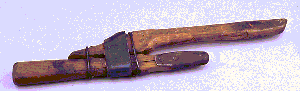
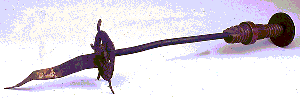
|
| Studying for the tests is in a way a small part of ham radio, lots of learning to do afterwards. I passed one test, studied for the next and passed that and then studied for extra and passed that all before having a radio. I'm starting to learn about electronics from a club builders group. They are slowly walking us through soldering, removing components, identifying defective components, testing them etc. I just recently got a radio and am now starting to learn on that. Just study and take it one test at a time, think of it as a lifetime of learning. Good luck and welcome. |
|
Quoted:
I will make no bones about it whatsoever. I am an appliance operator. As I've said before, with amateur radio everybody has something to bring to the table. |