


Posted: 3/10/2016 12:07:21 PM EDT
|
I moved over a year and a half ago and have yet to get any antennas up. This needs fixed! I had what I thought was a great plan, but started looking at implementation and found some issues.
Here is what I planned. The shack will be in the basement. It is almost a full basement, but has a 10' crawl space at one end. I also have an old TV tower on the crawl space end that I thought would work great to mount and support antennas. I don't really like going in the crawl space more than I need to and for ease of running cables, I thought I would install conduit from the outside wall to the basement. I don't want to bring anything in right by the shack location since it is the front of the house. I can't really move the shack location for various reasons. Mostly to scale (conduit size exaggerated for clarity): 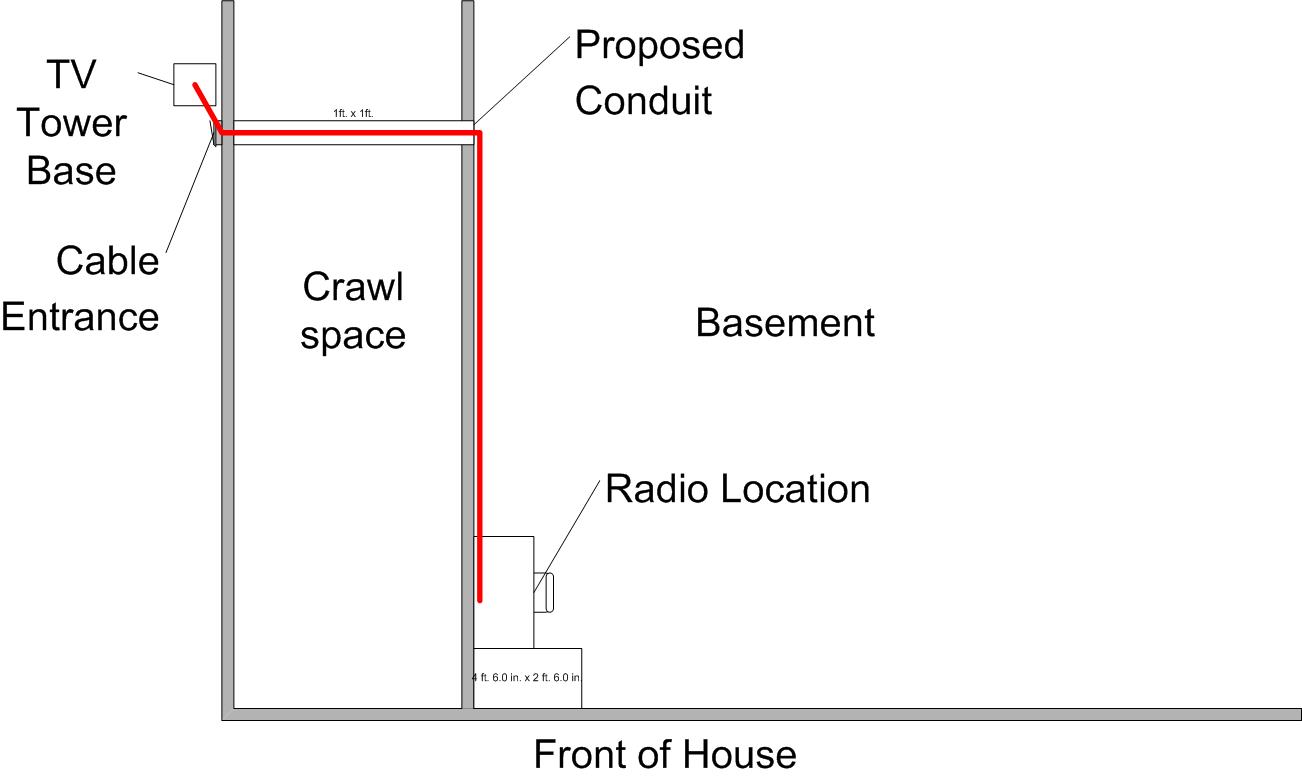
Some questions/issues: I thought I would install a box of some sort where the cables enter the house, but right now the concrete block (and existing TV cable entrance) are below grade. It doesn't seem like a great idea for the box to be in contact with the ground, or are they rated for that? I was thinking metal, but I guess plastic would work better? The electrical service entrance and ground are on the opposite side of the house. If I ground the cables for lightning protection at the cable entrance, will that cause any problems? The cable run inside is 25-30 feet alone. That shouldn't be a problem on HF, but seems like a lot for UHF/VHF. Or shouldn't I worry? The inside run would also pass by several electrical runs, but I guess I can run the cables horizontally mid-way down the wall. Or won't the electrical cause a problem? |
Suggestion one: plan on three times that space for all the radios, computers, screens, and coffee cups you'll end up with. 
Runs of 100' or more are not an issue on VHF / UHF even using RG-8X. Upgrading to LMR-400 will cut line losses a little bit it's a lot stiffer and more difficult to work with. There's a lot of comparison information out there on coax, within reason almost anything will work. I suggest that you do some research unless you already have the coax you'll be using. Running your feed line near electrical equipment shouldn't cause much of a problem, if any, but I always try to stay away from possible noise sources like appliances when I can. If your existing below-grade box is sealed and isn't wet inside, then you should be fine. Water is the enemy of coax. Does the TV service line go through the box and into the house below grade? I'll stay away from the grounding discussion because there are so many expert opinions. |
|
Here's the proper way to handle your ground.
http://www.w8ji.com/house_ground_layouts.htm If it were me I'd find away to mount a metal box above grade outside. |
|
Thanks for the replies!
Some responses and additional information: Quoted:
Suggestion one: plan on three times that space for all the radios, computers, screens, and coffee cups you'll end up with.
Runs of 100' or more are not an issue on VHF / UHF even using RG-8X. Upgrading to LMR-400 will cut line losses a little bit it's a lot stiffer and more difficult to work with. There's a lot of comparison information out there on coax, within reason almost anything will work. I suggest that you do some research unless you already have the coax you'll be using. Quoted:
Suggestion one: plan on three times that space for all the radios, computers, screens, and coffee cups you'll end up with.
Runs of 100' or more are not an issue on VHF / UHF even using RG-8X. Upgrading to LMR-400 will cut line losses a little bit it's a lot stiffer and more difficult to work with. There's a lot of comparison information out there on coax, within reason almost anything will work. I suggest that you do some research unless you already have the coax you'll be using. I have various types of coax, including LMR-400, but I'm not sure it is long enough for the new run. I'll have to figure that out, but I can buy some more. Running your feed line near electrical equipment shouldn't cause much of a problem, if any, but I always try to stay away from possible noise sources like appliances when I can. There are two deep freezes I would running behind/over. Would they make noise? If your existing below-grade box is sealed and isn't wet inside, then you should be fine. Water is the enemy of coax. Does the TV service line go through the box and into the house below grade? Right now there is no box, just a rotator control cable and twin lead. They enter below grade and feed through a small hole in the concrete block. Quoted:
Here's the proper way to handle your ground. http://www.w8ji.com/house_ground_layouts.htm If it were me I'd find away to mount a metal box above grade outside. I've always heard to ground to a single point, but I thought that might not apply for lightning protection. Between cost and obstacles like a concrete walk, I don't think it is feasible to bond them outside, nor do I like the idea of running the bonding inside. Hmm... I can mount the box up and run a 90 degree sweep down and through the wall. Any reason to prefer metal over plastic? ============================================================================================================ It sounds like I shouldn't worry about the coax run, and worry more about the grounding. I'm not sure how to solve that, so I'll keep thinking. |
|
Quoted:
I can mount the box up and run a 90 degree sweep down and through the wall. Any reason to prefer metal over plastic? I don't think there's a real requirement for metal over plastic. You see a lot of low power RF setups using plastic and DXE even sells a plastic box for use with RG-8 size cable. I'm pretty sure their box was originally designed for cable TV. Whenever I see a rugged high quality commercial, military, or ham install it's in a metal box. Your surge suppression and main ground connection is in that box, and the box is bonded to it. In the event of a lightning hit it would hopefully stay in the box and divert to ground for the most part. I don't think plastic would help out there. |