


Posted: 9/28/2015 12:29:58 AM EDT
|
Yesterday, Saturday, September 26, 2015, my buddy and I participated in a statewide Simulated Emergency Test.
The scenario included total grid down, no electrical, communications, or other power/comms working. We were assigned to set up and operate from a courthouse several counties away. We got up early, made coffee and biscuits, and while that was brewing/baking, loaded the last few items into the truck. On the road by 06:00, and arrived about 07:00. Once we explained to the city policeman on duty in that area why we were there we got good cooperation and coffee. Due to the size of the HF antenna footprint (roughly 70' x 70') and the need for sun exposure, it was suggested we set up in an empty grassy area in back of the courthouse. There was a big spreading oak which provided excellent shade. 
All coax is RG-8X. Also note the use of fluorescent orange paracord for the tie off rope on the ends of the antenna wire elements. Here is the radio setup: 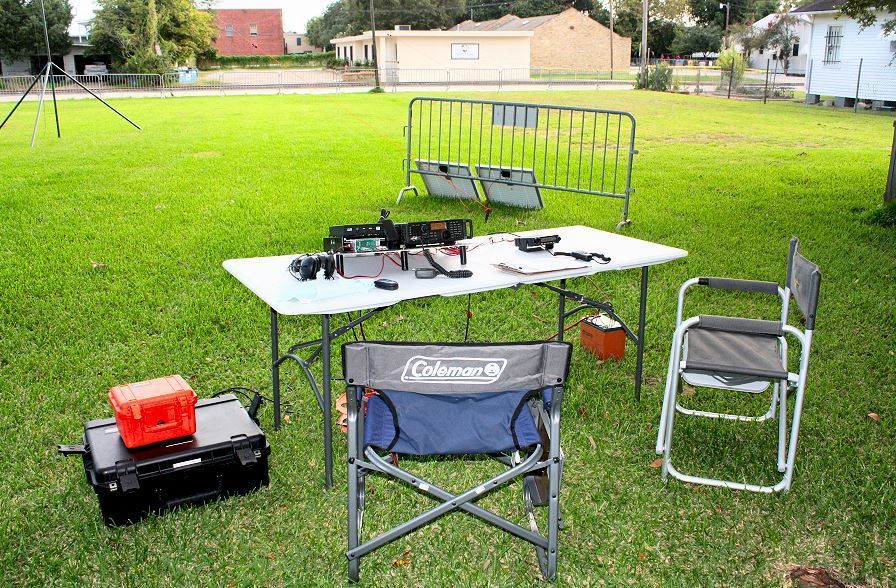
Equipment included an Icom IC-7200 HF rig, LDG IT-100 tuner, Samlex SEC-1223BBM power supply (not used here). Also used was a Yaesu FT-1802M 50 w 2 meter rig. It was plugged into the Powerpole power strip in the back of the HF go kit. A write-up on my HF go kit here: http://www.ar15.com/forums/t_10_22/675680_.html A/C power from the power grid was not to be used, but rather any kind of portable or emergency power, generator, battery, etc. We used a 55 AH AGM battery, about the size of a large lawn tractor battery. This battery was kept charged from two 50 watt solar panels, each roughly 22" x 26" simply leaned against a police traffic barrier and angled up about 45 degrees. A Y-cable put them in parallel and fed the power to the battery through a KI0BK Solar Charge Controller. Also used, the KI0BK Battery Monitor, which was plugged into the Powerpole power strip in the back of the HF go kit. 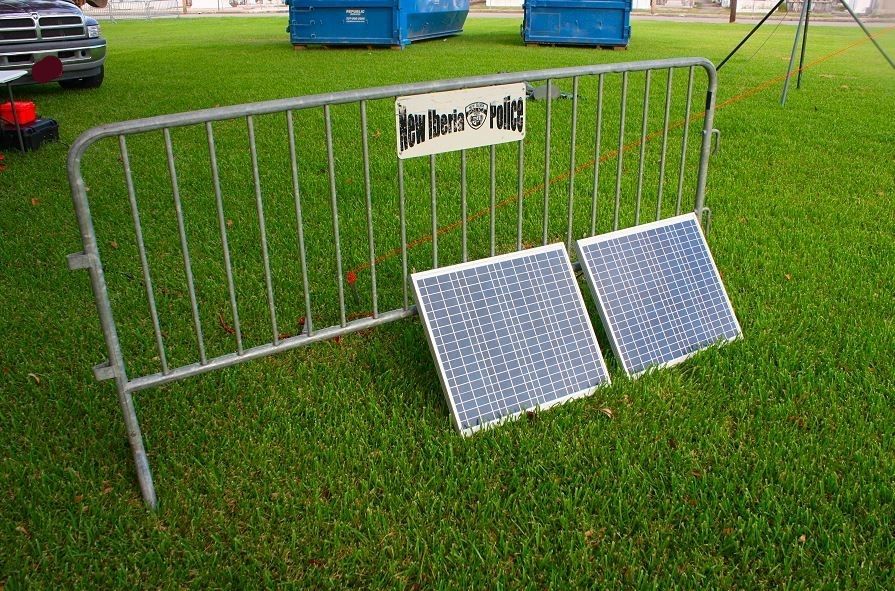

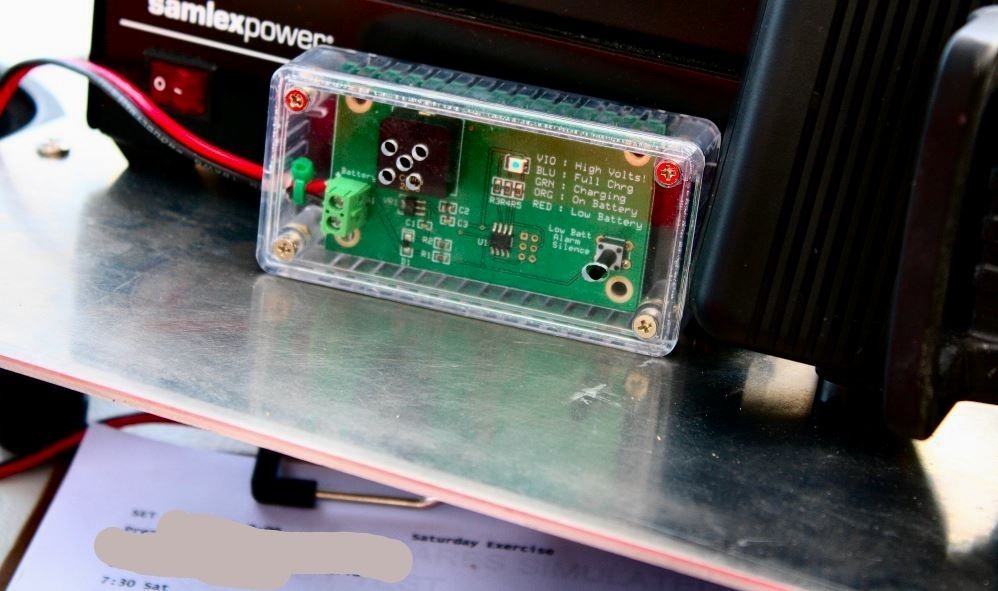
A write-up on my solar power setup here: http://www.ar15.com/forums/t_10_22/671603_Portable_power_and_Solar_Charging_Gadgets.html While two solar panels quickly brought the battery up to full charge, as indicated by a blue light on the KI0BK Solar Charge Controller, disconnecting one panel still kept the battery "in the green" even while operating both HF and VHF radios. The VHF antenna was the N9TAX 2m rollup slimjim simply taped to two mil-surp fiberglass mast sections, which were placed on top of several mil-surp aluminum mast sections held vertical with the tripod center section from a Go Vertical mast kit. I have two of these mast kits. https://goverticalusa.com/featured/antenna-tripod-29ft-aluminum-portable-tower-mast-kit.html The HF antenna is one I found on Hamuniverse.com in the Antenna Design section, which I used mounted to the much better Go Vertical mast kit above. We would need to operate on both 75 meters and 40 meters, and this antenna will do that, as well as 20, 17, 15, and 10 meters with light touchup from the IT-100 tuner. http://www.hamuniverse.com/ae5jufielddayantenna.html 
The Simulated Emergency Test began with a check-in on 75 meters, a statewide traffic net frequency, then check-in on the 2 meter Skywarn repeater system. Tests were run passing traffic via digital on 80 and 40 meters. Also checkins on a 2m simplex frequency. In the middle of all of that I made contact with a special event station, K2V, "Convoy on the Air", about 300 miles away We completed the drill and went QRT at 12:00 local time. Equipment was taken down, coax and antenna wire elements properly coiled and put away, everything neat and orderly for quick setup next time done in about 20 minutes, and we were on the road going home by 12:30. |

|
Quoted:
What he said Quoted:
Quoted:
Sounds like fun, except for the getting up early part. What he said Yeah, what those guys said! Arrived home, my partner in crime helped tote everything back to the hamshack. After he left I took a cool shower and a much needed nap. Last time we used this gear there was tangled wire, things not put away as they were taken out of the cases. It had all been used for a special event by my club while I was out of town. This is a reason I often say, "No thanks, I don't need any help putting this stuff up." It is just easier to put it away correctly, so it will be easy to reel out and set up next time. This particular ham friend that helped me has an almost identical set up. Identical HF go kit, solar setup, antennas. And he has worked in a similar field that wrangled cables and hoses like I did, knows what it takes to keep it all squared away and in good condition. We work together well, and don't have to tell each other what to do. When he rolls up my coax I don't worry about twists and kinks. Anyway, we have this stuff down to a fine art. 
|
|
Quoted:
Excellent write-up (as always)!! Thanks for the photos and the links.  Thanks for the accolades, guys! My ham buddy did the photos. Also processed the photos for clarity, color, contrast. My point in doing this post was that it was the culmination of some of the other projects I had posted, all coming together for this purpose... portable radio kit, antenna kits, solar power, all to make an easy to setup, and effective station that can go anywhere, any time, with no "infrastructure". I continue to fix what I perceive to be weaknesses. I see that two solar panels will provide plenty of power to keep up with not only two radios but also enough juice left over to operate my laptop. I have been very unhappy with the difficulty of operating digital with the IC-7200's USB cable. Adjustment of audio levels is very difficult at best. I am presently building, at the suggestion of another member here, some Easy Digi interfaces. These are Keep It Simple, Stupid interfaces with minimal parts count, 1:1 600 ohm audio isolation transformers for both Tx and Rx, and instead of a reed relay, an optocoupler for PTT. These well designed, and well made circuit boards will go into some neat extruded aluminum cases I found at MCM Electronics. I will add two 5k pots, one for Tx audio level, one for Rx level, set once and forget, to get rid of the level mismatch problem. |
|
Thank you Jupiter7200 especially for the pictures and links to previous project descriptions.
About the take-down/cleanup. As he wrote below, taking time to put it away right makes it easier to put it into service the next time. One of the questions posed in ICS training is 'When do you begin planning for asset recovery?' The answer is before you deploy. So that when recovery begins the team members know not only how to put it away but how to note which items need repair/replacement at that time. The EPA has a good graphic for this I think. Our area SET is this coming weekend. BTW: your kind of setup is where I hope we'll be in less than 2 years. Quoted:
Last time we used this gear there was tangled wire, things not put away as they were taken out of the cases. It had all been used for a special event by my club while I was out of town. This is a reason I often say, "No thanks, I don't need any help putting this stuff up." It is just easier to put it away correctly, so it will be easy to reel out and set up next time. This particular ham friend that helped me has an almost identical set up. Identical HF go kit, solar setup, antennas. And he has worked in a similar field that wrangled cables and hoses like I did, knows what it takes to keep it all squared away and in good condition. We work together well, and don't have to tell each other what to do. When he rolls up my coax I don't worry about twists and kinks. Anyway, we have this stuff down to a fine art.
|
|
On the nose, Grinning Wolf.
During an event I make notes of equipment that does not perform as expected, or as needed. Or something that might be prone to failure. Frayed wire? Nicked jacket on coax? Damaged plugs? And while it is all being put away we visually inspect, looking for any damage or problem areas. We make note, and I mean write it down on the clipboard. (And that's another thing, clip boards, log forms, pens - cheap Bic or other throwaway pens, and note paper. Any other forms, or information, local contact names and numbers, whatever needed for the event.) At the suggestion of another Arfcommer here, I had obtained 12 volt cig lighter plug in type power supply for my laptop. I cut off the cig lighter plug, and put Anderson Powerpoles on each wire end. I can now plug the laptop into the power strip on back of the HF go kit, or reattach the cig plug and plug it into the socket in the vehicle. Anyway, a postmortem is done, and any problem areas addressed, either repaired or it is decided how to do it better, and then do so. And test it to make sure. You have to make the assumption you will have no, or few tools, no electricity, no soldering iron, etc. Do everything you can to ensure a successful operation. Create a check list. A story... Many years ago I was a competitive R/C model flyer. A week before a contest I drove an hour to fly at the field where the contest would be held. I had heard there was a very slight, but invisible slope to the field which made landing from one direction very difficult, and just generally threw you off balance. I packed up, drove, found the place, unpacked only to discover I had left the transmitter back home sitting on the work table in the spare bedroom. Lesson learned. Have a check list. Santa does. He checks it twice. |
|
Quoted:
very cool! and that's one hell of a tree. The limbs of a "spreading oak" will often dip all the way down to the ground and start up again. They are great for kids to climb. There is a place owned by a fellow church member where we sometimes have special services. Beautiful grounds, historic home, and LOTS of spreading oaks. We had a photo with all the kids of the church sitting side by side along the limbs of one of the big oaks. Those limbs are 3' or more in diameter. |
|
Very nice! Many people talk about it. You guys get'er done!
Were you taking advantage of NVIS propagation during the exercise? If yes, have you used any reflector elements placed on the ground to improve NVIS pattern? I've tried using three reflector elements made of yellow THHN wire and cut slightly longer that the driven element for both 40 and 80 meters. There was noticeable improvement. |
|
No, was not trying for NVIS, but I'm sure that figured in, especially on 75 m.
I've seen good NVIS on 80 m using an ordinary wire dipole at 6' off the ground. We also have OCFDs to hang where we only have a long narrow strip of land available. It all depends on the venue. Never tried a reflector, but sounds like a place to experiment in the future. |
| Thanks for taking the time to post up your field operation. It's great to see everyone's portable set-ups e.g. radios, power supplies, antennas and more importantly, how you support the antennas and keep 'em in the sky! Thanks for the links to your solar set up as that's certainly on my list of 'portable kit enhancements' for the future. |

|
Quoted:
Personally I use neon pink for guy wires. It keeps people away a little better than orange does for some reason. Not only that but having oddball colored items helps you keep track of what is yours. I've painted all of my HT batteries OD Green. Not because it's tacticool but because it was the only color I had lying around that was Krylon Fusion. Since most people have the same type of battery pack, having mine a different color makes them easy to find later. My winter project this year is getting my go-box put together. Everything (coax, wires, stands, poles, etc.) will have the same color sequenced zip ties. Using methods like this makes it easy to grab your stuff and not have to question if something is yours when it's dark or you're tired. |
|
Quoted:
Personally I use neon pink for guy wires. It keeps people away a little better than orange does for some reason. Picc, they think... well... 
Then again, it takes a manly man to wear pink. We can easily get neon pink, neon orange, neon lime green, neon snot yellow. Any suggestions of which of these shows up best in dusk conditions? I just don't want people tripping on the gear, both to protect them AND my antennas. |
|
Quoted:
Now there's a good idea! Quoted:
Quoted:
Chem lights. With Halloween approaching, you can buy bags of them for cheap and hang them where you need to. Now there's a good idea! work great at night - some caution tape for the daytime works well also (lots of wires strung around and no lights when we operate in the field) |
|
Quoted:
Any suggestions of which of these shows up best in dusk conditions? I like reflective paracord: decently cheap, strong enough for my tasks, and lights up like a Christmas tree when walking around at night with a headlamp. Comes in very loud colors, and 'Count 'Em! TWO shades of pink for Pic. |
| Assume it is a right place to post this link: http://www.iaru.org/emergency-telecommunications-guide.html |
|
Quoted:
I like reflective paracord: decently cheap, strong enough for my tasks, and lights up like a Christmas tree when walking around at night with a headlamp. Comes in very loud colors, and 'Count 'Em! TWO shades of pink for Pic. Quoted:
Quoted:
Any suggestions of which of these shows up best in dusk conditions? I like reflective paracord: decently cheap, strong enough for my tasks, and lights up like a Christmas tree when walking around at night with a headlamp. Comes in very loud colors, and 'Count 'Em! TWO shades of pink for Pic. Excellent! Thank you! |
|
Quoted:
Assume it is a right place to post this link: http://www.iaru.org/emergency-telecommunications-guide.html Entirely appropriate to post here. Thank you! I've bookmarked the site and downloaded the pdf. |
|
One thing I feel I need to add about the Solar Power setup... the KI0BK or some other form of battery
voltage monitoring is vital. I just cannot stress that enough. Batteries can be easily damaged by both overcharging/overvoltage and discharges. That is one reason I don't use, and don't want to use a "battery booster" to wring out every last electron from my battery as I kill it deader than hell. If the battery is too low to run the radio, I'll recharge it. Simple as that. This could be as simple as simply attaching a digital voltmeter to the power buss of your system. I do like the KI0BK Battery Monitor, which has an audible alarm if voltage drops too low. |
|
Quoted:
work great at night - some caution tape for the daytime works well also (lots of wires strung around and no lights when we operate in the field) Quoted:
Quoted:
Quoted:
Chem lights. With Halloween approaching, you can buy bags of them for cheap and hang them where you need to. Now there's a good idea! work great at night - some caution tape for the daytime works well also (lots of wires strung around and no lights when we operate in the field) Tell that to the guy driving the CO around at night with Chem Lights all over my OE-254 and engineering tape (WHITE) and still ran my antenna over......Was not a happy Commo guy at 2am putting a brand new antenna up, then again he did have to carry the feed cone around with him the next few months....... |
|
Quoted:
Chem lights. With Halloween approaching, you can buy bags of them for cheap and hang them where you need to. REAL men use RAILROAD FLARES!!!
Either that or set up magnesium flares on a trip wire near the guy lines. WHAP! Whoosh! The whole area lights up and the guy can now see the guy wire. 
|
|
Quoted:
Chem lights. With Halloween approaching, you can buy bags of them for cheap and hang them where you need to. You can also take the leftovers and hang them from a weather balloon full of helium and set it aloft. Then listen in on a scanner to all the people that call in UFO reports. Ask me how I know this. 
(when I did it there were no chem lights. We used a couple railroad flares.) |