


Posted: 7/18/2015 10:57:20 AM EDT
|
Not that I'm doing anything new, I'm just trying to get functionality.
I don't want an Android phone or tablet or anything. I have an iPhone. Laugh if you will, but it suits me. I also like Springfield XD's, women without tattoos and fly fishing for sunfish, so I'm not stylish in any fashion. I found software to use the iPhone as a sound card TNC: http://koomasi.com/pocketpacket/ Fascinating. I can turn on the APRS-IS functions and I'm rolling. 
But APRS-IS via my cell is cheating. No good. I want to get on the air. The iPhone uses a special arrangement on its 4-conductor plug relative to everybody else. 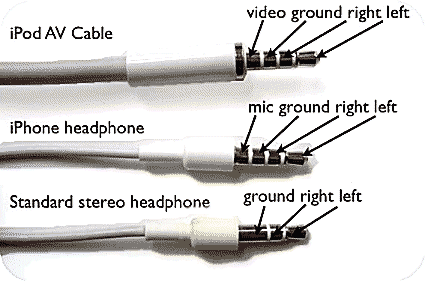
I did some experimenting with a splitter. Every mic/headset I have uses the TRRS (tip-ring-ring-sleeve) plug and my PC's all use separate stereo jacks for mic and headphone and line in, so I have splitters. I bought a converter for 3.5mm plug to 2.5mm plug and strung them together in some sort of incestuous bastard daisy chain. Plugged it in to my TH-F6a HT. It keyed the mic and left it open, but never listened. That's not cool at all. I did some reading. Naturally, I read AFTER I plug things in. Low power has thus far kept me from hurting myself. It turns out somebody has already solved this problem. His name is John Boiles. He designed a little board that fools the iPhone into thinking that there is a microphone attached. Nice! The boards are $1.70 for three. How can I go wrong? Parts list from Digikey, enough to make three units was about $20. The parts list called for surface mount components. OK, I can figure this out. They arrive from Digikey. Shit, I can't even SEE them. 
My father-in-law is an EE. He looked at them and said, "Holy shit! I'll fix that." A few days later, he sent me a packet of full-size components. All right! Time to use my new soldering station! As I got started, I realized I couldn't read the labels on the PCB - they were too small. I went to the drug store and bought a pair of the strongest reading glasses they had. I assembled the itsy-bitsy PCB. The hardest part was figuring out which wire went to which hole - the labels didn't make sense to me. I traced on the PCB and made notes, so I THINK I got it. It's ugly, but when I'm sure it works, I'll glue it to a piece of HDPE and shrink wrap it for durability. 
Plugged it in to my Boofang UV5RA+ because I don't want to wreck my expensive HT (screw the phone - it's insured). I set it to VOX and turned the squelch down and the volume up. The HT broadcast at about the expected transmission interval and I was on! After a few minutes, APRS.fi showed my call sign and location. Just to make sure, I changed the symbol to the Kenwood and APRS.fi picked it up. The HT antenna sure got hot, though. Interestingly, I double-checked on openaprs and found that it was not finding me, but it was finding near-by stations that aprs.fi wasn't. Also, Pocket-packet wasn't finding me, either. I had some beer, read a book and went to bed. To be continued. Nothing excites me more than going to a pool party with a bunch of elementary school teachers in NJ when there's a threat of thunderstorms. I wanna be stuck in their house listening to four hours of teacher blather and I won't be able to talk guns, fishing, hunting, radios or science. The kids will be spastic indoors. There will be Coors Light, so I guess I'll be hydrated. |
|
Quoted:
But..... Beans or no beans? I can't comment until this is cleared up. Quoted:
But..... Beans or no beans? I can't comment until this is cleared up. Who cares? This is Important Radio Stuff! If you must know, both. When I eat chili at places that serve real chili, I go with no beans. When I make chili, the family expects beans, so I add beans. I'm beansexual, I suppose. ETA: What routing were you using? For it to show up on aprs.fi means you're technically getting out on RF. It has to be something with the routing. Here's my routing settings: 
That's the default setting and according to the software guide, this is suggested for moving APRS units. I tried a little more juice this morning. I ditched the Boofang for my TH-F6A and a Diamond triband antenna and then a big Jpole on the side of the house. I was thinking that the digipeater was hearing me but my radio wasn't hearing them. That's probably not the case because when I'm listening to repeaters, I can hear them and they can't hear me on an HT. Still, I got WI3Z and K3TU to hear me according to APRS.fi. Interestingly, openaprs was down this morning. I tried after dinner and I wasn't getting packets out until I went back to my jpole. Now they are going out but still not coming back. The next step is to check the connector I built because the radio's speaker is not tripping the microphone of the iPhone. I'll also try the squelch and VOX settings on the radio. |
|
Just curious, are you decoding your digipeated packet on the Baofeng? I've tried using one with the Mobilind TNC2, and it seems like the tx->rx switching is too slow to get the digipeated packet. I fooled around with my base station and KPC-3+ and had to bump up the digipeat delay to decode the digipeat on my HT. I used a non-standard APRS frequency for it, BTW. |
|
Quoted:
Just curious, are you decoding your digipeated packet on the Baofeng? I've tried using one with the Mobilind TNC2, and it seems like the tx->rx switching is too slow to get the digipeated packet. I fooled around with my base station and KPC-3+ and had to bump up the digipeat delay to decode the digipeat on my HT. I used a non-standard APRS frequency for it, BTW. Quoted:
Just curious, are you decoding your digipeated packet on the Baofeng? I've tried using one with the Mobilind TNC2, and it seems like the tx->rx switching is too slow to get the digipeated packet. I fooled around with my base station and KPC-3+ and had to bump up the digipeat delay to decode the digipeat on my HT. I used a non-standard APRS frequency for it, BTW. I think I get it: The radio stops transmitting and doesn't start receiving fast enough so it isn't picking up incoming packets? I don't think that's the problem here. I turned transmit off and still wasn't reading packets. Quoted:
Don't be scared of surface mount soldering. It's not as difficult as you think it'd be. Use a fine tip iron and super fine solder. (.015") Because the stuff is tiny you can line everything up, and just touch the iron to it. Bam, done. I think I ordered the wrong components. They were too short to fit between the contacts because they were about half the size of a grain of sand. If I took them out of the tape, I'm pretty sure they'd vanish. I've got a fine iron tip, but I didn't realize there was solder smaller than 0.032" I'll get some of that smaller solder and build another board. The more I think, the more I believe my assembly skills caused my problem. |
|
As a suggestion..... I read the same thing about the squelch dropping to slow on the Baofengs. You can open the squelch up wide and just let it receive static and you should be able to receive and decode packets. Obviously this won't work for normal use, but it can help troubleshoot if the radio is the issue.
On the packet path: the problem with APRS is that a lot of the information on the internet is old, really old. The last time I reset my TM-D700 and started transmitting I got a nasty-gram from a digi owner that what I was using was "old" and I was wrong, a LID and my mother was fat. I do not know the proper answer and frankly it probably varies slightly in different areas of the country. |
|
Quoted:
As a suggestion..... I read the same thing about the squelch dropping to slow on the Baofengs. You can open the squelch up wide and just let it receive static and you should be able to receive and decode packets. Obviously this won't work for normal use, but it can help troubleshoot if the radio is the issue. Quoted:
As a suggestion..... I read the same thing about the squelch dropping to slow on the Baofengs. You can open the squelch up wide and just let it receive static and you should be able to receive and decode packets. Obviously this won't work for normal use, but it can help troubleshoot if the radio is the issue. I tried on both the Kenwood and the Baofeng. The phone isn't copying the data from either one. On the packet path: the problem with APRS is that a lot of the information on the internet is old, really old. The last time I reset my TM-D700 and started transmitting I got a nasty-gram from a digi owner that what I was using was "old" and I was wrong, a LID and my mother was fat. I do not know the proper answer and frankly it probably varies slightly in different areas of the country. I know. The way I found out about the PCB was from a couple of forum threads from 2013. Is your mother fat and how did he know? 
Quoted:
Hell I would have assembled that for you. SMT is easier than fighting the through hole leads. I feel the opposite. I'll see if I can get father-in-law to assemble. I'll make the kids ask grandpa - he'll never refuse. |