


Posted: 10/31/2014 5:28:07 PM EDT
|
I don't see any sticky posts about repeaters, and the search didn't turn up much. I'm a fairly new ham, and have used rental repeaters in a racing setting as well. While I've done a bit of reading up and HT's, mobiles and base stations, I haven't seen a lot out there about repeaters. I understand the basics and how they work, I'm more interested in brand x/y/z are good, here's the difference in them, options you can get, etc. The repeaters I've rented were on commercial freq's in the 460-470MHz range. They didn't have a front end that appeared to have a user selectable frequency set by a keypad or knob or anything. Another repeater I've used had a channel button on the front, so I assume they can be pre-programmed for a set of frequencies. Are these the same repeaters that would be used in the ham bands? I'd imagine 50w-100w would be common for repeaters, but I've seen some low wattage repeaters too. Any good resources to read to get a general idea on the differences of what's out there? |
|
Quoted:
Any good resources to read to get a general idea on the differences of what's out there? there are three common ways to get a repeater going (from an electronics perspective; the duplexer and antenna system are a whole other thread). 1) buy a modern commercial repeater unit (e.g. Vertex) and get it set up for your specific split; ($$$ most expensive approach, most deterministic approach) 2) buy a surplussed public safety repeater unit and retune it for your specific split; (be careful with highband public safety repeaters that can not be retuned down below about 146MHz) 3) buy a pair of surplussed public safety mobiles and in addition buy a repeater controller. (there is a DIY element here for cabling, control, isolation, RSSI, and so on...) see http://www.repeater-builder.com/rbtip/ and http://www.repeater-builder.com/rbtip/supplyindex.html and for an example of a popular commercial unit, http://www.vertexstandard.com/lmr/Repeaters just keep in mind that for the 2m band, with the narrow 600KHz split, the duplexer -- not the actual repeater electronics -- is your main problem. in the 70cm band, the 5MHz split is a lot easier to deal with from a duplexer construction perspective. see http://www.ar15.com/forums/t_10_22/604477_Ham_Radio_101.html&page=1#i10323265 (damn -- more broken links in the ham radio 101 thread, i could spend hours fixing that stuff and a month later there are another dozen to attend to...  ) )
ar-jedi 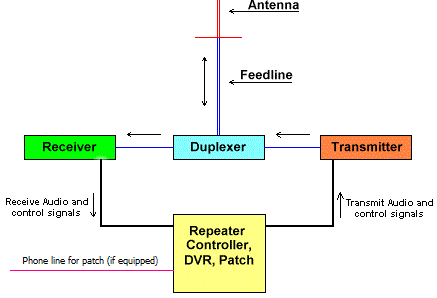 |
|
My favorite subject.
Repeaters are fairly simple in operation, but it can get complex very quickly. Basic Repeater Theory (duplex) For a basic repeater you need 3 main components. Some sort of receiver, a controller, and a transmitter (see ar-jedi's post above for visual aid). When a signal is received on the receiver, the controller acknowledges it's present and in turn key's the transmitter which re-transmits the received signal. Receivers can be stand alone, or in a mobile radio (that radio does nothing but receive however). Transmitters can be standalone or based off a mobile radio (the radio's only job in life is to transmit, not receive). Sometimes you come across more modern, full-duplex modules (has a receiver, transmitter, and controller in one box). Most amateur stuff is surplus commercial gear that didn't qualify for narrow banding. Repeaters can have two antennas, or a single antenna with a duplexer (split antennas, one for the receive frequency and one for the transmit frequency). It's rare to see multiple channel repeaters with one antenna (the equipment to pull it off is expensive) though there are some multi-channeled systems out there (I'm not sure of any running on either ham or GMRS). Have unanswered questions, feel free to ask away. |
|
Quoted:
The repeaters I've rented were on commercial freq's in the 460-470MHz range. They didn't have a front end that appeared to have a user selectable frequency set by a keypad or knob or anything. Because you have a precision tuned electro-mechanical device (a duplexer) as the critical connection between your antenna, receiver and transmitter, which would require expert service to realign to a new frequency. You have much to learn about repeaters. |