


Posted: 8/3/2014 6:44:14 PM EDT
|
I'm going to be off of work for probably another 2-3 months so I'm looking at learning code. Finished up my licenses so thinking of getting it out of the way now. What type of key or paddle or whatever would be good for a beginner? My right index finger has a condition they refer to as "trigger finger" oddly enough. It ocassionaly locks closed. Not sure if one type would help that over the other. I also sitll have limited feeling in my hand which about the only sympton left. So not really looking to be a speed demon but at least learn code enough to tell what is being transmitted and possibly do some if I can. You have no idea how hard it is to fill time when you are someone who is used to working sometimes 7 days a week 12-16 hours a day and everyone you know is located 300 miles or so away. Thanks for any advice. I had saved a few websites mentioned here before on learning code techniques and lessons, but didn't really have any insight on what to use to get started. If I don't get started learning code you guys will have me out building a new tower or installing a yagi/rotator or another vertial radial field or whatever. At least I can learn code in the AC. |
|
For a "straight key" you don't use your finger, you grip the key knob between your thumb and middle finger, with the index finger on top. Better, a "Navy" type knob.
Some rest the index finger and ring finger on each side of the knob, on the lower disk of the "Navy" style knob, with middle finger on top of the knob. I'm using a early 1900's railroad telegraph key, a J. H. Bunnell made for Signal Electric. Same key sold as J. H. Bunnell, Western Union, etc. 
(I restored this key and mounted it on a walnut base.) But I'm far from an expert telegrapher, just learning myself. But I'm a long time collector of railroad telegraph equipment. |
|
There are lots of websites to learn receiving code. Just search and start learning to receive over your PC speaker, or smart phone, or whatever.
I suggest learning to send with the old fashioned straight key. Learn the proper timing, and you should have no problem running one, especially at beginner speeds. You can make one out of junk or buy anything from cheap to super nice online. Once you get too fast for the straight key, then get a paddle. If your finger locks closed you're set for CW! There a condition called glass arm and it can happen if you send too long with a straight key. 
ETA: Too bad someone tried to clean it a bit too much. http://forums.qrz.com/showthread.php?445512-1937-ADMY-British-Admiralty-7681-Morse-Telegraph-Key |
|
I am very new to code myself, been working on being proficient for about a year now. Based on the issue with the finger, my recommendation would be to skip the straight key and go to a iambic. Single paddle or dual. I recently bought a Bulldog keyer, and I am happy with it for the price, but annoyed the idea didn't occur to me. In any case you can operate this type of key just doing left/right for dit/dah or you can use the squeeze feature to alternate if your radio supports that feature. This seems like a great idea if your finger has limited mobility, as you are literally bumping the levers left or right, no joint movement at all really. DO NOT start trying to learn code at a lesser speed than 15-20wpm. I did not heed this advice and I am spending extra effort relearning the sounds at the higher speeds. No matter how slowly you pick it up, pick it up at the higher speeds. The experts will be along shortly to give you serious advice, as a n00b that's all I've got. |
|
Quoted: There are lots of websites to learn receiving code. Just search and start learning to receive over your PC speaker, or smart phone, or whatever. I suggest learning to send with the old fashioned straight key. Learn the proper timing, and you should have no problem running one, especially at beginner speeds. You can make one out of junk or buy anything from cheap to super nice online. Once you get too fast for the straight key, then get a paddle. If your finger locks closed you're set for CW! There a condition called glass arm and it can happen if you send too long with a straight key. ETA: Too bad someone tried to clean it a bit too much. http://forums.qrz.com/showthread.php?445512-1937-ADMY-British-Admiralty-7681-Morse-Telegraph-Key Yeah it's not really that bad. You just straighten it back out. Part of it comes from running a digitizer puck for 25 years. You would think when you get something called trigger finger it would be cool. It's not really limited mobolity, it just sticks for spolit second closed. Since I havent' done code I don't know how often you are closing your finger to begin with. May not be an issue. |
| With paddles you don't really move your thumb or finger all that much, it's just a slight movement. You can even send without moving thumb or finger at all and just move your hand back and forth. Trying to learn with a straight key is sadism. Most rigs have keyers built in, so just get a paddle type key and you're in business. |
|
I bought a Vibroplex - it was made in 1962.
http://www.hamradio.com/detail.cfm?pid=H0-002524 I would sell it for what I have in it plus the cost of shipping. I would give you a straight telegraphers key if you wanted to learn, but I doubt if you would waste your time when you can buy a paddle that does the dits and dah's for you and all you have to do is wiggle it. As far as speed goes, unless the sender is sending at 20 wpm - you can't listen to the words, because it is so slow, you will get bored and not want to listen to it. The best thing to do is to tune into the ARRL broadcasts and listen. Then tune into the morning rag chews and listen. Then find an Elmer - if such a thing still exists in your neighborhood and con the person into teaching you how to send and receive code. A person with a good memory can memorize all 26 letters of the alphabet in about a week or two, but putting dah di dah together and knowing it is the letter K is always easier said than done. I use a lot of word association because my parents were smart azzes and they always had a nasty come back to any question I ever asked. La Di Dah Di Dah - was a famous one... Di Di Di Dah - World War II movies - the Letter V for Victory. We actually have a lot of CW incorporated into our language and culture. Everyone says Di Di Di Dah Dah Dah Di Di Di - means S O S ... E I M S T are all Dee's or Dah's! Numbers - one Dit per a number to 5 and then one Dah per a number 6 - 9 .. You can almost turn it into a game... When you get really good, you will be able to send code faster than a kid can text message. There is no real reason to learn Morse Code anymore! The digital modes are more secure, faster, more reliable, and you can send blocks of text at a time the whole way to complete documents or pictures. I would have to agree though that big beam antenna's, large dipoles and high perches for them to hang from is more important then learning CW... The last thing you should buy is an amplifier - since amplifiers do not do anything, or do it well. You can get a much bigger bang for your buck with a hi gain antenna, low loss coax and a quiet transceiver with a decent tuner. That means that a mobile isn't a really good radio to buy as a good first radio. The passing the test part is not a big deal, since they already give you all the questions and the answers... It's like shooting fish in a barrel! It doesn't prove anything except that you have a good memory... The actual hands on stuff is what teaches you how to be a good ham and the contesting, building of your own station and equipment and knowing how to program your own radios and connect radios to different devices and being able to do this even in the middle of a rain storm or a emergency shelter is a prime example of being a Class A operator, not the score you got on the test or how many contacts you made with your handheld on a linked repeater system. Most of all - HAVE FUN! If it isn't F U N -- you aren't going to enjoy doing it! Some people never makes it past the Net Stage, where they check in on nets and hang out and talk like they were on the CB radio or talking on a telephone. If that was all you wanted to do - you just wasted several weeks of your life taking tests and buying radios and learning stuff. There is a whole neat world out there, Kings and Princes and Royalty and Educated people that are sometimes willing to talk your ears off if you let them. Sometimes its just a peanut farmer from Georgia or a airline pilot from Bulgaria.. You never know who you might meet on the radio... |

|
Quoted:
Based on the issue with the finger, my recommendation would be to skip the straight key and go to a iambic. Single paddle or dual. -snip-. In any case you can operate this type of key just doing left/right for dit/dah or you can use the squeeze feature to alternate if your radio supports that feature. This seems like a great idea if your finger has limited mobility, as you are literally bumping the levers left or right, no joint movement at all really. DO NOT start trying to learn code at a lesser speed than 15-20wpm. I did not heed this advice and I am spending extra effort relearning the sounds at the higher speeds. No matter how slowly you pick it up, pick it up at the higher speeds. Quoted:
Based on the issue with the finger, my recommendation would be to skip the straight key and go to a iambic. Single paddle or dual. -snip-. In any case you can operate this type of key just doing left/right for dit/dah or you can use the squeeze feature to alternate if your radio supports that feature. This seems like a great idea if your finger has limited mobility, as you are literally bumping the levers left or right, no joint movement at all really. DO NOT start trying to learn code at a lesser speed than 15-20wpm. I did not heed this advice and I am spending extra effort relearning the sounds at the higher speeds. No matter how slowly you pick it up, pick it up at the higher speeds. This. Note bold text above. Quoted:
With paddles you don't really move your thumb or finger all that much, it's just a slight movement. You can even send without moving thumb or finger at all and just move your hand back and forth. Trying to learn with a straight key is sadism. Most rigs have keyers built in, so just get a paddle type key and you're in business. And this. As to which paddle, it doesn't make a difference. Only suggestion is to not spend a fortune on a Bengali, get a good serviceable one. I'm using a Kent Twin Paddle. Learned on it and have not had any reason to change. For a keyer I like the K1EL Winkeyer USB. You can program it so that certain CW strings are just a button push away. Very handy in busting DX pileups when you have to send beyond your physical capability. For a lesson plan download Zen and the Art of Radiotelegraphy. Stupid name but a solid lesson plan. Plug the lessons into Just Learn Morse Code and get to work. Dirty secret is that copying is harder than sending. So along with the lessons start copying the ARRL Code Practice Transmissions. 20 minutes a day for a month and you'll be on the air. |
|
Quoted:
Ok I guess I need to research paddles. Anyone code with the their non dominant hand? Sounds like it would take 10x as long to learn. When I learned basic sign language I did it with my non-dominate hand. IDK why, but it was easier. As far as trigger finger goes, my father had a problem with that in the past. His doctor told him to wear one of those finger splints on the affected finger at night for about a week. He did and he said in his case it pretty much alleviated the problem. |
|
Quoted:
If you are just starting it won't make a difference. It's all new to you at that point. Quoted:
Quoted:
Ok I guess I need to research paddles. Anyone code with the their non dominant hand? Sounds like it would take 10x as long to learn. If you are just starting it won't make a difference. It's all new to you at that point. I did this because of an old injury, it did take quite a bit of work. The old timers advice to send a page of text out of the news paper still holds if you want to be good at it. It's worth it to be able to send with one hand and write with the other. 73, Rob |
|
Quoted:
Kent TP-1 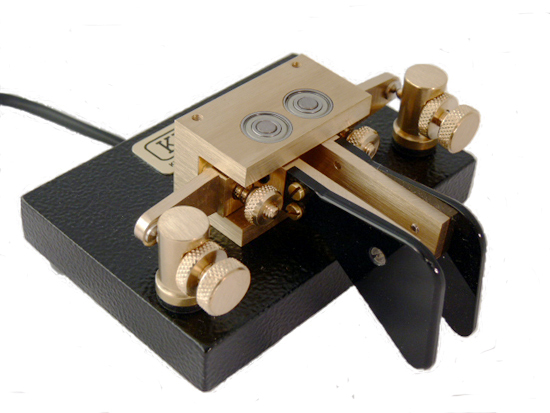
Best bang for the Buck THIS I never could send with a straight key I bought a beater paddle from the hamfest and never looked back I started with the Gordon West tapes, now on CDROM, and then slowly started calling CQ on 40m less than a month later, I passed the 13wpm FCC test for both my General and Advanced license |
|
Quoted:
I am very new to code myself, been working on being proficient for about a year now. Based on the issue with the finger, my recommendation would be to skip the straight key and go to a iambic. Single paddle or dual. I recently bought a Bulldog keyer, and I am happy with it for the price, but annoyed the idea didn't occur to me. In any case you can operate this type of key just doing left/right for dit/dah or you can use the squeeze feature to alternate if your radio supports that feature. This seems like a great idea if your finger has limited mobility, as you are literally bumping the levers left or right, no joint movement at all really. DO NOT start trying to learn code at a lesser speed than 15-20wpm. I did not heed this advice and I am spending extra effort relearning the sounds at the higher speeds. No matter how slowly you pick it up, pick it up at the higher speeds. The experts will be along shortly to give you serious advice, as a n00b that's all I've got. I will emphasize this also. Don't learn it slow. I learned it at 5wpm and that was a waste of time. The letter L sounds different at 5wpm, 10wpm, 15wpm, 20wpm, etc. So if you learn at 5, then 10, then 15, 20, then you really learn the whole alphabet 4 different times. Just start somewhere around 20wpm and use character spacing if it is too fast for you. I spent way too long focusing on learning to recognize random letters and numbers when I should have been focusing on learning to form words in my head from those characters. Don't do random for too long. Learn the characters and then learn words and sentences as soon as you can. Learn from other's mistakes when you can. It will save you tons of time. ETA: If you have Apple devices, CWText is a great app. |
I have this one.

It's great. It took a month to get here from China, but it rocks. |
|
http://electronicsusa.com/mk.html
$30 if you want to try a paddle 

|
|
Quoted:...So, you think I should switch to the bug?... Why be a one-trick pony? Learn 'em all! I have a Nye Viking Navy knob straight key, a 1922 Vibroplex bug, and a Bencher BY-1 sitting side by side on my desk and can switch between them mid-sentence. The ARRL website has W1AW code practice files available for downloading: http://www.arrl.org/code-practice-files |
|
Do a little looking around and you can probably find a useable straight key for a reasonable price. Keep in mind that it's just a mechanical device, so use that mindset when you examine it, looking for excessive rust, bent components, or missing parts. The most important thing is to examine the contacts. Open them up and look closely for signs of pitting, corrosion, or having been filed. Like a relay, contacts are plated with highly conductive metals that are resistant to corrosion. One swipe with a file or emery cloth can destroy it. If the knob is missing, a small drawer pull can be substituted, or you could order a Navy knob from Nye Viking.
This is one to be wary of: 
Notice the ball bearings. Bad idea! The balls re too large, there are too few of them, and the conical points they contact are not hardened metal. They tend to dimple it if overtightened and make for erratic sending. Note also how thin the metal of the armature is. It has too much give for all but the most delicate (dare I say limp-wristed?) touch. If it hasn't been abused, it will get you started, though. Unless you're going to have a transceiver with you, you're going to need a code practice oscillator. Some of the vendors will probably have kits or pre-assembled units. If you purchase a set of paddles, you'll need a keyer to generate the dits and dahs. If you get iambic paddles, the keyer will have to have an iambic mode to take advantage of them. Most do, a few don't. |
| If you have an older Vibroplex, you can find the year it was made by clicking HERE. |
|
Quoted:
THIS Me, too. The Kent TP-1 rocks! 
|