


Posted: 6/10/2013 12:22:04 PM EDT
|
I have been neglecting the installation of a proper grounding system for far too long. It is partially due to the fact that the whole back side of the house (where my station is located) has a concrete patio preventing me from running copper strap to bond ground rods there. Honestly, I have been using an unbonded ground rod for an RF ground in a window well right behind my station, where I bring in my coax as well. (Yes I know this is bad and aim to change it)
Currently I only run a dipole on HF and just completely disconnect it from everything outdoors if a storm comes. I plan to bring the coax in at the window well near the electrical box soon, and install a KF7P box outside, and bond it to the main ground. Here is a link to the KF7P box. http://www.kf7p.com/KF7P/Welcome.html The main problem I am facing is how to get an adequately grounded ground bus at my station which is 20-25 feet from where the coax will come in near the electrical box. This is the shortest length I can get between my station and the entrance panel... Most Important Questions I need answers to: 1. Would it be acceptable for me to clamp one end of a 20-25 foot length of braided ground strap to the ground wire between the ground rod and service panel, and run the other end to a ground bus at my station? 2. If I did this would I be at risk of standing wave on the strap at certain frequencies or does the fact that it is braided sufficiently prevent this? 3. Is there a better option that doesn't require cutting into the concrete behind the house for copper bonding strap? (this is not an option) Any and all suggestions will be greatly appreciated. No need to tell me what I am doing wrong currently (I already know it is basically all wrong) Here is a picture of the layout of the basement and house. 
|
Check out these threads on the topic, strictlyb. I also think Homeslice just put in that same grounding box recently. 
ARCHIVED THREAD - Station Grounding / Lightning Protection Pic Thread Added a Couple I.C.E. Arrestors to Station Ground / Lightning Protection Box Tell me about installing a good ground system |
|
Quoted:
Check out these threads on the topic, strictlyb. I also think Homeslice just put in that same grounding box recently.
ARCHIVED THREAD - Station Grounding / Lightning Protection Pic Thread Added a Couple I.C.E. Arrestors to Station Ground / Lightning Protection Box Tell me about installing a good ground system I have read through the threads and some stuff from other sites, some of which confused me more regarding my own situation... I posted the thread because it seems most hams put a bonded ground rod right outside from their station which I can't do... and I didn't find a specific answer to my biggest concern which whether it is acceptable to use a 25 foot braided strap from the main ground at the panel to my ground bus at the station. eta: in my research there is conflicting concensus on whether using a longer ground strap is effective. I am also wondering if anyone has a suggestion I haven't thought of. |
|
you need to bond your station, your VHF/UHF antennas and your extra ground rod to the main service ground on the left side of you pic.
I would use the thickest heaviest gauge wire you can find. It doesn't have to be braid good info here... http://www.w8ji.com/house_ground_layouts.htm 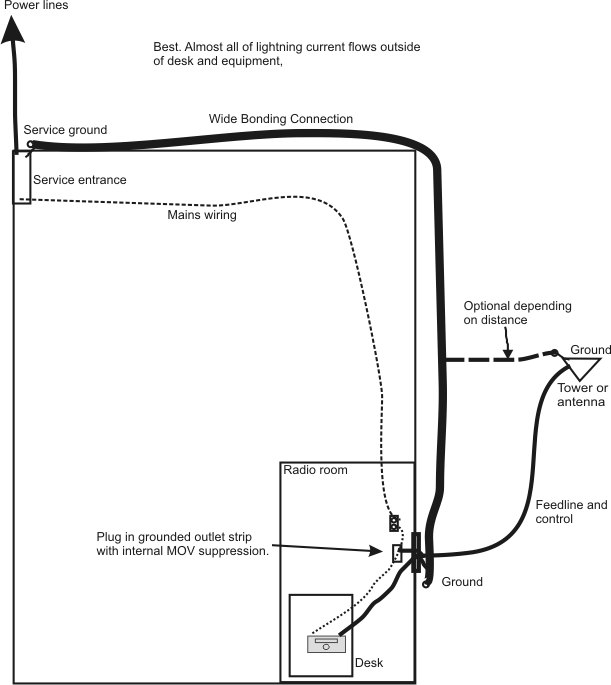
|
|
Quoted:
Most Important Questions I need answers to: 1. Would it be acceptable for me to clamp one end of a 20-25 foot length of braided ground strap to the ground wire between the ground rod and service panel, and run the other end to a ground bus at my station? Unnecessary. 2. If I did this would I be at risk of standing wave on the strap at certain frequencies or does the fact that it is braided sufficiently prevent this? Braiding is completely irrelevant. You are creating a ground loop however, and it's pretty pointless considering the coaxial cables that will presumably be running parallel to the ground strap. 3. Is there a better option that doesn't require cutting into the concrete behind the house for copper bonding strap? (this is not an option) Not understanding why you would consider cutting up concrete. Can't run a wire or strap on top of, next to, under or around the concrete? Any and all suggestions will be greatly appreciated. No need to tell me what I am doing wrong currently (I already know it is basically all wrong) Here is a picture of the layout of the basement and house. http://i42.tinypic.com/nee1d2.png How much grounding do you have on your tower and antennas? If you're talking about protection from a direct strike you need to be worried more about dissipating that energy versus all this attention to the house. Or what is the goal? |
|
Quoted:
you need to bond your station, your VHF/UHF antennas and your extra ground rod to the main service ground on the left side of you pic. I would use the thickest heaviest gauge wire you can find. It doesn't have to be braid good info here... http://www.w8ji.com/house_ground_layouts.htm http://www.w8ji.com/images/Grounding/Houseground-best.gif The VHF/UHF antennas are coming down tomorrow until I figure out what to do with everything else, and will probably be reinstalled on the other side of the house. I have no way of bonding the second ground rod because of the concrete patio, so I am ditching that rod, and hopefully able to remove it and put it maybe 20 feet out in the yard and bonded to the main ground. I have been on the w8ji site before and that is part of why I can not figure out what to do.... In all of those pics, and ones I see on here, there is a bonded ground rod directly outside from the station location. This I can not do because the entire back side of the house has a 12-18 inch thick poured concrete patio. So the best thing I can think of is running 25 or so feet of braided strap indoors from where the electrical box is to my station. |
|
Quoted:
This I can not do because the entire back side of the house has a 12-18 inch thick poured concrete patio. Which is an excellent ground conductor, far more effective than a ground rod, if you had some way to connect to it (bonding to rebar is the normal practice). |
|
how is the ground rod near your station getting to the desk ?
thru the basement window ? Can't you just run some thick wire around the perimeter of your house foundation from the electrical service ground, to the ground rod by your station ? Yep....Moving the V/U antennas to the west side roof would get them close to the service ground. |
|
Quoted:
No matter how well grounded the system, if the coax is connected to the radio when you get either direct or close lightning strike, your radios will likely be damaged. tell that to every TV station, Cell tower, commercial radio, etc. 
If you spend the money and follow the Motorola book, your equipment can survive repeated direct hits. ( money most of us don't have ) 
|
|
Quoted:
How much grounding do you have on your tower and antennas? If you're talking about protection from a direct strike you need to be worried more about dissipating that energy versus all this attention to the house. Or what is the goal? Not understanding why you would consider cutting up concrete. Can't run a wire or strap on top of, next to, under or around the concrete? All I have is a wire up in the trees, no tower, no grounding at all... I unplug it and throw the coax outside when storms are coming... Had a G5RV take a lightning hit last year and get blown to pieces with no other damage to house/station doing it this way. I guess what, I am looking for now just getting a basic safety ground before I can even think about lightning dissipation. When I read and see pics of grounding systems, I see where the bonding is done through digging trenches and such... and I have read people do it under ground to prevent standing wave on the ground wire. The concrete is super think (over 18 inches thick in some places and has rock under it so I couldn't go under it, and I never thought going over it could be a proper grounding option. |
|
Quoted:
how is the ground rod near your station getting to the desk ? thru the basement window ? Can't you just run some thick wire around the perimeter of your house foundation from the electrical service ground, to the ground rod by your station ? Yep....Moving the V/U antennas to the west side roof would get them close to the service ground. I guess I can run thick wire above ground along the foundation between the rods, I didn't think that was acceptable because I have read elsewhere "ground wires above ground can act as antennas" and such in this configuration. Honestly I have read so much conflicting stuff on grounds I am more confused than before I started looking into it. That is the plan is the V/U antennas which I am not really concerned about. |
|
Quoted:
Quoted:
How much grounding do you have on your tower and antennas? If you're talking about protection from a direct strike you need to be worried more about dissipating that energy versus all this attention to the house. Or what is the goal? Not understanding why you would consider cutting up concrete. Can't run a wire or strap on top of, next to, under or around the concrete? All I have is a wire up in the trees, no tower, no grounding at all... I unplug it and throw the coax outside when storms are coming... Had a G5RV take a lightning hit last year and get blown to pieces with no other damage to house/station doing it this way. I guess what, I am looking for now just getting a basic safety ground before I can even think about lightning dissipation. When I read and see pics of grounding systems, I see where the bonding is done through digging trenches and such... and I have read people do it under ground to prevent standing wave on the ground wire. The concrete is super think (over 18 inches thick in some places and has rock under it so I couldn't go under it, and I never thought going over it could be a proper grounding option. Bonding the ground system is to equalize the ground potentials, provide a path for currents to flow OUTSIDE the building so that you don't have currents flowing THROUGH the building. If you sink a few ground rods around the perimeter of the structure along the bonding conductor you won't have any problems with the length. Get the little inexpensive 4 foot rods and put them in every 8 to 10 feet. Big chucks of concrete in contact with the ground are fantastic ground conductors, if only they'd been connected before the concrete pour. If you're relying on the station ground to dissipate lightning energy you're going to be in trouble. In some ways putting in a lot of grounding around the house can be a negative, since that will become the lowest impedance path to ground (your house) if you don't provide some other path. You want the lightning energy to go somewhere else, not toward your house. People generally have too much emphasis on "station grounds" and making sure their radios have direct low impedance ground connections when the opposite is true - the antenna/tower and surge suppression need the low impedance ground systems. Quoted:
I guess I can run thick wire above ground along the foundation between the rods, I didn't think that was acceptable because I have read elsewhere "ground wires above ground can act as antennas" and such in this configuration. Any conductor is an antenna, including guttering, flashing, soffits, downspouts, roof ridge vents, and all the other wiring in your house. |
|
Quoted:
Bonding the ground system is to equalize the ground potentials, provide a path for currents to flow OUTSIDE the building so that you don't have currents flowing THROUGH the building. If you sink a few ground rods around the perimeter of the structure along the bonding conductor you won't have any problems with the length. Get the little inexpensive 4 foot rods and put them in every 8 to 10 feet. Big chucks of concrete in contact with the ground are fantastic ground conductors, if only they'd been connected before the concrete pour. If you're relying on the station ground to dissipate lightning energy you're going to be in trouble. In some ways putting in a lot of grounding around the house can be a negative, since that will become the lowest impedance path to ground (your house) if you don't provide some other path. You want the lightning energy to go somewhere else, not toward your house. People generally have too much emphasis on "station grounds" and making sure their radios have direct low impedance ground connections when the opposite is true - the antenna/tower and surge suppression need the low impedance ground systems. Quoted:
I guess I can run thick wire above ground along the foundation between the rods, I didn't think that was acceptable because I have read elsewhere "ground wires above ground can act as antennas" and such in this configuration. Any conductor is an antenna, including guttering, flashing, soffits, downspouts, roof ridge vents, and all the other wiring in your house. The concrete was poured in the 70's so no ground rods can be connected before it was poured. I am not trying to dissipate lightning, just have an RF ground so my gonset mic doesnt bite me on key down anymore, and to have a safety DC ground since I use a lot of equipment with internal HV power supplies. So it is acceptable for me to run a wire along the back side of the house where the coax is in this picture to bond the two grounds together? 
|
|
Quoted:
Quoted:
So it is acceptable for me to run a wire along the back side of the house where the coax is in this picture to bond the two grounds together? Absolutely. You are already running a ground conductor there (the coax). well that helps me out a lot, i didnt know that was acceptable, but it is starting to make sense... as you can tell i know less about proper grounding than i should i guess step 1 for me is going to be bonding those two rods together now that i realize i can connect them above ground... i need to pick up some thick wire to do that with this week, i think i will grab a few extra ground rods when i do it as well. thanks for the replies everyone |
|
Quoted:
i need to pick up some thick wire to do that with this week, i think i will grab a few extra ground rods when i do it as well. Definitely add a few ground rods, and I was serious about the 4' rods. 8' are unnecessary for this kind of stuff, if 8' rods are all you can get you're better off cutting them in half to make two 4' rods. |
|
Quoted:
A hammer drill sure makes it easy to put the rods in. Luckily my area has very thick soil with clay beneath it (which holds water a few feet below the surface for a good ground)... I drove an 8 foot rod with a ladder, IPA, and sledge hammer without any problems.... i think i am going to add three 4 foot rods north, south, and west of where the service panel is... and probably one more eventually if i get the rohn mast and 10/15/20 beam i am thinking about. ETA: one thing I still cant decide on is whether to bring in the coax where it is now (which means it is lying on the back porch), or by the service panel on the side of the house. |
|
Quoted:
Quoted:
Quoted:
Any idea how to get effective grounding in an apartment building? What kind of outside antenna setup do you have? What floor are you on? 3d floor High rise grounding... single point ground and bond to the building structure/ground at the same level as the equipment. |
|
Quoted:
Quoted:
Quoted:
Quoted:
Any idea how to get effective grounding in an apartment building? What kind of outside antenna setup do you have? What floor are you on? 3d floor High rise grounding... single point ground and bond to the building structure/ground at the same level as the equipment. Soo, wrap a strap around the gas line leading to my range? |
|
Quoted:
Quoted:
Quoted:
Quoted:
Quoted:
Any idea how to get effective grounding in an apartment building? What kind of outside antenna setup do you have? What floor are you on? 3d floor High rise grounding... single point ground and bond to the building structure/ground at the same level as the equipment. Soo, wrap a strap around the gas line leading to my range? I'm guessing that's humor, but no, you should never connect a ground to a gas line. |