


Posted: 1/27/2013 6:25:25 AM EDT
|
Studying my code to learn CW, any ideas for a straight key to practice and then use for sending? Most would be outdoors with my FT-817. Tks in advance.
|
|
I never could send worth a crap with a straight key.
I bought an old heathkit paddle and that worked a lot better for me. 
later, I got a BENCHER BY-1 and recently bought a KENT Iambic. 

. with a paddle, when you push it one direction, it sends out perfect dits....when you push it the other direction...perfect dahs |
|
I've never tried these...but they are popular with QRP. http://electronicsusa.com/mk.html  |
|
Quoted:
This.
Just buy a lambic... Old school thinking is to learn with a straight key then once you learn to send perfect code then you upgrade to paddle / iambic. Totally backwards. Get an iambic first. Learn with that and your learning curve will be shorter and you'll be sending good code in a hurry. BTW: My key is a Kent Twin Paddle also. Your rig may have a keyer built in. If not or you want to use an external keyer I highly recommend the K1EL WinKeyer USB. |
|
Quoted:
Quoted:
This.
Just buy a lambic... Old school thinking is to learn with a straight key then once you learn to send perfect code then you upgrade to paddle / iambic. Totally backwards. Get an iambic first. Learn with that and your learning curve will be shorter and you'll be sending good code in a hurry. BTW: My key is a Kent Twin Paddle also. Your rig may have a keyer built in. If not or you want to use an external keyer I highly recommend the K1EL WinKeyer USB. I am 99% positive that the 817 does indeed have an internal keyer. The Begali traveler is a great choice. it is expensive, but there is no replacement for quality. Just spend the extra coin for the metal finger pieces. |
|
Easier means not having to make the transition from a straight key to a set of paddles but rather learning the paddles from the beginning. A 'keyer' is the circuit inside the radio that makes the basic morse characters, dits and dahs, FA mind you, that are combined into words. Make no mistake, morse code requires much more dedication than most are interested in doing. The good news is that you can start with a minimum of knowledge and work on improvement while nobody you talk to will let it bother them. Even experienced morse ops are glad to help a newbie out. HTH 73, Rob Palm Paddles |
|
Quoted:
Easier means not having to make the transition from a straight key to a set of paddles but rather learning the paddles from the beginning. A 'keyer' is the circuit inside the radio that makes the basic morse characters, dits and dahs, FA mind you, that are combined into words. Make no mistake, morse code requires much more dedication than most are interested in doing. The good news is that you can start with a minimum of knowledge and work on improvement while nobody you talk to will let it bother them. Even experienced morse ops are glad to help a newbie out. HTH 73, Rob Palm Paddles Very true. I just did a QSO last night with a friend who is trying to learn CW. 99% of CW ops are thrilled to share their passion. The QSO I had last night was at 8 wpm, which was actually kind of fun, but challenging for someone used to going at it above 30 wpm. |

|
Quoted:
I've never tried these...but they are popular with QRP. http://electronicsusa.com/mk.html  http://www.youtube.com/watch?v=cqYq__jjJfI http://www.youtube.com/watch?v=cqYq__jjJfI
+1 If you're looking to stash the key or paddle in a ruck, get one of these. They're not rugged, but their construction is such that you don't have to worry about something getting out of adjustment –– cause there IS no adjustment. 
They're fine for what they are if you're packing them for portable use. There are straight keys out there that would be rugged enough (like J-38's) but still bulky. Might as well get the Whiterook iambic paddle (MK-44), wrap in some thin foam wrap or bubble wrap and stash it. Dremel a couple slits in the base plate and run a strap through for a DIY leg strap. Or buy his. Or just hold it still with your non-sending hand. All that to say, you probably want a paddle that is suitable for good desktop use while learning. I'm very happy with my K8RA paddle (I have a P-2). They've gone up in price (like everything else), but you can still get a P-1 for $95. P-1. Pretty much all modern radios have built-in keyers. You need a keyer in order to use a paddle (single or dual lever). Straight keys (like my avatar) and Bugs don't need a keyer since you mechanically form the dits and dahs. |
|
Quoted:
Looking to spend less than $100, need something I can put in an ammo can or a ruck with the radio. I have always looked at straight keys, but you people seem to be of the opinion that paddles are better/easier? And for my next question, what is a "keyer"? Iambic paddles are really just ( odd shaped) momentary switches. The Keyer is a circuit that takes these left and right inputs and turns them into dits and dahs most newer HF rigs have a built in keyer circuit and a menu determines if you want to use a straight key or paddle. most can also reverse the dit and dah sides of the paddle they also adjust the speed in words per min. |
|
This is a great keyer if you just want to practice "off-air" or have an old rig without a built-in keyer.
http://www.hamgadgets.com/index.php?main_page=product_info&products_id=89 

|


|
Quoted:
Looking to spend less than $100, need something I can put in an ammo can or a ruck with the radio. One problem with small keys is that they slide around during operating. Not a good thing. What I like about this one is the magnets to attach it to a ferrous surface. That ammo can would work perfect. I have always looked at straight keys, but you people seem to be of the opinion that paddles are better/easier?
Paddles are easier. With a straight key it's entirely up to you to get the spacing correct. Each dash is 3 dits long, A dit pause between letters. A dash pause between words. With paddles the keyer does the work sending perfect spacing every time. As a new CW op you have enough on your plate just copying what you hear then sending the response. Make it easy on yourself and go with paddles. Get on YouTube and search for iambic key or iambic CW. Many demos on how paddles work and how much easier it is than a straight key. |
See if you can find one of these: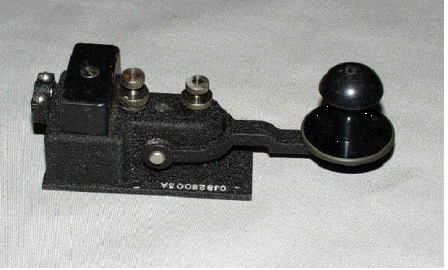 Military Naval Flameproof keys xxx-26003A Type Then get one of these when you go trekking outdoors: 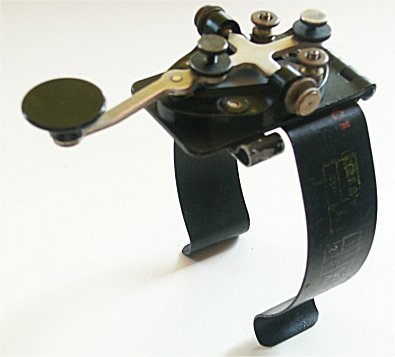 J37 key with leg mount making it a J45 |
|
Quoted:
This is a great keyer if you just want to practice "off-air" or have an old rig without a built-in keyer. http://www.hamgadgets.com/index.php?main_page=product_info&products_id=89 http://www.hamgadgets.com/images/DSC_0050.JPG http://www.hamgadgets.com/images/PK-Plus-Cabinet-4.jpg Yep, I'm a brand new CW guy, and I highly recommend getting some type of keyer that is separate from your radio. The reason I say that, is because it makes practicing very easy. The Pico keyer looks great, and there are a bunch of other keyers (kits and complete) available, too. Check out the reviews on eHam.com. I have my paddle connected to a CMOS4 keyer. Since the keyer is "always on", all I have to do is sit down and practice sending some code. I don't have to fire up the radio, or flip any switches. Just sit down and start keying. And I do that every day. I sit down for a few minutes, practice my CW, and then get back to whatever I was doing. Doing that several times a day is easy. And the easier it is to practice, the more you will enjoy it. 
|
|
Quoted:
Quoted:
This is a great keyer if you just want to practice "off-air" or have an old rig without a built-in keyer. http://www.hamgadgets.com/index.php?main_page=product_info&products_id=89 http://www.hamgadgets.com/images/DSC_0050.JPG http://www.hamgadgets.com/images/PK-Plus-Cabinet-4.jpg Yep, I'm a brand new CW guy, and I highly recommend getting some type of keyer that is separate from your radio. The reason I say that, is because it makes practicing very easy. The Pico keyer looks great, and there are a bunch of other keyers (kits and complete) available, too. Check out the reviews on eHam.com. I have my paddle connected to a CMOS4 keyer. Since the keyer is "always on", all I have to do is sit down and practice sending some code. I don't have to fire up the radio, or flip any switches. Just sit down and start keying. And I do that every day. I sit down for a few minutes, practice my CW, and then get back to whatever I was doing. Doing that several times a day is easy. And the easier it is to practice, the more you will enjoy it.
Just to muddy the waters more... Most all Yaesu radios (op says he has an 817) have a way to disable the "break-in" feature so you can practice without broadcasting. Typically if I don't operate for a week or so or to get ready for a contest, I'll send a few pages of QST at various speeds. Just to warm up my fist and to get my brain working effectively again 
|
|
Quoted:
I've never tried these...but they are popular with QRP. http://electronicsusa.com/mk.html  http://www.youtube.com/watch?v=cqYq__jjJfI http://www.youtube.com/watch?v=cqYq__jjJfI

|
|
Quoted:
I use my Palm paddle on a small piece of 1/4 inch steel plate that has been de-burred, painted and has feet glued on to it. The paddle is small and does take a more careful touch. HTH 73, Rob A lot of new CW operators do not have a soft touch at first. I know I did not. I would get excited about a contact, or get "stuck" trying to figure out what letter I was trying to send, and I would hit the paddle even harder. It takes some practice, but after a while your touch will get lighter. |
|
Quoted:
Quoted:
I use my Palm paddle on a small piece of 1/4 inch steel plate that has been de-burred, painted and has feet glued on to it. The paddle is small and does take a more careful touch. HTH 73, Rob A lot of new CW operators do not have a soft touch at first. I know I did not. I would get excited about a contact, or get "stuck" trying to figure out what letter I was trying to send, and I would hit the paddle even harder. It takes some practice, but after a while your touch will get lighter. WORD! My main paddle is the Kent twin. I actually got it cheaper from Waters & Stanton in the UK than it was here in the states. 73, Rob |
|
Chinese Army key
You can grab the cord and beat the shit out of someone with it and then plug it in and send out an SOS. |
|
Most all Yaesu radios (op says he has an 817) have a way to disable the "break-in" feature so you can practice without broadcasting.
I just realized I could do this with my TenTec R4030 by setting the frequency outside of an amateur band (it has a built-in keyer).
Another key to consider (I'm thinking of ordering one of these): Porta Paddle Porta-Paddle Base Porta-Paddle Leg Mount I haven't been able to find a comparable base for the Whiterook paddle. |
|
Another key to consider (I'm thinking of ordering one of these):
Porta Paddle Porta-Paddle Base Porta-Paddle Leg Mount I ended up ordering the above on 2/18, they arrived on 3/1. It took me about an hour (working slowly) to assemble the paddle. All I need now is a suitable cable.
|
|
My Vibroplex Cable Assembly arrived yesterday, so I finally got to play with my first paddle last night. This iambic keyer thing will take some getting used to, but I think I'm going to like it.
|
|
Second best paddle I have ever used... Next to my ~$400 Begali. If I had it to do over again, if probably buy the kent and put the extra coin into my K3 fund. |
|
AMEN! |
|
Quoted:
I've had a Bencher dual paddle for 6 month now and but get used to it. It's hard to adjust properly and there is nothing to absorb contact chatter. It was a waste of money.  My homemade single paddle keyer works much better. My homemade single paddle keyer works much better.It's wide as hell spacing is what would drive me crazy. It's hard to go QRQ with a paddle so wide. |
|
Quoted:
Anyone use a Vibroplex bug? I've never heard much good about them, seen quite a few complaints, but they still make them. However, they look interesting and intrigue me.... I want one and I'm still learning. Are they any good for beginners? A bug takes a huge amount of practice in order to wind up with evenly spaced characters, some can't be set for lower speeds and work well. Just be prepared to put some time in while learning the bug, the older OPs will appreciate it. Here is where to go for a new key. Don't be afraid to ask about a lower speed key, I ran a bug I got at a hamfest when I was working on my extra, while running a TS-440s/at, and the experienced OPs told me it was 'OK'. One of the best CW OPs I know runs an old MFJ outboard keyer to an older TS-450. 73, Rob |
|
Quoted:
Quoted:
I've had a Bencher dual paddle for 6 month now and but get used to it. It's hard to adjust properly and there is nothing to absorb contact chatter. It was a waste of money. My homemade single paddle keyer works much better.It's wide as hell spacing is what would drive me crazy. It's hard to go QRQ with a paddle so wide. Are you talking about the contact spacing, or the paddles ? I don't remember the bencher being that wide,.....but the KENT is a dream to adjust makes the Bencher seem like a rube goldberg device VERY HAPPY with the KENT 
|
|
I have a big collection of keys and paddles. Check out this one. I got it a couple years ago as a kit at Dayton. The favorite of most ops at field day. We all like it much better than the bencher. (I have 2 of them) http://www.eham.net/reviews/detail/4368 I did a review of it here on arfcom when I built it. Should be in the archives somewhere. |
|
Quoted:
I have a big collection of keys and paddles. Check out this one. I got it a couple years ago as a kit at Dayton. The favorite of most ops at field day. We all like it much better than the bencher. (I have 2 of them) http://www.eham.net/reviews/detail/4368 I did a review of it here on arfcom when I built it. Should be in the archives somewhere. I was looking at that one (online) the other day How is it with the finger pieces at an angle? |

 Win a FREE Membership!
Sign up for the ARFCOM weekly newsletter and be entered to win a free ARFCOM membership. One new winner* is announced every week!
You will receive an email every Friday morning featuring the latest chatter from the hottest topics, breaking news surrounding legislation, as well as exclusive deals only available to ARFCOM email subscribers.