


Posted: 6/23/2011 7:49:53 PM EDT
| And I will try and stop bugging you guys. I plan on getting a Yaesu 857d or something similar. I think Im going to start out putting a dual band antenna up 2m/70cm. I want to eventually expand out to other bands. How do I add on to my original antenna to get other bands? I want to avoid putting up multiple masts or run wires through the air for dipoles. Wife would flip! Im putting this Dual Band on a tripod mount on my garage. Also I need to start getting a shopping list going. Can someone walk me through everything I will need from Antenna to radio? Also any install start to finish how to posts would be great. Thanks guys. |
|
I don't know that you're going to find a 2/70 vertical (assuming this is what you're looking at) that will also be suitable for the HF bands. They do make some that are 6/2/70, so that would get you one more band, but likely at the cost of performance on 2/70. For HF, you'll need to put something larger up in the air, AFAIK. Good luck, -Slice |
|
This Link will be of no use to you
I'm thinking I've seen vertical antennas in the catalogs that would do most HF freq (ahhh yes) , but not sure if there was one that went up to UHF/VHF....I'm a newbie so I'm no real help.... Eham Review |
|
Quoted:
I don't know that you're going to find a 2/70 vertical (assuming this is what you're looking at) that will also be suitable for the HF bands. They do make some that are 6/2/70, so that would get you one more band, but likely at the cost of performance on 2/70. For HF, you'll need to put something larger up in the air, AFAIK. Good luck, -Slice Ok, let me rephrase it a little. When I said I wanted to add on I didnt mean add on to the antenna itself. I meant branching off the mast that the dual band antenna is mounted to, if you can do that sort of thing. |
|
Quoted: Quoted: I don't know that you're going to find a 2/70 vertical (assuming this is what you're looking at) that will also be suitable for the HF bands. They do make some that are 6/2/70, so that would get you one more band, but likely at the cost of performance on 2/70. For HF, you'll need to put something larger up in the air, AFAIK. Good luck, -Slice Ok, let me rephrase it a little. When I said I wanted to add on I didnt mean add on to the antenna itself. I meant branching off the mast that the dual band antenna is mounted to, if you can do that sort of thing. your best bet will be separate antennas - they DO make HF verticals that you can put on a small tower, with your 2m/70cm vertical off a side leg if you'd like also though.... |
|
Quoted: Also if I use more than one antenna do I need a switch to move back and forth to whatever antenna I want to use? the 857 **should** have two outputs - one for HF/6 and one for 2M/70CM (I don't own one, someone should be here who can confirm) if you wanted to use a separate antenna on 6m you'd need an antenna switch for that but, for HF and 2m/70cm you'd be good to go
|
|
How about one of THESE? (you need to move the coax to the uhf/vhf output for 2 meter)
You don't need a switch. They just make life easier when switching antennas. |
|
Quoted:
And I will try and stop bugging you guys. I plan on getting a Yaesu 857d or something similar. I think Im going to start out putting a dual band antenna up 2m/70cm. I want to eventually expand out to other bands. How do I add on to my original antenna to get other bands? I want to avoid putting up multiple masts or run wires through the air for dipoles. Wife would flip! Im putting this Dual Band on a tripod mount on my garage. Also I need to start getting a shopping list going. Can someone walk me through everything I will need from Antenna to radio? Also any install start to finish how to posts would be great. Thanks guys. The 857, similar to my old 897, has two antenna connections on the back. One is for 2m/70cm. Run coax... as short as possible and as fat (big low loss stuff) as you can afford... to your 2m/70cm antenna. I have a B-Square Engineering J-pole, which has elements for both bands, up on top of the mast that supports the middle of my multiband dipole. This is the one I have, and it is omnidirectional, meaning no need for a rotator. And I can hit repeaters 40-50 miles away. http://www.b-squareengineering.com/jpole.htm Some other guys here have this one, a similar antenna: http://www.arrowantennas.com/osj/j-pole.html B-Square says their offset by 90 degrees of the third element improves radiation pattern. The other socket on the back of the 857 and 897 is for HF. Run coax from there to the feedpoint of your HF antenna. A simple dipole will work only one band. BUT you can put elements for several bands connected to the same feedpoint. Automatic switching, in effect, as any of the elements not resonant for the frequency you are working will be high impedance and almost out of the picture. There will be a little interaction, but that can be taken care of when you trim the antenna on each band. There are other multiband antennas, such as the Super Loop 80, or other designs, such as the "Windom" or Offset Center Fed Dipole (OCF Dipole). Here's a guy that did just what I'm talking about: http://www.hamuniverse.com/ae5jumultibanddipole.html |
|
Quoted:
Quoted:
Also if I use more than one antenna do I need a switch to move back and forth to whatever antenna I want to use? the 857 **should** have two outputs - one for HF/6 and one for 2M/70CM (I don't own one, someone should be here who can confirm) if you wanted to use a separate antenna on 6m you'd need an antenna switch for that but, for HF and 2m/70cm you'd be good to go I have an 857. Your answer is correct. There IS a device that will allow both HF/6m and 2m/440 outputs to go into one coax line, so you can use a single screwdriver antenna for all bands (I had a ATAS antenna on my car). |
|
Quoted:
How about one of THESE? (you need to move the coax to the uhf/vhf output for 2 meter) You don't need a switch. They just make life easier when switching antennas. Wouldnt I have to get up on my roof all the time changing positions of the antenna, or alter positions on the coil for different bands? I remember seeing a write up of that somewhere. Could be wrong. If I would have to get up there that would suck doing it a lot. Not to mention, not that Im trying to be a cheap ass but this is the time of piss poor economy. Dont need something cheap but would like to do things right but cheaply as possible. I want to grow into the HAM hobby and not all at once. |
|
Quoted:
Also if I use more than one antenna do I need a switch to move back and forth to whatever antenna I want to use? No. Let's assume you have a 'fan dipole.' This is basically a setup where you have one feedline that serves several wire dipole antennas. Each antenna essentially 'isolates' itself from the other antennas because they do not resonate at the same frequency*. So your 10 meter signal (28 MHz) won't resonate on your 20 meter antenna (14 MHz). *One important exception: in the case of the 40 meter and 15 meter antennas: 15 meters (21 MHz) is the 3rd harmonic of 40 meters (7 MHz x 3 = 21 MHz). A 15 MHz signal will resonate on the 40 meter band. Many hams using a fan dipole will simply put up 10-20-40 meter dipoles, and let the 40 meter antenna double up as a 15 meter antenna. (The 3rd harmonic of a certain frequency is resonant on the fundamental frequency.) ETA Also, if you have a 'trapped' dipole or vertical antenna, you will not need a switch. If you have separate antennas of some sort, like separate verticals, you WILL need some way to discriminate between antennas. If you run more than one coax line from your shack, you can have a multi-antenna switch in the shack. And... don't worry about bugging us. We've all bugged someone else with our newbee questions, so we sort of "pay it forward" by helping other new hams. |
|
Quoted:
What kind of thick coax would be best. Im looking at roughly 75-100 ft run from the radio to the top of the roof(thats running along the ground in conduit, up the garage and to the antenna). Also how do you ground a dipole? For a 100 foot run for 2m/440 you'll probably want "RG-8" size coax, although actual RG-8 wouldn't be recommended. You want a higher quality low-loss cable like Times Microwave LMR-400 (preferably), or a least a low loss foam dielectric type. If you do go with LMR-400 or something similar, be aware that it will likely have a copper coated aluminum center conductor which does not take kindly to flexing to a tight bend radius, or repeated bending at all. Your conduit needs to have larger diameter curved sections instead of any 90 degree elbows for example. I don't really recommend the Cu/Al conductor cable for most HF dipole installations as the amount of cable flex and movement that is typical of those installations concerns me. If you find that you need or want a more flexible cable, an excellent choice is Belden 9913F7. Not to be confused with 9913, the "F7" model is a completely different product that is a very good choice for a flexible, high performance RG-8 size cable. That size coax is also good for your HF antenna run, but is not a practical advantage over a smaller, lower cost cable. Something in an "RG-8X" size cable would be adequate for that length of run for a 100w HF station. Times has LMR-240 cable in that size which is also an excellent product. There are lots of foam dielectric RG-8X size cables that would be adequate for an HF feedline for your setup. Part of the difference in cable is the outer jacket material. The Times LMR cables and other similar products have a polyethelene outer jacket, which is lighter in weight, but stiffer and more expensive. It's also a lot more durable as well as being significantly more resistant to sunlight degradation. More typical cables have a vinyl jacket, the least expensive of which is "contaminating" vinyl, and more upscale cables which use "non contaminating" vinyl, which will last longer in an outdoor installation, but neither is as good as polyethelene. The best way to ground a dipole is by putting an ICE lightning protector at the ground point where the coax enters the building. As a minimal alternative you can just ground the shield of the coax at that point. |
|
Quoted:
So the LMR-240 would be good for my dual band and the dipole? Is it fairly easy stripping them and placing connectors on with the right tool? The company who sells the cable should have the tools and connectors? HF: for most applications, you can use LMR-240 or RG8X. but use LMR400/9913F7 for runs over 200 feet. VHF/UHF: LMR400/9913F7 is pretty much mandatory. the coax and connectors can be purchased from a number of vendors, including Amazon and Ebay, in either raw form or as pre-terminated assemblies. putting the connectors on the cable does not require immense skill, just a soldering iron and the ability to follow directions. there are many, many pictorial and video "how-to's" on the net which demonstrate how to attach PL259 (aka UHF) and N connectors. example 50' LMR400 assembly with N connectors: http://www.amazon.com/LMR-400-Ultra-Cable-Connector-Black/dp/B0013REMTE here is a vendor of raw cable and connectors, along with pre-made assemblies: http://www.dxstore.com/cable.html#Times ar-jedi |
|
1) No, your questions do not bother us. Anyone that is bothered should not hang out here or any ham forum. This is what forums are for.
2) If you don't continue to ask questions you aren't doing anything. You aren't learning. You aren't continuing to polish your skills. And we all have different questions, and each of us has different areas of expertise. ARJedi, for example, is the world champion expert on the use of orange boxes. 
So as to not be confused, RG58 and LMR200 are both right around 0.200" diameter. RG58 is a bare minimum for a short run. It is cheap, and good for SWL (Short Wave Listening). You could use it for portable HF ops, too. LMR200 is the same diameter, but will carry much more power and has less loss. It is a much better quality coax if you need skinny. Now I'm going up two sizes. RG-8/U was the old standby fat coax. It was low loss. RG-8/U, LMR-400, RG-213, and the 9913 are all 0.400" diameter. I don't think they even make RG-8/U anymore, but you can still find it for sale on occasion. I think RG-213 is more equivalent to the old RG-8/U. I was given some 8/U and use it for my VHF rig. BTW, in the coax section at www.universal-radio.com you will find a chart for power rating and db loss per 100' for various coax types. NOW the confusion... a popular lower cost coax, RG-8X (that X makes all the difference!) is hardly any more expensive than RG-58. RG-8X is also known as "Mini-8". So do not confuse "RG-8" with RG-8X. RG-8X and LMR240 are both 0.240" diameter. LMR240 is a higher quality version of 8X, carries more power and less loss. It is a great compromise for cost vs loss and power. I use LMR240 in my shack for all jumpers and my 800 watt amp, on up to my fan dipole. RG-8X may very well have worked fine with my amp, but I thought it might be marginal, so bought LMR240. (RG-8/U and LMR400 are terrible for jumpers. Very stiff, hard to handle. This is where RG-8X and LMR240 shine.) I use RG-8X for my portable antennas. I don't need the 1300+ watt power rating of LMR240 when operating with just 100 watts. It is more flexible, that is, it rolls up easier and neater, than 240. it is reasonably cheap, 29 cents per foot from Universal Radio, and it is just good coax. I buy my 8X and LMR240 from Universal. You can get coax, 8X, 240, 400, from www.hamcity.com already made up with PL-259's. You cannot buy the plugs and coax and solder on for that price. The PL-259's are high quality, and the soldering is as good as I can do, and I've been soldering for 50 years. Seriously. But you need to learn to do this yourself. My jumpers in the shack were purchased ready made from Ham City. My antenna coax (at the shack and portable) all purchased from Universal. Helpful hint: Do not buy the cheap plated PL-259's from Radio Shack. They are very difficult, but not impossible, to solder to. You would be wasting your time and money and using up all your best cuss words for that junk. Buy Amphenol silver plated PL-259's. They are easy to solder, and just a much higher quality plug. There are others on the market, but just buy Amphenol and be done with it. They will have Amphenol printed on the shell. There are Youtube videos on how to install connectors to the various types of coax. http://www.youtube.com/watch?v=7m4fhs__kAI YouTube - HAM RadioPL-259 Installation Made Easy and FUNny 1 of 2 These are GREAT!
http://www.youtube.com/watch?v=xX6zOGP0RY4 YouTube - HAM RadioPL-259 Installation Made Easy and FUNny 2 of 2 http://www.youtube.com/watch?v=PzXXjzmA-IE YouTube - PL-259 Installation Made Easy for RG8X By Scott Robbins, formerly with Ten-Tec, now owns the Vibroplex key (aka, the "bug") company. http://www.youtube.com/watch?v=n1nabA6yMoI YouTube - PL-259 Installation Made Easy for RG213 |
|
Quoted:I want to avoid putting up multiple masts or run wires through the air for dipoles. Wife would flip!
here is another multi-band HF and 2m antenna...looks to be pretty huge, not sure she wouldn't prefer a Dipole or something...just going by initial request. GAP Challenger DX |
|
Another cable which is really nice but almost unknown in amateur radio is Times Microwave LMR-300. Belden makes a similar cable 7809A aka "RF300". These are 50 ohm cables with the outside diameter of RG-6, or 0.300" (hence the names). If you look at the specs they make a really good cable for longer HF runs as well as shorter VHF runs, in a cable that's a lot more flexible and easier to handle, pull, etc, than RG-8/0.405" size cables. Crimp connectors are available for BNC, N, UHF, you can also drill out a PL259 reducer and use a solder type PL259. Times also makes an ultraflex version of LMR300 which looks very interesting although I've never tried it. I used a lot of LMR300 for little 25-75 foot cable runs on VHF, a lot easier than running a heavier cable and then putting flexible jumpers on the end as is the standard practice.
Times-Microwave has an online calculator for their products so it's easy to figure out cable losses: http://www.timesmicrowave.com/cgi-bin/calculate.pl |
|
Quoted:
Quoted:I want to avoid putting up multiple masts or run wires through the air for dipoles. Wife would flip!
here is another multi-band HF and 2m antenna...looks to be pretty huge, not sure she wouldn't prefer a Dipole or something...just going by initial request. GAP Challenger DX Are there any good reviews for this with any guys here? |
|
Quoted: Quoted: Quoted:I want to avoid putting up multiple masts or run wires through the air for dipoles. Wife would flip! here is another multi-band HF and 2m antenna...looks to be pretty huge, not sure she wouldn't prefer a Dipole or something...just going by initial request. GAP Challenger DX Are there any good reviews for this with any guys here? OP beware, that thing is 31' tall. A dipole in the trees may be more appealing to the wife...  |
|
Quoted:
To the OP, you know, you can have just ONE mast, with the 2m/70cm antenna on top. Then hang your dipole, OCF, or whatever off that. Tell your wife those wires are guy wires to hold it straight so it doesn't fall over. If I get to crazy she may just hang my ass off it! 
|
|
Quoted: Quoted: To the OP, you know, you can have just ONE mast, with the 2m/70cm antenna on top. Then hang your dipole, OCF, or whatever off that. Tell your wife those wires are guy wires to hold it straight so it doesn't fall over. If I get to crazy she may just hang my ass off it! I just put up an 80-10 fan dipole in my back yard.... my wife is going along with it (for now) |
|
Quoted:
I was looking at a diagram of the back of the Yaesu. 2 SO239 adapters. They look just like the Type N adapters. They are not the same correct? Im going to try and measure the exact length of coax I need and want to try and have the connectors already on it. N adaptors are not the same as SO239. They do look similar though... N adapters are considerably better than S0239s though. |
|
Quoted:
Quoted:
I was looking at a diagram of the back of the Yaesu. 2 SO239 adapters. They look just like the Type N adapters. They are not the same correct? Im going to try and measure the exact length of coax I need and want to try and have the connectors already on it. N adaptors are not the same as SO239. They do look similar though... N adapters are considerably better than S0239s though. N and UHF/SO239 use the same outer thread, it's the center pin contact setup that is completely different. As a curiosity I believe the thread is 5/8x24, which is the same muzzle thread used on most 7.62x51 rifles as well as some others. |
N male:
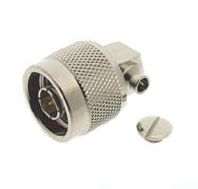
Type N female: 
SO-239 male and female: 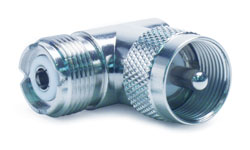
Images are from this Wikipedia article: |
|
This may be another option?
Universal Link OPEK HVT-400B 
Much shorter than the last I posted 
|
|
While we're on the subject of putting up an antenna mast, etc, I would like to call your attention to the VERY important subject of station grounding. BigDaddy had a GREAT pictorial and explanatory thread. I'm at work (don't have the time to search), so someone will be along shortly to post a link.
Good luck! |
|
Quoted:
This may be another option? Universal Link OPEK HVT-400B http://www.universal-radio.com/catalog/hamantm/hvt400b.jpg Much shorter than the last I posted I might have to give that a try for a portable antenna. It sure is cheap! |
|
I might have to give that a try for a portable antenna. It sure is cheap! More Details |