


Posted: 2/25/2015 8:13:49 AM EDT
Anyone else planting any apple trees this spring ?. I placed my order for five Liberty bare root whips a few weeks ago.I'm thinking I'm may have to change their estimated ship date of march 16 the way the weathers been this winter the ground will probably still be frozen solid.  I'm replacing some freedom apple trees, I made the mistake of planting about 5 or 6 years ago that I can't stand.......no flavor about the only thing it's got going for it is that it's fairly disease resistance and easy to care for. I'm replacing some freedom apple trees, I made the mistake of planting about 5 or 6 years ago that I can't stand.......no flavor about the only thing it's got going for it is that it's fairly disease resistance and easy to care for.
|
|
Quoted:
Anyone else planting any apple trees this spring ?. I placed my order for five Liberty bare root whips a few weeks ago.I'm thinking I'm may have to change their estimated ship date of march 16 the way the weathers been this winter the ground will probably still be frozen solid. I'm replacing some freedom apple trees, I made the mistake of planting about 5 or 6 years ago that I can't stand.......no flavor about the only thing it's got going for it is that it's fairly disease resistance and easy to care for.I am going to plant a few more this year. Last year we planted 2 Apple (Cortland, Gala) as well as three plum and two pear trees. We already have 12 Apple trees that are good producers but wanted a few more. I will be planting about 4 more Apple trees this year as well as two or three other fruit trees. Have you thought about adding different varieties? We currently have somewhere between 4-5 feet of snow on the ground so we will probably be late this year as well. |
|
I usually try to plant a few different apple varieties each spring or fall. I got carried away last spring and planted 8 honeycrisp & 2 red delicious bare root whips.Some of my favorite apples I grow are
Honeycrisp Liberty Zestar Jonafree GoldRush I've ordered the majority of my trees from starkbros and a few from gurneys.I like starkbros they offer a 1 yr replacement it the bare root dies whip no questions asked......... The biggest headache I have is keeping the pesky deer away from the young trees long enough to get them started.I have to put a circular wire mesh cage around any seedlings I plant.If not they come in at night and tear up and break branches and cause havoc. cuttingedge what are some of your favorite varieties in you're area ? I don't recall if I've ever had a Cortland, I hear they make the best pie fillings. I like to eat Gala apple, I've never grown that variety before maybe I'll plant a few this fall and see how they do. Quoted:
I got some 2 years ago. I was thinking about adding some more this year. Maybe a peach and pear too. I've gotten some from Burgess but had better luck just getting 4' from Tractor Supply. This company you use - do you like them - good luck with them?? |
|
I have a variety of fruit trees on our property. Most of them were mail ordered. I find pears easier to grow than apples, without a lot of spraying. Yes Honeycrisp taste great, I've had better luck with Jonagold though. There is the Hilltop Nursery near Kalamazoo I got a few from.
I'd get some pears, regular Bartlett, Seckle, and maybe another. Birds get most of my cherries, some plums are good too. While you're at it plant some asparagus and raspberries too. You want to plant right after the ground thaws if able, up to May or so at our latitude. |
|
Quoted:
I usually try to plant a few different apple varieties each spring or fall. I got carried away last spring and planted 8 honeycrisp & 2 red delicious bare root whips.Some of my favorite apples I grow are Honeycrisp Liberty Zestar Jonafree GoldRush I've ordered the majority of my trees from starkbros and a few from gurneys.I like starkbros they offer a 1 yr replacement it the bare root dies whip no questions asked......... The biggest headache I have is keeping the pesky deer away from the young trees long enough to get them started.I have to put a circular wire mesh cage around any seedlings I plant.If not they come in at night and tear up and break branches and cause havoc. cuttingedge what are some of your favorite varieties in you're area ? I don't recall if I've ever had a Cortland, I hear they make the best pie fillings. I like to eat Gala apple, I've never grown that variety before maybe I'll plant a few this fall and see how they do. Quoted:
I usually try to plant a few different apple varieties each spring or fall. I got carried away last spring and planted 8 honeycrisp & 2 red delicious bare root whips.Some of my favorite apples I grow are Honeycrisp Liberty Zestar Jonafree GoldRush I've ordered the majority of my trees from starkbros and a few from gurneys.I like starkbros they offer a 1 yr replacement it the bare root dies whip no questions asked......... The biggest headache I have is keeping the pesky deer away from the young trees long enough to get them started.I have to put a circular wire mesh cage around any seedlings I plant.If not they come in at night and tear up and break branches and cause havoc. cuttingedge what are some of your favorite varieties in you're area ? I don't recall if I've ever had a Cortland, I hear they make the best pie fillings. I like to eat Gala apple, I've never grown that variety before maybe I'll plant a few this fall and see how they do. Quoted:
I got some 2 years ago. I was thinking about adding some more this year. Maybe a peach and pear too. I've gotten some from Burgess but had better luck just getting 4' from Tractor Supply. This company you use - do you like them - good luck with them?? Some of my favorite varieties that we have are Cortland, Gala, Honeycrisp, Fuji, Zestar, Empire, Liberty, Jonagold and of course McIntosh. For eating, I would say my two favorite are Honeycrisp and Gala. Most of the trees that we have were here already. We have a mix of Standard and Semi-dwarf. All of the trees that we purchased are from Fedco. The most productive tree that we have is a Gala tree that sits right behind our house. It had hundreds of Apple on it last year. |

|
Quoted:
How much work are apple (or pear for that matter) trees? What sort of time investment would they require? Depends on how many trees were talking about ? Just one or two apple trees, I'd probably just go the organic approach and bag each individual apple so I wouldn't have to spray every 10 -14 days during the summer months. I have over 50 apple trees so bagging is not an option for me........ Usually takes me a few hours to spray my trees every few weeks.Then theirs pruning in the winter that needs to be done.......Weed control in the summers months. Young trees need to be watered the first few years until the roots get established. Then theirs fencing to keep the rabbits & deer away. |
|
I've planted a few specimen trees around the property but am leaning strongly towards putting in a row or two using the high density "tall spindle" approach for reliable and varied harvest.
ex: 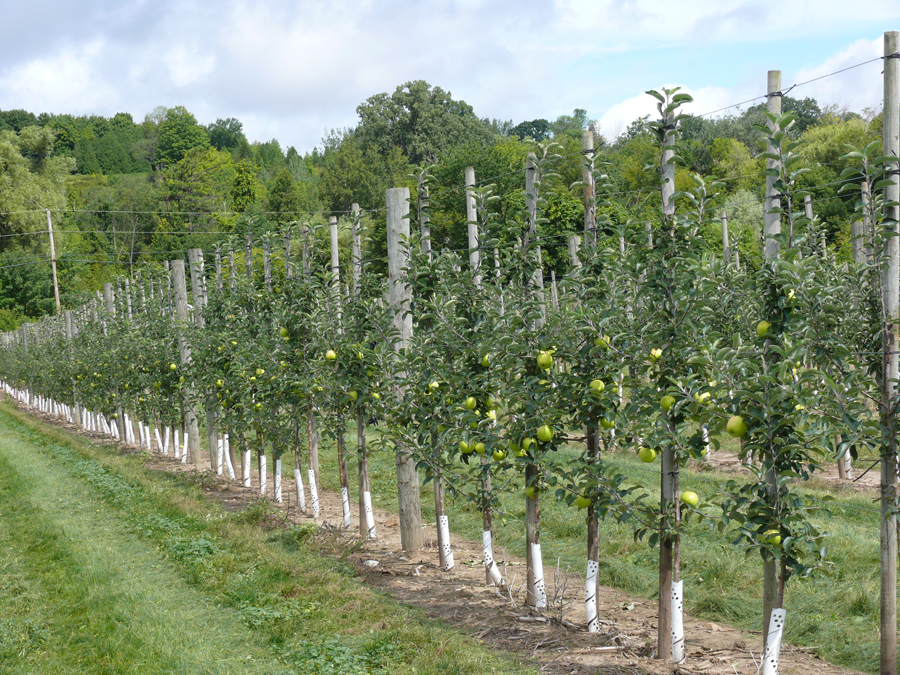
I've been reading up on it for a year or two and while it is geared towards commercial applications I think it would also work very well on a smaller scale. Some of the benefits I see on the farmstead: Quick from planting to fruiting - as little as 3 years for real production High density/less area needed - more varieties in a smaller area Less or no ladder work for maintenance/harvest - tree height kept very short of dwarfing rootstock (m9,etc) and headed Trimming maintenance and expertise is minimal - fruiting wood is constantly renewed vs trying to shape and preserve traditional scaffolding Easier spraying/treatment due to tree size/spacing Irrigation is easier in a smaller/row layout Can intersperse dwarfed pollinators in the rows On a small scale, easy to cover with netting (pest protection) or frost covers if necessary. etc. |
|
Quoted:
Depends on how many trees were talking about ? Just one or two apple trees, I'd probably just go the organic approach and bag each individual apple so I wouldn't have to spray every 10 -14 days during the summer months. I have over 50 apple trees so bagging is not an option for me........ Usually takes me a few hours to spray my trees every few weeks.Then theirs pruning in the winter that needs to be done.......Weed control in the summers months. Young trees need to be watered the first few years until the roots get established. Then theirs fencing to keep the rabbits & deer away. Quoted:
Quoted:
How much work are apple (or pear for that matter) trees? What sort of time investment would they require? Depends on how many trees were talking about ? Just one or two apple trees, I'd probably just go the organic approach and bag each individual apple so I wouldn't have to spray every 10 -14 days during the summer months. I have over 50 apple trees so bagging is not an option for me........ Usually takes me a few hours to spray my trees every few weeks.Then theirs pruning in the winter that needs to be done.......Weed control in the summers months. Young trees need to be watered the first few years until the roots get established. Then theirs fencing to keep the rabbits & deer away. One or two in a suburban back yard. I'm not a farmer, or even a gardener. 
My ex used to have a few tomato plants and it was nice going out to pick a couple for dinner. All we did after planting was water them when I let the dog out. I mentioned maybe planting some again and a guy at work mentioned planting fruit trees instead as relatively low maintenance. |
|
Quoted:
I've planted a few specimen trees around the property but am leaning strongly towards putting in a row or two using the high density "tall spindle" approach for reliable and varied harvest. ex: http://www.omafra.gov.on.ca/neworchard/images/apples/7systemf4-zoom.jpg I've been reading up on it for a year or two and while it is geared towards commercial applications I think it would also work very well on a smaller scale. Some of the benefits I see on the farmstead: Quick from planting to fruiting - as little as 3 years for real production High density/less area needed - more varieties in a smaller area Less or no ladder work for maintenance/harvest - tree height kept very short of dwarfing rootstock (m9,etc) and headed Trimming maintenance and expertise is minimal - fruiting wood is constantly renewed vs trying to shape and preserve traditional scaffolding Easier spraying/treatment due to tree size/spacing Irrigation is easier in a smaller/row layout Can intersperse dwarfed pollinators in the rows On a small scale, easy to cover with netting (pest protection) or frost covers if necessary. etc. That's very interesting thanks for posting that photo.I've seen some other pics of high density test plots if I recall I thought the University of Michigan Extension did some experimenting with different apple varieties. I guess one concern I have is some of the apple varieties more prone to powdery mildew might be an issue since the dense foliage doesn't allow proper air circulation ? I have to agree, I think it work very well on a smaller farmstead scale........ |
|
Quoted:
That's very interesting thanks for posting that photo.I've seen some other pics of high density test plots if I recall I thought the University of Michigan Extension did some experimenting with different apple varieties. I guess one concern I have is some of the apple varieties more prone to powdery mildew might be an issue since the dense foliage doesn't allow proper air circulation ? I have to agree, I think it work very well on a smaller farmstead scale........ Quoted:
Quoted:
I've planted a few specimen trees around the property but am leaning strongly towards putting in a row or two using the high density "tall spindle" approach for reliable and varied harvest. ex: http://www.omafra.gov.on.ca/neworchard/images/apples/7systemf4-zoom.jpg I've been reading up on it for a year or two and while it is geared towards commercial applications I think it would also work very well on a smaller scale. Some of the benefits I see on the farmstead: Quick from planting to fruiting - as little as 3 years for real production High density/less area needed - more varieties in a smaller area Less or no ladder work for maintenance/harvest - tree height kept very short of dwarfing rootstock (m9,etc) and headed Trimming maintenance and expertise is minimal - fruiting wood is constantly renewed vs trying to shape and preserve traditional scaffolding Easier spraying/treatment due to tree size/spacing Irrigation is easier in a smaller/row layout Can intersperse dwarfed pollinators in the rows On a small scale, easy to cover with netting (pest protection) or frost covers if necessary. etc. That's very interesting thanks for posting that photo.I've seen some other pics of high density test plots if I recall I thought the University of Michigan Extension did some experimenting with different apple varieties. I guess one concern I have is some of the apple varieties more prone to powdery mildew might be an issue since the dense foliage doesn't allow proper air circulation ? I have to agree, I think it work very well on a smaller farmstead scale........ Most of what I've been following comes out of UMass, but I'm sure other departments are also working with it. The foliage is actually not very dense - in fact practically zero non-fruiting wood is retained and even that is pruned when it reaches about 3/4". The goal being to force the tree to focus its energy into fruit production vs leaf and limb. The picture above shows fairly tight spacing, but the individual trees aren't dense and spacing can be widened as needed. If (when) mold or other issues come up, spraying the trellis trained trees is trivial vs dealing with traditional canopies - full access to all sides of the tree in two passes and low overall height. What I found interesting is the practice of tying/bowing the feathers/fruiting branches down the first year or two and how it triggers the tree to develop fruit much earlier and at greater volume. It doesn't make for a traditional picturesque orchard, but seems very practical. |