


Posted: 7/11/2014 8:33:29 AM EDT
|
I have been cutting some nasty oak recently, and while I can touch up the teeth with a hand file, I need them trued up every so often.
I haven't had good service from the local sharpening service places. I'd appreciate any recommendations for a reasonable cost garage sharpening rig? My chains are 72 link .050 / .325. |
I think part of my difficulty with this wood is that it is full of crud
In the past I have given each tooth a few touch up strokes with the file when refilling the gas. I would guess I had eight to ten or tanks before any particular chain started cutting to one side or the other. I would take it that chain to a guy who used the correct profile cutter and didn't sharpen half the tooth away. Six or so "pro" sharpenings at $3 each out of a chain = a lot of wood cut before really needing replacement. Buying six chains at $15 each would pay for at least a good part of a sharpener, plus I won't have to deal with the new chain stretch. I cut, buck and split 10 cords a year. I don't think I'll do this again though. |
|
I have an old Dremel sharpening tool that I use if I bugger a tooth. But most of the time I just use a file or an old McCullahgh file jig. Stihl now makes it.
File guide I don't know if they still make it but it looks like the one in the picture. |
|
Granberg bar mount sharpening jig is what I use. Works well once it is set up. http://www.amazon.com/Granberg-Bar-Mount-Chain-Sharpener-G-106B/dp/B0002ZY1WG/ref=sr_1_2?ie=UTF8&qid=1405131955&sr=8-2&keywords=chainsaw+sharpening ETA: how it works http://www.youtube.com/watch?v=XMJ8zYJUfIY |
|
Nothing is going to work as well as hand filing if you know what you are doing.
That said it can be a PITA if you have multiple chains to do. I would start with an small grinder set-up like harbor freight has or you can spend the money and get a good Oregon model. Make sure if you go the Oregon route, that you get one made in Italy not China. Also for wood that is not clean (dirty wood) we use semi-chisel chain as it will keep an edge longer. Checkout arborsite for as much reading as you can handle on these subjects. |
|
Quoted:
I have an old Dremel sharpening tool that I use if I bugger a tooth. But most of the time I just use a file or an old McCullahgh file jig. Stihl now makes it. File guide I don't know if they still make it but it looks like the one in the picture. and don't forget to work on the bar if it needs it......... |
|
The Granberg File-N-Joint, will produce the same or better results than having the avg. shop grind on your chain.
They take patience, but they produce accurate results in getting the cutters all the same length. I used one on and off for a couple years..it's still in the barn somewhere near the project saw, and stray bar pile. I gave up and went back to clamping an old bar in the vice to work on the chain, then using a dial caliper to find the shortest cutter and keeping the rest within .020 or so. A depth gauge guide that generates a progressive angle, like the Carlton File-O-plate or Husqvarna roller guide for setting rakers gets used at the same time. The raker height to cutter angle, is more to blame for circle cutting, than cutter length. You can have a loop half full of uneven length cutters, thanks to finding wire or pebbles in shagbark etc. and still cut dead straight if the raker height angles are all in proportion. 
Beware the generic raker guides like the Oregon and Stihl jobs...they do not generate a progressive angle, just a consistent but incorrect angle. Makes for a good winter shop project when things get too nasty out to cut. I rotate through half a dozen chains for each saw, and when they get field filed into a hairy mess, they go on a nail to await a slow day to do some filing. Most shops grind too fast, take too much in one bite, and surface burn the steel. Nevermind most ignore the depth gauges, and leave a cluttered gullet. I havn't taken a chain to a grinder in years. Not bragging, but I can hand file a faster chain, than any grinder can produce, and most times, faster than new chain right off the reel. The Granberg is really nice for guys that just want to quickly get a chain back up and running correctly, and don't have the patience for fussing. Good luck!! |
|
I use this one. The hydraulic clamping is great.
http://www.oregonproducts.com/pro/products/accessories/BenchGrinderHydraulic.htm |
|
Quoted:
and don't forget to work on the bar if it needs it......... Quoted:
Quoted:
I have an old Dremel sharpening tool that I use if I bugger a tooth. But most of the time I just use a file or an old McCullahgh file jig. Stihl now makes it. File guide I don't know if they still make it but it looks like the one in the picture. and don't forget to work on the bar if it needs it......... I use a variable speed router table and a medium sand paper drum to true my bar then run a jewelers file down the groove to clean out the burs. In the field and old small screw driver works to clean my oiler groove. |
|
Quoted:
The Granberg File-N-Joint, will produce the same or better results than having the avg. shop grind on your chain. They take patience, but they produce accurate results in getting the cutters all the same length. I used one on and off for a couple years..it's still in the barn somewhere near the project saw, and stray bar pile. I gave up and went back to clamping an old bar in the vice to work on the chain, then using a dial caliper to find the shortest cutter and keeping the rest within .020 or so. A depth gauge guide that generates a progressive angle, like the Carlton File-O-plate or Husqvarna roller guide for setting rakers gets used at the same time. The raker height to cutter angle, is more to blame for circle cutting, than cutter length. You can have a loop half full of uneven length cutters, thanks to finding wire or pebbles in shagbark etc. and still cut dead straight if the raker height angles are all in proportion.
Quoted:
The Granberg File-N-Joint, will produce the same or better results than having the avg. shop grind on your chain. They take patience, but they produce accurate results in getting the cutters all the same length. I used one on and off for a couple years..it's still in the barn somewhere near the project saw, and stray bar pile. I gave up and went back to clamping an old bar in the vice to work on the chain, then using a dial caliper to find the shortest cutter and keeping the rest within .020 or so. A depth gauge guide that generates a progressive angle, like the Carlton File-O-plate or Husqvarna roller guide for setting rakers gets used at the same time. The raker height to cutter angle, is more to blame for circle cutting, than cutter length. You can have a loop half full of uneven length cutters, thanks to finding wire or pebbles in shagbark etc. and still cut dead straight if the raker height angles are all in proportion.
Off to google. I have always used something like you mention right below. Beware the generic raker guides like the Oregon and Stihl jobs...they do not generate a progressive angle, just a consistent but incorrect angle. Makes for a good winter shop project when things get too nasty out to cut. I rotate through half a dozen chains for each saw, and when they get field filed into a hairy mess, they go on a nail to await a slow day to do some filing. Most shops grind too fast, take too much in one bite, and surface burn the steel. Nevermind most ignore the depth gauges, and leave a cluttered gullet. I havn't taken a chain to a grinder in years. Not bragging, but I can hand file a faster chain, than any grinder can produce, and most times, faster than new chain right off the reel. The Granberg is really nice for guys that just want to quickly get a chain back up and running correctly, and don't have the patience for fussing. Good luck!! |
|
Quoted:
Nothing is going to work as well as hand filing if you know what you are doing. Quoted:
Nothing is going to work as well as hand filing if you know what you are doing. I can hand file or grind with a dremel. Not sure I want to spring for a saw chain chop saw, even though it might work really well. I can't freehand this though. That said it can be a PITA if you have multiple chains to do. I would start with an small grinder set-up like harbor freight has or you can spend the money and get a good Oregon model. Make sure if you go the Oregon route, that you get one made in Italy not China. Also for wood that is not clean (dirty wood) we use semi-chisel chain as it will keep an edge longer. I like semi chisel profile. Most of the firewood I buck is 8 inches and cuts quick enough regardless of profile. Checkout arborsite for as much reading as you can handle on these subjects. Great suggestion. I have been over there to read up on wood boilers but it didn't cross my mind to check this subject. They probably have 800 threads asking the same question. |
|
In my area to have a chain sharpened starts at $7 for 18" or less, $8 and up for longer. If you don't know how to hand sharpen a chain, try to learn, either at a Chainsaw dealer or from someone who knows how, it's not rocket surgery. If you use Oregon bars, they make an auto sharpener which goes on the tip of the bar and works relatively well according to some folks I know who use them. As far as pitch, sap and other crap on your bar and chain, kersosene works very well on removing it. |
| The Granberg guide is good to use. Or you can get a 1x2 and make an angled cut on each end one at 35 degree and the other end at your choice (have 35 and 40 degree marked on my cheapo 1x2 ends). You can then hold that up to the bar to get the correct angle while sharpening in the field. Hold the stick on the opposite side of the bar for a line up with the tooth being sharpened. Once you get the desired sharpens go to the other side and repeat. If you take off to much material on the teeth don't forget to check the drag height also, they make a small stamped steel tool to measure drag height you can find at a lot of mower and saw shops. If not look on line I think the one we have is an Oregon brand. |
|
They used to make a little jig that held the small file and had a flat piece that ran across the top of the cutting tooth to maintain proper depth. They were very compact and could be used almost anywhere although a vise was nice to clamp the blade in for support. I sharpened quite a few teeth with those things back when the family was in the firewood business.
Anybody know what I'm talking about? Do they still make them? |
I have one of these:

An Oregon 511 bench grinder. I bought it used from the local Stihl dealer for $100. It doesn't have the pink stone wheel on it, but a +$100 diamond wheel on it. Lasts much longer according to the dealer. He showed me how to use it because up to then I had been taking my chains to him at +20 miles round trip plus $5 each. That was several months ago. Never needed it until today. Spent about a half hour sharpening my 362 chain and then went out and used it. WOW! Huge difference. I'm going to sharpen my Husky 350 chain tomorrow. I think the Stihl 440 Magnum chain is GTG. |
|
Quoted:
They used to make a little jig that held the small file and had a flat piece that ran across the top of the cutting tooth to maintain proper depth. They were very compact and could be used almost anywhere although a vise was nice to clamp the blade in for support. I sharpened quite a few teeth with those things back when the family was in the firewood business. Anybody know what I'm talking about? Do they still make them? Yep, used one today as a matter of fact. Bought it at the local Stihl dealer (actually I think he gave it to me when I bought the grinder above). Mine is made by Oregon. Here's an example: _M.jpg)
Available here: sharpening kit Good luck! |
|
Quoted:
They used to make a little jig that held the small file and had a flat piece that ran across the top of the cutting tooth to maintain proper depth. They were very compact and could be used almost anywhere although a vise was nice to clamp the blade in for support. I sharpened quite a few teeth with those things back when the family was in the firewood business. Anybody know what I'm talking about? Do they still make them? You mean one of these? 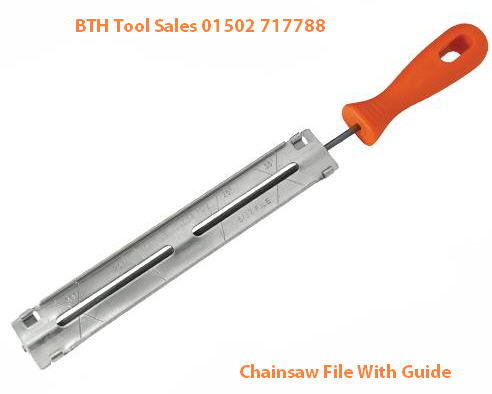
|
|
Quoted:
Yep, used one today as a matter of fact. Bought it at the local Stihl dealer (actually I think he gave it to me when I bought the grinder above). Mine is made by Oregon. Here's an example: http://www.baileysonline.com/productImages/image.axd/i.ORF+38277/w.172/h.169/x._AZ/xm.0/Oregon+Chain+Sharpening+Kit+(3+16+)_M.jpg Available here: sharpening kit Good luck! Quoted:
Quoted:
They used to make a little jig that held the small file and had a flat piece that ran across the top of the cutting tooth to maintain proper depth. They were very compact and could be used almost anywhere although a vise was nice to clamp the blade in for support. I sharpened quite a few teeth with those things back when the family was in the firewood business. Anybody know what I'm talking about? Do they still make them? Yep, used one today as a matter of fact. Bought it at the local Stihl dealer (actually I think he gave it to me when I bought the grinder above). Mine is made by Oregon. Here's an example: http://www.baileysonline.com/productImages/image.axd/i.ORF+38277/w.172/h.169/x._AZ/xm.0/Oregon+Chain+Sharpening+Kit+(3+16+)_M.jpg Available here: sharpening kit Good luck! That's what I'm using to touch up the teeth every tank of gas. After several touch ups I'm finding the chain needs to be sharpened using a jig because it will cut to one side. The shops here used an incorrect profile and sharpened half the tooth away at $5 per. I'm going to try the Granberg jig. If that doesn't give satisfactory results I'm getting a bench grinder. |
|
I second the Dremel. In fact, I have a little one from Harbor Freight that runs off of 12v. I have an old jet ski battery that has enough life in it to spin the tool. I take that into the woods so I am independent of line voltage. I guess I could do the same thing with an inverter and a 120v Dremel, but this is easier to me. I have one of the Dremel filing guides, but I don't use it. My Stihl chains have a witness line for the proper angle.
The advantage of this is that I don't have to take the chain off the bar. When the saw slows down, I just put in on a stump and dress the teeth a little. If you buy multiple chains at once, it's barely more expensive to replace chains that to have them sharpened at a shop. I think I was getting 26" chains for about $15 and paying $10 to ahve them sharpened. A guy who cuts wood for living swears by hand filing with diamond files. |