


Posted: 4/5/2012 10:48:37 AM EDT
|
im gearing up for a big milsim evet this summer and i need help on radios.
i have smaller coms that work great when me and my team are spread a few hundred in the woods. but what i need is a heavy duty radio that can reach a few miles out through hilly heavily wooded areas. i know from last year people had programmable radios but i dont thin they where cb or ham. i reserved my team a helicopter for infil/exfil and need to be able to radio command to give intel and coordinates. so what to get? thanks for any help. |
|
Quoted:
im gearing up for a big milsim evet this summer and i need help on radios. i have smaller coms that work great when me and my team are spread a few hundred in the woods. but what i need is a heavy duty radio that can reach a few miles out through hilly heavily wooded areas. i know from last year people had programmable radios but i dont thin they where cb or ham. i reserved my team a helicopter for infil/exfil and need to be able to radio command to give intel and coordinates. so what to get? thanks for any help. Don't forget that once you are off the ground, or on a hilltop, your VHF or UHF signal will travel much farther. A few hundred feet on the ground = a mile or more in the air, since these are line-of-sight. One other possibility is to enlist the aid of a couple (or more) ham operators in your group. If you look around enough, you are likely to find some hams (especially among the younger crowd) who will enjoy helping you out here. Ham radio operators have VASTLY greater privileges than non-hams. For example, citizen's band or CB allows (legally) 4 watts or so of output power at 27 MHz; a ham at 28 MHz is allowed 1500 watts (Techs and Novices are limited to 200 watts). Who knows... you just may learn to enjoy amateur radio yourself! |
|
HERE IS A LINK to the F4/F4s spec sheet.
4 watts on the 440 MHz band makes it a fairly powerful handheld rig. It also has some other neat features, like TRUNKING. Few if any hams use this feature. The radio will operate both in and out of the 70-cm UHF band so it can be used by hams working with EMS, fire or police. It's a pretty sweet rig, IMO. Icom is one of the 'big three' radio manufacturers. With 4 watts of output power, it will easily overcome most terrain features (buildings, trees, etc) EXCEPT deep dips or high hills. UHF is very much a "line of sight" system. If they are hams, they should be aware of these limitations. eta Quoted:
Does anyone here have experience with Motorola handheld walkie talkies? Are their GMRS/FRS AA units acceptable units for bugout use or should I get something else? Oh, boy, you've opened a can of worms. I love to soapbox about ham radio! FRS/GMRS are two different services, designed with slightly different purposes. FRS is "Family Radio Service." 1/2 watt maximum output power is allowed. No license is required. Basically, if you and your spouse are shopping at a big-box store, you can keep in touch with each other. (My mom and dad did this with some small Icom 440 handie-talkies; that's about all Mom did with her ham license.) They have limited power, limited capabilities (you cannot upgrade your antenna* on a FRS radio, for example). GMRS has greater capabilities; for example, you can use a repeater system. 50 watts of power is allowed. (See some of the above tacked posts about repeaters.) There is a FCC license required to use GMRS, I think it is $20 or so for 5 years. (Anyone may correct me here.) See the sidebar below. GMRS: 16 UHF frequencies, eight for simplex and repeater outputs, eight for repeater inputs. Inputs and outputs are usually paired 5 MHz. apart, but any pairing of an input and output frequency is legal. CTCS (Control Tone Coded Squelch) is usual on repeaters. FCC license required, may be obtained by any individual for personal communications. Equipment must be type-certified for use in the 450-470 MHz band, 50 watts max, any antenna.
FRS: 14 UHF frequencies for simplex operation. The frequencies are interstitial between the GMRS frequencies. CTCS may be used. Two kinds of use operation allowed. 1) Unlicensed operation on any channel using FRS type-certified radios. These are hand-held, ½ watt max, 2.5 KHz. deviation, with permanently attached rubber antenna. 2) Licensed operation on channels 1-7 by any GMRS license holder, 5 watts max, 5 KHz. deviation allowed, any antenna, using any equipment type-certified for GMRS. GMRS users may talk with unlicensed FRS users. GMRS users must transmit their GMRS call signs when using non-FRS type-certified equipment. from THIS SITE *An antenna upgrade makes a HUGE difference in the capabilities of your radio! Going from a simple "rubber duck" antenna like this one (usually supplied with a HT): 
to a longer antenna like this (which must be bought at the radio store): 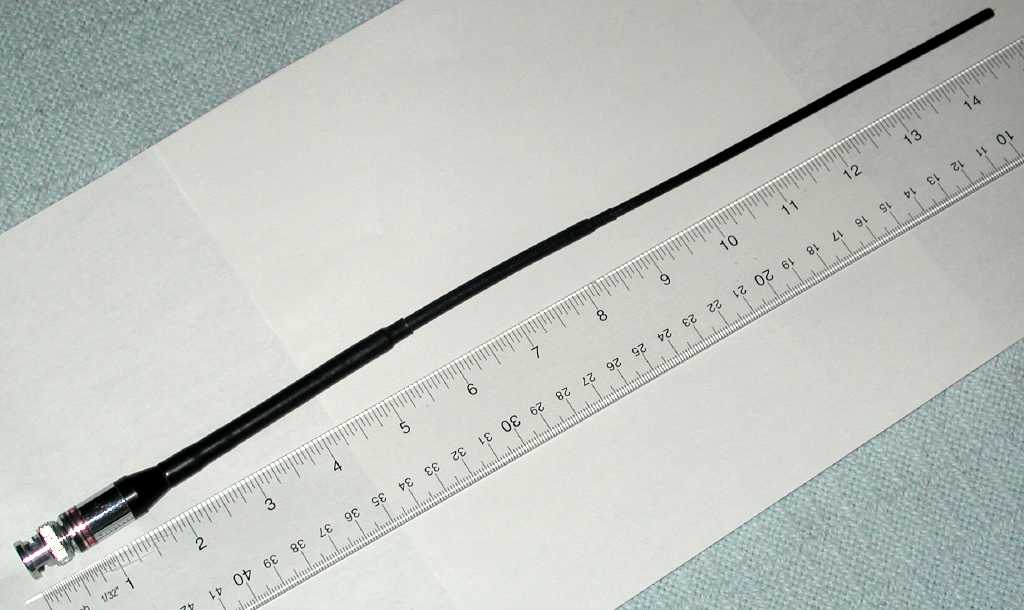
can make the difference between "not readable" to "fully readable." I've made the test myself with such antennas. As far as your "bugout" plans go... read some of the posts in the Outdoors>>Ham Radio forum. FRS radios are good for short-range applications but the equipment itself is frequently very cheaply made. In general, ham radio equipment offers far more for the buck. And the ham radio license has NEVER been easier to obtain! Many people on this site can attest to that. Here's a link to the Ham Radio forum. |
|
Standard Horizon HX370S
One of my favorites that you can program for MURS, HAM, Commercial, Marine, etc..., that is waterproof and puts out up to 5 watts. There are several good reviews in the ham radio forum on them. Add a Smiley Rubber Duck or external antenna to improve range. |
|
Quoted:
Quoted:
Does anyone here have experience with Motorola handheld walkie talkies? Are their GMRS/FRS AA units acceptable units for bugout use or should I get something else? Oh, boy, you've opened a can of worms. I love to soapbox about ham radio! FRS/GMRS are two different services, designed with slightly different purposes. FRS is "Family Radio Service." 1/2 watt maximum output power is allowed. No license is required. Basically, if you and your spouse are shopping at a big-box store, you can keep in touch with each other. (My mom and dad did this with some small Icom 440 handie-talkies; that's about all Mom did with her ham license.) They have limited power, limited capabilities (you cannot upgrade your antenna* on a FRS radio, for example). GMRS has greater capabilities; for example, you can use a repeater system. 50 watts of power is allowed. (See some of the above tacked posts about repeaters.) There is a FCC license required to use GMRS, I think it is $20 or so for 5 years. (Anyone may correct me here.) See the sidebar below. GMRS: 16 UHF frequencies, eight for simplex and repeater outputs, eight for repeater inputs. Inputs and outputs are usually paired 5 MHz. apart, but any pairing of an input and output frequency is legal. CTCS (Control Tone Coded Squelch) is usual on repeaters. FCC license required, may be obtained by any individual for personal communications. Equipment must be type-certified for use in the 450-470 MHz band, 50 watts max, any antenna.
FRS: 14 UHF frequencies for simplex operation. The frequencies are interstitial between the GMRS frequencies. CTCS may be used. Two kinds of use operation allowed. 1) Unlicensed operation on any channel using FRS type-certified radios. These are hand-held, ½ watt max, 2.5 KHz. deviation, with permanently attached rubber antenna. 2) Licensed operation on channels 1-7 by any GMRS license holder, 5 watts max, 5 KHz. deviation allowed, any antenna, using any equipment type-certified for GMRS. GMRS users may talk with unlicensed FRS users. GMRS users must transmit their GMRS call signs when using non-FRS type-certified equipment. from THIS SITE *An antenna upgrade makes a HUGE difference in the capabilities of your radio! Going from a simple "rubber duck" antenna like this one (usually supplied with a HT): http://www.sportfishermen.com/shop/images/P/25307.gif to a longer antenna like this (which must be bought at the radio store): http://www.w6ze.org/FOR-SALE/K6JGN_Images/CH72S.jpg can make the difference between "not readable" to "fully readable." I've made the test myself with such antennas. As far as your "bugout" plans go... read some of the posts in the Outdoors>>Ham Radio forum. FRS radios are good for short-range applications but the equipment itself is frequently very cheaply made. In general, ham radio equipment offers far more for the buck. And the ham radio license has NEVER been easier to obtain! Many people on this site can attest to that. Here's a link to the Ham Radio forum. Ha ha. I should probably clarify that. My BOL is a 100 acre farm. Adjacent to it is 15,000 acres owned by a paper company. The BOL is on a hill that looks over all 100 of our acres and most of the adjacent land. I had planned on getting a large FRS/GMRS radio for in the BOL and then getting a 4-8 handheld radios. I'm not sure what I'd use them for but I think having an established communication is a good thing. I have some garmin rino's that my father and I use during hunting season. We have no issues talking or texting via FRS, though we've never been on either sides of the 15,000 acres. So I've found a pretty decent deal on some motorola handhelds. I know they're not high quality upgradeable/programmable units but they run an AA batts (which I have a SHTF recharge plan) and they come with a rechargeable pack. Is this a reasonable plan? Are the motorola units worth their salt? I'm guessing a ham license and equipment would be able to communicate with with these radios, correct? |
|
Ha ha. I should probably clarify that. My BOL is a 100 acre farm. Adjacent to it is 15,000 acres owned by a paper company. The BOL is on a hill that looks over all 100 of our acres and most of the adjacent land. I had planned on getting a large FRS/GMRS radio for in the BOL and then getting a 4-8 handheld radios. I'm not sure what I'd use them for but I think having an established communication is a good thing. I have some garmin rino's that my father and I use during hunting season. We have no issues talking or texting via FRS, though we've never been on either sides of the 15,000 acres. So I've found a pretty decent deal on some motorola handhelds. I know they're not high quality upgradeable/programmable units but they run an AA batts (which I have a SHTF recharge plan) and they come with a rechargeable pack. Is this a reasonable plan? Are the motorola units worth their salt? I'm guessing a ham license and equipment would be able to communicate with with these radios, correct? There are a few things to consider here to stay legal. 1. You haven't specified the band these radios are designed for. Do these radios transmit on a band in which you are legal? Most FM handies are either business band, police/fire band, marine mobile (meaning ship-to-ship) aircraft band, or ham radio band. If your radios are FRS then they are GTG as they are. 2. Radios must be type accepted; this means that they have been tested by FCC-approved labs and are acceptable for the band in which they are used. For example, business band radios are not type accepted for police or marine use. Ham radios may be superior in quality, but are not intended for business or other bands. A business band radio MAY be re-tuned for use by hams IN THE HAM BANDS, though; the privileges afforded by a ham radio license allows the ham to make these adjustments. Hams are NOT allowed to transmit just anywhere; we are limited by our licenses to operate in discrete frequency bands. Motorola radios are generally pretty durable. Lots of hams have adapted them in the past for ham radio usage. Ar-Jedi may be able to answer your questions if you get him the specs on those radios. |