


Posted: 2/10/2017 1:43:18 PM EDT
|
I bought a deep cycle battery at least 7 or 8 years ago to go with my solar panels. I put it on a battery tender and stored it off the ground, but it hasn't been used at all since.
Did I kill it by not maintaining it properly? What maintenance should be done on a lead acid battery? How do I test it to see if it's useable? |
|
If its been on a maintainer, it may be fine.
Keeping the water up is maintenance on them. Test it with a battery load tester. I just got a new charger/maintainer/repair(er) that is supposed to de-sulfate lead acid batteries (get rid of the scale on the plates). Need to hook it up to my weak battery I replaced from the Excursion and see if it helps yet. |
|
Battery tender on deep cycle for an extended time will eventually result in electrolyte loss (BTDT). Had one sitting around on a tender as a backup power source, before using it with a solar charger setup I had checked it with a resistor pile tester & it failed. Turned out it was down by maybe half the electrolyte volume. Topped it with distilled water & it recovered OK (tested OK anyway). It has been doing OK with the solar panel & controller as 12v power for the equipment shed, but I do keep an eye on electrolyte levels now...
Nick |
|
Sitting is probably the worst thing on a battery of this type.
Check the electrolyte level. If you have to add water add distilled only to about 1/8 inch above the plates. You do not fill these up to the top like some batteries. Check the lead posts, has the battery case "grown" up by it? I see this in really old L16s a far amount and I'm told it's lead accumulation. A high charge EQ regularly is essential. If you look at Trojan's website, they kill the notion that a battery of this type HAS to be up off the ground. We run 28 L16's in our bank and all but 4 are only little scraps of 1 by wood. The 4 that aren't have not shown ANY difference and they are directly on a concrete floor of a non climate controlled building. |
|
As long as it's been charged from time to time, it may still have some life.
About 5 years ago, we got about 8 deep cycle batteries from a ~25 year old elevator system that was being replaced in a pretty tall building. The battery bank was pretty large... They might have been in service guessing 4 years when we got them. I get my SO to charge them with a Vector programmable charger once or twice a year, down here. There's 2 or three in the barn in the mtn and I hook them to the solar battery bank occasionally. They absorb little charge it seems and with a high current battery tester like H-F and everyone sells, they test fine. After a total of ~10 years? Surprising... I need to do a capacity test really evaluate them, maybe I will... A lot of the deep cycle batteries are sealed and the said Interstate batteries are. That makes it practically impossible to evaluate the electrolyte that would give definitive clues as to their condx. There's a good chance your battery has some life left... |
|
Quoted:
If its been on a maintainer, it may be fine. Keeping the water up is maintenance on them. Test it with a battery load tester. I just got a new charger/maintainer/repair(er) that is supposed to de-sulfate lead acid batteries (get rid of the scale on the plates). Need to hook it up to my weak battery I replaced from the Excursion and see if it helps yet. Never had any luck with the high frequency pulse chargers. The forklift battery I posted abt in my solar thread has responded well to being charged every day to 15.4 VDC from a staged Outback controller. When I first got it is couldn't run 300 watts [per 12 volt section] for more than fifteen minutes It's SG and capacity have increased dramatically. It usually 'absorbs' ~ .75 kw a day and most of that is bubbling the water. Need to get up there to check water levels on all the batteries... Topped them all off a couple weeks ago, and turned down the 'absorb' voltage a few tenths... The cheapest way to get a smart charger that is easily programmable and that can cycle over and over to a high programmable absorb voltage, is to get an old Outback solar charger or similar. Then supply it with juice from a solar panel or some sort of home made AC mains powered rectifier. Or make one... 
|
|
Quoted:
Sitting is probably the worst thing on a battery of this type. Check the electrolyte level. If you have to add water add distilled only to about 1/8 inch above the plates. You do not fill these up to the top like some batteries. Check the lead posts, has the battery case "grown" up by it? I see this in really old L16s a far amount and I'm told it's lead accumulation. A high charge EQ regularly is essential. If you look at Trojan's website, they kill the notion that a battery of this type HAS to be up off the ground. We run 28 L16's in our bank and all but 4 are only little scraps of 1 by wood. The 4 that aren't have not shown ANY difference and they are directly on a concrete floor of a non climate controlled building. Putting batteries up off the ground dates to when they were burning witches... 
This said I put our L16's and a few others in permanent service on rigid pink foam insulation. As far as filling, I fill so the meniscus touches the bottom of the cap well... That's so I don't have to fill as often. One of the cells in my bank of 8 L16's in the barn has gone bad, the SG is 1240 when the rest may be 1260. I've charged the heck out of it but it hasn't responded well... I need to hook up the big HP 6269B power supply I got to try to restore the FL battery, since I'm only dealing with 6 volts and can't connect it to the Outback's independently... I may sell them and replace with Surrette 2 volt cells. It's not a big deal now because I have a Schottky diode connecting the forklift battery to the L16 bank. And more sunny wx is around the corner. During this winter the extra panels and the forklift battery system really worked well during times of extended cloudiness when we weren't there. Also have a contactor that I can control remotely to connect the FL battery directly to the system, without losing the .3 voltage drop power. Just looked with the remote PTZ cam that does 'overwatch' on the solar system and the forklift dedicated Outback has already put 1.0kw into the battery and in 'absorb' mode. Voltage is 15.2 volts and the current at the moment is 13.7 amps. The 3 other Outbacks that charge the L16's are all in absorb or float mode. If it's sunny in the morning, everything will be charged by 11:30AM. Unless I've used the lab the evening before... Here's a pic that I'll put again after updating it in the Solar Panel thread... This was taken in early NOV and shows some of the panel voltage dropping regulators up at the top. The interconnection of the F-L battery and the rest of the system hasn't been done yet and the remote control and automatic over voltage controls for the voltage droppers aren't installed. They have worked perfectly this year. A lot of work has been done on this before the snow got too deep and I thought I had the latest pix on this mem stick -but don't... 
|
|
Quoted:
If its been on a maintainer, it may be fine. Yep - Assuming (1.) your Battery Tender doesn't "float" the battery at more than 13.5 volts or so and (2.) the electrolyte inside the cells didn't evaporate enough to expose the plates to air, it could still be in pretty good shape. I've seen RV deep-cycle batteries that still had decent capacity after a decade of being float-charged. |
|
Found 3 pics of some that I'll be putting in the solar topic in the next week or so with some details and explanations...
First is the assembly of the voltage dropping regulators... 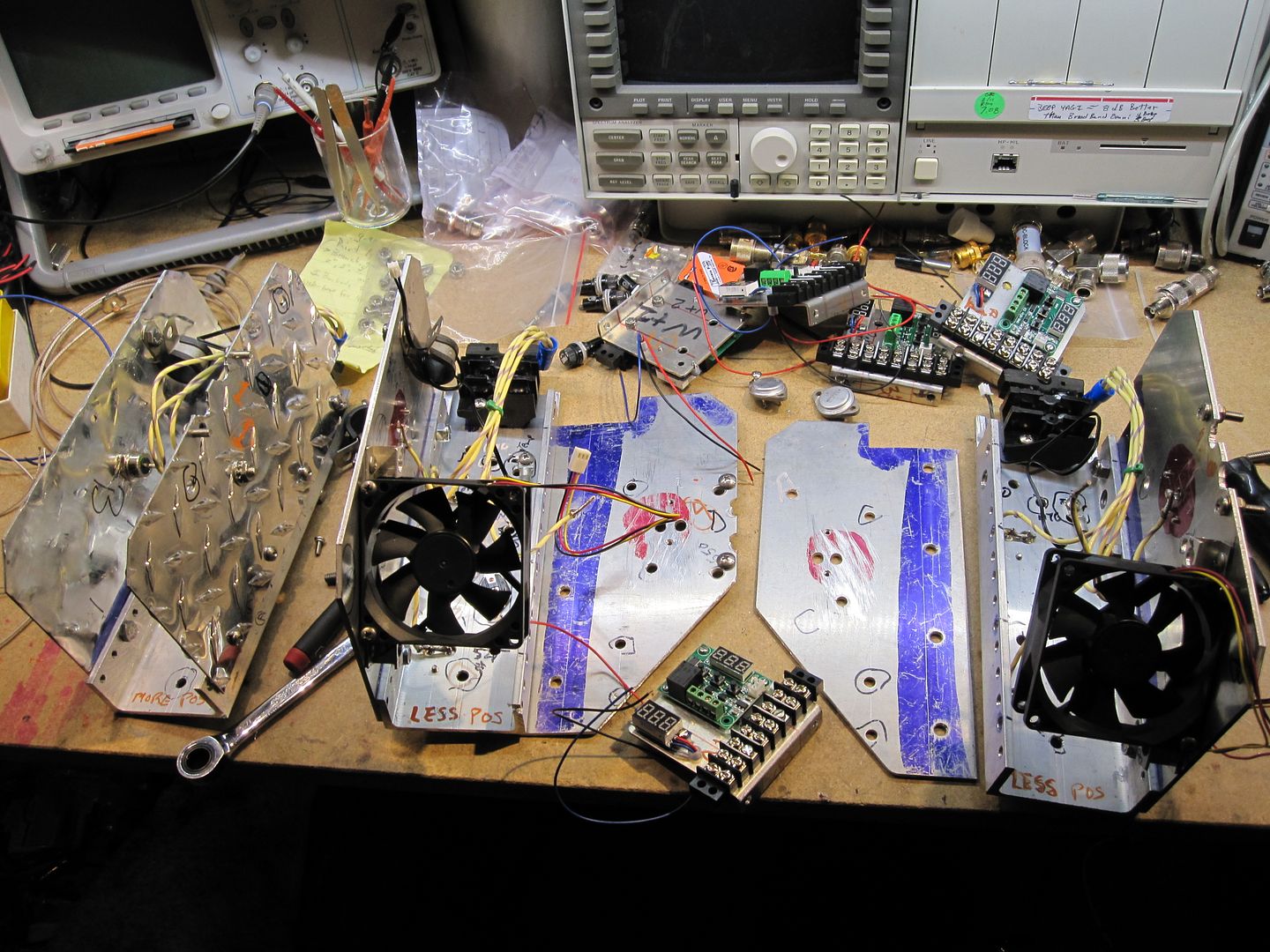
Next is the updated system with 5 dropping regulators... Note the various LED readouts on each of the regulators that indicate the temperature and shunt voltage. The L16 batteries are going into their 8th year... 
Here's a close-up of the forklift battery Schottky power diode and the contactor that can connect the forklift directly to the system batteries via an internet control. 
Yet 2 more... 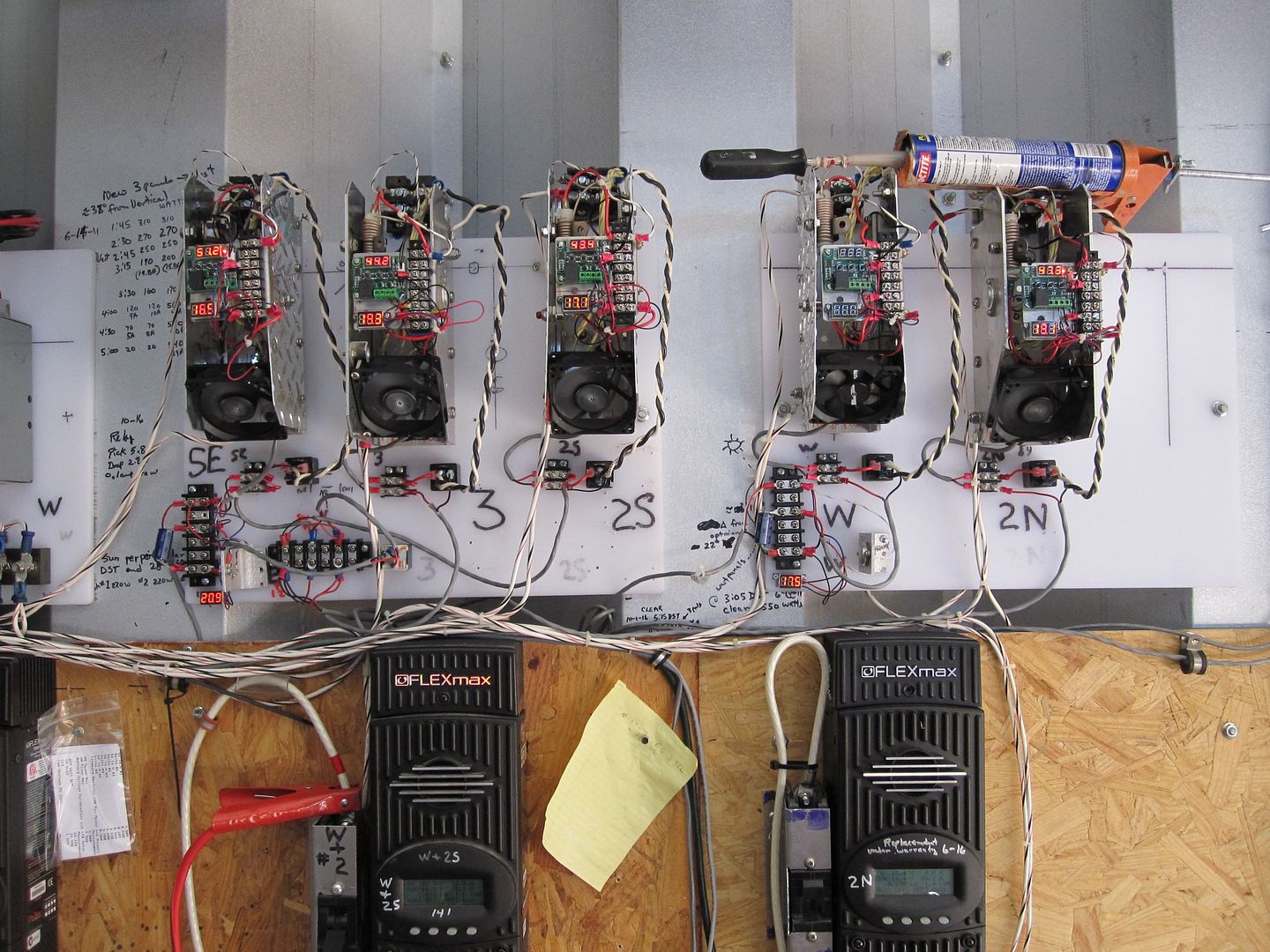


|