


Posted: 2/7/2015 11:06:03 PM EDT
|
Hey all - I need an interlock to connect my Champion 4000 to my breaker panel.
Here's my panel: 
Here's an interlock that's $62.99: (from geninterlock.com), and sorry in advance that the sizes are screwy, 
It includes: the Interlock Clip Drill Bit needed for installation Labeling for circuit panel Kit does not include breaker or panel Here's an interlock that's $149.95: (from interlockkit.com) 
It includes: Back plate Front plate Binder post Binder screw Drill bit 11/64 Thread lock pipette Main label DANGER label Generator label Instructions label Self Tapping Screw 2 Breaker Retainer So clearly in both cases the external plate prevents you from having both the main commercial breaker and the genny breaker on at the same time. Is there a sizeable difference in these two kits? Why would one be more than double the cost? Is the cheaper one just a simpler design to the same end, thus cheaper? I know a lot of you all have installed interlocks - would love to hear from you. Thanks, all. |
|
got mine from here http://natramelec.com/ 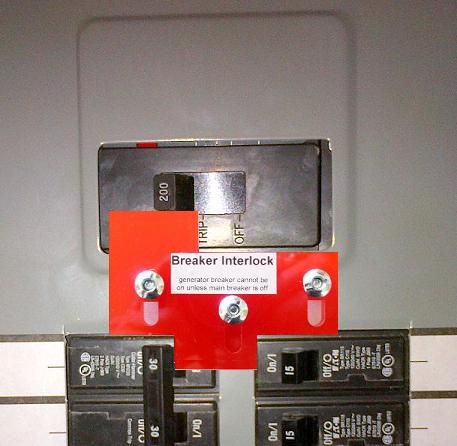 wouldn't be hard to make your own. |
|
Quoted:
Gotcha. So *quite* literally, all an interlock is is a plate that prevents them both being on at the same time?? And they're charging $150 for that?? Incredible. I think I'll try to make one before I shell out for that!! Thanks, guys. Quoted:
Gotcha. So *quite* literally, all an interlock is is a plate that prevents them both being on at the same time?? And they're charging $150 for that?? Incredible. I think I'll try to make one before I shell out for that!! Thanks, guys. Well, yes and no. It's a plate that prevents them from both being on at the same time AND it's UL listed. I think a significant part of what you're paying is for the UL testing and subsequent listing. Quoted:
If I'm looking at it correctly the top example still allows for both to be on at one time? You have to connect the generator first then disconnect the main. Edit I'm wrong. I thought that too. I kept looking at it wondering to myself, HTH does that work? Then I saw it... It's the glare of the picture washing out part of the main breaker that threw me off. |
|
From what I gather from the two different links is, the cheaper one does not have a breaker hold down. Code says that a "mains" breaker (power in) needs to be fixed to the panel so that it can't be lifted off when power is going through it. Not my pic, but this is what the expensive kits come with...
 |
| Thanks all for the input - I really appreciate it. I am demonstrating my ignorance, but I have no idea what UL listing is, though I imagine it's pretty much code. Is it legal for me to make my own, as long as it prevents both being on at once? Or would I save considerable hassle by buying the cheaper one? |
|
Quoted:
Thanks all for the input - I really appreciate it. I am demonstrating my ignorance, but I have no idea what UL listing is, though I imagine it's pretty much code. Is it legal for me to make my own, as long as it prevents both being on at once? Or would I save considerable hassle by buying the cheaper one? UL is Underwriter Laboratories. They test nearly everything known to man for safety. They basically create standards within the industry to ensure that no matter who you buy products from they are safe. UL lists things from the security level of safes to the safety of electrical devices. Using non UL listed electrical devices could land you in trouble with your insurance if you have a house-fire. That being said, this is a VERY low risk device. What is the worst that it can cause if it fails? If it fails and you turn both on at the same time you could electrocute a line-man (unlikely, but possible) or possibly cause a fire in your home. In a bad house fire they may not even notice that it wasn't UL listed. That being said, make it good and this won't happen. This is a very simple mechanical device, there isn't much that can go wrong. |
|
if an OEM interlock kit is available for your panel (it looks like a Murray/Siemens type) then get an OEM kit: http://w3.usa.siemens.com/us/internet-dms/btlv/residential/residential-murray/docs/Standby_Power_Interlock_Kits_Brochure.pdf why? there are three issues with the DIY approach which typically conspire to make purchasing an OEM interlock kit a no-brainer. 1) directly behind the breaker panel cover and very near the main breaker is a set of main lugs that terminate the 100A, 150A, 200A (etc) service coming from the utility pole. you'll note that this is exactly the location on the panel where you will be mounting the interlock plate. the positioning and type of the sliding plate fasteners used on the OEM interlock kits is such that there is no possibility of interference between the fasteners and the main lugs. any inadvertent metallic contact with the main lugs will cause undesirable results, including unpleasantness such as fire and/or death. 2) once in place, the newly installed backfed breaker technically becomes a "main breaker", since power can now be delivered to the panel via that breaker. and, per the NEC, a main breaker must be secured in place by mechanical means. you may have noticed that you can not just snap out your 200A main breaker like you can the 15A or 20A branch circuit breakers. hence all OEM interlock kits, in addition to the sliding interlock plate, include a means to mechanically retain the backfed breaker. in SquareD setups, for example, there is a Z-shaped retainer bracket which is placed over the backfed breaker and which uses an existing screw just below the main breaker for retention. you will have a tough time replicating this Z-shaped bracket unless you have a sample one to copy, a metal punch, a metal brake, and some appropriate sheet stock. again, a lot of care must be taken as the Z-shaped retainer bracket fits quite snugly in between the two phase conductors on the load side of the main breaker. in Cutler-Hammer setups, a special two-pole breaker with a retention hole is available. 3) one final aspect is that the OEM interlocks are UL-listed for use with the panel. UL-listing (actually, NRTL listing) is a requirement in the NEC and the NFPA codes. in some municipalities this might be a don't-care, in others having the UL-listed part in place may prevent you from having any issues during the pre-sale home inspection done by the buyer's inspector. electrical wiring or related apparatus which is non-code compliant may need to be fixed or removed. so... the easiest/cheapest service panels to add an interlock to are Square-D QO (copper backplane) and HO ("homeline", aluminum backplane) -- the OEM interlocks from Square-D can be bought almost anywhere (amazon, etc) for $30 to $50 and installed in 10 minutes. Cutler-Hammer CH series service panels require an entire new front panel. they are expensive if you go to an electrical supply house but they can be had online for $125 or so. Siemens/Murray service panels have dedicated interlocked breakers available; see the PDF linked above and then head to Amazon where they have really good pricing on them. ar-jedi |
|
Quoted:
Thanks, AR - again, just what I needed to know. My Siemens panel (about a year and a half old) isn't listed on that PDF, and that PDF appears to be the most recent one, so I'll look for one of the Square Ds as they are cheap and abundant. Thx all! won't work. the interlock is custom made by the panel vendor to fit their panels. you can not use a square-d kit on a siemens panel, and vice versa. what siemens panel model do you have? ar-jedi |