


Posted: 7/31/2014 8:47:19 PM EDT
|
As an engineer and life-long gear head, I love to tinker. Prepping has become a single outlet which ties most of my hobbies together. (guns, camping, 4wheeling, metal fabrication, electronics, ham radio, etc)
3 or 4 years ago, I got started playing with micro-controllers because I wanted to learn something new and saw utility in being able to write a few lines of code to accomplish a task. As usual, my focus turns to how I can leverage a new skill to old hobbies or tasks. I would like to open a discussion about the utility of embedded systems post-shtf. Embedded systems are all around us, hence the name. Your phone, car, security system, toaster, oven, coffee maker, TV, battery chargers, etc all use micro-controllers to accomplish a given task. If you haven't notice, the hobby market and the open source movement have made some impressive advances thanks to cheap uCs and the spread of knowledge via the internet. It is now possible to monitor your furnace or turns lights on and off at your house from across the world with less than $100 worth of equipment and little of your time. In fact, there are resources available that you don't even have to be a programmer to accomplish these tasks, so long as you can use a computer and follow instructions. Even if you are not a programmer, an electrician, or mechanically inclined, I would like to hear your ideas on what types of tools or systems you would build to make your prepping easier. Embedded systems can be another tool in our arsenal to help us do more or get by a little easier. I see them as force multipliers, just like guns. They can allow a single person to perform multiple tasks simultaneously or be in many places at once. Here are some ideas I have worked on or plan to work on in the future. - An auto-start system for a generator that can monitor my battery bank and run the generator as needed to recharge batteries on low solar or wind days. This has the advantage of maintaining power for fridges, heat, etc when I'm not home. It also can be set to protect the generator from damage due to low oil, overheating, excessive load etc. - A automatic load-sharing system that allows a small generator to run multiple fridges and freezers without outside interaction. - A wood-gas generator controller. I have not built a wood gas generator, but wouldn't it be nice if a uC could monitor the system and make adjustments on the fly? Most systems like this generally out-perform a human because of their ability to see minute changes in the system. - Remote monitoring of your BOL. Including well water, power, security, etc. - Automated transfer switch for critical systems in your house. - Autonomous drones that fly patrol loops around your remote property and report back with live video. With current and cheaply available technology, an amateur can build a simple drone that can receive GPS coordinates and fly autonomously then return to where is started. Google "Ardupilot" Even a live-operated ground drone equipped with a camera could roam your property performing security patrols, leaving the operator out of harms way. The military already does this with tiny wheeled robots that can be tossed through the windows of unfriendly buildings. - If you are not familar with APRS, Google it. It is ham radio based and has huge potential to coordinate and monitor large groups. It is often used for SAR operations. There are many tiny and cheaply available trackers and monitors based on inexpensive uCs or single board computers like the Raspberry Pi. There is also free, open-source software available. I'm no computer geek, but I have successfully implemented XASTIR on a $35 Raspberry Pi and can freely monitor all APRS traffic in my AO without outside infrastructure. - Autonomous ground-moisture monitor and watering system for a garden or green-house. This could be easily tied to the internet for remote monitoring. - Knock, RFID, keycode, or finger print protected secret storage areas in your house for hiding sensitive data or equipment such as guns. - Automated environmental controller for greenhouse, gun safe, remote cabin etc. - Small and cheap solar charge controller These are just a few ideas I've had to get the ball rolling. Obviously some of these systems can be purchased commercially, but the beauty of learning these things, like any new skill, is that you can apply them in new ways tailored to prepping or home-brew an existing system cheaper. One of the biggest advantages I see over commercial systems, is that if you build many unrelated systems base on the same uC and support components (relays, switches etc.), you will have full understanding of their function and it will be easy to stock common replacement parts to repair damaged components. The great thing though, is that modern electronics are very robust and require little to no maintenance. |
|
Yep - Being able to program simple microcontrollers in the field could be a huge asset.
A few more examples: - Simple, low-power security alarms for protecting residences, garages, sheds, trailers, boats, vehicles, etc. Most of the off-the-shelf home security hardware is too big, expensive, feature-bloated and power-hungry to be practical during an extended power outage. In many cases, all you really need is a few inputs for monitoring magnetic switches, a siren output, and maybe a keyswitch or keypad for arming/disarming it. That's 5 bucks worth of hardware, and a couple hours of time to program it. - "Smart" charge regulators for use with vehicle alternators in building wind- and engine-driven battery chargers. - Solar panel trackers. Since obtaining additional solar panels could become difficult or impossible after TSHTF, anything that increased the daily power output of your existing panels might be worthwhile. ETA: A pet project I've been kicking around: An adjustable-temperature crock pot that operates on low-voltage DC. Could use a few power MOSFETs attached to the inside of the crockpot as the heating elements, driven by a simple microcontroller. Since the micro could maintain constant power through the MOSFETs with a wide variation of supply voltages, it could be connected directly to a solar panel - no batteries required. |
|
Quoted:
ETA: A pet project I've been kicking around: An adjustable-temperature crock pot that operates on low-voltage DC. Could use a few power MOSFETs attached to the inside of the crockpot as the heating elements, driven by a simple microcontroller. Since the micro could maintain constant power through the MOSFETs with a wide variation of supply voltages, it could be connected directly to a solar panel - no batteries required. Here's something on my gizmo wish-list: a programmable, electric cheese vat. I've been fooling around with making homemade cheese, and for me the most difficult part is temperature control - especially on an electric stove. Cheesemaking instructions are full of steps like "warm curd from 90° to 105°, bringing the temperature up no faster than 2° per minute; this should take approximately 30 minutes" and "hold temperature at 98° for thirty minutes"... I figured there were crockpot-like contraptions out there that would do that, but all I saw were big commercial vats. I bet a homeowner model would sell. Being able to turn fresh milk into long-shelf-life cheese would be a pretty good long-term survival skill. |
|
Quoted:
Here's something on my gizmo wish-list: a programmable, electric cheese vat. I've been fooling around with making homemade cheese, and for me the most difficult part is temperature control - especially on an electric stove. Cheesemaking instructions are full of steps like "warm curd from 90° to 105°, bringing the temperature up no faster than 2° per minute; this should take approximately 30 minutes" and "hold temperature at 98° for thirty minutes"... I figured there were crockpot-like contraptions out there that would do that, but all I saw were big commercial vats. I bet a homeowner model would sell. Being able to turn fresh milk into long-shelf-life cheese would be a pretty good long-term survival skill. Quoted:
Quoted:
ETA: A pet project I've been kicking around: An adjustable-temperature crock pot that operates on low-voltage DC. Could use a few power MOSFETs attached to the inside of the crockpot as the heating elements, driven by a simple microcontroller. Since the micro could maintain constant power through the MOSFETs with a wide variation of supply voltages, it could be connected directly to a solar panel - no batteries required. Here's something on my gizmo wish-list: a programmable, electric cheese vat. I've been fooling around with making homemade cheese, and for me the most difficult part is temperature control - especially on an electric stove. Cheesemaking instructions are full of steps like "warm curd from 90° to 105°, bringing the temperature up no faster than 2° per minute; this should take approximately 30 minutes" and "hold temperature at 98° for thirty minutes"... I figured there were crockpot-like contraptions out there that would do that, but all I saw were big commercial vats. I bet a homeowner model would sell. Being able to turn fresh milk into long-shelf-life cheese would be a pretty good long-term survival skill. Super simple if you have an electric chese vat or you can make one... Look into a PID temp controller... super simple to use. You just need the PID and a Solid-state relay for the load (can't run high current through the PID controller). I built a PID controller for use with my lead casting pot. My lead stays within 2-3 degrees of my set temperature. The PID is "smart" in that it seeks your set temperature and "learns" how long to pulse the heating elements on/off to maintain at that temperature... Even if your system has a large thermal sink like a 20 lb pot of lead, it will learn how long to leave it on and off to reach temps and maintain them... |
|
Quoted:
- "Smart" charge regulators for use with vehicle alternators in building wind- and engine-driven battery chargers. - Solar panel trackers. Since obtaining additional solar panels could become difficult or impossible after TSHTF, anything that increased the daily power output of your existing panels might be worthwhile. ETA: A pet project I've been kicking around: An adjustable-temperature crock pot that operates on low-voltage DC. Could use a few power MOSFETs attached to the inside of the crockpot as the heating elements, driven by a simple microcontroller. Since the micro could maintain constant power through the MOSFETs with a wide variation of supply voltages, it could be connected directly to a solar panel - no batteries required. I'm glad you mentioned that. I've looked into turning a car alternator into a true 3-stage charger. (Or maybe 2-stage, since float charging would be a waste of gasoline) I have a few alternators and a small engine and this will work along side my auto-start system. Solar trackers are another great idea! You could even build a micro-sized unit that used an R/C servo and a 5-10watt panel for remote monitoring projects. To add to your Crock Pot idea, it could even be propane powered with a controller to turn the burner on and off to regulate temperature. There are tons of PID programs written already for uCs like the AVR series running Arduino IDE. One option I would like to explore is 900 Mhz radio modems. There are some inexpensive units out there with impressive range. It would be a great option for remote monitoring and controlling a generator or camper or discrete security outpost. |
|
At work we have a commercial switchgear, it does exactly what your first two projects will do. The problem is that even though it cost $1,000,000 it still requires monitoring, and is relatively unreliable in that regard. Seriously, a million bucks. The problem is that load-sharing, load-shedding, etc. even auto-start can do all sorts of funny stuff. It still has to be monitored closely. If the commercial stuff still has issues dealing with this sort of stuff, I'm not sure there's any consumer-type solution that would do it better. And keep in mind ours supplied by 6 massive Aggreko gensets and everything on the other side is UL listed, PAT tested, etc. Dealing with a bunch of consumer electronics and appliances is gonna be even worse.
I'm very curious to see what you can come up with. |
|
Good topic R_R!
I've been saying here for many years that tech is a tremendous force multiplier in most respects. Here's my personal first u-controller for a sort of 'prep' ap. It's to the right of the Xantrex inverter in the pix below, mounted on a cover plate from a failed sq wave inverter. What it does is automate the restarting of the Xantrex when it goes offline due to the Xantrex detecting a transient overvoltage condition from one of the 3 Outback MPPT charge controllers charging the batteries it's hooked to. It has saved countless trips to the barn, to get the cams and electrical system back in operation, especially when out of town. 
I agree w/ your comments regarding IP controlled outlets and relay controls. I've posted here countless times how we use them but it seems to fall on mostly deaf ears. Maybe if they were packaged in RealTree camo, but I don't know... 
|
|
If you look to the right of the digital voltmeter there's an IP enabled power strip that can remotely turn on lights, fan, cameras, etc. It is a great help to manage power during cloudy times. It's fun to turn on a light and see it in the distance with binoculars.
Just above to the left of it is a Control by Web temperature monitor and controller, with aux relay closures. I monitor temps at the ceiling and at waist level in the barn and plan on automating the commercial Dayton ceiling fan already installed [and controlled w/ the IP AC power switch], in the winter. That's so the water tanks that are now located on top of the steel framed room we built stay thawed out longer. All this IP stuff is controlled via a bridge a dozen or two miles away, PtP. |
|
That picture was taken when I was a couple thousand miles away using an IP/network Axis 231D PTZ cam mt'd to the the barn ceiling used for monitoring temperatures, readouts on the Xantrex and Outbacks, etc. There are many more cams in the system.
Right now I'm testing a deployed u-processor controlled security 'appliance' that I've been working on for almost 1 year so far. Tech is where it's at especially since it makes most folks eyes glaze over, making it more effective for the remaining few of us. 
|
|
Quoted:
At work we have a commercial switchgear, it does exactly what your first two projects will do. The problem is that even though it cost $1,000,000 it still requires monitoring, and is relatively unreliable in that regard. Seriously, a million bucks. The problem is that load-sharing, load-shedding, etc. even auto-start can do all sorts of funny stuff. It still has to be monitored closely. If the commercial stuff still has issues dealing with this sort of stuff, I'm not sure there's any consumer-type solution that would do it better. And keep in mind ours supplied by 6 massive Aggreko gensets and everything on the other side is UL listed, PAT tested, etc. Dealing with a bunch of consumer electronics and appliances is gonna be even worse. I'm very curious to see what you can come up with. Well I'm always willing to give it a go. I do have a background in industrial automation and machines that require high speed precision movements. I also tend to be the engineer that solves other people's problems, so I like a challenge.
|
|
EXPY - Cool stuff. I do like gaining an edge wherever possible and electronics tend to baffle people, so when you understand them, you have a leg up.
Most of my project ideas have revolved around security and power, so I'm hoping a few more people will chime in with some alternate views. If nothing else, we can make some sweet blinking lights! 
|
|
Quoted:
As an engineer and life-long gear head, I love to tinker. Prepping has become a single outlet which ties most of my hobbies together. (guns, camping, 4wheeling, metal fabrication, electronics, ham radio, etc) 3 or 4 years ago, I got started playing with micro-controllers because I wanted to learn something new and saw utility in being able to write a few lines of code to accomplish a task. As usual, my focus turns to how I can leverage a new skill to old hobbies or tasks. I would like to open a discussion about the utility of embedded systems post-shtf. Embedded systems are all around us, hence the name. Your phone, car, security system, toaster, oven, coffee maker, TV, battery chargers, etc all use micro-controllers to accomplish a given task. If you haven't notice, the hobby market and the open source movement have made some impressive advances thanks to cheap uCs and the spread of knowledge via the internet. It is now possible to monitor your furnace or turns lights on and off at your house from across the world with less than $100 worth of equipment and little of your time. In fact, there are resources available that you don't even have to be a programmer to accomplish these tasks, so long as you can use a computer and follow instructions. Even if you are not a programmer, an electrician, or mechanically inclined, I would like to hear your ideas on what types of tools or systems you would build to make your prepping easier. Embedded systems can be another tool in our arsenal to help us do more or get by a little easier. I see them as force multipliers, just like guns. They can allow a single person to perform multiple tasks simultaneously or be in many places at once. Here are some ideas I have worked on or plan to work on in the future. - An auto-start system for a generator that can monitor my battery bank and run the generator as needed to recharge batteries on low solar or wind days. This has the advantage of maintaining power for fridges, heat, etc when I'm not home. It also can be set to protect the generator from damage due to low oil, overheating, excessive load etc. - A automatic load-sharing system that allows a small generator to run multiple fridges and freezers without outside interaction. - A wood-gas generator controller. I have not built a wood gas generator, but wouldn't it be nice if a uC could monitor the system and make adjustments on the fly? Most systems like this generally out-perform a human because of their ability to see minute changes in the system. - Remote monitoring of your BOL. Including well water, power, security, etc. - Automated transfer switch for critical systems in your house. - Autonomous drones that fly patrol loops around your remote property and report back with live video. With current and cheaply available technology, an amateur can build a simple drone that can receive GPS coordinates and fly autonomously then return to where is started. Google "Ardupilot" Even a live-operated ground drone equipped with a camera could roam your property performing security patrols, leaving the operator out of harms way. The military already does this with tiny wheeled robots that can be tossed through the windows of unfriendly buildings. - If you are not familar with APRS, Google it. It is ham radio based and has huge potential to coordinate and monitor large groups. It is often used for SAR operations. There are many tiny and cheaply available trackers and monitors based on inexpensive uCs or single board computers like the Raspberry Pi. There is also free, open-source software available. I'm no computer geek, but I have successfully implemented XASTIR on a $35 Raspberry Pi and can freely monitor all APRS traffic in my AO without outside infrastructure. - Autonomous ground-moisture monitor and watering system for a garden or green-house. This could be easily tied to the internet for remote monitoring. - Knock, RFID, keycode, or finger print protected secret storage areas in your house for hiding sensitive data or equipment such as guns. - Automated environmental controller for greenhouse, gun safe, remote cabin etc. - Small and cheap solar charge controller These are just a few ideas I've had to get the ball rolling. Obviously some of these systems can be purchased commercially, but the beauty of learning these things, like any new skill, is that you can apply them in new ways tailored to prepping or home-brew an existing system cheaper. One of the biggest advantages I see over commercial systems, is that if you build many unrelated systems base on the same uC and support components (relays, switches etc.), you will have full understanding of their function and it will be easy to stock common replacement parts to repair damaged components. The great thing though, is that modern electronics are very robust and require little to no maintenance. Some of this sounds really cool. I have the background but really haven't screwed about with micro controllers since my college labs when I got my BSEE. Any websites that you can suggest to get me back involved? |
|
Wright, you have the background needed to get started real fast.
Here's what I use to program Microchip's u-processors. PicBasicPro These good folks sell it and everything you need in the US. Melabs The experimenter version is abt $50. The important thing for me at least is to have a roughly defined objective. Making the controller then becomes part of the exercise in reaching the objective. For me, a Purpose and burning desire to reach the OBJECTIVE needs to come first, otherwise interest is quickly lost. Here's the programming manual with the instructions, and a very simple beginners section in the front to get started. Manual I like a hard copy manual because it's so fast to reference stuff. There are many forums to provide support... |
|
Thanks I appreciate the insight!
Quoted:
Wright, you have the background needed to get started real fast. Here's what I use to program Microchip's u-processors. PicBasicPro These good folks sell it and everything you need in the US. Melabs The experimenter version is abt $50. The important thing for me at least is to have a roughly defined objective. Making the controller then becomes part of the exercise in reaching the objective. For me, a Purpose and burning desire to reach the OBJECTIVE needs to come first, otherwise interest is quickly lost. Here's the programming manual with the instructions, and a very simple beginners section in the front to get started. Manual I like a hard copy manual because it's so fast to reference stuff. There are many forums to provide support... |
THESE are also nifty little PIC programmers - They use Microchip's PICkit programming software, so everything works smoothly.
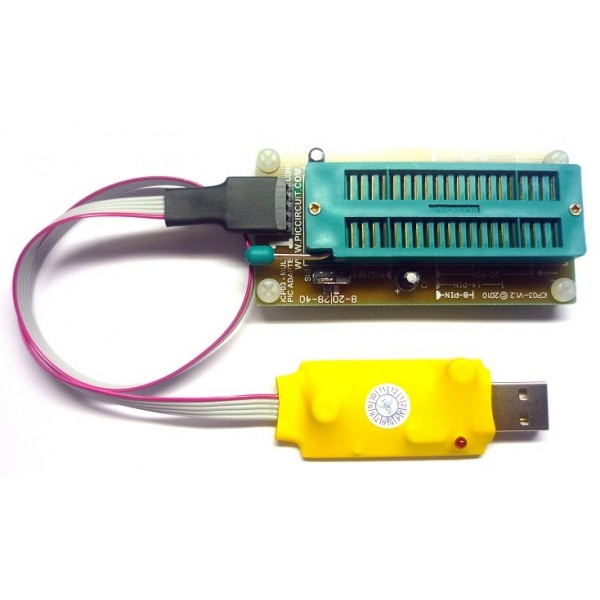
The Chinese have been copying Tony Nixon's classic K150 USB programmer, and are now selling 'em for dirt-cheap on ebay (example here). 
I bought one, and it works fine on my XP and Win7 machines - The programming software isn't as clean as PICkit, but it's still very workable. At well under 10 bucks apiece, you can afford to have one or two spares laying around. |
When I got started w/ PicBasicPro ~2005 I got the Lab-X1 Experimenter board with a lot of features like an LCD display, pots, keyboard, LED's etc, so you can take it with you and learn in a hotel room etc.

Everything from Melabs incl support in moments is turnkey and no pissing around as you get your feet wet. An inexpensive digital scope is also handy to have after you learn the basics. I like the older HP 54622A scopes [like new ones can be found on ebay for abt $250 or even less in the past month before classes start] because they are functionally and ergo-mentally similar to the new HP DSO's like the DSO X-2012A. 
I also bought an Owan DS7102V [good ratings, but there's just something abt it that seems a bit off after using the HP [now Keysight, "Richmond Squirrels" anyone ] stuff a year or so ago [about $400 but if I did it over, I'd buy another HP DSO X-2012A, and may do it anyhow's.
A 100 meg scope is adequate for me now since anything faster is likely RF and a spectrum analyzer is better suited. Don't worry initially what processor you chose, use the one that's well supported and has plenty of practice programs to use with this board, with tons of resources on forums. This is what to cut your teeth with, and although pricy fully built, there are partial kits, etc. Once you get the hang of what you're doing, like Ski says, there's so many inexpensive boards, etc, on ebay to expand with. Although, I think it's important for beginners like me to have a solid point of reference to begin to work from. Once you get a project in mind, for the quantities a home experimenter will do, just stay with the 40 pin do everything chip that's currently recommended for the Lab X-1. Like the PIC16F877A I used that board to develop the security device I've been working on, and then went to my own laid out board with an 18 pin 16LF88 [low voltage therefore less power, a few 100+ u-amps at 4 volts] processor. Code was the same pretty much... I use a simple but powerful PCB layout pgm called Sprint Layout and it's inexpensive and wonderful, and I'm sort of a wiz at using it after so much time together... 
Better for my needs than Eagle, etc, with all the exotic stuff that takes more time than I have to learn and will do tons of stuff I don't need. |
|
Quoted:
Some of this sounds really cool. I have the background but really haven't screwed about with micro controllers since my college labs when I got my BSEE. Any websites that you can suggest to get me back involved? Arduino's are arguably the most popular platform right now. This is where I started as a result. http://www.arduino.cc/ There is tons of beginner info if you surf around their site. And tons of online support to boot. Most Arduinos are based on the Atmel AVR series of 8-bit microcontrollers, which themselves have a lot of backing. One of the more popular retailers to the "hacker" community is a local company call SparkFun You could also check makershed and adafruit for parts and supplies. Raspberry Pi is another popular single board computer platform right now. You can run Linux one, which opens up a ton of possibilities. |
|
Quoted:
<snip> - Autonomous drones that fly patrol loops around your remote property and report back with live video. With current and cheaply available technology, an amateur can build a simple drone that can receive GPS coordinates and fly autonomously then return to where is started. Google "Ardupilot" Even a live-operated ground drone equipped with a camera could roam your property performing security patrols, leaving the operator out of harms way. The military already does this with tiny wheeled robots that can be tossed through the windows of unfriendly buildings. I may know a little something about this particular kind of thing.  The Ardupilot that 3-D Robotics sells is a piece of hardware that combines an easy-to-use Arduino compatible microcontroller with sensors and GPS to create a decent method of making a small UAS that can do basic things such as fly waypoints, etc. There is more than one code base that generates firmware that can be loaded onto the board: Arduplane (for fixed wing aircraft), ArduCopter (for helis and multi-copters), ArduRover (ground vehicles) and probably several more that I'm not aware of. Since the hardware design as well as the software libraries are open source, anyone can make them or change them as they please. HobbyKing has been selling a cheaper version for some time. They also designed their own derivative that is smaller and lighter (but omits some analog input lines) so it can be used in a much smaller vehicle. The Ardupilot that 3-D Robotics sells is a piece of hardware that combines an easy-to-use Arduino compatible microcontroller with sensors and GPS to create a decent method of making a small UAS that can do basic things such as fly waypoints, etc. There is more than one code base that generates firmware that can be loaded onto the board: Arduplane (for fixed wing aircraft), ArduCopter (for helis and multi-copters), ArduRover (ground vehicles) and probably several more that I'm not aware of. Since the hardware design as well as the software libraries are open source, anyone can make them or change them as they please. HobbyKing has been selling a cheaper version for some time. They also designed their own derivative that is smaller and lighter (but omits some analog input lines) so it can be used in a much smaller vehicle.
It's capability to fly a random vehicle out of the box is OK but not without issues. For a home-brew multi-copter, you can plan on spending quite a bit of time in the "tuning" (or breaking as it were) phase. For fixed wing, it's not too bad out of the box but some minor tweaks to the default parameters can make a big difference in its ability to hit waypoints, hold altitude correctly, etc. Still, the price of the unit is pretty cheap, especially when you consider how much that same capability used to cost less than 5 or 10 years ago, if you could even get it at all in a small package. |
|
Quoted:
Solar trackers are another great idea! You could even build a micro-sized unit that used an R/C servo and a 5-10watt panel for remote monitoring projects. I'd bet that a cruise control actuator out of an old junker car could also be operated pretty easily with a micro. 
Either one would also work great with a micro for building engine speed governors - perfect for home-brew generators. |


|
Quoted:
THESE are also nifty little PIC programmers - They use Microchip's PICkit programming software, so everything works smoothly. http://www.piccircuit.com/shop/349-thickbox/ica01-usb-pic-programmer-set.jpg The Chinese have been copying Tony Nixon's classic K150 USB programmer, and are now selling 'em for dirt-cheap on ebay (example here). http://imageshack.com/a/img536/7042/SGg1gI.jpg I bought one, and it works fine on my XP and Win7 machines - The programming software isn't as clean as PICkit, but it's still very workable. At well under 10 bucks apiece, you can afford to have one or two spares laying around. FYI most all modern PIC development boards and devices use ICSP -- in-circuit serial programming. this is in lieu of using a flash device which must be pulled from the board and inserted into a programming fixture. the PIC itself stays put on the board; using a PICkit dongle (or compatible) you attach a 6 pin cable to a header on the target board, and this provides the in-situ programming interface. moreover, this same interface is used by MPLAB and others as the in-circuit debugger ICD; you can single step through your code, set breakpoints, etc. example board, https://www.sparkfun.com/products/20 PICkit dongle, https://www.sparkfun.com/products/9973 ar-jedi |
|
Quoted:
FYI most all modern PIC development boards and devices use ICSP -- in-circuit serial programming. this is in lieu of using a flash device which must be pulled from the board and inserted into a programming fixture. Yes, both of the programmers I mentioned above support ICSP. However, having a ZIF socket on the programmer is still a nice touch - Often, you'll run into situations where the device's ICSP feature can't be used, particularly on the smaller chips with just a few pins. It's also handy for quickly loading the same code in a bunch of chips, without having to install them in their PCBs. Nowadays, the ZIF comes at very little additional cost, so there's no good reason not to have it. |
|
Quoted:
Yes, both of the programmers I mentioned above support ICSP. Quoted:
Quoted:
FYI most all modern PIC development boards and devices use ICSP -- in-circuit serial programming. this is in lieu of using a flash device which must be pulled from the board and inserted into a programming fixture. Yes, both of the programmers I mentioned above support ICSP. i see that, now that i have read the entire product ad..
ar-jedi |
|
Melabs in-ckt pgmr...
I used to use the serial one and they came out with a USB one. Model U2. Nice. It plugs onto the various Experimenter boards or actual device u-processor board and when developing code, you don't have to fiddle with moving chips. Plugs by standard 10 pin header [a floppy drive or audio or something ribbon cable]. Only 6 of the pins are actually needed so I layout the larger u-proc boards with the necessary pins to support on board programming. And if I add those pins I usually add the IIRC 8 or so to support a parallel LCD. One of my goals is to learn I2C 2 wire or whatever routines and have some 2 and 4 line serial LCDs but haven't tried to get them to work yet. They would sure eliminate some pins... Just make a chg in the code, click compile and program, and a few seconds later, your u-controller is running with the updated code. So if I need to try a slightly different parameter in the present project, that's how fast it ready to reevaluate. Very good to maintain interest and motivation. Pgmrs I remember the old days when my guys had to pgm a chip, then pull from the socket, place into the DUT and run. And repeat... A zillion times... 
They were happy when they got flash! |
|
Quoted:
I remember the old days when my guys had to pgm a chip, then pull from the socket, place into the DUT and run. And repeat... A zillion times...
They were happy when they got flash! Remember the ol' windowed processors that you had to "bake" under a UV light to erase? They weren't cheap, either - If you wanted to keep a stack of them around to play with your code, it was gonna cost ya!
|
| I have burnt so many eproms that I could walk to the moon on them. All of our older machines had their programs stored on eproms and every time an update was issued I had the wonderful job of burning a set of eproms for every machine. We are talking hundreds of machines. Old 6800 series processors and what was the other one 8000 series? |
|
Quoted:
Remember the ol' windowed processors that you had to "bake" under a UV light to erase? They weren't cheap, either - If you wanted to keep a stack of them around to play with your code, it was gonna cost ya!
Quoted:
Quoted:
I remember the old days when my guys had to pgm a chip, then pull from the socket, place into the DUT and run. And repeat... A zillion times...
They were happy when they got flash! Remember the ol' windowed processors that you had to "bake" under a UV light to erase? They weren't cheap, either - If you wanted to keep a stack of them around to play with your code, it was gonna cost ya!
when OTP's (one-time programmables) first came out, they were about 1/20th the price of a UV-eraseable windowed ceramic DIP. so, you could economically and efficiently just use OTP's as long as you could verify your design in less than 20 attempts...
ar-jedi |
|
Quoted:
One of my goals is to learn I2C 2 wire or whatever routines and have some 2 and 4 line serial LCDs but haven't tried to get them to work yet. They would sure eliminate some pins... Just make a chg in the code, click compile and program, and a few seconds later, your u-controller is running with the updated code. So if I need to try a slightly different parameter in the present project, that's how fast it ready to reevaluate. Very good to maintain interest and motivation. this is what makes CCS C for PIC so attractive. tons of built in libraries, tons of GPL'd libraries (i wrote the reference lib for onewire and i2c), and the ecosystem is well supported. i can't say enough good things about CCS C; it's ANSI C, it's cleverly extended to support the PIC and it's myriad of peripherals, and it works. the handling of HW interrupts, often the most problematic of issues with embedded programming, is so cleverly and cleanly done in CCS C that it makes you wonder why every compiler doesn't work that way. i have done quite a few projects at work, and of course the sensors of my home automation system is built with it, and it works well. the code/compile/program/run/debug cycle is so rapid that it makes really efficient use of time. http://www.ccsinfo.com/forum/ ar-jedi |
|
I agree with the OP. I have a few MSP430 Launchpads that I will spend this winter learning how to program. If I get good with those I will start with my MSP432 Launchpad. Anybody have any suggested uses for a Hercules Launchpad?
In the mean time, I will start with the simpler PSOC4. |
|
"An inexpensive digital scope is also handy to have after you learn the basics. I like the older HP 54622A scopes [like new ones can be found on ebay for abt $250 or even less in the past month before classes start] because they are functionally and ergo-mentally similar to the new HP DSO's like the DSO X-2012A."
OK- fess up... Who bought the NICE Agilent 54622A on ebay for only $150??? 
You otta be ashamed... And send it to me...
And share your highly refined hair-trigger reaction and motivational skiz with us...
|