


Posted: 7/28/2014 11:52:06 PM EDT
| I'm getting really interested in trying to can some stuff. Particularly stuff that's like a "meal in a jar" as well as just being able to buy stuff that's cheap in season and keep more of it. Can we get something started? |
|
Canning is a BIG topic. Lots to cover. I don't want to write a dissertation, so I'll keep it condensed.
Preserving the food you have is often a much better idea that trying to find more food in the future, when much of it is out of season. Canning is a great method. One thing to consider: Canned food is not particularly portable, especially when you consider the volume you may need. A can of veggies to go with lunch, and another for supper, means 365 cans times 2 for well over 700 jars. That's just a simplified example to highlight quantities. When we say "canning" we usually mean "water bath canning or steam canning in glass jars". Look for end of season sales, and many people give away old jars. Old solid glass jars with glass tops, wire bails and a solid rubber gasket are quite usable but don't buy them, even used. The gaskets are expensive and hard to find. If you get them free, great, otherwise, buy newer mason type jars. Lids are supposed to be single use only. I tend to example all used lids. If they are is pretty good condition, I keep them and toss em in a bag for potential future use. I always can with new lids, but should shit hit the fan, and I run out of new lids, I'll try reusing old lids. I would expect higher sealing fail rates. Water bath canning; Suitable ONLY for high acid foods. Tomatoes. Vinegar based recipes, etc. NOT suitable for meats, veggies. Greatly simplified, jars are boiled in water for 10 minutes to sterilize, and lids are sterilized. Jars are removed, quickly filled with hot, processed food, lids are placed on, and the filled jars are returned to the water bath and processed for XX minutes, depending on the recipe and the size of jar. This does two things: It further sterilizes the food and jar, and it heats contents, including air. As contents are heated, a little air if forced out under the lid. When the jar cools, contents contract, and dome lid is pulled down under slight vacuum. It is canned and preserved. Water bath canning kills most bacteria, while acid levels prevent growth of a few other bacteria, particularly the one responsible for botulism. Water bath canning low acid foods can lead to botulism, and cooking canned foods contaminated with botulism will NOT make that food safe. Steam/pressure canning: You can water bath can in a steam canner (just don't close the lid). You can also pressure can. Dump food into clean jars. Put on lids. place in canner, with some water in bottom., Screw on lid, heat until steam vents for 10 minutes. Place weight on vent, and wait for vent weight to move. Continue to process for XX minutes. TUrn off heat and then remove product after waiting an hour or two. Pressure canning uses higher temperatures than water bath methods, and these temps kills ALL bacteria, meaning this method is safe for even low acid foods. You can process veggies and meats. Equipment: You need a canner . For water bath, this is just a big stock pot. For pressure, you need a pressure canner. I own and have used all sorts. Spend the money and buy an All American. They are worth it. Buy a big one. You can process a small batch in a large canner, but you cannot process a large batch in a small canner. And for SHTF purposes, you'll need to process large batches. Book: Buy the Ball's Blue Book of Canning. lots of good techniques and recipes. DO NOT follow grandma's old recipes from the '40's. Lots of dangerous recipes back then. You'll need, jars, lids, a jar lifter (sort of plier thingie you use to reach into hot water, grab a jar and remove a jar), and a lid lifter (magnet on the end of a stick). Also a wide mouth funnel. A couple hundered dollar investment in equipment will last a lifetime. Fro |
|
"Meal in a jar" type foods would more than likely require pressure canning.
Meats and low acid vegetables also require pressure canning. Ball Blue Book is an excellent source of info. I also use Packyourown.com for info. Water bath canning is easy and basic, I did it for yours. Pressure canning the first few times was a bit nerve racking as there is a pressurized container sitting on the stove, but after a few times it's also easy. I watch out for sales on vegetables and meats. As I find them, they go into jars and then in the pantry for winter. Last week the local Wally World had ear corn for $0.10 per ear so I got 40 ears and that made 14 pints. I saw in a sale ad yesterday that a local grocery has bone in chicken breast for $1.00/ lb. I plan on getting 40 lbs, strip off the bones, can the meat and make broth and can. |
|
In addition to the Ball Blue Book,
another good free source is: http://nchfp.uga.edu/publications/publications_usda.html |
|
Quoted: I'm getting really interested in trying to can some stuff. Particularly stuff that's like a "meal in a jar" as well as just being able to buy stuff that's cheap in season and keep more of it. Can we get something started? |
|
Homestead, Farm & Garden, a forum two slots below this forum, has lots of gardening info and several canning threads.
That is a more appropriate forum for such a thread. |
|
One comment on the meal in a jar....
Generally, you will be better off canning ingredients. You will have greater flexibility in what you cook. Additionally, process times vary quite a bit. If you canned a chicken stew, you would process using the time for chicken, but by the time it was done your vegetables might be annihilated. |

| Consider Tattler reusable canning lids We use them with great success. Granted the do cost more than the one use and you are done lids, but come SHTF how great will it be to have your shelves full of reusable jars and lids. You can buy extra gaskets to put back too. |
|
Quoted: One comment on the meal in a jar.... Generally, you will be better off canning ingredients. You will have greater flexibility in what you cook. Additionally, process times vary quite a bit. If you canned a chicken stew, you would process using the time for chicken, but by the time it was done your vegetables might be annihilated. I agree with this statement. I've tried chili and stew and it was edible, but it wasn't good chili or stew. I prefer pressure canning to water bath canning, it's just easier to keep the times, it's cut and dry. Plus it doesn't heat up the house much. Canned meat is delicious! Most of my canned meat used to be venison, and I guess so far it still is till I eat it, but I've been canning more beef lately. I also flip flop on weather I can in quarts or pints. Wide mouth jars are a lot easer to clean and get meat out of. The nice thing about pressure canning meat is how easy it is. You basically just put the meat in the jars and process. You don't have to precook it unless you want to brown it or something. It is rather time consuming, you have to let it vent for 10 minutes before you even put the pressure regulator on, then it has to come to pressure. Then process for an hour an a half (for quarts), the depressurising. You don't' want to rush this, just let it come down and cool off on it's own. Don't just yank the lid off, I loosen it first and let it sit a few minutes, then crack the lid and let it sit a few more. If you take the jars out too soon they will be superheated and liquid will boil out. I have an all American 921, and an old national #7 that I refurbished and put all American vent tube and jiggler on. I strongly suggest that you get a pressure canner with a jiggler that lets you select different pressures. Not the one that is just preset at 15lbs. You probably don't need 15lbs unless you live at high altitudes. You don't have to have your pressure gauge checked, as the pressure is regulated by the jiggler. The gauge is nice though, you can keep tabs on how fast pressure is rising and know when it's depressurized. My latest batch of meat. I did pints of beef. 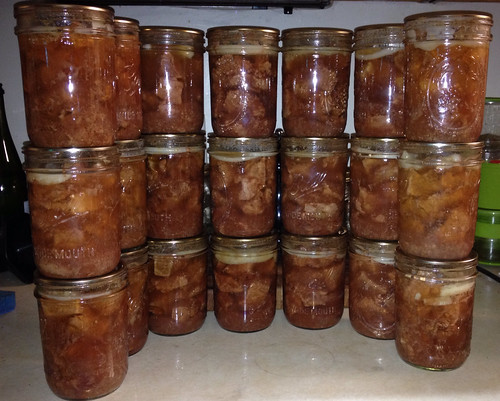 This is my all American 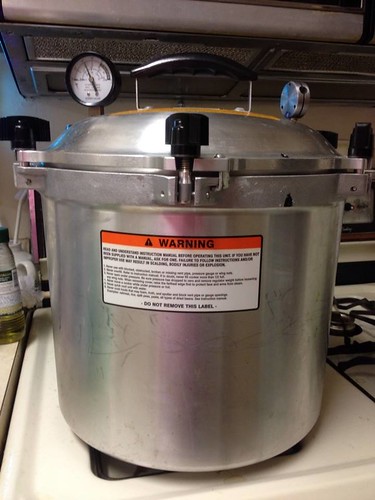 This is a poor pic of my old national. I've since replaced the wooden handles with resin ones. I have extra gaskets as well. 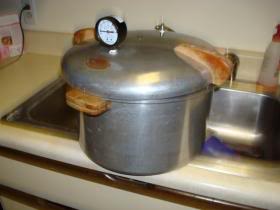 They both hold 7 quarts but the all American can also double stack pints, 19 of them. I like having 2 of this size instead of one huge one because I can move them for one thing. And It's flexible, I can either crank both of them up, or just one. |
|
Quoted: Soups always come to mind if you're looking for a meal in a can/jar. Chicken vegetable and beef vegetable have worked well for me in the past. Both should be done in a pressure canner as they require temps above 212*F to kill the bacteria that may be present. Actually it's the spores you are killing. The bacteria are relatively easy to kill. Gram positive rods produce spores that can withstand a lot of punishment. That's what botulism is. I boil chicken and turkey carcasses and make stock to can. I also can scraps for my doggies. 
|
|
Quoted: Consider Tattler reusable canning lids We use them with great success. Granted the do cost more than the one use and you are done lids, but come SHTF how great will it be to have your shelves full of reusable jars and lids. You can buy extra gaskets to put back too. I have some of those. I also have some from another company. Got some extra gaskets too. The other ones are a little easier though. I figure they will outlaw canning sooner or later, you can't have the populace doing things for themselves. When they outlaw canning only outlaws will can. With tattler lids. |
|
I don't know if tattler will do it again but they had a sale last year that hit across the net and got them a ton of business. Took a long while to fill the last orders but they did it and the product is good. Tattler has a little test set, just a couple lids as I recall, so you can try it out and see what you think. Ball blue book is the book to get and get the new one. I do like having the old ones around but for getting started I am sticking to the new super duper worried book vs. the old book that did things some folks say not to do now. I am a newb on canning though. Waldo has some good threads on it and I know others have done threads as well. |
|
Quoted: Actually it's the spores you are killing. The bacteria are relatively easy to kill. Gram positive rods produce spores that can withstand a lot of punishment. That's what botulism is. I boil chicken and turkey carcasses and make stock to can. I also can scraps for my doggies. Quoted: Quoted: Soups always come to mind if you're looking for a meal in a can/jar. Chicken vegetable and beef vegetable have worked well for me in the past. Both should be done in a pressure canner as they require temps above 212*F to kill the bacteria that may be present. Actually it's the spores you are killing. The bacteria are relatively easy to kill. Gram positive rods produce spores that can withstand a lot of punishment. That's what botulism is. I boil chicken and turkey carcasses and make stock to can. I also can scraps for my doggies.  |
|
yep, I'd rather can whole tomatoes or tomato sauce than chili, spagetti sauce etc. That leaves your options open.
I canned venison and it was ok but it was a bit overcooked and a bit salty for my tastes. Maybe I did something wrong. I did a few batches and it kept well for a few years before I used it all up before moving. I did quarts of cubed stew both hot pack and cold pack, and thin slices in pint jars. I canned about a half a deer. I prefer well wrapped frozen to the canned but the beauty of having some canned is you don't have to worry about appliance failure and you can pack it with you camping if you're going car or boat camping. I ain't packing jars on my back even though I've done it before. I'd like to do some beef and chicken to see how it comes out. ETA- vension canning is the whole reason I bought an all american 915,.....then a new 921 from a friend who never used it. In hind sight, big cans of tomatoes in all varieties go on sale often enough that I may be better off growing and canning other stuff like green beans and such. (Green beans need a pressure canner.) |