


Posted: 11/19/2010 3:28:44 PM EDT
| Looking at a Generac propane generator since I have a 500 gallon underground propane tank. What are the advantages and disadvantages of propane vs diesel? How much propane does a 10kw genny use? |
|
A few years back when I had purchased NG Briggs http://norwall.com/ had the best price Here is the link for the Generac from Norwall http://www.norwall.com/product_info.php?manufacturers_id=6&products_id=1000&osCsid=14aa07f1cac6892b0360ab5b318933d3 Home Standby type Fuel Consumption 1/2 Load - LP 1.25 gal/hr Full Load - LP 1.93 gal/hr If you a looking for Portable Propane 10kw... not sure what brand names they have on the market... My 2 cents stay with Honda or Briggs... any lawnmover shop could repair if need be Here is what I had done before I got my 18KW ng Home stand by Gas Portable Briggs and a Conversion Kit p/n: 650-444 Carburetion & Turbo Systems |
|
My local Costco had one of these for 1900 with a transfer switch.
Costco.com has a Cummins Onan 20kW that uses the following 1/4 load 1 gal/hr 1/2 load 1.5 gal/hr 3/4 load 2.1 gal/hr Full load 3.1 gal/hr Info is from the spec sheet link on Costco.com web site. For the Onan RS 12000 9/11 kW, those are 1, 1.2, 1.5, 2.1 gal/hr at the above loads.l |
|
Quoted:
What are the advantages and disadvantages of propane vs diesel? Advantages: 1. The propane version will usually cost quite a bit less, since the engine is not much different from a gasoline-fueled generator. 2. Propane fuel stores indefinitely, without any worries about algae, water or other contamination. 3. Engine maintenance is relaxed, since propane burns very clean - Longer oil change intervals, less fuel dilution. 4. Very little exhaust odor. 5. 3600 RPM propane engines tend to be quieter than 3600 RPM diesel engines. 6. Starts easier in cold weather. 7. Engine is smaller and weighs considerably less than a diesel engine of comparable power. Disadvantages: 1. Engine lifespan is much shorter - roughly comparable to a gasoline-fueled generator. 2. Consumes a much greater volume of fuel per KW, mostly because propane doesn't contain nearly as much heat energy as diesel. 3. Requires specialized equipment to refill the tank - You can't just siphon fuel out of an F-350 or a farm tractor. 4. Fuel economy gets much worse when powering small loads, due to engine "pumping" losses. How much propane does a 10kw genny use?
Typical fuel consumption is around 1/4 gallon of propane per hour, for every 1,000 watts of electrical load. For example, if you're powering a 4 KW load, your generator will use around 1 gallon per hour. |
|
I looked into Generac, Kohler, Guardian, and one other brand whose name escapes me... and ended up going with Kohler.
Nothing against Generac... lots of places sell them (though they can be a challenge if they need service), but when I looked behind the local EOC, hospitals, and other mission-critical facilities? I saw Kohler. A lot of the RV and boating crowds also swear by them. Mine: 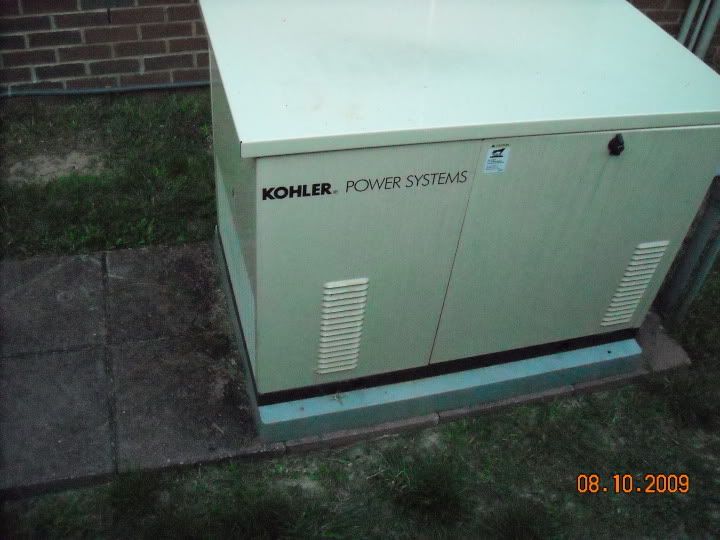


Runs off propane, or NG (mine is on NG)... and is basically fire-and-forget. It automatically starts up when the mains go offline, waits a few seconds for the field to stabilize, then kicks the household load onto the genset. When main power comes back online, it kicks the household load back to the mains, then runs a cool-down cycle for about ten minutes, and shuts itself off. Great peace-of-mind... and it beats storing hundreds of gallons of diesel or gasoline. |
| This is also relivant to my interests as all I currently have is a small gas genny that powers just my furnace, fridge, and kitchen lights/outlets. I would like a larger genny to be able to be more "comfortable" durring short term outages and to have more flexablilty. Problem is I am kinda KwH retarted. I know I currently use 20 KwH a day on average. I would hope that if I needed to use the genny that we would be able to cut that in half (not using clothes drier, or dish washer, only having on TV pluged in and used, unplug the desk top and use only the laptop, etc.). So what would be a good rough idea of how much LP would be used a day by using 10 KwH a day average? Reason I ask about the LP is that I get it for $1.00 a gallon, but it has to be in "portable" containers at that price so I am limited to 100 lb tanks. |
|
I love this idea, and I just moved to a house that has a 500 gallon LP tank but as I've learned, that tank costs a friggen arm and a leg to fill. Currently 2.60 per gallon. This is a concern.
And, has anyone thought about how to get replacement LP during a crisis??????? |
|
Quoted:
And, has anyone thought about how to get replacement LP during a crisis??????? Most propane dealers need utility power to operate their pumps - They can't fill a tank or load a propane delivery truck without it. Even if you assume one of your local dealers will get a generator running during an extended power outage, they're probably going to be swamped with customers and deliveries. If you live in an area where power outages are routine (ice storms, etc.), you might have better luck - Your local propane dealers might have already made the investment in backup power. Most folks buy their propane generators in relatively large sizes - 10 KW and up. Those big generators won't run very long on a 20 pound barbecue tank. Even when powering small loads, they use quite a bit of fuel. |
|
Quoted:
This is also relivant to my interests as all I currently have is a small gas genny that powers just my furnace, fridge, and kitchen lights/outlets. I would like a larger genny to be able to be more "comfortable" durring short term outages and to have more flexablilty. Problem is I am kinda KwH retarted. I know I currently use 20 KwH a day on average. I would hope that if I needed to use the genny that we would be able to cut that in half (not using clothes drier, or dish washer, only having on TV pluged in and used, unplug the desk top and use only the laptop, etc.). So what would be a good rough idea of how much LP would be used a day by using 10 KwH a day average? Reason I ask about the LP is that I get it for $1.00 a gallon, but it has to be in "portable" containers at that price so I am limited to 100 lb tanks. I try to be 'comfortable' only rarely. 
|
|
Quoted:
Quoted:
What are the advantages and disadvantages of propane vs diesel? Advantages: 1. The propane version will usually cost quite a bit less, since the engine is not much different from a gasoline-fueled generator. 2. Propane fuel stores indefinitely, without any worries about algae, water or other contamination. 3. Engine maintenance is relaxed, since propane burns very clean - Longer oil change intervals, less fuel dilution. 4. Very little exhaust odor. 5. 3600 RPM propane engines tend to be quieter than 3600 RPM diesel engines. 6. Starts easier in cold weather. 7. Engine is smaller and weighs considerably less than a diesel engine of comparable power. Disadvantages: 1. Engine lifespan is much shorter - roughly comparable to a gasoline-fueled generator. 2. Consumes a much greater volume of fuel per KW, mostly because propane doesn't contain nearly as much heat energy as diesel. 3. Requires specialized equipment to refill the tank - You can't just siphon fuel out of an F-350 or a farm tractor. 4. Fuel economy gets much worse when powering small loads, due to engine "pumping" losses. How much propane does a 10kw genny use?
Typical fuel consumption is around 1/4 gallon of propane per hour, for every 1,000 watts of electrical load. For example, if you're powering a 4 KW load, your generator will use around 1 gallon per hour. if you get a diesel genny, if at all possible, get one that runs at a lower rpm - many run at 1800rpm - noise is less and life of the genny is generally extended. another benefit of the diesel is that you can be creative w/ your fuel. for example, you could run the obvious waste vegetable oil, but you can also burn transmission fluid and waste engine oil, peanut oil, etc. of course you're going to need a good filtering setup. |
|
Quoted:
I looked into Generac, Kohler, Guardian, and one other brand whose name escapes me... and ended up going with Kohler. Nothing against Generac... lots of places sell them (though they can be a challenge if they need service), but when I looked behind the local EOC, hospitals, and other mission-critical facilities? I saw Kohler. A lot of the RV and boating crowds also swear by them. Mine: http://i251.photobucket.com/albums/gg286/TGrayman/generator/exterior.jpg http://i251.photobucket.com/albums/gg286/TGrayman/generator/interior.jpg http://i251.photobucket.com/albums/gg286/TGrayman/generator/transferswitchguts.jpg http://i251.photobucket.com/albums/gg286/TGrayman/generator/transferswitchgenpower.jpg Runs off propane, or NG (mine is on NG)... and is basically fire-and-forget. It automatically starts up when the mains go offline, waits a few seconds for the field to stabilize, then kicks the household load onto the genset. When main power comes back online, it kicks the household load back to the mains, then runs a cool-down cycle for about ten minutes, and shuts itself off. Great peace-of-mind... and it beats storing hundreds of gallons of diesel or gasoline. Nice setup. I don't have natural gas in my neighborhood yet. The gas company had plans to run lines out here, but have halted due to the economy. We should have NG within 5 years. What is required to convert a propane generator to natural gas? Just change the orifice? |
|
Quoted:
I don't have natural gas in my neighborhood yet. The gas company had plans to run lines out here, but have halted due to the economy. We should have NG within 5 years. NG isn't without its drawbacks, either. Typically, gas lines are buried right next to power lines, in the same easements. When a contractor digs into a gas line, the fire tends to also burn through the power lines in short order. Result: No power, and no gas service. Also, NG service isn't guaranteed during a long-term power outage - most pumping and monitoring equipment runs on utility power. In earthquake-prone areas, NG service may be shut off as a routine safety precaution - even in the absence of any pipe ruptures. |
|
Quoted:
Quoted:
I don't have natural gas in my neighborhood yet. The gas company had plans to run lines out here, but have halted due to the economy. We should have NG within 5 years. NG isn't without its drawbacks, either. Typically, gas lines are buried right next to power lines, in the same easements. When a contractor digs into a gas line, the fire tends to also burn through the power lines in short order. Result: No power, and no gas service. Also, NG service isn't guaranteed during a long-term power outage - most pumping and monitoring equipment runs on utility power. In earthquake-prone areas, NG service may be shut off as a routine safety precaution - even in the absence of any pipe ruptures. So would it be feasible to run the generator on natural gas up until the point that service is interrupted, then switch to propane back up. NG is much cheaper than LP in this area. |
|
Quoted:
I looked into Generac, Kohler, Guardian, and one other brand whose name escapes me... and ended up going with Kohler. Nothing against Generac... lots of places sell them (though they can be a challenge if they need service), but when I looked behind the local EOC, hospitals, and other mission-critical facilities? I saw Kohler. A lot of the RV and boating crowds also swear by them. Mine: Snip Couple questions. How loud is it? Could you rig it to burn NG coming from the utility or switch to propane if the need arises? |
|
Quoted:
Quoted:
I looked into Generac, Kohler, Guardian, and one other brand whose name escapes me... and ended up going with Kohler. Nothing against Generac... lots of places sell them (though they can be a challenge if they need service), but when I looked behind the local EOC, hospitals, and other mission-critical facilities? I saw Kohler. A lot of the RV and boating crowds also swear by them. Mine: Snip Couple questions. How loud is it? Could you rig it to burn NG coming from the utility or switch to propane if the need arises? They advertise that it's about like a vacuum cleaner... and that's probably pretty close. Mine isn't visible from the road, and is well buffered by vegetation and a privacy fence. You can hear it from the street, but it's not obnoxious. Mine is currently set to burn NG from the utility... though they also burn propane. I don't know how difficult a field conversion to Propane would be, but they're both gaseous fuels, so I suspect it wouldn't be too involved. |
|
Quoted:
would it be feasible to run the generator on natural gas up until the point that service is interrupted, then switch to propane back up. Yes, although I'd definitely want to know how involved the changeover process is before choosing any particular model. |
|
Quoted:
Quoted:
would it be feasible to run the generator on natural gas up until the point that service is interrupted, then switch to propane back up. Yes, although I'd definitely want to know how involved the changeover process is before choosing any particular model. I've known a few people who converted gas logs and a furnace from propane to NG. The gas company sent their tech out to change the orifice. Didn't take them long, but unlike me, they know what they are doing. |
| I have a Generac that is a 16KW. I did an addition to my house and upgraded to a 1000 gal propane tank. At a full load I believe it's 2.5 gallons an hour but I don't run a full load. I did look at the bigger model 20K and that was getting me into the liquid cool engines. I got the biggest air cooled I could get. I figured that if it crapped out for the price I can get the parts easier or if all else fails replace it. I ran me $2600 and I've had it for about 8 years. It's not that loud and I don't think the wife will ever have a house without one. |
|
Quoted:
Quoted:
would it be feasible to run the generator on natural gas up until the point that service is interrupted, then switch to propane back up. Yes, although I'd definitely want to know how involved the changeover process is before choosing any particular model. For the small units, it's extremely easy (yellow=NG, Black=propane). The QD connects are a little pricey... 
|
|
Quoted:
Quoted:
Quoted:
I don't have natural gas in my neighborhood yet. The gas company had plans to run lines out here, but have halted due to the economy. We should have NG within 5 years. NG isn't without its drawbacks, either. Typically, gas lines are buried right next to power lines, in the same easements. When a contractor digs into a gas line, the fire tends to also burn through the power lines in short order. Result: No power, and no gas service. Also, NG service isn't guaranteed during a long-term power outage - most pumping and monitoring equipment runs on utility power. In earthquake-prone areas, NG service may be shut off as a routine safety precaution - even in the absence of any pipe ruptures. So would it be feasible to run the generator on natural gas up until the point that service is interrupted, then switch to propane back up. NG is much cheaper than LP in this area. I have a 16kw Generac and mine only requires flipping a switch under the air filter. 1 minute tops. Grove |
|
Quoted:
Looking at a Generac propane generator since I have a 500 gallon underground propane tank. What are the advantages and disadvantages of propane vs diesel? How much propane does a 10kw genny use? I have a 3200 sq ft house with a propane furnace, kitchen stove, and water heater. When I purchased the house it already had a 500 gallon tank and when I installed my 16kw Generac I added a 2nd 500 gallon tank. Truthfully I don't know the consumption of my house to really forecast the total run time available but just the generator at full load would suck a full 500 gallon tank dry in 6 days (400 gallons 24hrs/day @ 2.5gph). Having been through multiple 10+day outages from ice storms I decided having the extra tank was worth it. Why spend several thousand on a generator and install and then run out of gas? I keep my 2nd tank full all the time so I know that I have a minimum of 400 gallons at the ready. But another benefit of having extra capacity is that you could buy when the price is low and run longer when it is high. If I could have a do over I would purchase a smaller unit and only run critical circuits. With the 16kw we are able to use both electric ovens while doing laundry (electric dryer). This is with the rest of the house operating normally and the voltage @ 123v 59hz. This is just stupid and fuel wasteful but it was 3 or 4 years ago when I was tasked with selecting generators for a group, mother's house, father's house, and a few family friends, who's homes are larger than mine and all have multiple HVAC systems. I got a deal on multiple 16kw Generacs and thought bigger is better, I was wrong. If somebody had a big house in a hurricane area with the needs for A/C maybe but not here where ice storms are the primary problem. A post above detailed the Kohler vs Generac and being the owner of over a dozen generators I would have to agree with him that Kohler is superior to Generac. Keep in mind this is from someone who purchased 5, owns 1, and handles service on 3. I'm not dogging Generac but to me the order goes something like this, CAT, Onan, Kohler, Generac/Briggs (Honda/Yamaha excluded). Once again nothing wrong with them but there are better. Please keep in mind that in 3 1/2 yrs of service our only problem was a starter. Grove |