


Posted: 7/12/2009 9:53:54 AM EDT
|
I have looked around at all of the Jerry Can and then I though why not get anouth 30 gallon gas tank and mount it on the roof rack. 240lbs shouldn't be too much. Feed a gravity line down to the existing tank with a switch.
Go or no? |
|
If you own a diesel I saw these 55 gallon replacement tanks. They are way too pricey for me but they fit in the factory gas tank location.
http://www.xtremediesel.com/search.aspx?manufacturer=87&gclid=CImB0vzl0JsCFU1M5Qod_0rxMA 
|
|
Quoted:
240lbs is pretty heavy. I not sure how much roofs will hold up, but probably not 240lbs, maybe a 100lbs is more likely?
I have looked around at all of the Jerry Can and then I though why not get anouth 30 gallon gas tank and mount it on the roof rack. 240lbs shouldn't be too much. Feed a gravity line down to the existing tank with a switch. Go or no? What happen if you have an equipment mishap you potential could loose a lot of your fuel. The reason I say that is that I saw pre-smog controlled VW bus that had a gas tank above the engine compartment, somehow there was a fuel leak from the tank, and POOF! the whole bus goes up in flames from gavity feed gasoline flow that the owner was unable to stanch. Thank goodness no body was hurt, but the VW bus was a total loss. |
|
Paul, just because I have to answer "dadee I have to go to the bathroom!" doesn't mean I want to buy gas.
Quoted:
I have looked around at all of the Jerry Can and then I though why not get anouth 30 gallon gas tank and mount it on the roof rack. 240lbs shouldn't be too much. Feed a gravity line down to the existing tank with a switch. Go or no? Though I find no fault with a long range vehicle; I have to say no go. The 240 pounds will be at the highest point of the BOV, and gas is a liquid that does slosh. You are creating a vehicle combination that desperately wants to roll over; it will have unpleasant handling, and ride characteristics. In trucking some of the most demanding and dangerous trucks to drive are tankers(so they said in trucking school); remember that sloshing liquid I mentioned? I have driven a baffled tanker and they really aren't too bad, but the fuel tanks in autos only baffle a quart of fuel at the pickup point and leave the remaining 29.75 gallons free to slosh. The most difficult, sloppy handling, and desperately seeking to roll over truck I ever drove was a crane on a bobtail truck. The truck was fully loaded with just the crane and most of the weight of the crane was in the steel boom which stowed above the cab for road travel. 200 pounds of fuel sloshing about that high in your BOV would probably not be fun to ride with. |
|
OK I routinely put 15 gallons of fuel on the roof and 20 gallons of water in the truck while doing some of the more extreme off-road trips. We're 75-150 miles off road for four days and three nights. I've never needed more than five of those gallons of fuel to make it there and back but carry the extra ten for others and a reserve. The trips are better than 300 miles round trip and I enjoy passing the desert gas stations with their over inflated priced gas on the way home.
My BOV has a truck frame and I don't really notice the fuel. I also toss 40-50 pounds of firewood up there too. We do a mixture of expedition trail running at speeds and crawling though some pretty tough spots. If you're so off camber than your 4200 pound truck is going to roll over due to the extra 240 pounds on the roof you're pretty freaking hard core! 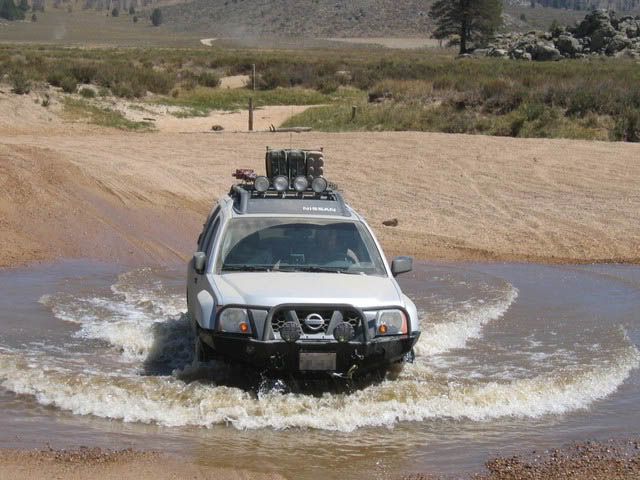
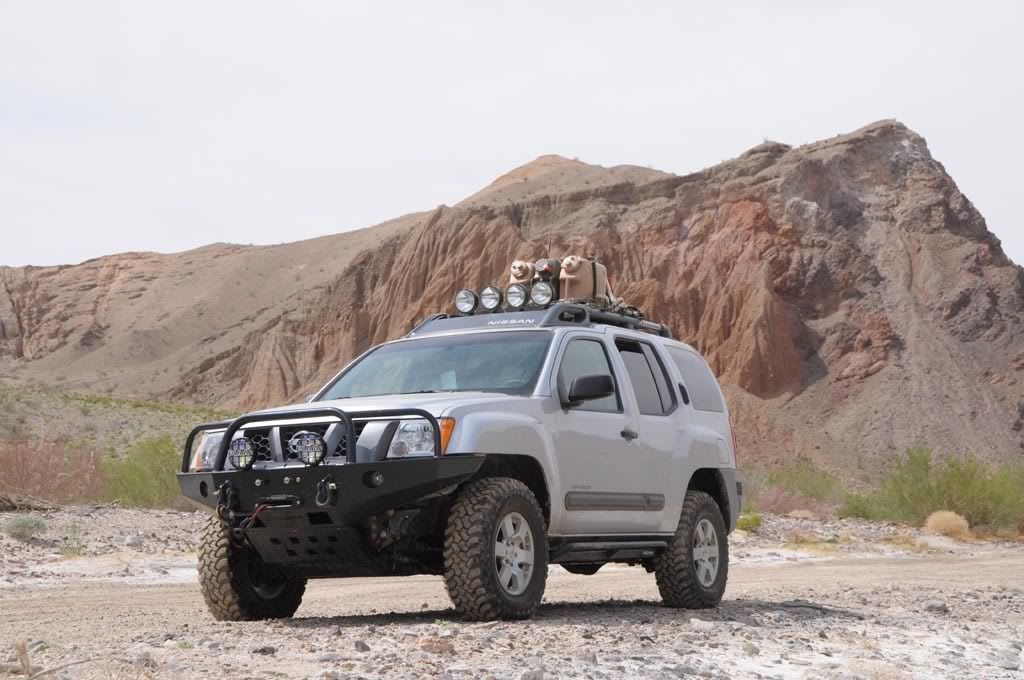
|
| In terms of being able to support the weight you should be good to go, modern vehicles have to be designed to support the weight off the vehicle of it were to roll over. However you are definitely going to change the center of gravity/mass of your vehicle and the handling characteristics will change. |
|
Paul you keep your gas in 5 gallon containers. If you give 1/2 of a can to a club member you only have 2.5 gallons or about 16.25 pounds to slosh and weight shift above your roof.
The OP wants to use a 30 gallon vehicle gas tank which is unbaffled. Take 5 gallons out of the tank and the op has over 160 pounds that can shift around. This weight shift will probably not be an issue when crawling, but could be very dangerous in a highway speed evasive maneuver (don't tell me you have never done a rapid lane change to keep someone from hitting you) or in the event of a catastrophic tire failure (blowout). I too have hauled liquid off road and off camber; 32,000 pounds (8 cubic yards of concrete), but the off camber off road part was slow and I did not suffer a blowout. I've also seen the remains of a friend smeared on the hwy by 28,000 pounds of concrete and a front tire blowout 60 mph. Weight shift at hwy speed is dangerous and something to be abated. I can't support someone rigging for such handling characteristics in clear conscious. ETA paragraph ETA2 Thanks for the pics Paul |
|
Quoted:
Paul you keep your gas in 5 gallon containers. If you give 1/2 of a can to a club member you only have 2.5 gallons or about 16.25 pounds to slosh and weight shift above your roof. The OP wants to use a 30 gallon vehicle gas tank which is unbaffled. Take 5 gallons out of the tank and the op has over 160 pounds that can shift around. This weight shift will probably not be an issue when crawling, but could be very dangerous in a highway speed evasive maneuver (don't tell me you have never done a rapid lane change to keep someone from hitting you) or in the event of a catastrophic tire failure (blowout). I too have hauled liquid off road and off camber; 32,000 pounds (8 cubic yards of concrete), but the off camber off road part was slow and I did not suffer a blowout. I've also seen the remains of a friend smeared on the hwy by 28,000 pounds of concrete and a front tire blowout 60 mph. Weight shift at hwy speed is dangerous and something to be abated. I can't support someone rigging for such handling characteristics in clear conscious. ETA paragraph ETA2 Thanks for the pics Paul There was a shop in Australia that made add on gas tanks underneath vehicles in the open areas. If I can dig it up. They were adding 50 gallon tanks if my memory serves me right. I have 6 Jerry cans I would use if I needed to bug out somewhere. |
|
Gas actually weighs 6 lb/gallon, water is 8 lb/gallon. I wouldn't do it without baffles or compartments. That much weight that high up sloshing arround could be enough to flip over in extreme manuvers. If you do do it, don't pump out of the tank until the main tank is 7/8 empty. Then dump as much as will go into the main tank, and add more as the tank empties.
I used to drive a converted 6x6 fire engine for the VFD. The tank was unbaffled. It was fine to drive full or empty, but a death trap on the highway otherwise. We would dump the tank unless we could refill close to the fire. I know of an almost identical unit that flipped during water transfer. The guys drafted half a tank, and the engine on the scene called on the radio, and said they were going to pull the guys out of the building and move to an exterior attack unless they got more water soon. The guys laft the pond with a half full tank, and probally at a high rate of speed- they never made it. |
|
Quoted:
Go with a Hitch mounted Cargo carrier and mount a tank on it, or 5 gal gas can on it. my harbor freight model holds 6 5 gallon cans. Mounted on the roof may not be dot approved methid.. I haven't tried that yet but a number of folks with Jeeps that have said they could feel the difference in handling and control with a loaded hitch carrier; it reduces the weight on the front wheels noticeably if you really load it. Perhaps not as much of an issue with a large pickup or other longer vehicles with a lot of front end weight. |
|
Quoted:
Quoted:
Paul you keep your gas in 5 gallon containers. If you give 1/2 of a can to a club member you only have 2.5 gallons or about 16.25 pounds to slosh and weight shift above your roof. The OP wants to use a 30 gallon vehicle gas tank which is unbaffled. Take 5 gallons out of the tank and the op has over 160 pounds that can shift around. This weight shift will probably not be an issue when crawling, but could be very dangerous in a highway speed evasive maneuver (don't tell me you have never done a rapid lane change to keep someone from hitting you) or in the event of a catastrophic tire failure (blowout). I too have hauled liquid off road and off camber; 32,000 pounds (8 cubic yards of concrete), but the off camber off road part was slow and I did not suffer a blowout. I've also seen the remains of a friend smeared on the hwy by 28,000 pounds of concrete and a front tire blowout 60 mph. Weight shift at hwy speed is dangerous and something to be abated. I can't support someone rigging for such handling characteristics in clear conscious. ETA paragraph ETA2 Thanks for the pics Paul There was a shop in Australia that made add on gas tanks underneath vehicles in the open areas. If I can dig it up. They were adding 50 gallon tanks if my memory serves me right. I have 6 Jerry cans I would use if I needed to bug out somewhere. Here are three threads over at the IH8MUD.com Expedition forum; it's geared to FJ-80 Toyota's but you might find some good info: Aux/Long Range fuel tank designs How do you carry fuel Inside fuel storage Since Paul showed pics of his, I'll show pics of mine. Here's how I roll when I'm out in the back country of the Mojave or Nevada deserts: '85 Toyota 4runner with 17 gallon OEM tank plus 26 gallon Blazer NOS diesel aux fuel tank plus 5 gallon jerry can, about 45 usable gallons total. That's a minimum of 450 mile range off road, up to 650-700 miles on road. Here's my 4runner at the Barker Ranch last summer before it got burned down last May. The Barker Ranch is where Charlie Manson was caught back in the '70's for the Sharon Tate murders. There is a 26 gallon aux fuel tank underneath where the spare tire used to go just aft of the rear axle. As you can see from this pic, it doesn't hang down more than a normal spare tire would, giving great clearance. 
For on road tow vehicle, like my diesel pickup, nothing beats carrying a 90 gallon aux fuel tank for a total of 138 gallons of diesel goodness. Even when towing my Toy on my 10k lb car hauler, I still have a +1500 mile range with over 2200 miles when not towing. For example, for summer 2006 and 2008, my son and I towed over 12,000 miles on our two summer trips, yet we only stopped for diesel fuel about 4-5 times each trip. It's nice being able to fuel up on my schedule and take advantage of lower fuel prices to boot. Here's my '06 PSD with the Toy on my car hauler; this pic was taken early morning, July 2006 in the Black Rock Desert, NW Nevada; that's Black Rock Point in the background. 
|
| This would solve the slosh problem. You may be able to find a cheap used one online. |
|
I take it that the foamed version is to prevent sloshing(foam as baffle)? Without any baffle that tank is a 33 inch by 17 inch bucket. An unbaffled tank of those dimensions half full will have 110 pounds of fuel that is free to shift it's effective weight 7 inches one way and 11 inches another(can scan textbook pages If anyone needs proof). A wise person would not put 110 pounds on the roof that is not securely strapped down |
|
Quoted:
Question for Paul, Do you head out of town with the gas cans full or do you fill them up when you get close to the AO? Quoted:
snip.. I enjoy passing the desert gas stations with their over inflated priced gas on the way home. snip... Based on this and other posts I think Paul uses his favorite regular fuel station and travels full from there. |
|
There are some decent threads on a lot of forums dealing with diesel pickups about adding fuel capacity and how to get that fuel into the truck without having to manually siphon it or pump it in.
The post mentioning the gravity feed vw van that burned to the ground is one reason why I do not like a permanent gravity feed setup. I love to use my siphons for moving fuel, but I use them and remove them because I want control of that fuel and I like 5 gallon fuel cans because you can plan around completely emptying them and that way you have little sloshing going on. Even if it costs a whole lot I highly recomend you read up on what people think of specific add on tanks for your vehicle. I used to have a one ton dodge pickup with the cummins engine and I put an L tank in the bed of it but never hookedit up to the fuel system. I would manually pump fuel into the dodge when I wanted to put fuel in the dodge. I really liked the transferflow tanks offerings but felt they cost too much. After messing around with the L tank for a few months and getting to know the reality I decided that while the transfer flow stuff was expensive it would have been better for day to day stuff since it was made to go under the vehicle and constantly be rotating fuel by itself or when I flipped a switch in the cab of the truck. One thing about having a large container on the roof of the vehicle is how you expect to fill it up. Are you going to go the fuel station and fill it while it is on the roof of your vehicle? With 5 gallon fuel cans you can fill them anytime and store them and put them on the roof of the vehicle when you choose to do so. I like setups where you have more than enough fuel under the vehicle for your use, but they can be expensive. Keeping a 5 gallon can or 3 around for emergencies or use by others is also nice since things happen. But a big tank up high on a vehicle with a gravity feed setup you leave in place sounds like a potential issue even if you instal an on/off switch somehow. |
|
Quoted:
Quoted:
Question for Paul, Do you head out of town with the gas cans full or do you fill them up when you get close to the AO? Quoted:
snip.. I enjoy passing the desert gas stations with their over inflated priced gas on the way home. snip... Based on this and other posts I think Paul uses his favorite regular fuel station and travels full from there. But I "think" that is in the context of going crusing in the desert. I know being prepared means you have fuel on hand and I keep at least 3 5-gal cans at home filled (I have something like 8 cans total that we rotate) as obviouly the generator, lawn mower, and other tools need gas anyways and if it sits more then a couple months we dump it into the truck and get more. I also do use stabil, fuel stabalizer but I am no expert to say how well it works 
If we had to evavuate, I would bring upto say 5-cans in the trailer (full or empty) and more then that I would use to top off the tank but I rarely if ever would have more then 25-gal of gas (more then 5 full gas cans). Estimating a low 15MPG as I might have in heavy trafic these cans would extend my range upto 375-miles. I really should look for some of the GI cans but I am used to the plastic ones I have and there are always other things to spend money on. |
|
Quoted:
Quoted:
Question for Paul, Do you head out of town with the gas cans full or do you fill them up when you get close to the AO? Quoted:
snip.. I enjoy passing the desert gas stations with their over inflated priced gas on the way home. snip... Based on this and other posts I think Paul uses his favorite regular fuel station and travels full from there. Skimmed past that comment - Thanks! I have been actively searching for a used 4x4 to use as an off road rig. I would have to really ponder the cost to benefit ratio on hauling that much weight on top at freeway speeds. A panic stop or swerve could end in disaster due to the Polar moment of inertia. You might be surprised at how much an effect that much weight could have on a roll over at 60 mph. SUV's already have a propensity to roll. 15 gals x $2 more per gal = $30. |
This is one reason why you buy your fuel where it's cheap and carry it as opposed to buying it on site at remote locations:

This was last summer at Death Valley Visitor Center's gas station. The other two gas stations in DV had similar prices (Panamint Springs and Stovepipe Wells - Scotty's Castle no longer has fuel unless they added since last July). Fuel prices in Beatty, for example, were $1.50-$2 cheaper, IRC. The downside is that Beatty is 45 minutes from the center of DV, but that's where we camped every day, so it was no loss. And don't be put off on gravity feed of fuel just because of one incident with a retard in a VW or worse, the unethical people over at Transfer Flow when they try to justify their overpriced aux fuel tanks. I've been using gravity feed since at least 1987 when I used it in my '85 Nissan pickup with it's Auxiliary Fuel Systems aux fuel tank, which was great out in the Nevada back country. If you read the RV.net forums, gravity feed is quite the popular mod for people towing large 5th wheels in that it allows them to pick and choose where they get their fuel i.e. truck stops where they can fit their large 5th wheel trailers. Taking advantage of lower fuel prices is just another positive side effect. Northern Tools sells both RDS Aluminum aux fuel tanks and the RDS gravity feed kit for diesel fuel trucks. I have this kit in my PSD since April, 2006 and it's been flawless. The US DOT has reviewed this kit and have stated, in writing, that gravity feed of diesel fuel using this kit meets USDOT regulations - there's a paper out on the 'net that has a copy of the US DOT letter in it. Merlin |
|
Gravity feed of diesel from an in bed tank is one thing in my mind. Not that big a deal and you could set up valves so you could shut it off when you wanted it shut off.
Gravity feed of gasoline from the roof of a vehicle is something else. If I had no other options I might consider it but I can find other options pretty easily so I don't want to think about it. I am not in fear after someone burned down a vw van, but I respect gasoline and gravity and fire so I don't really want to chance combining them all together. Most of the folks at rv.net are smart about how they go about things. I kind of keep my posts aimed towards someone who might not always think things through I guess. So gravity feed from an in bed fuel tank permanently installed in the vehicle and set up well, no biggy. 15 gallon tank of gas on roof of suv, I have to say that might not be the best option depending on how you run the fuel lines and valves and what not. |
|
Quoted:
Gravity feed of diesel from an in bed tank is one thing in my mind. Not that big a deal and you could set up valves so you could shut it off when you wanted it shut off. Gravity feed of gasoline from the roof of a vehicle is something else. If I had no other options I might consider it but I can find other options pretty easily so I don't want to think about it. I am not in fear after someone burned down a vw van, but I respect gasoline and gravity and fire so I don't really want to chance combining them all together. Most of the folks at rv.net are smart about how they go about things. I kind of keep my posts aimed towards someone who might not always think things through I guess. So gravity feed from an in bed fuel tank permanently installed in the vehicle and set up well, no biggy. 15 gallon tank of gas on roof of suv, I have to say that might not be the best option depending on how you run the fuel lines and valves and what not. All good comments, especially about gravity feed from the roof of a vehicle. Unless it's temporarly siphoning from a jerry can, I wouldn't use GF from a permanent tank on a roof. |