


[ARCHIVED THREAD] - Best generator (Page 1 of 2)
Posted: 9/1/2008 10:26:53 AM EDT
|
Is Honda still the best generator to buy? I'm looking for reliability, run time and clean power above all else. |
|
The Honda EU's or the Yamaha's (both are inverter models) all get good reviews.. They are very quiet and just sip gas... There is a place in WV that offers propane conversion for both models.. that way you dont have to worry about storing gasoline long term.. I have a EU2000 and really like it.. Brian |
| I am finally in the market for a generator myself. I want to buy one to power a deep freezer when the power goes out so I can feel reasonable secure in an investment in frozen food supply to augment my dry goods preps. I am chewing on the Honda 2000 or the 3000 model. They can both linked to another of the same model to increase their capacity. The question I am wrestling with is how much is enough. 4000 watts with two eu2000s or 6000 watts with two eu3000s. How much do I need (not want, need)? |
|
Get bigger than you think you need. You wil always find something else you wished you had power for. For what you would pay for 2 EU3000 you can buy an EU6500. EU6500 EU3000 Check the ID tag on freezer it will give you amp draw or wattage make sure its is starting load not running load. Freezers and AC units have a high starting draw. |

Yamaha tri-fuel conversions: http://www.propane-generators.com/ I have one of the tri-fuel Yamaha generators and am happy with it. Don't be in a big hurry if you are gonna order one from the US Carburetion guys at the link above, though. |
Cohort, I may be the odd man out on this, but if freezers are you main concern, I would get the EU2000. I am sitting here on the outter bands of Gustav, and mine is outside waiting for the power to go off. It will pull 2 freezers and the refrigerator on half idle, and will just sip gas. It has an "Eco" throttle, and the only time I hear it is when it briefly kicks the RPM's up when one of the compressors starts up, then it fades back into the background, as it generates plenty of amps to run them on low idle. Just my .02 Doc |
|
Many of us have purchased the Hondas from www.wisesales.com/. R. |
+1 I run two Yam's tri-fuel there very nice. |
| some of the Coleman generators have Honda engines in them. i have a Coleman Powermate 8750 watt/7000 running watts. i think i paid $1400 for it a year and half ago at my local hometown hardware store. [family owned] i think the avg home can function on 5000 watts or thereabouts. as suggested i got one that was a little bigger than i thought i'd NEED. but i run mine every month for 15-20 minutes and it starts on usually 2 pulls or less! i had it wired into my panel box so all i have to do is click off the main breaker and click ON the generator breaker, go out and start it and INSTANT JUICE!! it has 4 110v outlets on it besides the 220v that i use to connect to my panel box. so if you needed anything outdoors powered or a neighbor with enough extention cords that you could assist. mine has folding handles and back wheels to move it around like a wheel barrow. it's a powerful rascal and 2 dependable names to rely on. |
I run one of these as well. It's the 2400IS model, but man, that little box can run a TON of stuff. With the help of a couple of Kill-A-Watt meters, you can be sure not to overload it. |
Some are great. Some are not. Some are great right until they break. Even right next to the airport NAPA does not have turbine parts. Many companies won't sell parts to non mil customers. Also be very careful when buying surplus. Some are 208/416V only. Some are 110/240V, but are 400hz- totally useless for us. You can get some great great gensets surplus, but really, really do your homework. |
|
The best generator out there is the one that suits your needs. They are kinda like cars in the fact that they come in many makes and models from the Yugo to the Ferrari, you just need to pick what is right for your needs. The others are 100% right when it comes to the Honda and Yamaha inverter gennies, they are good and quiet. If you are in an urban setting you'd be surprised how fast that your neighbors figure that they are entitled to hook up to your generator to power their crap. Evaluate your usage needs first, then go from there. c0 ____________________________ Failure to plan on your part does not constitute an emergency on mine. Tpass.org |
|
I use a milsurp MEP-017A... cheap and bulletproof. Redundant systems, solid state no PCB's to fry and will survive a nuclear blast even if I don't. It runs the whole house including the central air. the generator is Onan, the engine is half a cessna 172 motor, continuous duty, brushless armature. there are conversions for LP or natural gas available. It burns a bit over a gallon an hour. The power is clean and voltage, phase and hertz are all adjustable on the panel. IMHO it beats the dogshit out of a honda. Before someone says "but they are noisy"... a few cheap mufflers and some exhaust pipe made it quieter than the home depot specials all the neighbors run a fan and light bulb on. |
|
These are listed as gasoline, but not enough data given to make sure. MEP-017A |
I hear ya there!! That is how I quieted down my previous 10KW and the current 12KW Diesel. Its amazing what some good insulation and a decent muffler or two can do to hide the signature noise of a generator.. Note: This generally only works on larger multi-cylinder generators, the little one bangers produce most of their noise from the motor itself and not the exhaust... c0 ____________________________ Failure to plan on your part does not constitute an emergency on mine. Tpass.org |
The MEP-017A's are gas.They use a military standard 2A032 engine (2cly, air cooled, 32ci) engines. If you get one, get one with electric start-it was an option, and hand cranking one of those sucks. For those that remember the old M274 Mule, the first ATV, they used the same engine. Engines are available new in box for under $700. They are loud, but they get the job done. |
You can run your whole house, AND central air on 5kW? |
Yes they are gasoline... they can be converted to NG or LP with a simple kit also. |
You got it.. open the front cover and move the switch to the position you want, in the 120/208 3 phase setting I can adjust the voltage with a rheostat on the front panel from 208-240... I set at 220 and run the house. it is like everything else the ARMY had... under rated, Don't ever put more than 5000 pounds on a duece and a half.. also that 5KW rating is at 8000 feet, I am at 17 AMSL thats why they call it a 5.0/7.2 KW in reality it pushes a bit over 9 at my altitude... basically sea level for all intents and purposes. Oh yeah.. mine is electric start.. no you do not want to try and start it with a rope... it won't happen and the other part is the electrical system is 24 volt.. I use 2-300 CCA lawn tractor batteries in series to start it. For the 995.00 I paid for it and the few bucks in batteries and exhaust parts... its the shit! 
|

I love mine.. It has outlasted new ones that neighbors bought at HD or the local generator shop.. And it was built in 1967!! Damn thing is as old as I am. Runs like a champ, has 668 hrs on the hobbs meter. Some pics of the critter.. 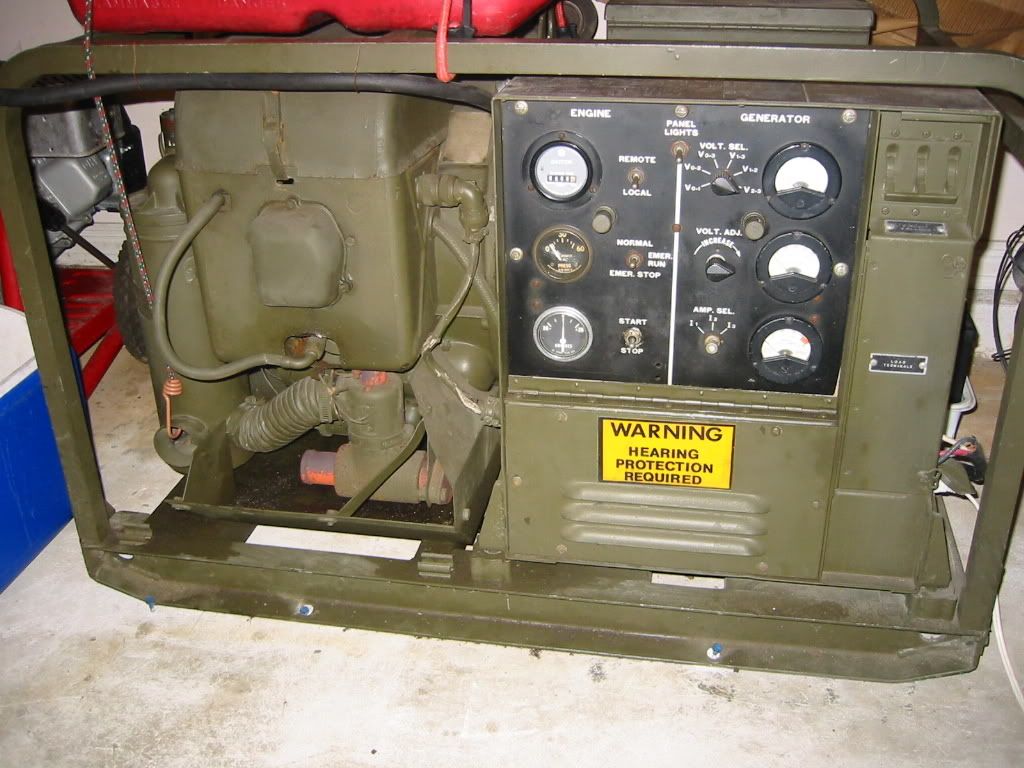      best bang for the buck as far as I was concerned. |
The flash makes it redundant actually... these have 3 diodes in the armature that take step voltage and feed through the windings until it has a full field charge... they build a full head of "steam" in about 4 seconds. When those diodes go bad or the wires somehow come off them then the field flash toggle will charge the field and put you back in the game. I had one of the diodes go out about a month after I got it, Allied had them cathode and anode to case for ... 12 cents a piece or some shit like that.. rediculous cheap... I bought 2 new sets and replaced the 35 year old broken ones. the pilot bearing as well while I was in there... grainger, 9 bucks. I also got the manual with it for a few bucks too.. I pretty much knew the whole machine before I set it up and started it. I have worked on aicraft for a few years so the engine with its mags and igniters was no mystery to me. all in all its a neat machine that I know I can count on. EMP bombs and nukes be damned.... I'll have power  Don't know exactly what Ill run with it but I'll have it.. Don't know exactly what Ill run with it but I'll have it..
|
Honda makes some nice generators but they have a tendency to be pricey. If you have more money than time (to learn more about generators) - buy the Honda and be done with it. If you are like me and have more time than money - there are more cost effective choices... For those inclined to learn a bit - THIS is a link to help you to understand the basics of portable generators. When selecting a generator, you should consider a few basic questions to help you to make a better selection... 1) Do you need 120 or 240 volt output? A few household loads are commonly 240 volts (the rest are 120V). They include but are not limited to - the stove (if electric), central A/C unit, water heater (if electric), pool pump, cloths dryer. If you don't need (want) 240V output, your life is a bit easier. I have an electric water heater and after Hurricane Wilma (the eye passed right over me), I found it nice to be able to heat water using generator power - I hate COLD showers. I have 2 water heaters and ran 1 per day (for about 1 hour) and had warm water for the entire power outage. 2) How many watts do you need? You can get an idea about this by adding up the wattages of everything that you want to run simultaneously. REMEMBER that, with limited wattage available, you can alternate when you run which loads. My water heaters in the above example draw 4,500 watts (each). In order to run them, I shut down almost every other load in the house (for the hour that it takes to heat a tank of water). Once you have an idea of your wattage needs - look at the single largest load that you might like to run even for a short time (like my water heater). Compare the 2 numbers - multiply the larger of the 2 by about 1.3 and that is the approximate size I recommend. 3) What about "surge" rating? Resistive loads (think things that produce heat - coffee pots, water heaters, stoves, etc.) are sometimes called dead loads and only draw the wattage that they are rated at... Inductive loads (think motors) require additional wattage (above and beyond their "rated" wattage) during start up. This additional wattage is sometimes called "surge" wattage. The total wattage to start motor is equal to the rated wattage plus the surge wattage. I multiply the running wattage by 1.5 to estimate the surge wattage if I can't not find it by any other means. As an example, my small central A/C unit runs on 2,400 watts - the surge wattage is estimated at 3,600 watts. That means that it takes approximately 6,000 watts to start my central A/C unit although, once it is started, it will run on 2,400 watts. If you plan to attempt to start an inductive load that is close to the capacity of your generator, be sure to shut down all un-necessary loads during the start up. You can add them back later if your generator can handle them while running your inductive load. Meters are useful to help you estimate and/or monitor your power consumption. THIS is a meter that you will find very useful. It will help you to estimate the wattage of any plug-in appliance. I found (to my surprise) that my coffee pot draws 900 watts while perking! The other nice feature of that meter is that it can help you to run diagnostics on your generator output - it'll tell you the frequency (on the money = 60Hz) and voltage (on the money = 120V) of the AC output of your generator. I run and meter my generator (with and without a load) twice per year. If you find any problems, you can fix them before you need your generator in an emergency situation. There are also "total output" meters which can help you determine your total load (at any point in time) to help you to not accidentally exceed your generator's capacity (and thus overload (read "FRY") it). In general you want the (reasonably) smallest generator that will get the "job" done. As the output of a generator gets larger - the physical unit size, noise, fuel consumption, and cost gets larger as well. If you have a natural gas line running to your house (I don't), you might consider adapting your generator to run on natural gas - this would eliminate and headaches associated with getting and storing gasoline. If you don't have access to natural gas - consider how much fuel you will need to store to prepare for an emergency. I recommend that you be able to store at least enough gasoline to run your generator for 3 days (continuously). In a real extended power outage you can typically run 50/50 (50% on / 50% off) and extend your fuel supply. While your getting prepared, decide on what type of oil you will want to run in your generator's crankcase - then go out and buy about 5 to 10 quarts of that oil (and a long neck funnel) to facilitate oil changes during extended outages (most manufacturers recommend changing engine oil every 25 hours of run time). It might also be a good idea to have a spare air filter and spark plug on hand as well. Once you have figured out "the basics", you may want to consider "features"... There are a lot of them - good luck wading through the choices... Other considerations might include - 1) How do you plan to distribute your generator output? Extension cord "spagetti" is not what you really want to do... 2) What is your budget for this project? The "generator" topic is a little too broad for me to cover in 1 post... hopefully, I have given you some food for thought... |
Very good post, informative. |

|
Linking to the LOGSA website doesn't always work well, so let me knwo if these work: Generator oper and maint manual: www.logsa.army.mil/etms/data/033374.cfm?pin=033374 Parts manual: www.logsa.army.mil/etms/data/015380.cfm?pin=015380 Egine Lube Order: www.logsa.army.mil/etms/data/030069.cfm?pin=030069 Einge op and maint: www.logsa.army.mil/etms/data/055675.cfm?pin=055675 Engine parts: www.logsa.army.mil/etms/data/071352.cfm?pin=071352 ETA: doing a right click-save as works best with these files. |
|
I've been doing a bunch of research on genys and it seems like all the honda, yamaha, etc while good for camping trips or powering a couple appliances 1 or 2hrs a day are not the best choice for LONG TERM generator usage. Where I`m moving power goes out for sometimes a week at a time and for that I've read a diesel is the best choice, as they will last 5 to 20x longer than a gas/propane unit and use 1/2 the fuel. Also, I've considered a diesel that burns .6/g hr running 1/4 load (20,000 watts total). So at 1/4 load I could power my entire house. If needed I could also run the welder from it to do repairs to the house/etc w/out power. |
I have a hard time beliving that a generator will run on .6 gal per hours pulling 5000 watts when the unit has available power of 20,000 watts. If it was a diesel that is rated at 6500 watts and you are pulling 4000 out of it, I could see the .6 gal per hour....likely a little less. But unlikely that you would get that low of a consumption at that level of power. I would expect to see you using about 1 gal per hour or a little more if it's a 20,000 watt unit. That would most likely be about a 25-30 hp diesel engine to produce that much power...so 2-4 cyl with a 3 cyl engine being the most likely. I still agree that a diesel is possibly suited to your needs. I have a diesel unit and it's rated at about 5500 continuous watts. It uses about .5 gal per hour to run. |
Yep, I was thinking the same thing - YES a diesel is the best choice for longevity of service and reliability but the fuel consumption of that 20kW has to be off... A 20kW generator should use a 40HP engine. The 11HP (gasoline) engine on my 6200 watt generator consumes about 1/2 gallon of fuel per hour under load. Linear extrapolation would suggest that a 40HP gasoline engine would use about 1.7 (or so) gallons per hour. I know that diesel engines are supposed to be more efficient than their gasoline counterparts but 3+ times more efficient seems overly optomistic... but I could be wrong... |
|
Ok I wasn't for sure on this myself so I had to go checking. Not to spend a lot of time searching comparing models I grabbed data on a generic 20KW generator with a Perkins diesel. HP rating turns out to be 32.6HP so close to 40hp. Now for rated fuel consumption everyone hit all around it but missed the target. 1/2 load .92 GPH 3/4 load 1.27 GPH Full load 1.93 GPH Rated at 3279 feet elevation 104 degrees F Here is the spec sheet on the one I found: 20kw diesel spec sheet |
G_S... thanks for those links... saved to hard drive. I have a hardcopy of the first one, the rest i did not have. Thanks again chief! |
1.7 GPM? Are you kidding? I don't think Al Gores private jet uses that much fuel.. |
|
When you are talking about a long lasting diesel genny, are you talking about the 4-pole 1800 rpm type generator? These are usually water cooled, have enclosures, big fuel tanks,4kw plus etc Made very robust for 24/7 type applications.The one that comes to mind is the Kubota low boy series. Or is it like the portable ones at home depot (2-pole,3600rpm)? Thanks |
|
I have one also and I'm about to get another one. It will power most things, very small and quiet, good clean power for electronics. The thing I like about it, is that while small, its big enough to get the job done with nearly all houshold stuff (except the big things A/C, stove) I don't have any big draw items so its not needed. I really feel like I get my money out of it because I use it a lot- take it camping (when I need to have creature comforts for the family), dip netting- I can fillet a ton of fish, use a commercial vac/sealer and throw them in a deepfreeze vs toting around a ton of ice. Being able to hook 2 together is even better. Like all things it depends on what you need it for. To run a house with a lot of wattage for a few days/weeks. get the big generators. If you dont need all of that, get the smaller ones. I used mine on a trip down from AK hauling a freezer full of salmon (400#). When we would camp at night, I would turn it on (quiet enough to camp next to) run a 500w light/charge up the electronics for the next day and plug the freezer into. It would run all night, cooling down the freezer and in the morning i would plug the coffee maker in to brew coffee. used less than a tank of gas for all that. its one of the things i will never part with. |
I have this generator. It's a diesel and uses about .5 gal per hour at max load (5500) watts. It's a 3600 rpm air cooled unit. You might look at these units: Aurora Generators Aurora Generator "silent" Video of Aurora generator running: You Tube Aurora diesel generator running Youtube Aurora "silent" diesel generator running The engines on the Aurora generators and the one that I have are the same engine. It's a chinese made Yanmar clone. I've been favorably impressed with it. Very good tolerances and runs very smoothly...especially considering that you can get a diesel Yanmar clone for about $1200-1600 but the Yanmar one will set you back about $3300!! |
|
Well, a lot of opinions on what is the best generator, and a lot of it depends on your individual needs. I'll say this though, the best one is the one that works when you need it. Half of this battle is periodic maintenance, and proper use. Use additives, change the oil and plug - run it once in awhile to maintain / test it and put an electrical load on it as well. These things will get you a lot farther than buying an expensive generator, running it once, and letting it sit forever until you need it. FWIW, MournSword |