


Posted: 7/29/2010 8:39:46 PM EDT
|
Forgot I had this pic I took hosted, and think some may be intrested...
This is from a PSO on a PSL. 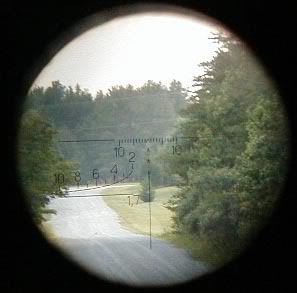
|


|
Quoted:
explain it please The 1,7 indicates that the scale is calibrated to 1.7m (5'6"). The scope is fixed power, so put any thing estimated at 1.7 meters in the scale, and you have your range. You set your range through an external range knob. Unlike western opics, the reticle moves up in the field of vision when the range is increased, and down when decreased. Not sure why it's not a little bigger than 5'6" as most western soldiers were taller, so maybe they are assuming some type of duck or hunch. Most East Block scopes were radioactive gas lit, or battery powered so the fact that the lines are fine and can't be seen at night isn't really a factor. The problem with the gas lit ones is that they are almost all dead now... Not my favorite reticle (that honor belongs to the SUIT inverted post), but it works. |
|
Quoted:
Quoted:
explain it please The 1,7 indicates that the scale is calibrated to 1.7m (5'6"). The scope is fixed power, so put any thing estimated at 1.7 meters in the scale, and you have your range. You set your range through an external range knob. Unlike western opics, the reticle moves up in the field of vision when the range is increased, and down when decreased. Not sure why it's not a little bigger than 5'6" as most western soldiers were taller, so maybe they are assuming some type of duck or hunch. Most East Block scopes were radioactive gas lit, or battery powered so the fact that the lines are fine and can't be seen at night isn't really a factor. The problem with the gas lit ones is that they are almost all dead now... Not my favorite reticle (that honor belongs to the SUIT inverted post), but it works. Additionally, the three chevrons below the center chevron are holdover points for ranges beyond 1000 meters (the scope range adjustment knob maxes out at 1000m), corresponding to 1100, 1200, 1300m. Remember, though, that you'd already have to have dialed the range adjustment to 1000, THEN hold over to the next range chevron or beyond. The hashmarks extending left and right of the center reticle are in 1 mil increments, and used for quick wind correction or for leading targets, as well as having a use in rangefinding as a supplement to the 1.7m rangefinding line. |
|
Quoted:
Quoted:
Quoted:
explain it please The 1,7 indicates that the scale is calibrated to 1.7m (5'6"). The scope is fixed power, so put any thing estimated at 1.7 meters in the scale, and you have your range. You set your range through an external range knob. Unlike western opics, the reticle moves up in the field of vision when the range is increased, and down when decreased. Not sure why it's not a little bigger than 5'6" as most western soldiers were taller, so maybe they are assuming some type of duck or hunch. Most East Block scopes were radioactive gas lit, or battery powered so the fact that the lines are fine and can't be seen at night isn't really a factor. The problem with the gas lit ones is that they are almost all dead now... Not my favorite reticle (that honor belongs to the SUIT inverted post), but it works. Additionally, the three chevrons below the center chevron are holdover points for ranges beyond 1000 meters (the scope range adjustment knob maxes out at 1000m), corresponding to 1100, 1200, 1300m. Remember, though, that you'd already have to have dialed the range adjustment to 1000, THEN hold over to the next range chevron or beyond. The hashmarks extending left and right of the center reticle are in 1 mil increments, and used for quick wind correction or for leading targets, as well as having a use in rangefinding as a supplement to the 1.7m rangefinding line. I don't have it in front of me to verify, but 54R PSOs go to 1,200. |
|
Quoted:
Quoted:
Quoted:
Quoted:
explain it please The 1,7 indicates that the scale is calibrated to 1.7m (5'6"). The scope is fixed power, so put any thing estimated at 1.7 meters in the scale, and you have your range. You set your range through an external range knob. Unlike western opics, the reticle moves up in the field of vision when the range is increased, and down when decreased. Not sure why it's not a little bigger than 5'6" as most western soldiers were taller, so maybe they are assuming some type of duck or hunch. Most East Block scopes were radioactive gas lit, or battery powered so the fact that the lines are fine and can't be seen at night isn't really a factor. The problem with the gas lit ones is that they are almost all dead now... Not my favorite reticle (that honor belongs to the SUIT inverted post), but it works. Additionally, the three chevrons below the center chevron are holdover points for ranges beyond 1000 meters (the scope range adjustment knob maxes out at 1000m), corresponding to 1100, 1200, 1300m. Remember, though, that you'd already have to have dialed the range adjustment to 1000, THEN hold over to the next range chevron or beyond. The hashmarks extending left and right of the center reticle are in 1 mil increments, and used for quick wind correction or for leading targets, as well as having a use in rangefinding as a supplement to the 1.7m rangefinding line. I don't have it in front of me to verify, but 54R PSOs go to 1,200.  I've never tried to run any of mine out that far, so I can't honestly say if they'll physically do it or not. Will check when I get home. I've never tried to run any of mine out that far, so I can't honestly say if they'll physically do it or not. Will check when I get home.
|
|
Quoted:
Quoted:
Quoted:
Quoted:
Quoted:
explain it please The 1,7 indicates that the scale is calibrated to 1.7m (5'6"). The scope is fixed power, so put any thing estimated at 1.7 meters in the scale, and you have your range. You set your range through an external range knob. Unlike western opics, the reticle moves up in the field of vision when the range is increased, and down when decreased. Not sure why it's not a little bigger than 5'6" as most western soldiers were taller, so maybe they are assuming some type of duck or hunch. Most East Block scopes were radioactive gas lit, or battery powered so the fact that the lines are fine and can't be seen at night isn't really a factor. The problem with the gas lit ones is that they are almost all dead now... Not my favorite reticle (that honor belongs to the SUIT inverted post), but it works. Additionally, the three chevrons below the center chevron are holdover points for ranges beyond 1000 meters (the scope range adjustment knob maxes out at 1000m), corresponding to 1100, 1200, 1300m. Remember, though, that you'd already have to have dialed the range adjustment to 1000, THEN hold over to the next range chevron or beyond. The hashmarks extending left and right of the center reticle are in 1 mil increments, and used for quick wind correction or for leading targets, as well as having a use in rangefinding as a supplement to the 1.7m rangefinding line. I don't have it in front of me to verify, but 54R PSOs go to 1,200. I've never tried to run any of mine out that far, so I can't honestly say if they'll physically do it or not. Will check when I get home.No gurarantees. I might be getting it confused with a Mosin Sniper Optic... |