


Posted: 12/11/2009 10:28:12 AM EDT
|
Why was the Navajo code so hard to break?
I don't know much about code-breaking, but I don't see any reason why deciphering the Navajo language would be any more difficult than any other language. |
|
Quoted:
Why was the Navajo code so hard to break? I don't know much about code-breaking, but I don't see any reason why deciphering the Navajo language would be any more difficult than any other language. Well there aren't many Navajo in Germany and Japan, plus I don't think it was a written language. |
|
Quoted:
Why was the Navajo code so hard to break? I don't know much about code-breaking, but I don't see any reason why deciphering the Navajo language would be any more difficult than any other language. First of all, it's not a code. So part of it was deception. The Japanese sigint types were trying to break some code, applying algorithms and concepts of discrete mathematics when, in fact, there was no "code" to be broken. Secondly, Navajo wasn't a written language, IIRC, and the Japanese didn't have access to any Navajo to interpret. It's not like they had Google where they could just look it up. |
|
Totally unrelated to any European or Asian language, different grammar so couldn't guess based on word order.
Plus there weren't a lot of (any?) books on the language then so it's not like the Nazis could just go to the library. And all the Navajos of course live here. In addition to know to go to the library they would have to know it was Navajo they were hearing and not made-up gobbledygook. Not a lot of linguists specializing in American languages who could even identify it. |
|
Quoted:
Well there aren't many Navajo in Germany and Japan, plus I don't think it was a written language. From what I understand they used Navajo words as a phonetic alphabet, as well as a dictionary of under 100 words to describe military equpment/ideas. Why would the Navajo language be any more complicated then generating a new language from scratch? |
|
Quoted:
Why was the Navajo code so hard to break? I don't know much about code-breaking, but I don't see any reason why deciphering the Navajo language would be any more difficult than any other language. A number of reasons but primarily because its an oral only language- by that I mean there is no alphabet etc. it was also only spoken by a very select and insular culture not found anywhere else on earth. If a langage has never been written down it becomes orders of magnitudes harder to understand it. Finally they had many ways to say the same thing just by changing tonal inflection or even where the word fell within a sentence. The same sound could mean "house" at one point but "tree" at another point within a sentence depending on what came before or after it. |
|
Well, how many people outside of the US spoke Navajo in the 1940's?
Probably not very many. Wiki: Philip Johnston proposed the use of Navajo to the United States Marine Corps at the beginning of World War II. Johnston, a World War I veteran, was raised on the Navajo reservation as the son of a missionary to the Navajos, and was one of the few non-Navajos who spoke their language fluently. Because Navajo has a complex grammar, is not nearly mutually intelligible enough with even its closest relatives within the Na-Dene family to provide meaningful information, and was an unwritten language, Johnston saw Navajo as answering the military requirement for an undecipherable code. Navajo was spoken only on the Navajo lands of the American Southwest, and its syntax and tonal qualities, not to mention dialects, make it unintelligible to anyone without extensive exposure and training. One estimate indicates that at the outbreak of World War II fewer than 30 non-Navajos, none of them Japanese, could understand the language.[citation needed] Early in 1942, Johnston met with Major General Clayton B. Vogel, the commanding general of Amphibious Corps, Pacific Fleet, and his staff. Johnston staged tests under simulated combat conditions which demonstrated that Navajos could encode, transmit, and decode a three-line English message in 20 seconds, versus the 30 minutes required by machines at that time. The idea was accepted, with Vogel recommending that the Marines recruit 200 Navajos. The first 29 Navajo recruits attended boot camp in May 1942. This first group then created the Navajo code at Camp Pendleton, Oceanside, California.[11] The Navajo code was formally developed and modeled on the Joint Army/Navy Phonetic Alphabet that uses agreed-upon English words to represent letters. As it was determined that phonetically spelling out all military terms letter by letter into words—while in combat—would be too time consuming, some terms, concepts, tactics and instruments of modern warfare were given uniquely formal descriptive nomenclatures in Navajo (the word for "potato" being used to refer to a hand grenade, or "tortoise" to a tank, for example). Several of these portmanteaus (such as gofasters referring to running shoes, ink sticks for pens) entered Marine corps vocabulary and are commonly used today to refer to the appropriate objects. A codebook was developed to teach the many relevant words and concepts to new initiates. The text was for classroom purposes only, and was never to be taken into the field. The code talkers memorized all these variations and practiced their rapid use under stressful conditions during training. Uninitiated Navajo speakers would have no idea what the code talkers' messages meant; they would hear only truncated and disjointed strings of individual, unrelated nouns and verbs. The Navajo code talkers were commended for their skill, speed and accuracy accrued throughout the war. At Iwo Jima, Major Howard Connor, 5th Marine Division signal officer, had six Navajo code talkers working around the clock during the first two days of the battle. These six sent and received over 800 messages, all without error. Connor later stated, "Were it not for the Navajos, the Marines would never have taken Iwo Jima."[12] As the war progressed, additional code words were added on and incorporated program-wide. In other instances, informal short-cut code words were devised for a particular campaign and not disseminated beyond the area of operation. To ensure a consistent use of code terminologies throughout the Pacific Theater, representative code talkers of each of the U.S. Marine divisions met in Hawaii to discuss shortcomings in the code, incorporate new terms into the system, and update their codebooks. These representatives in turn trained other code talkers who could not attend the meeting. The deployment of the Navajo code talkers continued through the Korean War and after, until it was ended early in the Vietnam War. Non-speakers would find it extremely difficult to accurately distinguish unfamiliar sounds used in these languages. Additionally, a speaker who has acquired a language during their childhood sounds distinctly different from a person who acquired the same language in later life, thus reducing the chance of successful impostors sending false messages. Finally, the additional layer of an alphabet cypher was added to prevent interception by native speakers not trained as code talkers, in the event of their capture by the Japanese. A similar system employing Welsh was used by British forces, but not to any great extent during World War II. Welsh was used more recently in the Balkan peace-keeping efforts for non-vital messages. Navajo was an attractive choice for code use because few people outside the Navajo themselves had ever learned to speak the language. Virtually no books in Navajo had ever been published. Outside of the language itself, the Navajo spoken code was not very complex by cryptographic standards and would likely have been broken if a native speaker and trained cryptographers worked together effectively. The Japanese had an opportunity to attempt this when they captured Joe Kieyoomia in the Philippines in 1942 during the Bataan Death March. Kieyoomia, a Navajo Sergeant in the U.S. Army, was ordered to interpret the radio messages later in the war. However, since Kieyoomia had not participated in the code training, the messages made no sense to him. When he reported that he could not understand the messages, his captors tortured him.[14]. Given the simplicity of the alphabet code involved, it is probable that the code could have been broken easily if Kieyoomia's knowledge of the language had been exploited more effectively by Japanese cryptographers. The Japanese Imperial Army and Navy never cracked the spoken code. High-ranking military officers have stated that the United States would never have won the Battle of Iwo Jima without the secrecy afforded by the code talkers. |
|
Quoted:
It was an un-written language. And where we would call a bird a bird, they would use a description to call it a bird. I cant give u an example of how that works. Plus the Navajo would call a Tank a turtle using their special descriptive language Yep, egg=grenade squash=bomb etc. |
| I've heard language experts say that the Western American Indian languages are among the hardest to learn in the whole world. I think the Navajo operated in the Pacific and Apaches were sent to Europe, no? Even if by chance the enemy started to crack it, the code talkers were calling planes and tanks by the names of different animals, so it was almost like two codes being used. |
|
my ex's grandfather was John Brown Jr. The original spokesman for the 29 Navajo Codetalkers. Amazing man. http://www.gallupindependent.com/2009/05May/052109originalcodetalker.html The way it was explained to me by him and his daughter (the ex's mother) was due to there being no real documentation of the Navajo language it's rather easy to speak in their code/dialect as no one has truly copied it/data logged it. It's the oldest Native American language in which has not been recorded. Before the ex and I broke up (she is full blooded Navajo/Crete) I learned quite a bit of the Navajo language. W/ that said she couldn't speak much of it. (Her grandfather considered that she couldn't speak it well b/c she was a "mutt") You have to use your tongue in a certain way for the words to be anunciated correctly and many words can mean multiple things. At the bottom of that article where it says he is survived by his children....Dorothy Whilden is my ex's mother.... Here is Mr. John Brown Jr. receiving his MOH. BTW John Brown Jr. is a name given to him by the white man. 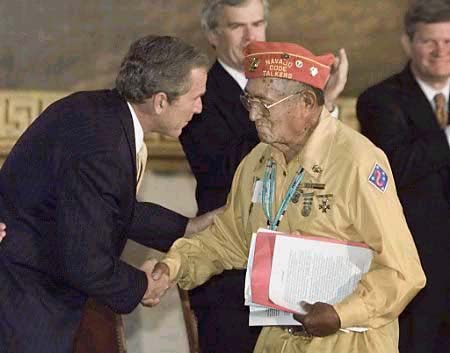 |
|
Quoted:
Quoted:
Well there aren't many Navajo in Germany and Japan, plus I don't think it was a written language. From what I understand they used Navajo words as a phonetic alphabet, as well as a dictionary of under 100 words to describe military equpment/ideas. Why would the Navajo language be any more complicated then generating a new language from scratch? You must work for the government! 
Why invent then train folks on a new language created by folks who grew up speaking established languages... thus influencing their made up stuff.. or just get folks who already are fluent and highly proficient at a language virtually unknown outside their group? They were able to alter it and add filler seamlessly to further confound the Japanese. |
|
Quoted:
my ex's grandfather was John Brown Jr. The original spokesman for the 29 Navajo Codetalkers. Amazing man. http://www.gallupindependent.com/2009/05May/052109originalcodetalker.html The way it was explained to me by him and his daughter (the ex's mother) was due to there being no real documentation of the Navajo language it's rather easy to speak in their code/dialect as no one has truly copied it/data logged it. It's the oldest Native American language in which has not been recorded. Before the ex and I broke up (she is full blooded Navajo/Crete) I learned quite a bit of the Navajo language. W/ that said she couldn't speak much of it. (Her grandfather considered that she couldn't speak it well b/c she was a "mutt") You have to use your tongue in a certain way for the words to be anunciated correctly and many words can mean multiple things. At the bottom of that article where it says he is survived by his children....Dorothy Whilden is my ex's mother.... Here is Mr. John Brown Jr. receiving his MOH. BTW John Brown Jr. is a name given to him by the white man. http://wrscouts.com/images/Code%20Talkers/JBJw_President7_26_01.jpg Now that's a hero a president should bow to. |
| The military used Choctaw / Chickasaw in WW1. The two languages are close enough together to be intelligible, but there are different dialects. We have a radio station in SE Oklahoma that sometimes have different Muskogeean speakers. It sounds like nothing else you've heard before. |
|
I just finished writing a 20 page survey of the Navajo language for my college linguistics class.
Navajo was given an alphabet before World War II by English-speaking linguists. The reason that it was the basis for a good code is that Navajo verbs are extremely complex. I wrote a 20 page paper on the language and I barely understand what I wrote about the verb. 
|
|
Quoted:
Quoted:
Why was the Navajo code so hard to break? I don't know much about code-breaking, but I don't see any reason why deciphering the Navajo language would be any more difficult than any other language. First of all, it's not a code. So part of it was deception. The Japanese sigint types were trying to break some code, applying algorithms and concepts of discrete mathematics when, in fact, there was no "code" to be broken. Secondly, Navajo wasn't a written language, IIRC, and the Japanese didn't have access to any Navajo to interpret. It's not like they had Google where they could just look it up. This FTW!!! 
|
|
Quoted: There's a very real possibility that without them, we could have lost the war. The war? Not a chance. Code talkers had nothing to do with the US naval victories which broke the back of the Japanese fleet. Individual battles? It's possible, but the most likely result would have been that thousands of more Marines and Sailors would have died before we overwhelmed the Japanese resistance. 
|
|
Yep, the Navajo "code" was not a code, it was just using the Navajo language to communicate. They used Navajo words for things, like a tank was called a turtle, etc etc.
It was not 'cracked' because it could not be cracked like a code, and it was a language that the Japanese and Germans had no knowledge of. It was so simple, it was absolutely brilliant. |
|
Quoted:
Quoted:
my ex's grandfather was John Brown Jr. The original spokesman for the 29 Navajo Codetalkers. Amazing man. http://www.gallupindependent.com/2009/05May/052109originalcodetalker.html The way it was explained to me by him and his daughter (the ex's mother) was due to there being no real documentation of the Navajo language it's rather easy to speak in their code/dialect as no one has truly copied it/data logged it. It's the oldest Native American language in which has not been recorded. Before the ex and I broke up (she is full blooded Navajo/Crete) I learned quite a bit of the Navajo language. W/ that said she couldn't speak much of it. (Her grandfather considered that she couldn't speak it well b/c she was a "mutt") You have to use your tongue in a certain way for the words to be anunciated correctly and many words can mean multiple things. At the bottom of that article where it says he is survived by his children....Dorothy Whilden is my ex's mother.... Here is Mr. John Brown Jr. receiving his MOH. BTW John Brown Jr. is a name given to him by the white man. http://wrscouts.com/images/Code%20Talkers/JBJw_President7_26_01.jpg Now that's a hero a president should bow to. +1 |
|
Quoted:
Yep, the Navajo "code" was not a code, it was just using the Navajo language to communicate. They used Navajo words for things, like a tank was called a turtle, etc etc. It was not 'cracked' because it could not be cracked like a code, and it was a language that the Japanese and Germans had no knowledge of. It was so simple, it was absolutely brilliant. No, it WAS a code, just in Navajo. Those who spoke Navajo would have had absolutely no freaking idea what was going on if they had heard a transmission in Navajo code. In fact, a Navajo speaking Indian WAS captured by the Japanese, and he couldn't tell them what the code meant because it was just a bunch of words with no meaning. |
|
Quoted:
my ex's grandfather was John Brown Jr. The original spokesman for the 29 Navajo Codetalkers. Amazing man. http://www.gallupindependent.com/2009/05May/052109originalcodetalker.html The way it was explained to me by him and his daughter (the ex's mother) was due to there being no real documentation of the Navajo language it's rather easy to speak in their code/dialect as no one has truly copied it/data logged it. It's the oldest Native American language in which has not been recorded. Before the ex and I broke up (she is full blooded Navajo/Crete) I learned quite a bit of the Navajo language. W/ that said she couldn't speak much of it. (Her grandfather considered that she couldn't speak it well b/c she was a "mutt") You have to use your tongue in a certain way for the words to be anunciated correctly and many words can mean multiple things. At the bottom of that article where it says he is survived by his children....Dorothy Whilden is my ex's mother.... Here is Mr. John Brown Jr. receiving his MOH. BTW John Brown Jr. is a name given to him by the white man. http://wrscouts.com/images/Code%20Talkers/JBJw_President7_26_01.jpg Really cool story and pic. |
|
Quoted:
Why would the Navajo language be any more complicated then generating a new language from scratch? in a word, syntax. as linguistically-capable human beings, we are shaped by our language. without going into a lot of onscure details and arguments, the way that we see the world is controlled by our understanding of language. that's why you can't really understand a culture without an understanding of its language. look at some of the taoist concepts that are obscure or even incomprehensible when translated into english. so any language that, say, an english-speaker created would be related to english structures in some way––it's inescapable. we think in terns of agent-action-object because of our language. we can invert this to action-object-agent, but the three elements will still be there. decryption would therefore be a process of substitution and permutation. but imagine a culture in which no person could affect another person directly––where things just happen. the language wouldn't name agents or objects, it would somehow describe a sequence of actions divorced from agents/objects. for a cryptologist, that would be a nightmare. where would he begin? he'd have to figure out the way this bizarre language worked (leaving behind his own linguistic concepts in the process) before he could ever get down to number crunching. it would also be incredibly difficult to create. imagine describing the actions on a battlefield without using terms like "us" and "them"––the elements of our own language. this isn't a perfect analogy, but it makes the point. |
|
Quoted:
I wonder how true the Nicholas Cage movie was where they implied that if one of the code talkers was about to be captured then he should be killed.
Coldly, its logical. He is a biological cryptographical material. David Kahn says that part was made up. |
|
Quoted:
Quoted:
Quoted:
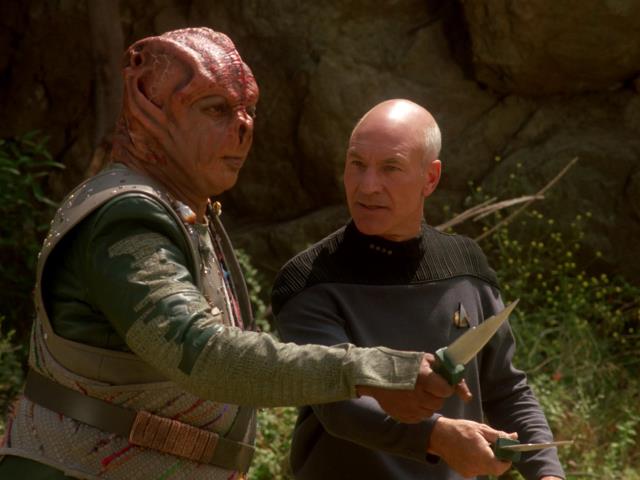
It's metaphoric. Trying to decode it would be like trying to fathom the meaning of pet phrases that a long-married couple use to communicate with each other in public without having other people understand them. Darmok and Jalad at Tanagra. http://www.durfee.net/startrek/images/TNG202.jpg Haha i spent the whole episode like this  ...that would make a grade code too lol. ...that would make a grade code too lol.
|
|
Quoted:
I wonder how true the Nicholas Cage movie was where they implied that if one of the code talkers was about to be captured then he should be killed.
According to what I read, not true at all. I read an interview involving one of the last Codetalkers shortly after the movie came out. He said that the "protect the code" stuff was Hollywood BS, and the code/life of the Marine were protected only by their combat skills. Might not be true, but that's what was said. |
|
Quoted: Quoted: It's metaphoric. Trying to decode it would be like trying to fathom the meaning of pet phrases that a long-married couple use to communicate with each other in public without having other people understand them. Darmok and Jalad at Tanagra. |
|
Quoted:
I've heard language experts say that the Western American Indian languages are among the hardest to learn in the whole world. I think the Navajo operated in the Pacific and Apaches were sent to Europe, no? Even if by chance the enemy started to crack it, the code talkers were calling planes and tanks by the names of different animals, so it was almost like two codes being used. one reason NA languageis hard is due to consonents and vowels not having the same sound as it does in english an example is Lakota which uses a specific, small set of sounds to form its words. pronounce this word with inflection (wedge symbol over the E & C) zuzeca IS pronounced zoozacha which means Snake some vowels are pronounced using a nasalization on a certain vowel others pronounced as they appear. MazaWakan Maza "metal or iron" wakan "thunder" maz a wa kan (broken down) as it is pronounced. mazawakan = thunderstick/gun and so on. i've tried to understand laCOta and man it's hard shit. one minute you get nasally with a vowel and it slides into a yiddish glottal inflection. |
|
Quoted:
Quoted:
Why would the Navajo language be any more complicated then generating a new language from scratch? in a word, syntax. as linguistically-capable human beings, we are shaped by our language. without going into a lot of onscure details and arguments, the way that we see the world is controlled by our understanding of language. that's why you can't really understand a culture without an understanding of its language. look at some of the taoist concepts that are obscure or even incomprehensible when translated into english. so any language that, say, an english-speaker created would be related to english structures in some way––it's inescapable. we think in terns of agent-action-object because of our language. we can invert this to action-object-agent, but the three elements will still be there. decryption would therefore be a process of substitution and permutation. but imagine a culture in which no person could affect another person directly––where things just happen. the language wouldn't name agents or objects, it would somehow describe a sequence of actions divorced from agents/objects. for a cryptologist, that would be a nightmare. where would he begin? he'd have to figure out the way this bizarre language worked (leaving behind his own linguistic concepts in the process) before he could ever get down to number crunching. it would also be incredibly difficult to create. imagine describing the actions on a battlefield without using terms like "us" and "them"––the elements of our own language. this isn't a perfect analogy, but it makes the point. I think you answered my question quite well. Thank you. And thanks to everyone else who has had information to share as well. |