


Armory Sponsor


Posted: 12/8/2013 11:42:25 PM EDT
|
So, I've been reloading pistol rounds for a couple of years and have never sorted my brass beyond nickel cases vs brass cases. However, I'm gearing up to reload .223 for the first time and I've read that sorting brass by lots/head stamps was a good idea for accuracy, keeping track of # of firings, etc...
I began sorting out my brass (have quite a bit, with more coming in) and I already have almost 20 different piles of casings. I have them sorted by brand, year, crimped/not crimped, nato marked, etc. Each unique head stamp gets a pile. It is getting very tedious very fast. My question is: with brass such as LC that have many different year markings (some nato marked, some not) can I lump them together and be ok? I have large piles of various LC, RP, and PMC all sorted in this manner. And then I have tiny piles, maybe a handful each, of brass like MAL, GLF, PPU, WCC, FC, etc. My goal is to consolidate these piles as much as reasonably possible to save time on sorting, but also to preserve practical consistency for decent grouping on targets. It would also be helpful to know what brass I can run the piss out of and then what brass should be limited to plinking/"lost brass matches"/scrapping. I hope I was decently clear on what I was asking. Thanks for the tips. |
|
I sort my brass by firings instead of headstamp
I did a test with RP, PMC, and LC with the same powder charge (24.4gr H335) and bullet + primer and shot 20 rounds of each over my chrono velocity stayed the same across all brass as well as accuracy, keep in mind my charge is not close to max either though |
|
What rifle are you loading for?
If you are loading for a 223 Bolt action for ultimate accuracy then carry on. If you are loading for an AR for general plinking and SHTF, then you may be wasting some time. How well it needs to be sorted depends on what you are going to do with this brass. Right now I have GLF (Fiocchi), Rem, LC and LC NATO on my bench. I load them all the same and do not sort them, no problems. But then I'm not shooting my loads in long range competition either. For that I would purchase New Lapua brass and take very good care of it. |
|
If you cull the PMP brass and don't load the rest to uber maximum charge weights, you can mix headstamps. I don't care much for that practice for my own use, however.
What I do recommend for you is to dump all the USGI LC and the WCC headstamps together, they are as identical as possible. Lose the rest in matches or trade it off. |
|
Quoted:
Brass that is heavier then the norm may produce excess pressure if loading near maximum. There is really no direct correlation between case weight and case capacity. One would think that a heavier case had less capacity, but in reality this is not the case, some do, some don't. 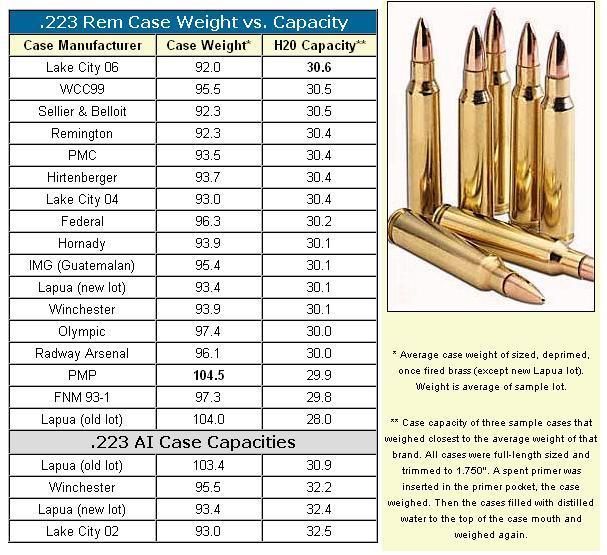
|
|
. Quoted:
There is really no direct correlation between case weight and case capacity. One would think that a heavier case had less capacity, but in reality this is not the case, some do, some don't. http://i2.photobucket.com/albums/y17/steve4102/223casecap_zps81d3f3e5.jpg Quoted:
Quoted:
Brass that is heavier then the norm may produce excess pressure if loading near maximum. There is really no direct correlation between case weight and case capacity. One would think that a heavier case had less capacity, but in reality this is not the case, some do, some don't. http://i2.photobucket.com/albums/y17/steve4102/223casecap_zps81d3f3e5.jpg 
|
|
Quoted:
. The chart tells me different. Look at old Lapua & PMP. In a 5.56 chamber using 223 load data, probably not an issue. A rifle chamber has a volume, running from the bolt face to where the bullet seals the bore. Put more mass in the volume, pressure goes up.
Quoted:
. Quoted:
Quoted:
Brass that is heavier then the norm may produce excess pressure if loading near maximum. There is really no direct correlation between case weight and case capacity. One would think that a heavier case had less capacity, but in reality this is not the case, some do, some don't. http://i2.photobucket.com/albums/y17/steve4102/223casecap_zps81d3f3e5.jpg
Show me where in the above chart it shows the heavier cases will always have less case capacity? Lets start with #2 and #3? Or Fed vs Hornady? etc.etc.etc. |
|
Quoted: So, I've been reloading pistol rounds for a couple of years and have never sorted my brass beyond nickel cases vs brass cases. However, I'm gearing up to reload .223 for the first time and I've read that sorting brass by lots/head stamps was a good idea for accuracy, keeping track of # of firings, etc... I began sorting out my brass (have quite a bit, with more coming in) and I already have almost 20 different piles of casings. I have them sorted by brand, year, crimped/not crimped, nato marked, etc. Each unique head stamp gets a pile. It is getting very tedious very fast. My question is: with brass such as LC that have many different year markings (some nato marked, some not) can I lump them together and be ok? I have large piles of various LC, RP, and PMC all sorted in this manner. And then I have tiny piles, maybe a handful each, of brass like MAL, GLF, PPU, WCC, FC, etc. My goal is to consolidate these piles as much as reasonably possible to save time on sorting, but also to preserve practical consistency for decent grouping on targets. It would also be helpful to know what brass I can run the piss out of and then what brass should be limited to plinking/"lost brass matches"/scrapping. I hope I was decently clear on what I was asking. Thanks for the tips. LC all years go together, unless I have several k of a certain year, then these get sorted out for accuracy loads. WCC, all years go together. I don't mix LC and WCC. Just my preference to do this. You could if you wanted to. Rest of mil cases go together in the "blasting" load batch. Commercial cases get sorted by headstamp. I sort out PMP (South Africian) as these are heavy cases and need a 2 grain reduction in powder charge. I'm not looking at a chart, I know this from experiance. 223 bolt rifle, and 223 Contender get sorted to headstamp commercial cases. |
|
If you're interested in accuracy, you should always load same head stamps into any given box. This goes for both rifle AND pistol.
I had the opportunity to test this out a few years ago. I have always loaded "same head stamp" ammo boxes, but my best friend (who was also a very experienced hand loader) never paid any mind to head stamp segregation. It just so happened that I was chronographing some test loadings one day that he was along and we decided to chrony his .45ACP cartridges which were (as usual) all mixed head stamp. IIRC, he had at least three different head stamps in his box. His mixed head stamp loads chronied all over the map in terms of standard deviation while mine were (as usual) pretty darn consistent. ETA: Oh yeah, importantly, both of us reload by weighing EVERY charge. In fact, the friend in question is the same guy who taught ME! 
|
|
Quoted:
I sort my brass into "LC" and "other". After a couple firings, the LC goes in with the "other". "Other" gets used for plinking/bulk ammo, the newer LC gets used for precision loads or other small-volume stuff (TSX rounds, etc). Quoted:
I sort my brass into "LC" and "other". After a couple firings, the LC goes in with the "other". "Other" gets used for plinking/bulk ammo, the newer LC gets used for precision loads or other small-volume stuff (TSX rounds, etc). Quoted:
This is what I do for loading 223 for my AR's. LC all years go together, unless I have several k of a certain year, then these get sorted out for accuracy loads. WCC, all years go together. I don't mix LC and WCC. Just my preference to do this. You could if you wanted to. Rest of mil cases go together in the "blasting" load batch. Commercial cases get sorted by headstamp. I sort out PMP (South Africian) as these are heavy cases and need a 2 grain reduction in powder charge. I'm not looking at a chart, I know this from experiance. 223 bolt rifle, and 223 Contender get sorted to headstamp commercial cases. Thanks. I like these two ideas and will combine them together for my own sorting methods. Looks like it will give me some ability to sort my cases for various uses but also not make it too tedious of a task. |
|
Quoted:
I have a question concerning some LC brass. I have been sorting cases as well and came across some with little grves cut at 12 3 6 and 9 o clock around the primer pocket. My question is why and is it safe to load. I havent sized or reamed primer pockets yet Those are fine, just a staked primer. Some LC brass in the last few years had the primers secured like that to deal with higher pressure M855A1 ammo. |
|
Quoted:
This is what I do for loading 223 for my AR's. LC all years go together, unless I have several k of a certain year, then these get sorted out for accuracy loads. WCC, all years go together. I don't mix LC and WCC. Just my preference to do this. You could if you wanted to. Rest of mil cases go together in the "blasting" load batch. Commercial cases get sorted by headstamp. I sort out PMP (South Africian) as these are heavy cases and need a 2 grain reduction in powder charge. I'm not looking at a chart, I know this from experiance. 223 bolt rifle, and 223 Contender get sorted to headstamp commercial cases. Quoted:
Quoted:
So, I've been reloading pistol rounds for a couple of years and have never sorted my brass beyond nickel cases vs brass cases. However, I'm gearing up to reload .223 for the first time and I've read that sorting brass by lots/head stamps was a good idea for accuracy, keeping track of # of firings, etc... I began sorting out my brass (have quite a bit, with more coming in) and I already have almost 20 different piles of casings. I have them sorted by brand, year, crimped/not crimped, nato marked, etc. Each unique head stamp gets a pile. It is getting very tedious very fast. My question is: with brass such as LC that have many different year markings (some nato marked, some not) can I lump them together and be ok? I have large piles of various LC, RP, and PMC all sorted in this manner. And then I have tiny piles, maybe a handful each, of brass like MAL, GLF, PPU, WCC, FC, etc. My goal is to consolidate these piles as much as reasonably possible to save time on sorting, but also to preserve practical consistency for decent grouping on targets. It would also be helpful to know what brass I can run the piss out of and then what brass should be limited to plinking/"lost brass matches"/scrapping. I hope I was decently clear on what I was asking. Thanks for the tips. LC all years go together, unless I have several k of a certain year, then these get sorted out for accuracy loads. WCC, all years go together. I don't mix LC and WCC. Just my preference to do this. You could if you wanted to. Rest of mil cases go together in the "blasting" load batch. Commercial cases get sorted by headstamp. I sort out PMP (South Africian) as these are heavy cases and need a 2 grain reduction in powder charge. I'm not looking at a chart, I know this from experiance. 223 bolt rifle, and 223 Contender get sorted to headstamp commercial cases. |
|
Quoted: Thanks. I like these two ideas and will combine them together for my own sorting methods. Looks like it will give me some ability to sort my cases for various uses but also not make it too tedious of a task. Quoted: Quoted: I sort my brass into "LC" and "other". After a couple firings, the LC goes in with the "other". "Other" gets used for plinking/bulk ammo, the newer LC gets used for precision loads or other small-volume stuff (TSX rounds, etc). Quoted: This is what I do for loading 223 for my AR's. LC all years go together, unless I have several k of a certain year, then these get sorted out for accuracy loads. WCC, all years go together. I don't mix LC and WCC. Just my preference to do this. You could if you wanted to. Rest of mil cases go together in the "blasting" load batch. Commercial cases get sorted by headstamp. I sort out PMP (South Africian) as these are heavy cases and need a 2 grain reduction in powder charge. I'm not looking at a chart, I know this from experiance. 223 bolt rifle, and 223 Contender get sorted to headstamp commercial cases. Thanks. I like these two ideas and will combine them together for my own sorting methods. Looks like it will give me some ability to sort my cases for various uses but also not make it too tedious of a task. Everyone has different need and amounts of brass.
|
|
Quoted: Is there still a crimp in there that needs reamed?  Crimped cases that have been decapped. Standard crimp on left, stab crimp on right. To remove either crimp, ream or swage primer pocket. If you ream ensure you use the proper tool, not something makeshift like a deburring tool, countersink, or drill bit.  Should look like this when you are done. Proper tool if you ream. http://www.midwayusa.com/product/253550/hornady-primer-pocket-reamer-cutter-head-small Has a positive stop so you can't over ream. |

Armory Sponsor