


Armory Sponsor


Posted: 3/30/2015 6:53:37 AM EDT
|
I am pretty new to reloading (and guns in general) but I have been loading shotshells for a couple months now with no problem. I decided to start reloading 9mm for my pistols. My first question... Does brass headstamp matter. Unlike shotshell loading data, I haven't seen any pistol loading data that specifies brass brand. Does that mean you load them all the same and it's safe to mix and match brands? Also, My understanding from shotsell loading is that primers can make a big difference in the load. Is that same true for small pistol primers? I was wanting to use Alliant's only load data for 9mm 115 gr FMJ using BE-86 but it specifies Fed primers and I have CCI 550. Is that a safe swap or would I need to change my load? I did start out less than their specified 6.1 grains and loaded at 5.8.
Finally, I loaded about 6 bullets to setup my mcahine (Lee Classic Turret) and noticed that they drop just drop right in and out my wife's Ruger SR9c's barrel. But in my CZ P-09 they wouldn't quite drop in all the way and I have to give them a slight press with my finger to get them in the last 1/16". Consequently they would not just drop out either when I inverted the barrel. Just a little pull with my fingers and they came right out. Is that a problem, and if so, how do I correct it? |
|
The interior volumn of shotshells will differ with brands , this requires different wads and load data.
With brass cases in pistol calibers there are some slight differences in size and brass hardness but most folks wouldn't bother brand sorting. If you find a certain brand doesn't size well or hold bullets well after taper crimping you might sort to get rid of that brand . In theory if one were trying to make super accurate match ammo or super uniform hunting ammo you might sort by headstamp/brand but generally not in 9mm. There can be differences between primer brand but unless one was working with a near maximum load as long as one used the same type of primer it isn't likely to make much of a difference. With the exception of a few warmish loads I carefully worked up for my guns for hunting use most everything I reload is middle of the road mid range stuff. Common advise is any time you change anything from a load you have been using is to back off powder level and slowly work back up . If you were loading a mild load and changed from one brand of small pistol standard primers to another brand the change isn't going to be much and isn't going to put you in any danger zone. On the other hand if you have worked up a warmish near maximum load and change case brand , primer brand or lot , different lot of powder or the depth of the bullet you could in theory put yourself into danger zone . Being cautious and conservative when reloading is a good thing. Loading books talk about checking length and trimming brass because they are conservative and want to cover all bases but I will tell you I have never heard of anyone having to trim 9mm . The only pistol brass I ever trimmed was some warm near max loads in 357 or 44mag that I wanted uniform length so I would get super uniform roll crimps |
|
I am not familiar with the CZ P-09 but it could have a tighter chamber; my first concern is you did not list your C.O.A.L. Are you within the listed length?
My second concern. I use the Lee dies in a classic turret, the powder through adds a flare, bells the case for the bullet, is your crimp DIE adjusted properly to remove the flare? I do sort my brass by headstamp but I have never had a problem with the mixed I seem to accumulate of RP, Star Line and S&B. My range pickups are generally a lot of Federal, WCC and Blazer Brass. Primers – I buy mostly CCI and Winchester. If I put a cartridge together using the exact components as listed in the manual it was an accident because I rarely use the same exact bullet, case and primer as listed. I do use the correct bullet weight, bullet type, powder weight and C.O.A.L. for the listed load. My limited usage of BE-86 was with 124gr Gold Dots and Hornady XTP. I used 5.3gr at the listed 1.12 COAL in both; of those that shot the Gold Dots everyone agreed it felt like a +P load. I have not been back to test the Hornady XTP’s. Note that I am below the listed max of 5.9gr. The link below is to an adapter for adding your powder drop to your press. It has worked great for me using a Lyman 55 that I picked up here in the Equipment Exchange. Adapter Link 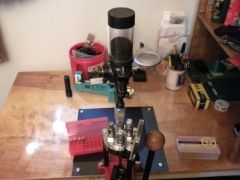
ETA - Welcome to the site and and I wish you success in your reloading. |
|
Quoted:
I am pretty new to reloading (and guns in general) but I have been loading shotshells for a couple months now with no problem. I decided to start reloading 9mm for my pistols. My first question... Does brass headstamp matter. Unlike shotshell loading data, I haven't seen any pistol loading data that specifies brass brand. Does that mean you load them all the same and it's safe to mix and match brands? Also, My understanding from shotsell loading is that primers can make a big difference in the load. Is that same true for small pistol primers? I was wanting to use Alliant's only load data for 9mm 115 gr FMJ using BE-86 but it specifies Fed primers and I have CCI 550. Is that a safe swap or would I need to change my load? I did start out less than their specified 6.1 grains and loaded at 5.8. Finally, I loaded about 6 bullets to setup my mcahine (Lee Classic Turret) and noticed that they drop just drop right in and out my wife's Ruger SR9c's barrel. But in my CZ P-09 they wouldn't quite drop in all the way and I have to give them a slight press with my finger to get them in the last 1/16". Consequently they would not just drop out either when I inverted the barrel. Just a little pull with my fingers and they came right out. Is that a problem, and if so, how do I correct it? Read your loading manuals. Most of your questions will be answered there. Many will not, like the Problems you are having with the plunk test. Start with your "crimp" what does it measure? If it is correct, move on to the correct OAL for your pistols. You find that correct OAL like this. 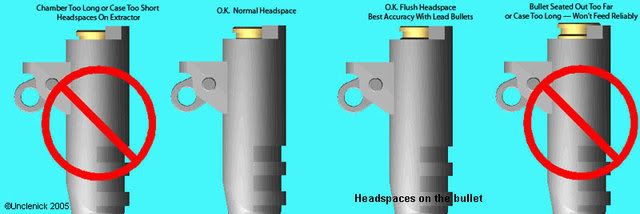
Nine times out of nine, if you have to push the round into the barrel, your OAL is to long. CZ's have short throats. It is also very common for someone having this issue to fire back" My OAL is correct, cuz I got it out of a manual." OAL is always bullet and firearm specific, Never, manual specific. |
|
Quoted: I am pretty new to reloading (and guns in general) but I have been loading shotshells for a couple months now with no problem. I decided to start reloading 9mm for my pistols. My first question... Does brass headstamp matter. Unlike shotshell loading data, I haven't seen any pistol loading data that specifies brass brand. Does that mean you load them all the same and it's safe to mix and match brands? Pistol reloading is different than shotgun. Yes you can mix cases. Look at the reloading data. The lowest powder charge is called the "start" load. As this is where you start. Not a trick, just the actual name. At the start load you can substitute different brand but like components, then work up your load watching for pressure signs. Also, My understanding from shotsell loading is that primers can make a big difference in the load. Is that same true for small pistol primers? I was wanting to use Alliant's only load data for 9mm 115 gr FMJ using BE-86 but it specifies Fed primers and I have CCI 550. Is that a safe swap or would I need to change my load? I did start out less than their specified 6.1 grains and loaded at 5.8. See above. Finally, I loaded about 6 bullets to setup my mcahine (Lee Classic Turret) and noticed that they drop just drop right in and out my wife's Ruger SR9c's barrel. But in my CZ P-09 they wouldn't quite drop in all the way and I have to give them a slight press with my finger to get them in the last 1/16". Consequently they would not just drop out either when I inverted the barrel. Just a little pull with my fingers and they came right out. Is that a problem, and if so, how do I correct it? Could be sizing or amount of crimp. Not normal, something to fix. Welcome to Arfcom and the Reloading forum.  A posting tip, if you double space after a complete sentence it makes your post easier to read and answer. Like I'm doing here. Read the FAQ's at the top of the page, it also has pic posting instructions. |
|
CZ pistols (SP01, 75, 85) are notorious for tight/short chambers. I would wager the P09 is no different.
Do not shoot those rounds in your CZ. Work some dummy rounds until you get OAL and crimp right for the CZ then try those same dummies in the Ruger. I would wager they will be fine with the Ruger. Now load some rounds on the low end of the charge range for that bullet and work up to where you want to be regarding recoil and accuracy. |
|
1.158, Your OAL is too long. Loading 115 gr RN, OAL should be 1.10. Fired case .380 to .384 After sizing .375 After belling .382 After crimping .376 to .378 You could also run into an OAL (over all length) issue with the bullet hitting the rifling. With my CZ 85, 1.10 is the longest OAL I load. Most are 1.05 - 1.06, depends on the bullet nose shape. You get your OAL from reloading data for the bullet shape you are loading. Lyman 49 is a great manual for 9mm data. So this is what you need to do. Size a case, chamber it in your CZ and eject. If it's normal sizing is good, the issue is OAL. If case sticks or doesn't chamber, it's a sizing issue. Lower sizing die 1/16 turn and repeat test. So do some testing and report back. |
|
Just goes to show I have a lot to learn. Lyman's 49th does not show a 115 gr RN FMJ so it was of no help to me. My Lee dies instruction sheet showed a max COAL of 1.169 I believe so I was trying to stay just under that. I did seat some dummies down to 1.148 and they dropped in fine but it sounds like I should go even lower. I'll have to get another reloading manual I guess since the Lyman's doesn't cover this. Two more questions if you guys don't mind:
1. When measuring the COAL on my dummies I noticed if I tightened my calipers pretty hard the bullet was being pushed down further into the case which I know is not good. I adjusted the Factory Crimp die (I'm using Lee 4 die set) and it no longer does it. Was that the correct fix? 2. I was only able to create 4 successful dummies before I was interrupted and had to stop. Their COAL measured 1.148, 1.148, 1.147 and 1.150. Is that amount of deviation normal? What is the normal deviation you guys experience? |
|
1) You should be able to take your completed round and push the bullet against a hard surface pretty hard with no movement of the bullet in the case. Just squeezing the calipers tighter and having the bullet seat deeper is not good.
2) A deviation of .003 is nothing. I go for +/- .005. For example I load my 124 grain Extreme plated to 1.150 for my RIA. When I measure the rounds, anything between 1.145 and 1.155 is considered good to go (by me). Anything down to 1.140 or up to 1.160 is set aside for practice rounds. I have never had anything measure under 1.140 or over 1.160 when trying to load to 1.150. If I did, I would likely pull them. |
|
Do you have a case gauge? That is helpful for me: if it passes the case gauge ("plunks") then it is usually good to go for the barrel chamber. If the case is fat then it sticks out of the gauge and that is obvious. I will pull these rounds and re-use the components, including the primer. The case then is discarded.
Using the barrel as a gauge is not as good IMHO, it's harder to tell if the case is long, and most barrels are bigger (fatter) than the gauge. Mostly in my guns if the case sticks, it really sticks. That's because the case was previously shot in an SMG like an open bolt UZI which really stretches out the base and is still fat after resizing. Resizing only goes down so far, unless you use a roller resizer, which I don't have. |
| I have a case gauge ordered, but I don't have it yet. How do you guys settle on a COAL? do you go with the longest that works or do you settle in the middle on the min and max? Assuming it fits the chamber of your gun, are there pros and cons of being on the shorter or longer end of the spectrum? |
|
Quoted: Just goes to show I have a lot to learn. Lyman's 49th does not show a 115 gr RN FMJ so it was of no help to me. Quoted: Just goes to show I have a lot to learn. Lyman's 49th does not show a 115 gr RN FMJ so it was of no help to me. Lyman 49 Page 342: 90 fr RN, OAL 1.045. 120 gr RN, OAL 1.065 You are looking for bullet shape (RN) to get an OAL. Doesn't have to be an exact match, and FMJ/cast use the same OAL. My Lee dies instruction sheet showed a max COAL of 1.169 That's too long., and doesn't work in your pistol. I believe so I was trying to stay just under that. I did seat some dummies down to 1.148 and they dropped in fine but it sounds like I should go even lower. I'll have to get another reloading manual I guess since the Lyman's doesn't cover this. Two more questions if you guys don't mind: 1. When measuring the COAL on my dummies I noticed if I tightened my calipers pretty hard the bullet was being pushed down further into the case which I know is not good. I adjusted the Factory Crimp die (I'm using Lee 4 die set) and it no longer does it. Was that the correct fix? 2. I was only able to create 4 successful dummies before I was interrupted and had to stop. Their COAL measured 1.148, 1.148, 1.147 and 1.150. Is that amount of deviation normal? What is the normal deviation you guys experience? |
|
Quoted:
I have a case gauge ordered, but I don't have it yet. How do you guys settle on a COAL? do you go with the longest that works or do you settle in the middle on the min and max? Assuming it fits the chamber of your gun, are there pros and cons of being on the shorter or longer end of the spectrum? I make dummy rounds to experiment with, one or two usually. I'll seat one to the longest published length, check to see if it fits the mag and chamber. If not then I'll see how much it is sticking out and seat it about that much more and check again. Keep doing that till it fits. Make another dummy without making any adjustments and check that one, if it's good I'll make a few to test fire. Sometimes I'll use the dummies to test for function. If they have a long OAL they may not feed right, then you shorten them a little at a time, about .010 each time till they feed right. Then I'll work on the charge weight to get that dialed in for the best accuracy. Generally the longer OAL you can use makes for a more accurate round because the bullet is closer to the lands and gets a nice straight start into the barrel. Seated deeper, the bullet has more space in which to get crooked before entering. With auto-pistol rounds I check every one in the gauge. The gauge is usually at min SAAMI specs, meaning it mimicks a tight chamber. If it fits the gauge you can almost guarantee it will fit the gun. The reason I gauge every one is because semi-autos don't let you know if one isn't fitting just right, for instance when loading a revolver you can feel if a round is a little tight. |
Armory Sponsor