


Armory Sponsor


Posted: 5/17/2010 2:44:07 PM EDT
|
I am working on some subsonic loads and was needing some measurements or a link where I can find the length of 308 SMK's.
I am needing lengths for these weights: 175 180 190 200 210 220 240 I am needing the lengths so I can determine which would be best for a 11 twist barrel with a velocity of 1050. I am going to be loading to a point where the bullet is hopefully just barely stabilized. A friend and I were talking about performance of HP's and figured a bullet that was barely stabile would tumble. Our thoughts are that HP performance is mediocre at best with a subsonic 308 and that a bullet that tumbles on impact would be more a more reliable performer. The heaviest bullet that will be stabile to 100 yards is what I am looking for. After that I will be test the load to see if it tumbles as is passes through water. I am not using a full size rifle cartridge case. It is a small case to optimize the case capacity. Thanks Dolomite |
|
Are you shooting these through a can?
I think your idea is poor. I think you should look for a different type of projectile rather than trying to engineer exterior ballistics with limited control of the variables. I would take a 240 GR round nose and bore a big ass hollow point in it. I bet that would be more interesting. People like using the MKs because they look cool and like a rifle bullet. At 1050, what works in handguns successfully would likely translate to the rifle loads. |
|
Quoted:
Are you shooting these through a can? I think your idea is poor. I think you should look for a different type of projectile rather than trying to engineer exterior ballistics with limited control of the variables. I would take a 240 GR round nose and bore a big ass hollow point in it. I bet that would be more interesting. People like using the MKs because they look cool and like a rifle bullet. At 1050, what works in handguns successfully would likely translate to the rifle loads. This pretty much mirrors my thoughts on the subject but I don't see the need for a hollow point unless you already have a source for a mold. It seams to me that a not too hard bullet should perform well balistically at these speeds and mushroom very well too. |
|
I would also think bearing surface is a more important measurement than length to you.
Most people would recommend a 170 or 180 grain round nose flat base bullet for a 1 in 11 twist for subsonic use. Some people swear that they can stabilize a 175 grain BTHP in a Rem 700 but I wouldn't risk my can using it. I am working on loads for my 300 Whisper and it is more fun than I expected. |
|
With my understanding of ballistics, if they are stable at the muzzle, they'll be stable at 100 yards. The RPMs (or revolutions per second) of the bullet are based on the twist and the muzzle velocity. The RPMs will not slow down like forward velocity will. If I'm wrong, I need a correction.
|
|
Quoted:
With my understanding of ballistics, if they are stable at the muzzle, they'll be stable at 100 yards. The RPMs (or revolutions per second) of the bullet are based on the twist and the muzzle velocity. The RPMs will not slow down like forward velocity will. If I'm wrong, I need a correction. They do become unstable, but it decays much more slowly than velocity. You're pretty much correct in saying 'stable is stable.' Now, as to the length, it is projectile LENGTH that is most critical to working out stability. Bearing surface plays no role in it, except that for the same weight, a shorter bullet will have more bearing surface. So it will be stable because it's shorter, not because it has more bearing surface. |
|
Quoted:
With my understanding of ballistics, if they are stable at the muzzle, they'll be stable at 100 yards. The RPMs (or revolutions per second) of the bullet are based on the twist and the muzzle velocity. The RPMs will not slow down like forward velocity will. If I'm wrong, I need a correction. I have yet to hear of a documented story of a baffle strike caused by an unstable bullet. Baffle strikes are generally loose cans and/or bad threads. There is nobody that is able to prove or disprove that without a ton of testing. I'd like to see some testing of crazy unstable loads with test silencers as I think there might be a bit of a myth on baffle strikes. Not on my can though :) |
|
Quoted:
Quoted:
With my understanding of ballistics, if they are stable at the muzzle, they'll be stable at 100 yards. The RPMs (or revolutions per second) of the bullet are based on the twist and the muzzle velocity. The RPMs will not slow down like forward velocity will. If I'm wrong, I need a correction. They do become unstable, but it decays much more slowly than velocity. You're pretty much correct in saying 'stable is stable.' Now, as to the length, it is projectile LENGTH that is most critical to working out stability. Bearing surface plays no role in it, except that for the same weight, a shorter bullet will have more bearing surface. So it will be stable because it's shorter, not because it has more bearing surface. Makes sense I think the main reason people like the shorter bullets that have a round nose and flat base are that they can shoot as heavy a bullet as possible compared to a BTHP of the same length at subsonic velocities. |
|
Quoted:
I am working on some subsonic loads and was needing some measurements or a link where I can find the length of 308 SMK's. I am needing lengths for these weights: 175 180 190 200 210 220 240 http://www.jbmballistics.com/ballistics/lengths/lengths.shtml |
|
Thanks alot guys.
Once I get everything worked out I'll post some results. It is a Savage that I have chambered in 7.62x25 Tokarev. It has a 16" SS barrel with an 11 twist. The barrel has a tensioning sleeve and the barrel has been lathed concentric to the bore to help with accuracy hopefully. I plan on loading heavy bullets for this one but I can still shoot cheap surplus in a pinch. I lathed the bolt face diameter from .378" to .400" to clear the .393 rim diameter of the Tokarev. I had one I built a few years ago and really liked it but it had a 24" barrel and a 10 twist. It was really quiet and this one is a bit louder but still manageable with the 16" barrel. The previous one was as quiet as a 16" 10/22 shooting subsonics but still had the muzzle energy of a 357 mag. Because I planned on staying subsonic with anything other than factory I saw no need to go through the extra expense of chambering in 300 Whisper like so many do. The dies for the Tok are cheaper, quality ammo is available as well as surplus and I don't have to fool with making brass. I did a ton of testing last time I had a Savage chambered in this round. This time I have a longer throat so I can make better use of the heavier bullets. Here are some dummys I made up: 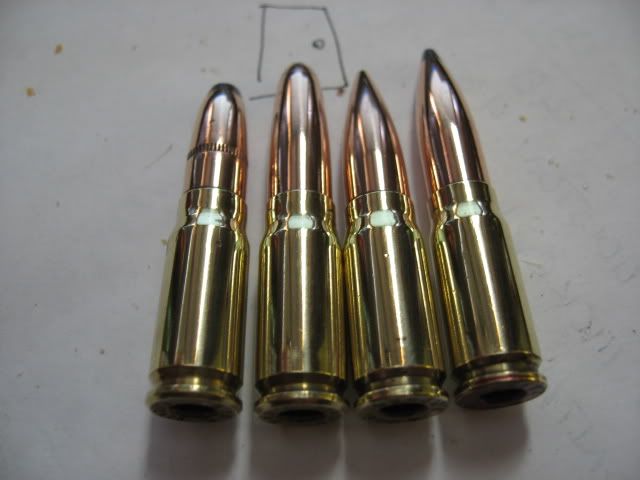
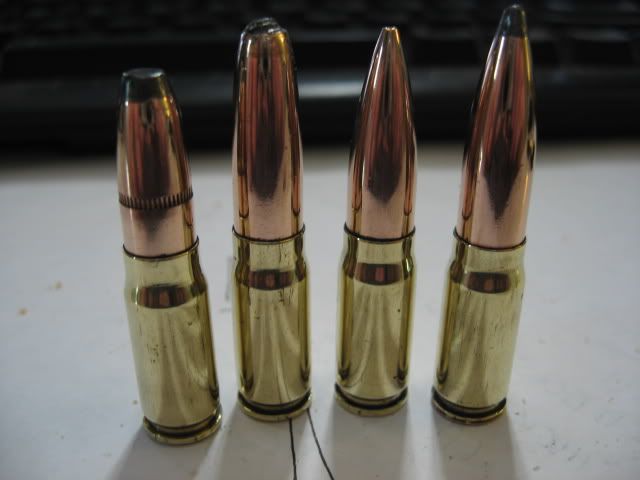
L-R 150 grain Sierra 30-30 180 grain Speer Hot-Cor 168 grain Sierra SMK 180 grain Sierra Spitzer I will be using small rifle primers and I am still working out the powder but it will probably be HS-6 based on the previous testing I did. I may try a few other powders based on a what a friend recommends. Here are a few pictures of this build: 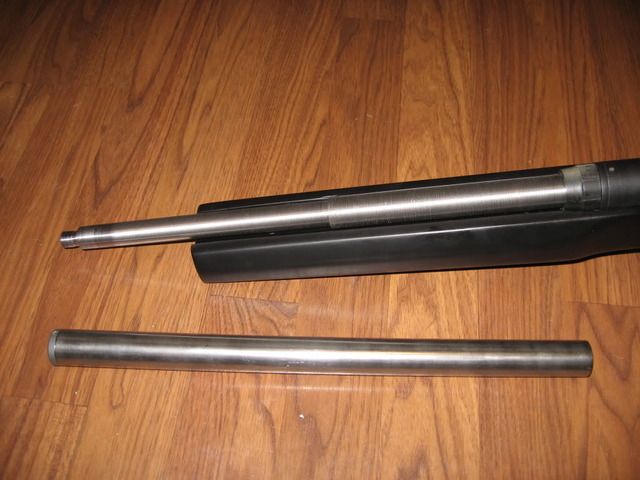
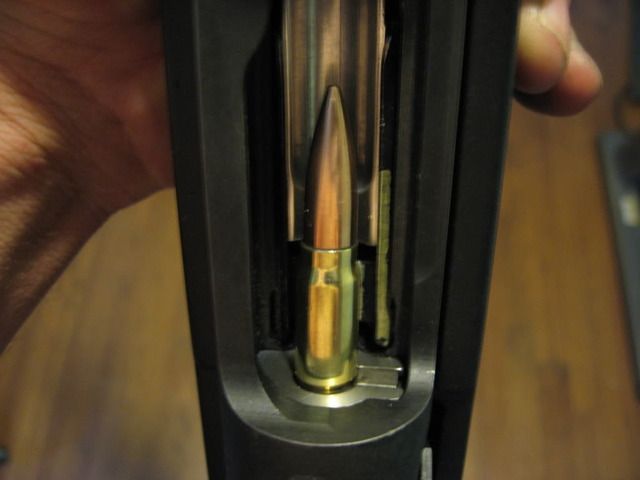
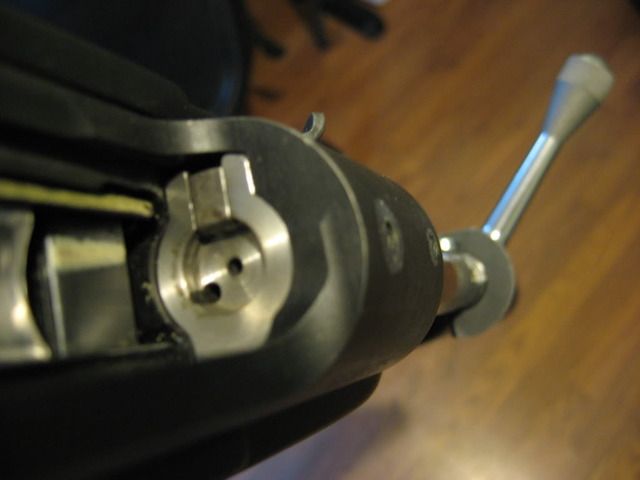
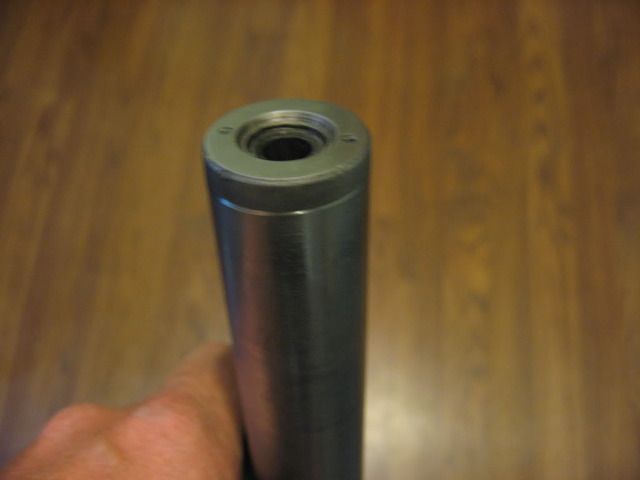
Dolomite |
|
No can as of yet, I am wanting to see if I can this one as quiet as the last one without a can. I doubt it with the shorter barrel.
Way far down the road I might form 1 it and integrally suppress it. The way it is setup it would be pretty easy with the tensioning sleeve. Dolomite Posted Via AR15.Com Mobile |
|
Accuracy Testing
Yesterday I loaded the Tok with N105 with 6.4 grains and the 3N38 with 6.3 grains. Both had the 180 grain Sierra Spitzer. I used small rifle primers. The N105 was quieter than the 3N38 but it wasn't as accurate. I might be able to tweak the load a bit to squeeze some accuracy out of it. The 3N38 was just barely noticeable as being louder than the N105 but was easily twice as accurate. I tested at 25 yards and the N105 was one hole no larger than the bullet diameter so I will test it a bit more at longer ranges. The N105 had a cluster but they were just barely touching. No keyholes by either at 25 yards. I did some testing using the 180 grain Sierra Spitzers loaded to approximately 950 FPS. It showed amazing accuracy yesterday when I was doing some testing. As long as they can get to 100-150 before they tumble that would be great. The best part about all this is the noise levels. Both loads were way quieter than a 9mm shot out of a 16" barrel or a 22lr out of a pistol. I can easily shoot without hearing protection and get no ringing. I suspect they are going to work out to be as quiet as a 22lr out of a rifle. I know the 3N38 is a keeper when using the 180's based on the accuracy. Stability Today I did some testing on stability using the 3N38 load and 180 grain Sierra Spitzer. The testing showed that at 6" of water the bullet remained stabile at least until it hit the target which was 5 feet behind it. Before exiting 10 inches of water the same bullet became unstable and pretty much blew the side out of the water jug. It continued on and keyholed in the target. I may do some more testing shooting through wood to simulate bone. But for now I think I am done for a few days. What is amazing is the SG is 1.55 which supposed to be very stable yet within 10" of water it becomes unstable. I also tested the Speer 180 grain RN bullets and they remained stabile in both the 6"and 10" tests. It would seem that it would because they are shorter even though the weight is the same as the Sierra lending itself to a more stabile bullet flight. So for now I am going to stick with the 180 grain spitzers until I get some 220 grain bullets to test. According to calculations with the Hornady 220 Rn the stability factor should be 1.42. This is pretty much the same as the original 5.56 loading of 55 grain in a 12 twist barrel that proved to be stable until it hit something then disintegrated dumping all its energy in the target. This is the same kind of performance I am looking for with this project and only time and testing will tell if it is even possible. The reaons why the 5.56 is having so many problems is the bullets are heavier as well as being overstabilized. As velocity drops the bullets spin doesn't drop as quickly making it way over stabile. When this slow, overstabilized bullet hits something it doesn't yaw or disrupt it just passes right through making a nice neat hole with litlle more damage. At extended ranges or reduced velocities this only gets worse. If someone were to either slow the twist to the point of being barely stabile the heavy bullets would be more effective because they will tumble much easier than they do now. Right now what helps the heavy over stabilized bullets work is velocity to help the bullets disrupt. When the velocity drops below that needed for the bullet to disrupt all it does is just pass through the target with little fuss. I also shot some surplus FMJ to see what would happen and it punched right through both the 6" and 10" water tests as expected. Thanks Dolomite |
|
Yeah, as long as I can get a bullet to remain stable to 100-150 yards then tumble when it hits something I will be happy. I really need to get a chrono because up to this point we are using calculations from Quickload. It is a great program but it is designed more for normal rounds and not so much for subsonic velocities. Without knowing what the velocity it makes all the other calculations just speculation.
Once I do get a chrono or are able to test using someone else's I am going to start a new thread in the precision carbine or maybe the general firearm areas. I can honestly say I like this 16" version better than my previous 24.5" version. The last one had a straigt tapered barrel and with the extra length it was heavy and unhandy. This one is lightweight because of the tensioned barrel and 16" length. So far it seems as though the noise levels between the two are comparable, mostly because I am trying different powder this time. Dolomite |
|
Quoted:
Quoted:
Quoted:
With my understanding of ballistics, if they are stable at the muzzle, they'll be stable at 100 yards. The RPMs (or revolutions per second) of the bullet are based on the twist and the muzzle velocity. The RPMs will not slow down like forward velocity will. If I'm wrong, I need a correction. They do become unstable, but it decays much more slowly than velocity. You're pretty much correct in saying 'stable is stable.' Now, as to the length, it is projectile LENGTH that is most critical to working out stability. Bearing surface plays no role in it, except that for the same weight, a shorter bullet will have more bearing surface. So it will be stable because it's shorter, not because it has more bearing surface. Makes sense I think the main reason people like the shorter bullets that have a round nose and flat base are that they can shoot as heavy a bullet as possible compared to a BTHP of the same length at subsonic velocities. I remember reading Hatcher's Notebook wherein they did maximum ordinate testing. Some of the rounds that landed were still spinning after their forward velocity had been exhausted. If I were you, I'd use the most blunt nosed bullet I could find. A soft point lead would probably be good, even if a hollow-point wouldn't work because of aerodynamic drag. |
Armory Sponsor