


Armory Sponsor


Posted: 9/11/2011 3:41:56 PM EDT
How are y'all doing it for your reloading setups...dedicated powder box? On a shelf? Just dumped in a big 5 gal bucket with assorted loose primers, rocks and bottle rockets? 
|
I only keep 8LBs of the powder I'm using to load at one time in the area of the presses. It is kept in a steel cabinet about 4 feet from the presses till it is needed. Once done filling the powder hopper the 8LB jug is returned to the cabinet. All other powder is stored in climate controlled conditions. 
The next shelf down is the H335. Above is the pistol powder.

|
|
Quoted:
I keep my small (1lb.) containers on a shelf. The larger ones (4# & 8#) sit on the floor under the loading bench. Me too. I have them stashed wherever they're out of the way. I keep the opened ones in the bench drawers, however. I'm in AC from May through September, so I don't worry too much about my primers and powder being effected by the humidity. 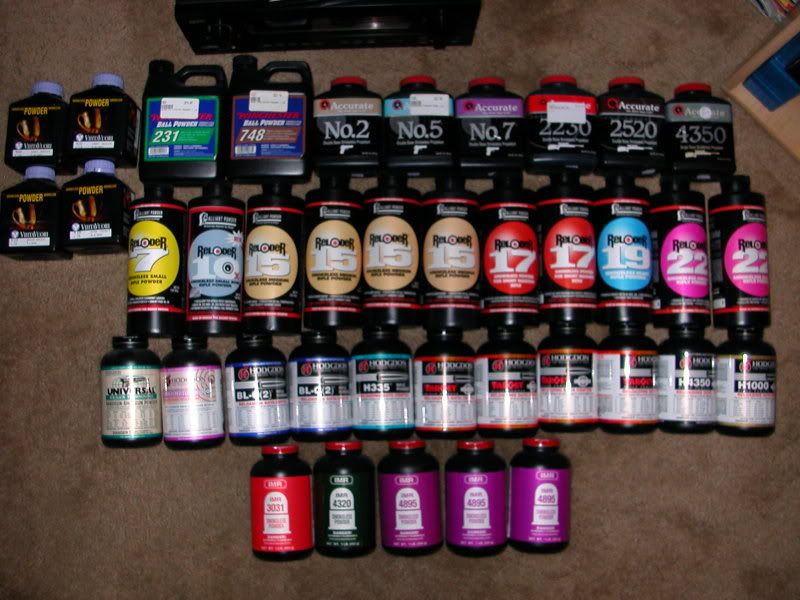
Rainbows are pretty. Chris |

|
I'm the opposite, I leave the jug of powder (all mine are 8lb jugs) on the bench, and only that jug of powder. That tells me what powder is in my powder hopper. Elminates second guessing of what powder is in the hopper and when it's time to refill it, I won't grab the wrong jug unless I put the wrong jug out on the bench to begin with |
|
Quoted:
Quoted:
I put the 1# cans in G.I. ammo boxes and put those cans on a shelf. 8#s sit next to the other cans. You do understand you have made a bomb? Not so. The GI ammo cans are made of sheet metal and are designed to rupture way before excessive pressures are reached in case of ignition of the contents. They have a rubber seal to prevent moisture from entering and are a convenient size for handling. All pluses and no downsides except availability or expense. |
|
Quoted:
I keep my small (1lb.) containers on a shelf. The larger ones (4# & 8#) sit on the floor under the loading bench. Bingo Bottles capped,empty measure when done with loading for the day The powder by itself is not any huge risk ( just like stock piled ammo) the burning powder is only efficiently converted to energy when contained by the firearms chamber. Many other common household cleaning supplies and chemicals have a higher risk to life and limb during a fire or similar catastrophe |
|
Quoted:
Quoted:
Quoted:
I put the 1# cans in G.I. ammo boxes and put those cans on a shelf. 8#s sit next to the other cans. You do understand you have made a bomb? Not so. The GI ammo cans are made of sheet metal and are designed to rupture way before excessive pressures are reached in case of ignition of the contents. They have a rubber seal to prevent moisture from entering and are a convenient size for handling. All pluses and no downsides except availability or expense. I'm affraid you have been misled. In 25 years in the military, in the munitions field, I have never seen or heard of a steel ammo storage can "designed" to give way and vent before the gases reach the point of detonation. Ammo cans are designed to indure rough handling and maintian their airtight and waterproof features. You pretty much have a bomb there. |
|
Quoted:
Safest place to store anything like that is a low as you can get it, remember, fires burn UP more than down. Ammo can is OK as long as it isn't latched. I'm thinking the safest place to store powder is a box that's lined with 2" of sheet rock sitting on the ground
|
|
Quoted:
Quoted:
Quoted:
Quoted:
I put the 1# cans in G.I. ammo boxes and put those cans on a shelf. 8#s sit next to the other cans. You do understand you have made a bomb? Not so. The GI ammo cans are made of sheet metal and are designed to rupture way before excessive pressures are reached in case of ignition of the contents. They have a rubber seal to prevent moisture from entering and are a convenient size for handling. All pluses and no downsides except availability or expense. I'm affraid you have been misled. In 25 years in the military, in the munitions field, I have never seen or heard of a steel ammo storage can "designed" to give way and vent before the gases reach the point of detonation. Ammo cans are designed to indure rough handling and maintian their airtight and waterproof features. I'll see your "25 years in the military" and raise it to thirty military years (75A Munitions Material Officer), 5 years civilian small arms munitions advanced design (Hercules Inc), one small arms caseless ammunition patent, and a year in the NJ State Police Ballistics Lab (just for the fun). The basic question asks for a desirable way to store propellant. The safest regarding blast or fire would be in a porous fire-proof bag on a raft in the middle of a large lake. The safest regarding preservation and future use would be a sealed container with low humidity and no temperature changes. About the closest compromise you will find would be a pre-scored plastic GI ammo can. If Walmart near you doesn't have any this month, the next best would be a real GI ammo can. You pretty much have a bomb there. |
|
An ammo can will work fine if you don't latch it, anything happens the lid opens up and vents. I store lithium polymer batteries in an unlatched ammo can, lipos can be very volatile, if they go off its usually when they are charging, but they have been known to go off spontaneously, so they are stored in an ammo can, if they go off they outgas tremendously, just like powder burning, unlatched can the lid opens just enough to vent the gas. |
|
Quoted:
An ammo can will work fine if you don't latch it, anything happens the lid opens up and vents. I store lithium polymer batteries in an unlatched ammo can, lipos can be very volatile, if they go off its usually when they are charging, but they have been known to go off spontaneously, so they are stored in an ammo can, if they go off they outgas tremendously, just like powder burning, unlatched can the lid opens just enough to vent the gas. Must be a RC man. 
|
|
Quoted:
Quoted:
Quoted:
I put the 1# cans in G.I. ammo boxes and put those cans on a shelf. 8#s sit next to the other cans. You do understand you have made a bomb? Not so. The GI ammo cans are made of sheet metal and are designed to rupture way before excessive pressures are reached in case of ignition of the contents. They have a rubber seal to prevent moisture from entering and are a convenient size for handling. All pluses and no downsides except availability or expense. ok well you've made a grenade with shrapnel going everywhere then |
|
If my failing memory serves me you may store up to 20lbs in the original containers; from 20 lbs to 50lbs you must store it in a magazine with 1" wooden walls (no metal alllowed), the lid must be designed to "vent " in case of a fire and in a seperate magazine you may store not more than 10K primers, all you are allowed in a residence. This is a National standard fire code. violation of this will void your homeowners insurance. I was a fire fighter for years.
|
|
Quoted:
The bulk of the powder is stored in an old freezer. The powder I am using is on the bench, usually one other under it due to laziness. Pretty much the same. I keep my powder in my old college "beer fridge", unplugged to the side of my setup. Whatever powder is in use, the container is kept up on my bench. |
Armory Sponsor