


Armory Sponsor


Posted: 12/25/2013 6:09:34 PM EDT
|
Been working up loads for my various AR rifles over the last 18 months (I like doing load workups more than any other type of shooting it seems) and have a question about "flyers" in groups. Fairly often I'll have four of my five shots be sub 3/4" and then have one oddball flyer that opens the group up to 1.25" or larger. How do you guys account for that in your workups? Just assume the group with the tightest 4 out of 5 is the one to go with, or are you guys more regimented and keep looking for different combos, or just do confirmation workups around the best 4/5 group?
Here is an example from last weekend... This is from my 16" Lothar Walther 1:8 Wylde chambered rifle. It has an SSA-E trigger and a 16X scope. Brass was LC once fired, CCI 41 primers, H322 powder and the Hornady 53 grain VMAX. Check out the 24.1 grn and the 23.8 grn. groups... 
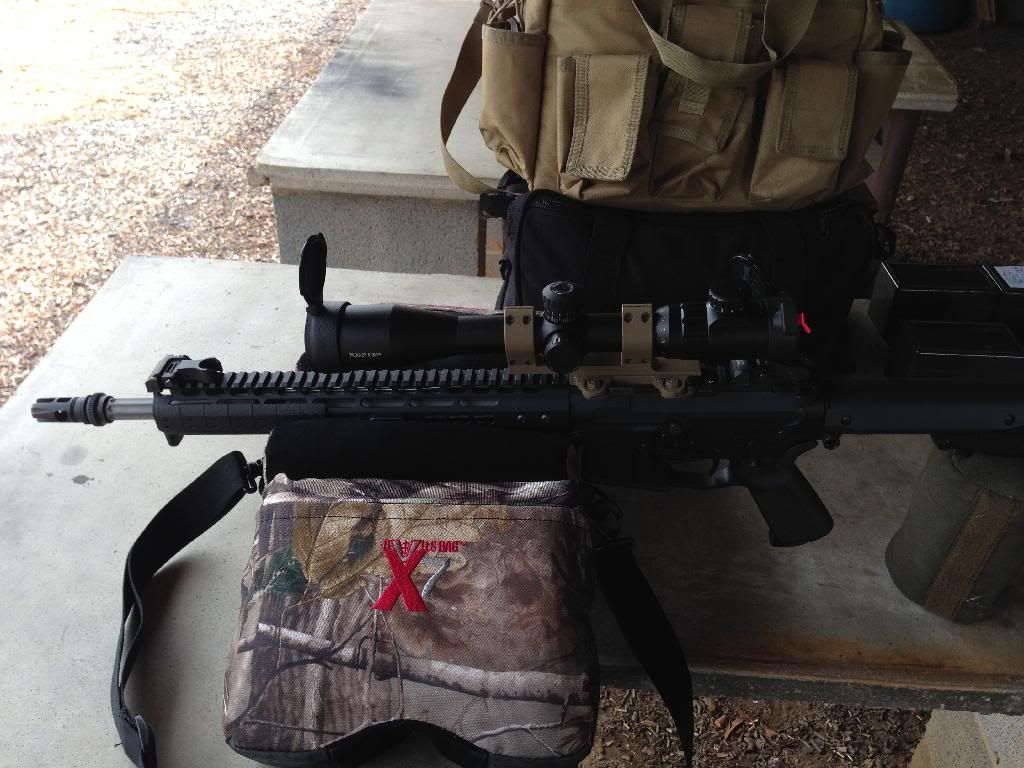
Gratuitous picture of the setup... L 
Opinions? ZA |

| A lot of variables can cause this, it's usually the shooters cheek weld changes or some other factor, like trigger control. H322 seems to tighten up with non magnum primers, the one you are using is the same as a magnum small rifle. Make one change at a time, starting with primers. Lastly, seating depth can also be part of the answer. Just make one change at a time. |
|
Another factor is how the rounds are fed into the chamber.
Dropping the bolt on one and the rest cycled through can make a difference. Oh, I feel your pain by the way, forgot to shoot a sighter and just dropped the bolt on the first of 5 shot when shooting this group. href=http://i374.photobucket.com/albums/oo186/yellowheap/GJB/cge22355btvbest_zps7006e2e5.jpg" /> DOH! |
|
It helps very much to work with a spotter who can record your sequence of shots, and also to shoot through a chrono.
If your spotter records the sequence of shots and the "flyers" all chrono slower (or faster) than the shots that grouped nicely--then you just have to drop or raise your charge slightly to keep all your velocities in the sweet spot. Sometimes it is variations in your componenets that explains the flyers. Example--I was working up a 75 grain Hornady load. I had a tight ten-shot group---but with two fliers that opened everytihng up. Strange thing was the two fliers were almost touching--but three inches left from the rest of the group. Just on a hunch I carefully inspected my brass, and discovered two of the fired cases had a different year LC headstamp. They had gotten into my segregated lot of brass. So I inspected the bucket of prepped brass I was working from and found five more of that different year of LC. I seperated them out and loaded them up with the same charge weight--and they shot just as good as the previoius group--but all of them impacted in a tight group three inches to the left. |
|
Quoted:
It helps very much to work with a spotter who can record your sequence of shots, and also to shoot through a chrono. If your spotter records the sequence of shots and the "flyers" all chrono slower (or faster) than the shots that grouped nicely--then you just have to drop or raise your charge slightly to keep all your velocities in the sweet spot. Sometimes it is variations in your componenets that explains the flyers. Example--I was working up a 75 grain Hornady load. I had a tight ten-shot group---but with two fliers that opened everytihng up. Strange thing was the two fliers were almost touching--but three inches left from the rest of the group. Just on a hunch I carefully inspected my brass, and discovered two of the fired cases had a different year LC headstamp. They had gotten into my segregated lot of brass. So I inspected the bucket of prepped brass I was working from and found five more of that different year of LC. I seperated them out and loaded them up with the same charge weight--and they shot just as good as the previoius group--but all of them impacted in a tight group three inches to the left. Hmmmmmm.... This was all LC brass, but I didn't sort by year.  I'll start doing that. They could have all been from different years for all I know. I'll start doing that. They could have all been from different years for all I know.
ZA |
|
Quoted:
Another factor is how the rounds are fed into the chamber. Dropping the bolt on one and the rest cycled through can make a difference. Oh, I feel your pain by the way, forgot to shoot a sighter and just dropped the bolt on the first of 5 shot when shooting this group. http://<a href=http://i374.photobucket.com/albums/oo186/yellowheap/GJB/cge22355btvbest_zps7006e2e5.jpg</a>" /> DOH! One thing I always do in load workups is load one cartridge in the mag, drop bolt, shoot, load one cartridge in the mag, drop bolt, shoot.... Etc. keeps me from shooting too fast, makes them all consistent that way and makes me refocus my eyes. ZA |
|
Quoted:
Hmmmmmm.... This was all LC brass, but I didn't sort by year. I'll start doing that. They could have all been from different years for all I know.
ZA Quoted:
Quoted:
It helps very much to work with a spotter who can record your sequence of shots, and also to shoot through a chrono. If your spotter records the sequence of shots and the "flyers" all chrono slower (or faster) than the shots that grouped nicely--then you just have to drop or raise your charge slightly to keep all your velocities in the sweet spot. Sometimes it is variations in your componenets that explains the flyers. Example--I was working up a 75 grain Hornady load. I had a tight ten-shot group---but with two fliers that opened everytihng up. Strange thing was the two fliers were almost touching--but three inches left from the rest of the group. Just on a hunch I carefully inspected my brass, and discovered two of the fired cases had a different year LC headstamp. They had gotten into my segregated lot of brass. So I inspected the bucket of prepped brass I was working from and found five more of that different year of LC. I seperated them out and loaded them up with the same charge weight--and they shot just as good as the previoius group--but all of them impacted in a tight group three inches to the left. Hmmmmmm.... This was all LC brass, but I didn't sort by year. I'll start doing that. They could have all been from different years for all I know.
ZA My brass was a lot of LC 02, and I had mixed in some pieces of LC 04. All brass in these particular lots was only shot in this particular rifle, and all came from the same factory case. ET: Having a smart spotter is also helpful. They can quickly look over and identify some fault or peculiarity in your shooting technique that leads to flyers. |
|
Could have something to do with neck tension.
Maybe one or the other has been loaded more times, more work hardened and has a different neck tension. ETA: I go with with the tighter group, four of five, or eight of ten real close are better than five or ten all over the place |
|
The load from the mag thing is often an issue but at least two of my precision builds do not exhibit this. I shoot thru a chrono and it is seldom the first round, but the last(or #4 of 5) in a group. Go figure. It doesn't always show up as the highest or lowest in a shot string. Heck, I even messed around using random brass....and you guessed it, random results. My 55 gr. V-Max and CFE load is also 27.0 gr with WSR primers. Have shot groups in the 3's with this load in my 20" 1-8 Sabre defense rifle, except on the days I don't. Even with a flyer, this load stys ay about .6 or so. Some days it all works.
|
|
For load work-up, I run 2 targets; I mark up the load # - shot # and shot hole on the bench target and single load to reduce the feeding variables. I am interested in shot performance, not the gun behavior, you want to minimize anything that interferes with the load. Afterwards at home, I transfer the shot string numbers to the actual shot target, that way when reviewing the results, the data is there to help draw conclusions. This Is my process, I get a little anal.
Example: 
Load # - Shot # A picture of a good target. I will stay with load #3. Load #2 I know I pulled the #5 shot, I think I was getting excited about the group. |
|
your bouncing. i can tell
you need to steady your head on your stock. turn down the magnification also when i shoot for groups, i put my hand over the top to the forearm to hold it solid into the front bag. you should have a relaxed not tight tension on the gun that lower left group is okay, but it is what i would work around. I would also try another powder and see if that helps. you need to redo all of that target. sorry to tell you this but those groups are way to wide and i would not accept that. it should be around no more than 1 inch max |
|
Quoted:
My brass was a lot of LC 02, and I had mixed in some pieces of LC 04. All brass in these particular lots was only shot in this particular rifle, and all came from the same factory case. ET: Having a smart spotter is also helpful. They can quickly look over and identify some fault or peculiarity in your shooting technique that leads to flyers. Quoted:
Quoted:
Quoted:
It helps very much to work with a spotter who can record your sequence of shots, and also to shoot through a chrono. If your spotter records the sequence of shots and the "flyers" all chrono slower (or faster) than the shots that grouped nicely--then you just have to drop or raise your charge slightly to keep all your velocities in the sweet spot. Sometimes it is variations in your componenets that explains the flyers. Example--I was working up a 75 grain Hornady load. I had a tight ten-shot group---but with two fliers that opened everytihng up. Strange thing was the two fliers were almost touching--but three inches left from the rest of the group. Just on a hunch I carefully inspected my brass, and discovered two of the fired cases had a different year LC headstamp. They had gotten into my segregated lot of brass. So I inspected the bucket of prepped brass I was working from and found five more of that different year of LC. I seperated them out and loaded them up with the same charge weight--and they shot just as good as the previoius group--but all of them impacted in a tight group three inches to the left. Hmmmmmm.... This was all LC brass, but I didn't sort by year. I'll start doing that. They could have all been from different years for all I know.
ZA My brass was a lot of LC 02, and I had mixed in some pieces of LC 04. All brass in these particular lots was only shot in this particular rifle, and all came from the same factory case. ET: Having a smart spotter is also helpful. They can quickly look over and identify some fault or peculiarity in your shooting technique that leads to flyers. 99% of my shooting is done on private land, but I set up two cameras, one records hits on paper and one facing my self. 
|
Armory Sponsor