


Armory Sponsor


Posted: 7/6/2015 3:20:09 PM EDT
|
I'd be interested in seeing what you guys do, but my process looks like this:
With Range pickup brass (which is usually once-fired, but sometimes more) First thing I do is throw them in the tumbler for a an hour or so to knock off the chunks and dust and make them clean for resizing. I do this to protect the die; Next, I resize/deprime using a single stage press, Cases are lubed with RCBS case lube on a RCBS pad. I use an RCBS resizing die set up in my RCBS Big Max press. Next, I will trim using the Giraud Tri Way trimmer chucked up in a Black & Decker drill clamped in a vice. Next, I'll clean primer pockets using my RCBS Trim Mate Case Prep Center; Next, if needed, I'll swage primer pockets using an RCBS case swaging die set up in my RCBS Rock Chucker press; Finally, I'll throw them back in the tumbler for a final shine. I'll store them in my tactical coffee can for loading up later:  </a>" /> </a>" />
|
|
Id say youre right on.
I wet tumble, so I do it just a bit different. Pick up brass Decap on Lee C press Cut crimps on anything that needs it with RCBS crimp cutter Tumble in SSTL media tumbler for 3 hours Pistol brass goes into storage at this point Lube rifle brass with homebrew lanolin case lube Size on LnL or single stage depending on caliber Trim with WTF2 Tumble for an hour or so to get case lube off Store brass for future loading |
|
For bulk brass: Toss in tumbler to clean Place in gallon bag, spray dillon case lube, seal and shake bag dump in top of XL650 case feeder Deprime in station 1, swage and pass expander ball through neck in station 2, trim and final size in station 4 For match brass: Toss in tumbler to clean Place in gallon bag, spray dillon case lube, seal and shake bag Size and deprime in station 1 Tumble case lube off Trim in Giraud Weigh cases and separate in corresponding batches. I have considered adding a primer uniforming step. |
|
My procedure -
1. Sort to remove interfering cases. 2. Add a capful (or two) of mineral spirits to walnut media and tumble to distribute (no brass). 3. Tumble clean brass (usually several hours but one hour is adequate). 4. Separate brass from media in media separator. 5. Put ~100 cases in a Ziploc bag and spritz with a couple (2 or 3) sprays of Dillon Lube. Repeat for additional batches of ~100. 6. Size and decap brass. 7. Remove primer pocket crimp. If the primer pockets look particularly crusty, I will clean/uniform them at this point. 8. Trim (if needed) in Giraud. 9. Ready to prime, fill and seat. 10. I tumble clean my finished rounds to remove the case lube. |
| OP, your procedure looks fine. Maybe you didn't mention these steps, but given you use the case prep center I'd add the primer pocket brush. Either you will remove dirt your tumbling doesn't catch, or you may be able to shorten the tumbler time it takes to clean the primer pocket. |
|
After a range session I pick up anything brass and toss it in an empty ammo can. I mark all my reloads with a sharpie.
When I get home I hand sort the brass. I quickly inspect for damage and sort by caliber. I also separate each caliber into 2 bins if it is a caliber I shoot. One bin is "new" brass and one is my previously reloaded brass. I then tumble them all in separate batches for 30-45 mins. I then decap and ream the primer pockets of any new to me brass. Then they all go into the correct container for resizing. Right now I only load .223 so I want to make sure primer pockets do not have a crimp. I make 2 passes through my press. One for decapping and sizing. The second for loading. I was trimming off the press with a Gracey trimmer. It works excellent but my hands can't take it anymore. Carpal tunnel has them hurting after 50-100 pieces. I usually process a few thousand cases at a time. I just bought a Dillon RT1500 to trim on my press. I have not set it up yet. I am still slowly reaming the last of a 5 gallon pail of .223 brass. I am collecting .45ACP, .308, .30-06, and 9mm for loading soon. I save anything brass and store it. I have calibers I don't even have a gun for. I have traded some and given some oddballs I found to a local guy who needed it. |
|
For bulk or pick-up brass:
Decap without resizing using a home brew automatic case feeder in my Hornady Lock N Load. Wet tumble with SS media. I trim using WFT in an electric drill. Chamfer neck, and deburr flash hole with my Hornady power case prep machine. Uniform primer pocket with an electric drill. Lube with One Shot Case Lube in a plastic bag, massage brass, and then full length resize. Wet tumble with SS media to remove case lube. Dry and anneal with my home brew automatic annealer machine. Store. For brass fired in my bolt gun which has been previously prepared. Decap and neck size using a Lee collet die in my progressive press. Wet tumble with SS media. Dry and anneal. Spot check for possible trimming using case gauge and/or micrometer. Store |
|
Quoted:
OP, your procedure looks fine. Maybe you didn't mention these steps, but given you use the case prep center I'd add the primer pocket brush. Either you will remove dirt your tumbling doesn't catch, or you may be able to shorten the tumbler time it takes to clean the primer pocket. That what I do, I clean primer pockets using the brush on the case prep center. Makes short work of it. |
|
Here's my protocol:
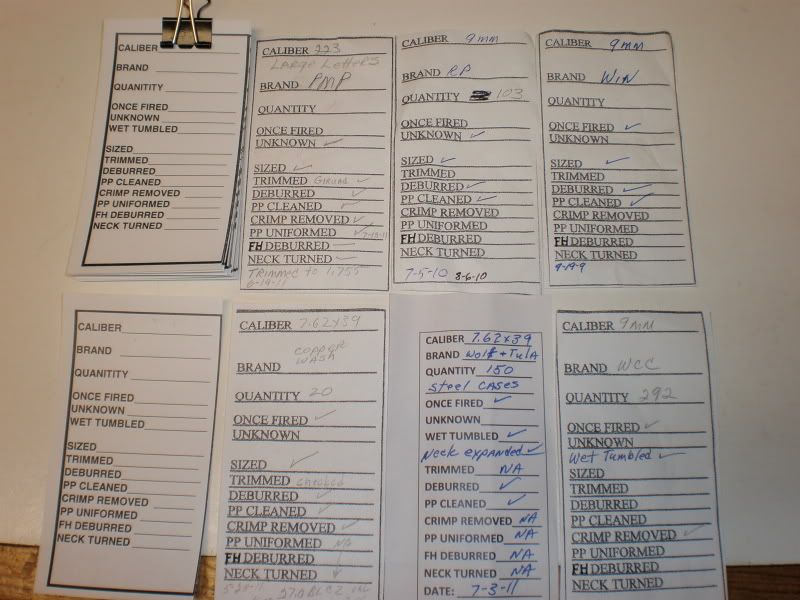
Collected brass is deprimed with a Harvey Deprimer, and sorted at the same time. I detect Berdan brass and obvious case problems at this step. Sorted brass is next wet tumbled. Wet tumbling with stainless steel pins produces very clean cases, and that makes them very easy to inspect for problems. I have found brass cases that shouldn't have passed the GI "visible defects" test, but the defects were hiding in the annealing marks on the shoulder and neck. The clean brass next gets lubed and sized. Yes, I lube ALL my brass, even pistol brass. It reduces sizing effort substantially, even with carbide dies. I run the cases through my case feeder so all I have to do is watch for bobbles and pull the lever. Once sized, the cases go into a dry tumbler with plain corn cob media to remove the lube. I separate the brass from the media and put it in containers for storage. When I'm ready to load a batch of ammunition, I get the clean, sized brass out and set up the press. Since sizing is the step that's most likely to cause vibration and shaking of a progressive press, I've eliminated a potential problem by sizing in a separate pass. Loaded rounds are collected and packaged, with load, date, and any other pertinent information attached. |
|
Quoted:
........ snip ............ Dry tumble in plain corn cob to remove the lube, about 1/2 hour. Why would you ever prep lubed cases? ....... snip ........ Here's why. Like you, I often perform trimming, primer pocket uniforming, flash hold de-burring, etc. This produces quite a lot of brass shavings which I prefer to eliminate during the wet SS tumbling process. The bottom of my rinse bucket always has lots of shavings,especially if a batch needs flash hole de-burring which pick-up brass always does.. If you tumble first and then trim etc., as you say you do, how do you get rid of the trimming shavings? |
|
Nick: My procedure is about the same, except I do the 2nd cleaning after sizing and before trimming, to remove the remaining lube. BTW, I learned long ago to be cautious about picking up brass at the range. Years ago, I got a lifetime supply of excellent .30-06 brass during "sighting in" seasons. The typical hunter hereabouts buys two 20-round boxes of Remington or Federal ammo each year, shoots one box at the range to verify her/his zero, sometimes even putting the empties back in their plastic sleeves, then takes the other box into the field. On the other hand, I picked up some .223 brass when I first got into AR rifles, but too many of them had expanded primer pockets with led to primers falling out inside the rifle. NFG! These days, my policy is to buy new unprimed brass, Winchester or Remington brand. Also, the new management at my local range collects empty brass for its scrap value, members are not allowed to harvest any brass other than their own. - CW
|
|
Starting with once fired brass or back from a range trip my process normally looks like:
1. Sort brass 2. Run through Lee universal decapping die 3. Four cycles through my ultrasonic cleaner 4. Dry cases 5. Trim or swage if necessary 6. Run through walnut media in vibratory tumbler for about 4 hours give or take for final cleaning and polishing That sequence seems to work fine for me and gets the primer pockets completely clean and the cases looking like new. |
|
It sounds like you all are doing just one caliber. I usually pick up all I can so I typically tumble clean it first. This will often require separation of different calibers so all do get clean and not "hide" inside larger cases.
After cleaning I inspect and often separate by head stamp but that depends on several factors. I also cull out the undesirables. Then the brass is stored in caliber, even sometimes head stamp specific marked containers. My prep sequence is very similar to the OP's. I normally swage military primer pockets right after sizing though. Then trim. Then all the brass is processed through the multi head prep center. This includes outside neck de burring, a light inside neck 45 degree break, fallowed by another light inside neck break with a 60 degree VLD. Then either scrape or brush primer pocket fallowed by a 45 degree primer pocket break then ran onto the primer pocket uniformer cutter. Then back into the tumbler for a final cleaning. Motor |
|
Every one has their way that works for them based on their target goal and equipment.
My target goal is to shoot 1 inch groups @ 100 yards with rifle cartridges and 2 inch groups @ 50 feet with pistol cartridges. I'm not a BR shooter, I like to shoot as many rounds down range as I can without breaking my budget and still reach my target goal. That said reloading allows me to do this cost efficiently at the expense of time. To keep my reloading time at a record low a Auto progressive press like my XL650 works well here. The less time my fingers touch the cases the more time efficient I can be. All my range brass and other brass gets collected and sorted/inspected by caliber at home, this is the most time I spend fondiling cases. Dump the pistol cases into the SS tumbler and when dry they get loaded in the case feeder lubeless and out come ready to go cartridges. I can't see pulling the handle twice just to pop primers out for wet cleaning. Rifle cases get the walnuts IF muddy with odarless mineral spirits to get the grime off. The few NATO cases I my find get set aside to be deprimed and reamed. Then sprayed with DCL homemade equivalent and tossed in the case feeder for prep head which will decap/resize RT1200 trim and M die flare. Then to the SS tumbler, dry and load up. Every third or so firing I will Anneal before the load cycle on my auto annealer if I'm feeling ambitious. |
|
Quoted: Here's why. Like you, I often perform trimming, primer pocket uniforming, flash hold de-burring, etc. This produces quite a lot of brass shavings which I prefer to eliminate during the wet SS tumbling process. The bottom of my rinse bucket always has lots of shavings,especially if a batch needs flash hole de-burring which pick-up brass always does.. If you tumble first and then trim etc., as you say you do, how do you get rid of the trimming shavings? Quoted: Quoted: ........ snip ............ Dry tumble in plain corn cob to remove the lube, about 1/2 hour. Why would you ever prep lubed cases? ....... snip ........ Here's why. Like you, I often perform trimming, primer pocket uniforming, flash hold de-burring, etc. This produces quite a lot of brass shavings which I prefer to eliminate during the wet SS tumbling process. The bottom of my rinse bucket always has lots of shavings,especially if a batch needs flash hole de-burring which pick-up brass always does.. If you tumble first and then trim etc., as you say you do, how do you get rid of the trimming shavings? I use a Giraud for trimming. |
Armory Sponsor

 Win a FREE Membership!
Sign up for the ARFCOM weekly newsletter and be entered to win a free ARFCOM membership. One new winner* is announced every week!
You will receive an email every Friday morning featuring the latest chatter from the hottest topics, breaking news surrounding legislation, as well as exclusive deals only available to ARFCOM email subscribers.