


AR Sponsor
Posted: 12/4/2022 7:05:53 PM EDT
Wolf WM193 5.56x45mm Accuracy Evaluation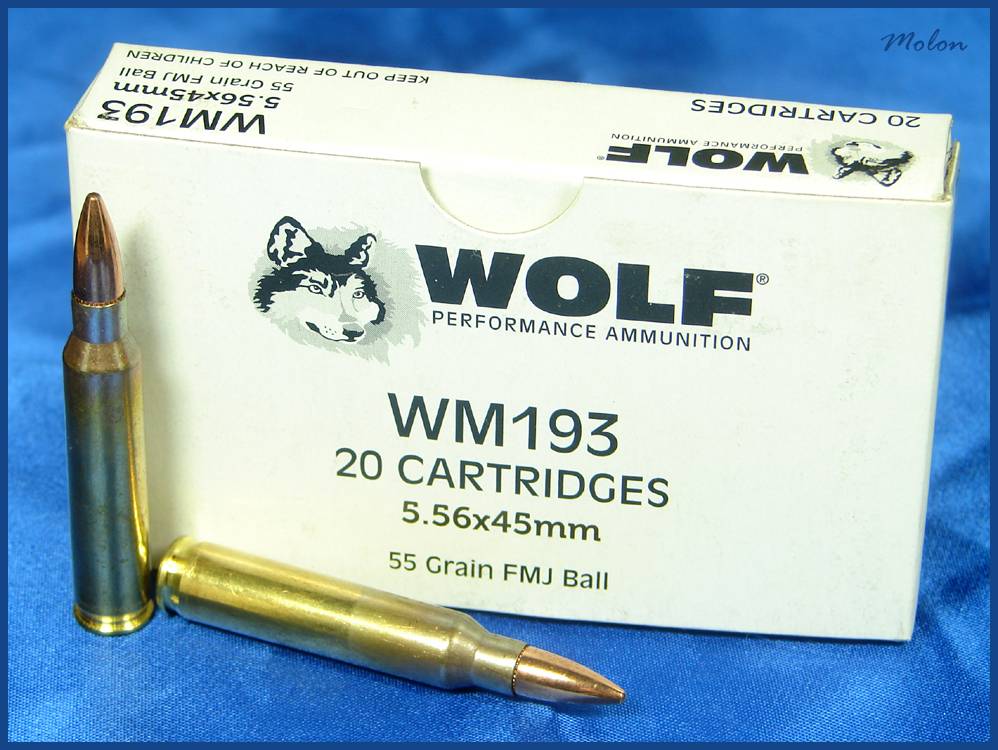 Notice that the box in the above picture is white. Also notice that the word “gold” does not appear anywhere on that box. Just, sayin’. It is known by many that Wolf does not manufacture ammunition, but rather, is an importer of ammunition. Wolf WM193 is imported from Taiwan. Unlike the steel-cased, bi-metal jacketed Wolf Performance Ammunition that is imported from Russia, Wolf WM193 has copper jacketed bullets loaded in brass cases. On-line vendors selling this ammunition claim that it is “manufactured to M193 specs.” Genuine US Military M193 can no longer be sold to civilians, thanks to the Clinton Administration. The ammunition that is sold on the commercial market with some form of “M193” in its nomenclature is often referred to as an “M193 clone” because it “appears to be a copy” of genuine M193, but we generally have no idea what specifications of MIL-C-9963 that this ammunition has passed, or has even been tested for. Genuine M193 must be tested for and pass all of the specifications laid out in the mil-spec, MIL-C-9963. The required areas of testing included in MIL-C-9963 range from velocity, accuracy, chamber pressure and port pressure to waterproofing, temperature stability, bullet extraction, case hardness, fouling and much more. M193 is loaded with a 55 grain FMJ bullet with a cannelure. The bullet itself, must meet required specifications in order to be used in genuine M193 ammunition. For example, the specification for the thickness of the gilding metal jacket of the bullet is 0.021" with a tolerance of - 0.002". For comparison, the jacket of Hornady’s 55 grain FMJ bullet has a thickness of approximately 0.028”. Jacket thickness can have a significant effect on terminal ballistic properties, particularly that of fragmentation. Even the composition of the copper alloy used for the jacket and the lead used for the slug must meet mil-spec requirements for genuine M193. Genuine M193 can only be charged with powder that has been specifically approved by the US Military for use in this cartridge. If the ammunition in question is not loaded with one of the approved powders, it is not genuine M193 and naturally we have no way of determining what powder was used in a load simply by visual inspection. Genuine M193 will have the annealing iris visible on the shoulder and neck portion of the case. It will also will have crimped and sealed primers. Genuine M193 has a crimped case mouth along with sealant at the case mouth. 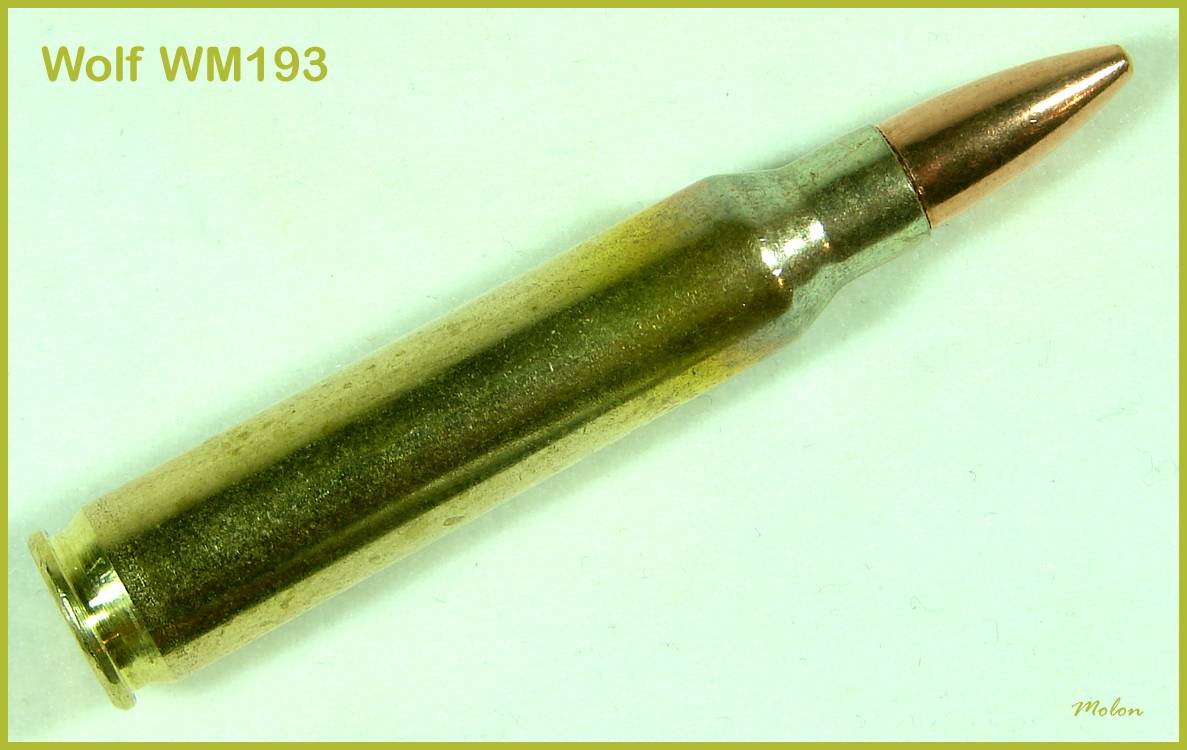 The annealing iris is lightly visible on the WM193 brass cases, though it’s not nearly as distinct as on a Lake City case. 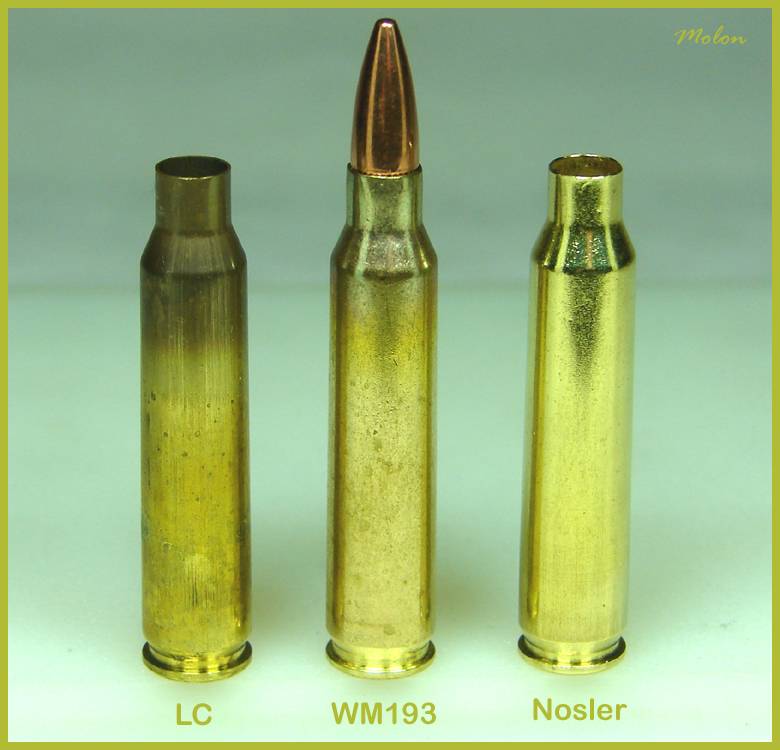 The Wolf WM193 uses a generic shaped 55 FMJ projectile with a cannelure and has a nominal length of 0.743”. The case mouth has a collet-crimp and asphalt sealant. 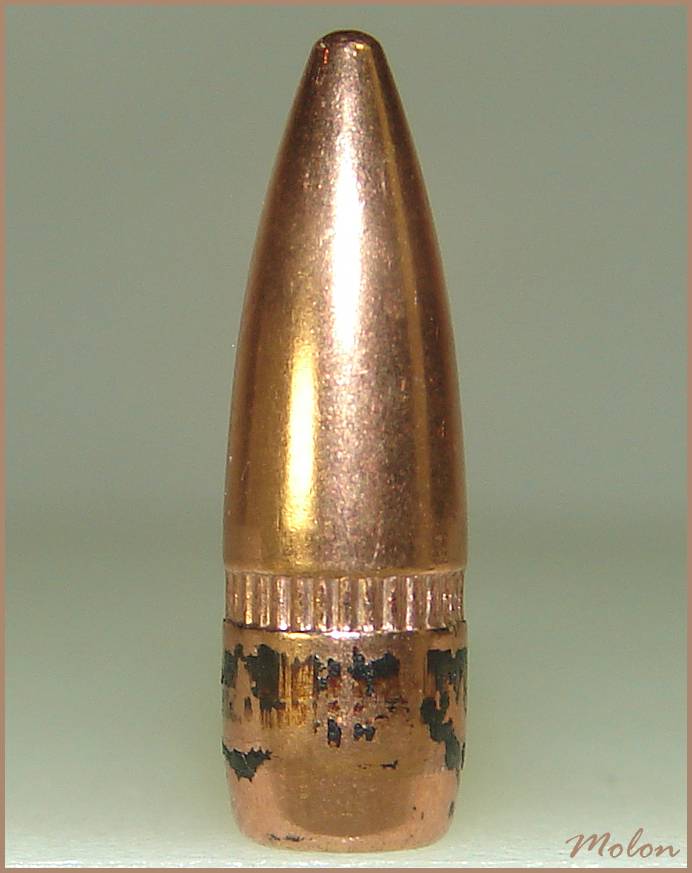 The head-stamp for this ammunition reads: “556 Wolf”. The primer pockets are crimped and smeared with sealant. 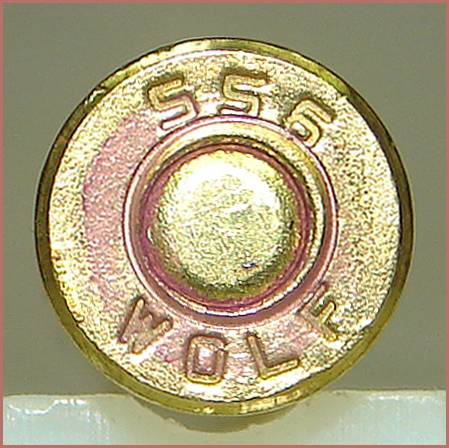 As with most M193 clones, the WM193 is charged with a flattened “ball” powder. 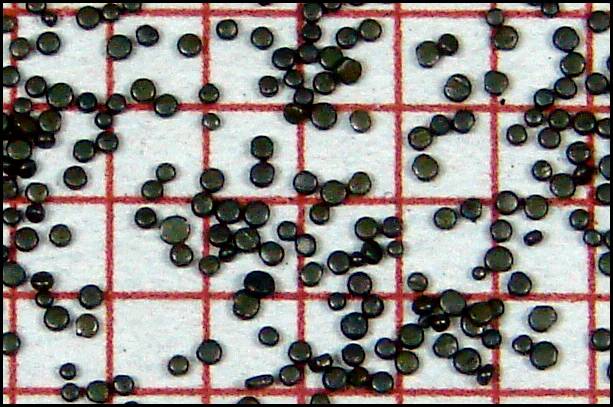 Velocity Aside from aspects of M193 clones that can be assessed by visual inspection, the two main aspects of M193 clones that we can assess via live fire testing to determine if an M193 clone adheres to the US mil-spec are velocity and accuracy (technically precision). The velocity specification for M193 as cited in MIL-C-9963F states: The average velocity of the sample cartridges, conditioned at 72 degrees, plus or minus 2 degrees Fahrenheit (F), shall be 3165 feet per second (ft/sec), plus or minus 40 ft/sec, at 78 feet from the muzzle of the weapon. The standard deviation of the velocities shall not exceed 40 ft/sec. The specification is for a 20” barrel. Depending on multiple variables, this velocity specification equates to a muzzle velocity of approximately 3270 FPS, plus or minus 40 FPS. I chronographed the Wolf WM193 ammunition from a semi-automatic AR-15 with a chrome-lined, NATO chambered 20” Colt barrel.  As an aside, after reading the above specification, some of you may be wondering, “Why 78 feet from the muzzle?” The answer to that question is that this specification is simply an historical hold-over from the days when “circuit” chronographs (e.g. Le Boulenge Chronograph and the Aberdeen Chronograph) were used at Aberdeen Proving Ground, Frankford Arsenal and Springfield Armory. These types of chronographs required a significant distance between their first and second screens to produce accurate results. As an example, when using the Boulenge Chronograph, the first screen of the chronograph was placed 3 feet in front of the muzzle and the second screen was placed 150 feet beyond the first screen. For those of you who might not be aware of the following fact; chronographs determine the velocity of the bullet at a point that is midway between the first and the second screen (i.e. not at the location of the first screen). Therefore, with the above spacing, the velocity of the bullet is determined for a point that is 75 feet from the first screen. So, add the three feet (from the muzzle to the first screen) to the 75 feet (the midway point of the screens) to obtain the “78 feet from the muzzle” distance. 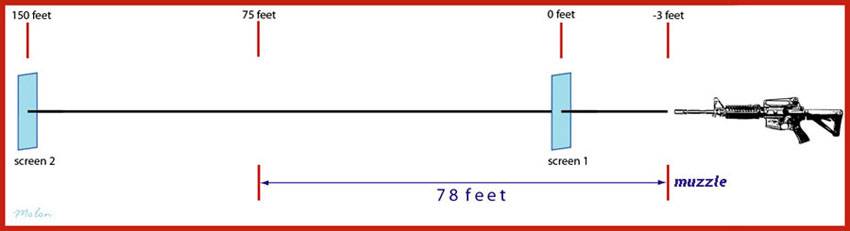 Chronographing was conducted using an Oehler 35-P chronograph with “proof screen” technology. The Oehler 35P chronograph is actually two chronographs in one package that takes two separate chronograph readings for each shot and flags any errant readings to let you know that the data is suspect. There was no invalid data flagged during this testing. The velocity stated below is the muzzle velocity as calculated from the instrumental velocity using Oehler’s Ballistic Explorer software program. The string of fire consisted of 10 rounds over the chronograph. 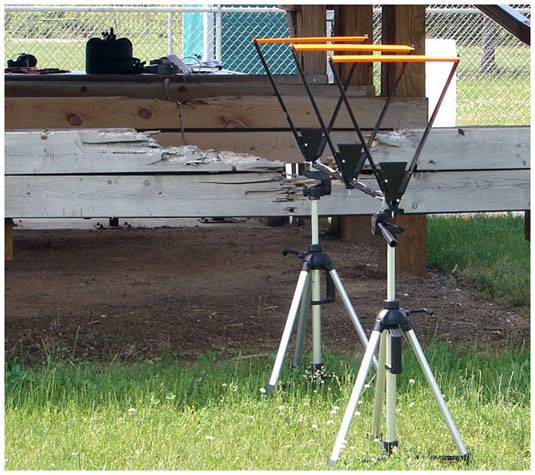  Each round was single-loaded and cycled into the chamber from a magazine fitted with a single-load follower. The bolt locked-back after each shot allowing the chamber to cool in between each shot. This technique was used to mitigate the possible influence of “chamber-soak” on velocity data. Each new shot was fired in a consistent manner after hitting the bolt release. Atmospheric conditions were monitored and recorded using a Kestrel 4000 Pocket Weather Tracker.  Atmospheric conditions. Temperature: 71.6 degrees F Humidity: 78.4% Barometric pressure: 30.02 inches of Hg Elevation: 950 feet above sea level The average muzzle velocity for the 10-shot string of the Wolf WM193 ammunition fired from the 20” Colt barrel was 3088 FPS with a standard deviation of 16 FPS. The coefficient of variation was 0.52%. For comparison, legacy IMI M193 had a muzzle velocity of 3274 FPS when fired from a 20” Colt barrel with a standard deviation of 18 FPS and a coefficient of variation of 0.55%. For those of you who might not be familiar with the coefficient of variation (CV), it is the standard deviation, divided by the mean (average) muzzle velocity and then multiplied by 100 and expressed as a percentage. It allows for the comparison of the uniformity of velocity between loads in different velocity spectrums; e.g. 77 grain loads averaging approximately 2,650 fps compared to 55 grain loads averaging approximately 3,250 fps. The US mil-spec for M193 allows for a coefficient of variation of approximately 1.2%, while one of my best 77 grain OTM hand-loads, with a muzzle velocity of 2639 PFS and a standard deviation of 4 FPS, has a coefficient of variation of 0.15%.  Accuracy The US accuracy specification for M193 cited in MIL-C-9963F is as follows: “The average of the mean radii of all targets of the sample cartridges, fired at 200 yards, shall not exceed 2.0 inches.” These averages are from 10-shot groups fired from machine rested, bolt-actioned, heavy test barrels. All things being equal this specification equates to a mean radius of 1 inch at 100 yards (the distance at which I tested this ammunition). I conducted an accuracy (technically, precision) evaluation of the Wolf WM193 following my usual protocol. This accuracy evaluation used statistically significant shot-group sizes and every single shot in a fired group was included in the measurements. There was absolutely no use of any Group Reduction Techniques (e.g. fliers, target movement, Butterfly Shots). The shooting set-up will be described in detail below. As many of the significant variables as was practicable were controlled for. Also, a control group was fired from the test-rifle used in the evaluation using match-grade, hand-loaded ammunition; in order to demonstrate the capability of the barrel. Pictures of shot-groups are posted for documentation. All shooting was conducted from a concrete bench-rest from a distance of 100 yards (confirmed with a laser rangefinder.) The barrel used in the evaluation was free-floated. The free-float handguards of the rifle rested in a Sinclair Windage Benchrest, while the stock of the rifle rested in a Protektor bunny-ear rear bag. Sighting was accomplished via a Leupold VARI-X III set at 25X magnification and adjusted to be parallax-free at 100 yards. A mirage shade was used. Wind conditions on the shooting range were continuously monitored using a Wind Probe. The set-up was very similar to that pictured below. 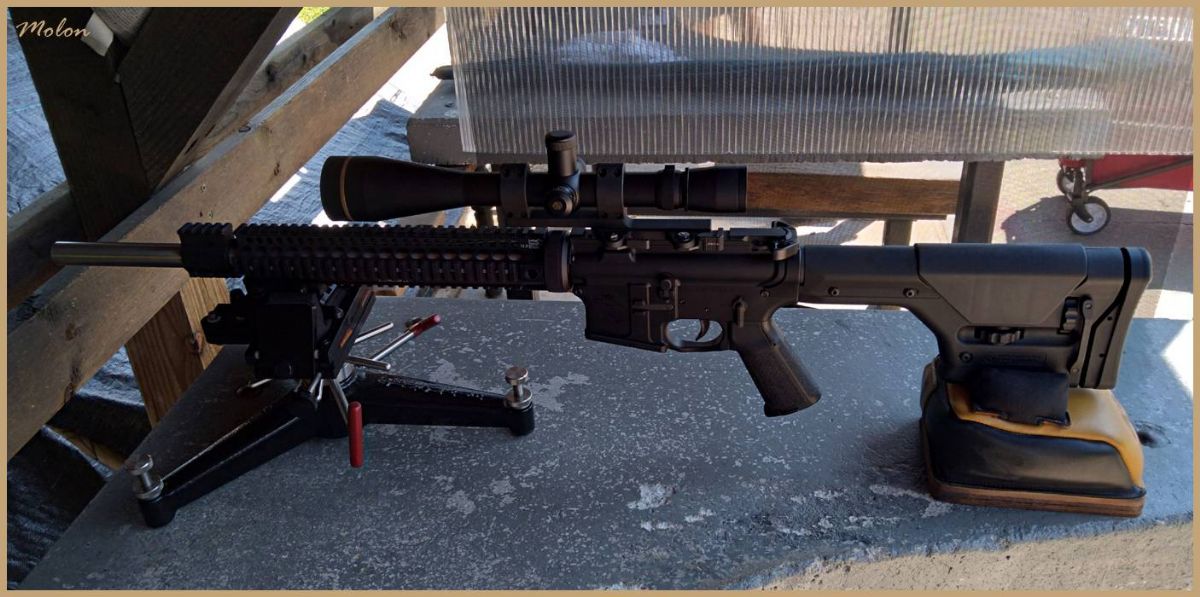 The Wind Probe . . . 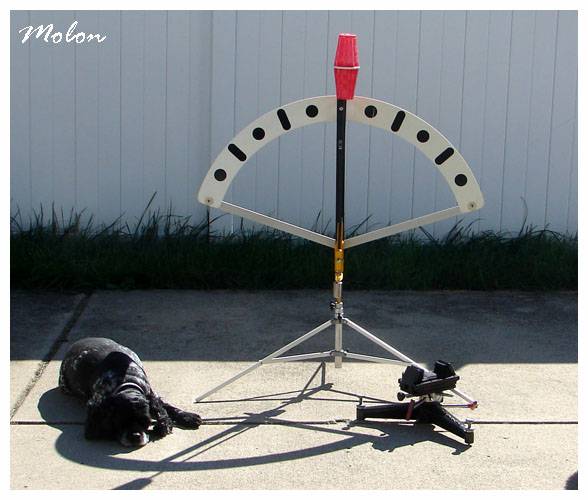 The test vehicle for this evaluation was one of my semi-automatic precision AR-15s with a 20” stainless-steel Lothar Walther barrel. The barrel has a 223 Wylde chamber with a 1:8” twist. 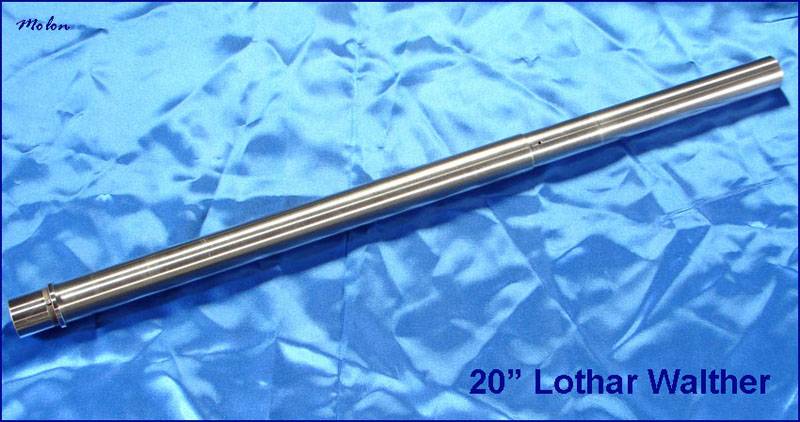 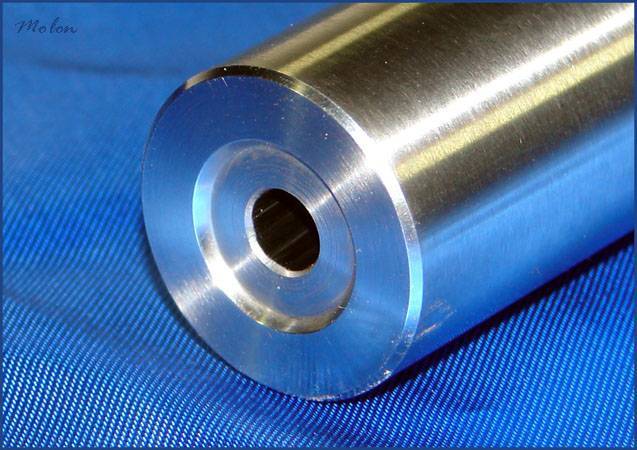 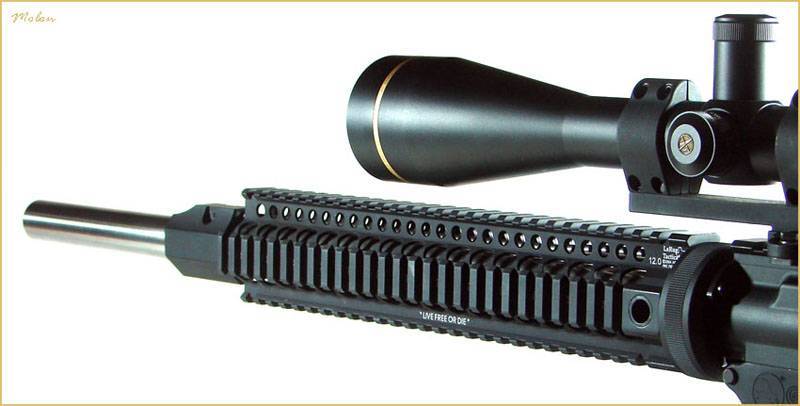 Prior to firing the Wolf WM193, I fired a 10-shot control group using match-grade hand-loads topped with the Sierra 52 grain MatchKing. That group had an extreme spread of 0.62”. 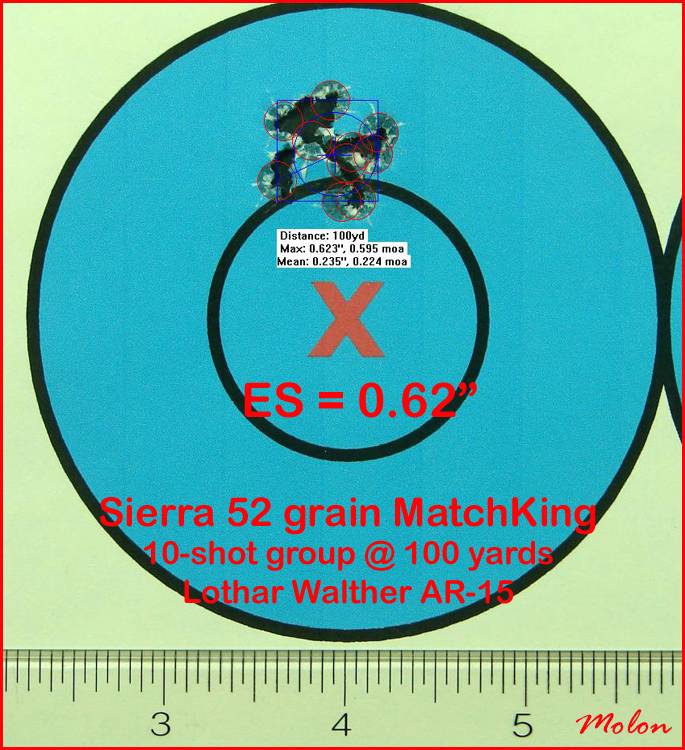 Three 10-shot groups of the Wolf WM193 ammunition fired consecutively from the Lothar Walther barreled AR-15 at a distance of 100 yards had the following extreme spreads: 1.72” 1.63” 1.62” for a 10-shot group average extreme spread of 1.66”. I over-layed the three 10-shot groups on each other using RSI Shooting Lab to form a 30-shot composite group. The mean radius of the 30-shot composite group was 0.60”. The smallest 10-shot group . . . 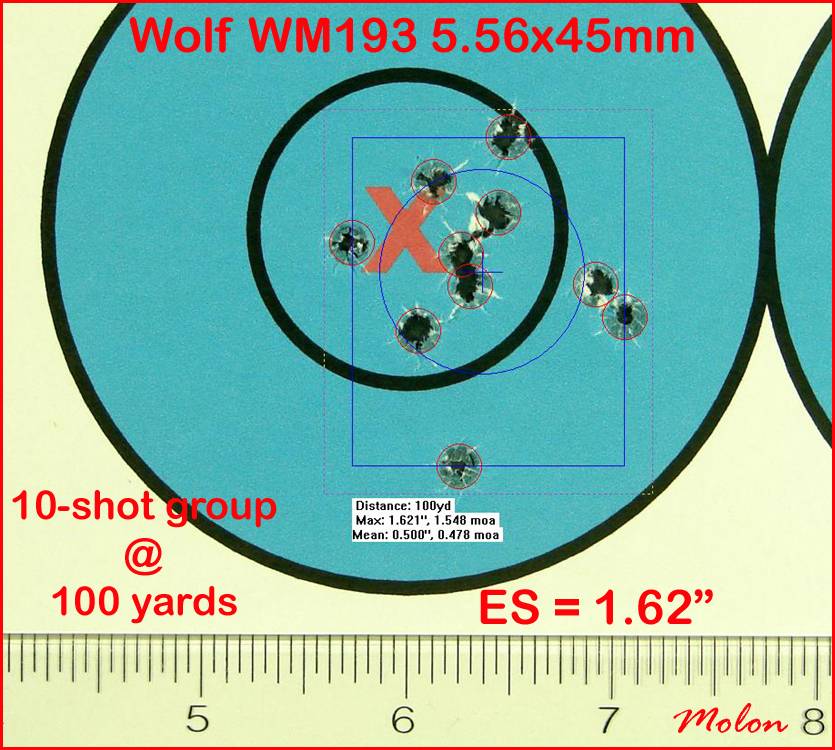 The 30-shot composite group . . . 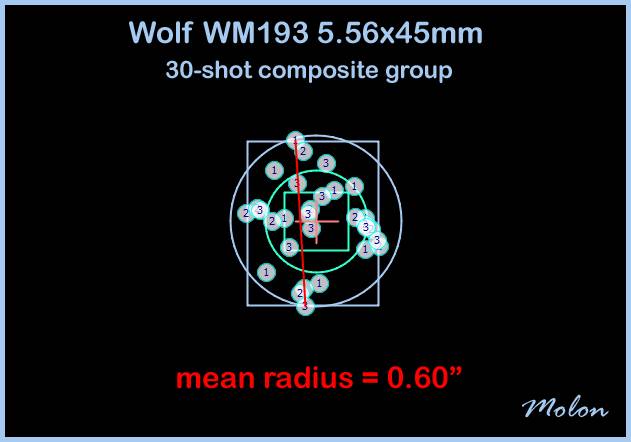 For comparison, you can view my evaluation of the Wolf Gold 55 grain FMJ 223 Remington ammunition here. The results of both evaluations are summarized in the tables below. 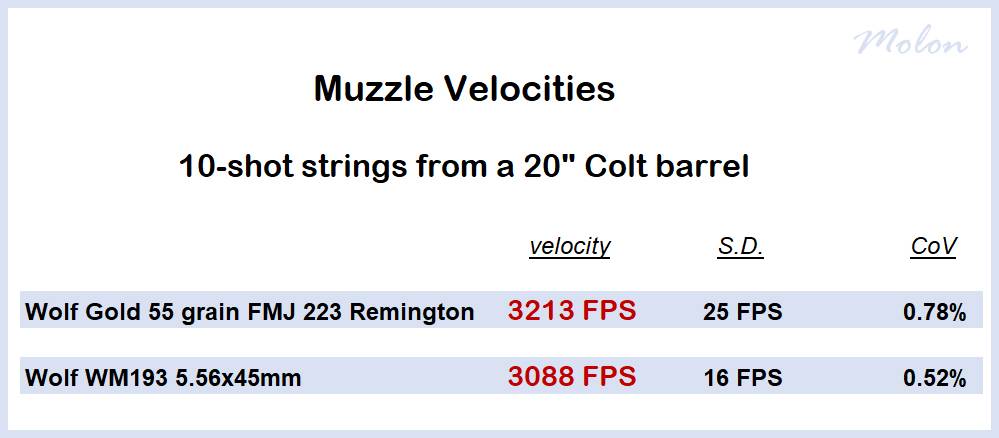 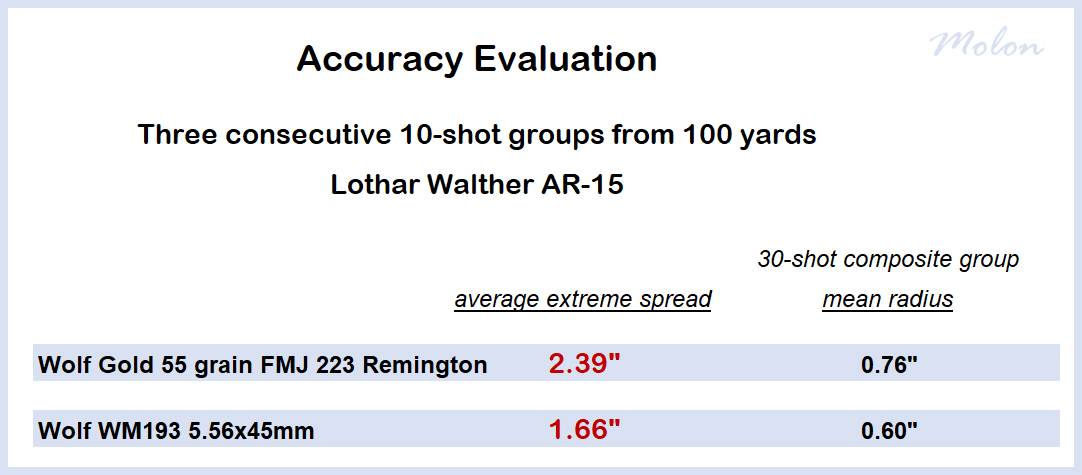 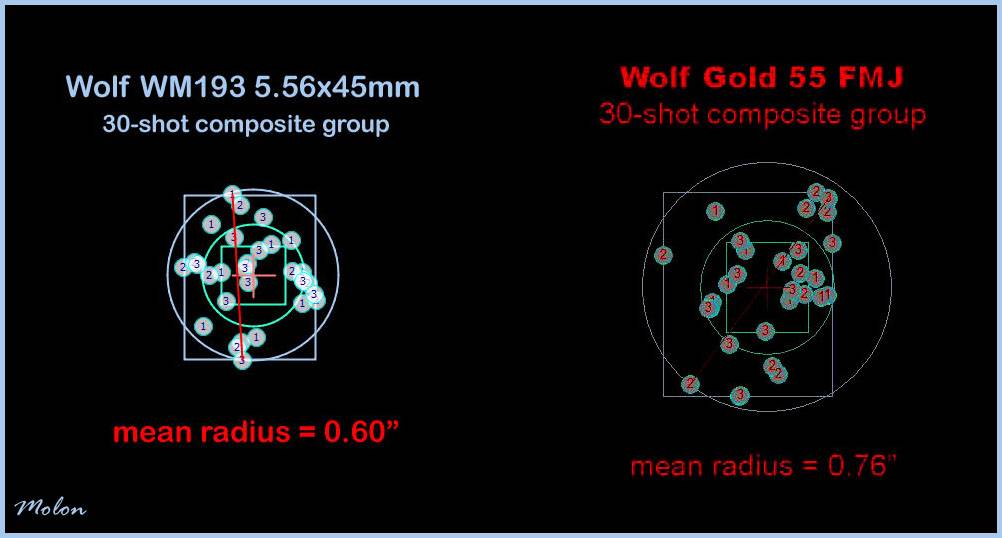  …. |
|
During the 2007-2010 Iraq Surge the US Army out-sourced 5.56mm production to make up the shortage that just plain couldn't be produced out of Lake City Army Ammunition Plant. The US bought mil-standard ammo (both M193 and M855) from around the world to arm ourselves, Iraq, Afghanistan, and our allies. Other sources were Federal, Winchester, IMI, CBC, Dominion, Radway Green (absolute shit), PMC (PSD), and from Taiwan. Taiwanese ammo came from the Taiwan Army 205th Arsenal, Material Production Center, Kaohsiung, Taiwan. Typically cases are head-stamped "TAA 09" and TAA 10." I have a standard GI can with the TAA lot number on the side (in lieu of Lake City lot number) and maybe 500 - 1000 cases. Just guessing (and I have no actual information - linkage), this may be Taiwan Arsenal-produced ammo. Singapore, Filipino, Thai, and Malaysian ammo cans were a slightly different olive-green, and definitely different boxes. |
|
Thanks for another great presentation. I can only imagine how much time and effort goes into these posts. I’ve had good experience with this stuff as range fodder but not something I would stash away just based on the lower velocities. It’s a shame we can’t have real deal m193 just for the QC that goes into it. |
|
Quoted: It looks like his original evaluation of Wolf Gold pre-dates the 2017 dial back of many imported 55gr FMJ "M193". Quoted: Quoted: So the .223 wolf is faster than the 5.56? That's pretty anemic for a 5.56 55gr out of a 20in barrel 3088 is slow for even for a dialed back M193 out if 20in barrel |

|
Quoted: How do you calculate mean radii? Is it the average distance from the geometric mean of the bullet holes? https://www.ar15.com/forums/ar-15/Mean-Radius/16-512887/ |

|
Thank you !! ...looks like decently uniform bases for bulk 55gr FMJ. On a side note.....How many rounds do you think you have fired in the 20” stainless-steel Lothar Walther barrel ? It sure keeps shooting great groups. ( IE, even I will miss it when it is done ) |
|
I was a big fan of Wolf Gold, stacked it and shot a ton of it. I've been buying this WM193 for a couple years now and I have taken for granted that it was just re-boxed. The bullet profile is the same, etc etc and I just didnt think I would need to re-test this stuff since I knew where my rifles were with it. Ever since I started shooting this white box stuff my numbers and holds have been ALL JACKED up, I thought it was me or barrel wear. Thank you Molon, I'm an idiot and it's confirmed 
|
|
Quoted: It looks like his original evaluation of Wolf Gold pre-dates the 2017 dial back of many imported 55gr FMJ "M193". Quoted: Quoted: So the .223 wolf is faster than the 5.56? That's pretty anemic for a 5.56 55gr out of a 20in barrel Thats a real bummer velocity was dialed back, seems guns are getting better while ammo is getting slower  Any indication of what caused this in 2017? |
|
Looks like the wolf gold you tested was close to actual M193 specs than the wolf WM193. The WM193 seems more like "223". Accuracy also matched the velocities. Faster does not mean more accurate. I have found every time I shoot ammo labeled "5.56", accuracy is always a little worse than ammo labeled "223" |
|
Quoted: Thats a real bummer velocity was dialed back, seems guns are getting better while ammo is getting slower Any indication of what caused this in 2017? My assessment is that in the mad rush to produce as much ammunition as possible for the inevitable President Hillary Clinton panic, IMI used a powder charge that was either too fast burning or too heavy and resulted in ammo that was too high pressure. Older lots of IMI were hot, but didn't show signs of leaking or blown primers like the 2016 headstamped lots did. To provide a greater margin for error in the future the 2017 and newer lots of ammo have been dialed back about 100FPS from their 2015 and older lots. Most shooters never chronograph their ammo and have noticed no difference in performance, however a small number of discriminating shooters immediately noticed how IMI "Nerfed" their ammo and have hoarded pre 2015 lots of ammo as it is loaded to the top end of M 193 specs. |
|
Quoted: How do you calculate mean radii? A PRIMER ON THE MEAN RADIUS The mean radius is a method of measurement of the radial dispersion of shot-groups that takes into account every shot in the group. It provides a more useful analysis of the consistency of ammunition and firearms than the commonly used method of extreme spread. Mean radius as defined in Hatcher's Notebook “is the average distance of all the shots from the center of the group. It is usually about one third the group diameter (extreme spread)” for 10-shot groups. The ratio is actually closer to 3.2 x the mean radius = the extreme spread for 10-shot groups, depending on the sample size and the morphology of the particular groups sampled. To obtain the mean radius of a shot-group, measure the heights of all shots above the lowest shot in the group. Average these measurements. The result is the height of the center of the group above the lowest shot. Then in the same way, get the horizontal distance of the center from the shot farthest to the left. These two measurements will locate the group center. Now measure the distance of each shot from this center. The average of these measures is the mean radius. Once you get the hang of measuring groups using the mean radius it becomes very simple to do. While being very simple to do, it is also very time consuming. Modern software programs such as RSI Shooting Lab and On Target make determining the mean radius a snap. The picture below is a screen capture from RSI Shooting Lab. The red cross is the center of the group (a little high and right of the aiming point). The long red line shows the two shots forming the extreme spread or group size. The yellow line from the red cross to one of the shots is a radius. Measure all the radii and take the average to obtain the mean radius. 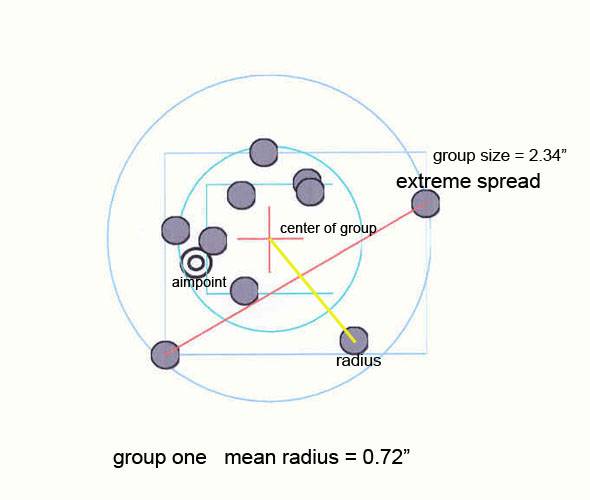 Mean Radius Demonstration Let’s say you fired a 5-shot group from 100 yards and the resulting target looks like this. (The X-ring measures 1.5” and the 10-ring measures 3.5”.) 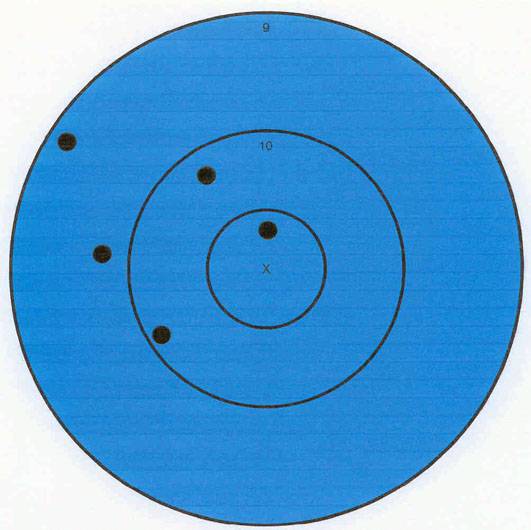 The extreme spread of the group measures 2.83”, but we want to find the mean radius (or average group radius.) In order to find the mean radius we must first find the center of the group. By “eye-balling” the target most people would see that the group is centered to the left of the “X-ring” and probably a little high, but we need to find the exact location of the center of the group. Locating the Center of the Group The first step in finding the center of the group is to find the lowest shot of the group and draw a horizontal line through the center of that shot. 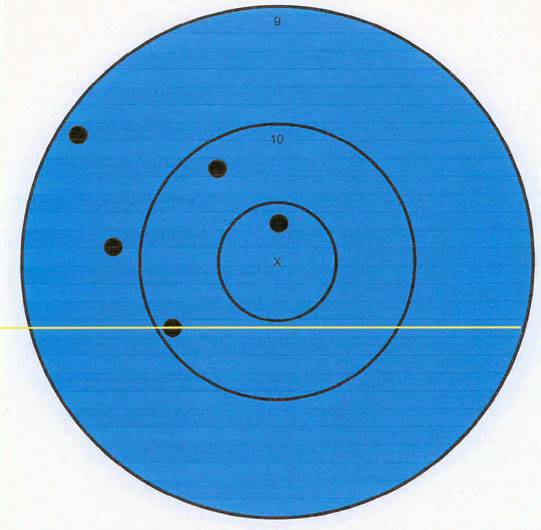 Next, find the left-most shot of the group and draw a vertical line through the center of that shot. 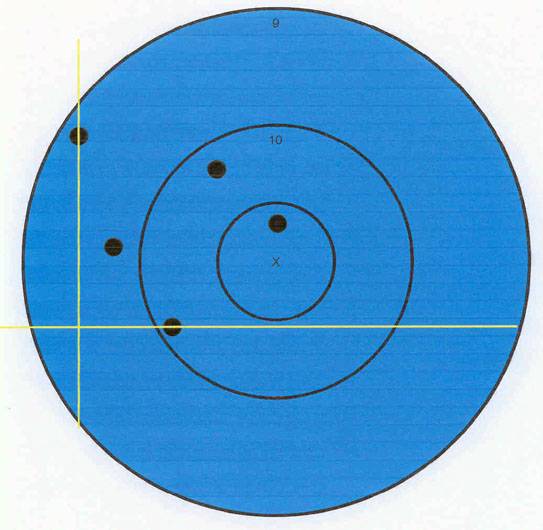 Now measure the distance from the horizontal line to the other four shots of the group that are above that line. Add those numbers together and divide by the total number of shots in the group (5). 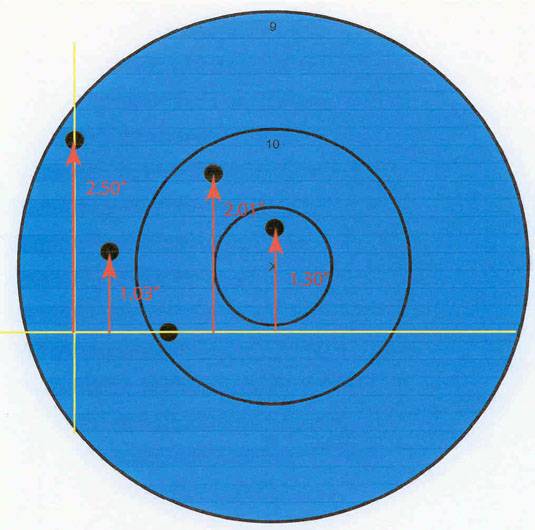 2.50” + 1.03” + 2.01” + 1.30” = 6.84” Divide by 5 to get 1.37”. This number is the elevation component of the center of the group. Next we need to find the windage component of the center of the group. From the vertical line, measure the distance to the other four shots of the group that are to the right of the line. Add those numbers together and again divide by the total number of shots in the group (5). 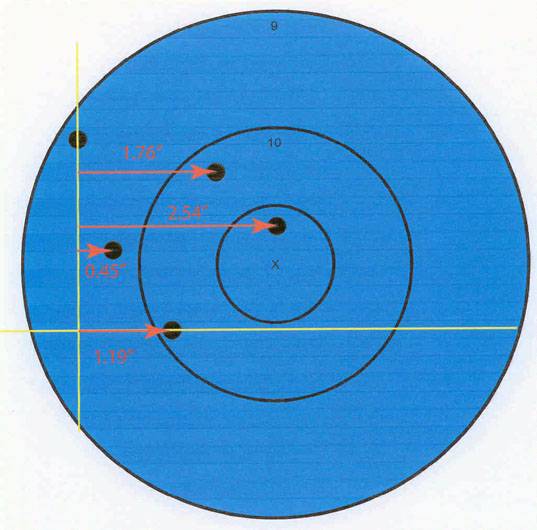 1.76” + 2.54” + 0.45” + 1.19” = 5.94” Divide by 5 to get 1.19” This is the windage component of the center of the group. Finding the windage and elevation components of the center of the group is the most difficult part of this process. Once that is done the rest of the process is a piece of cake. Using the windage and elevation components, locate the position on the target that is 1.37” (elevation component) above the horizontal line and 1.19” (windage component) to the right of the vertical line. This location is the center of the group! 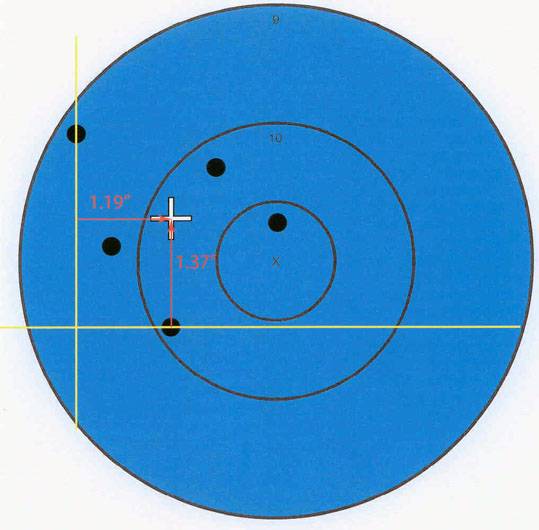 Determining the Mean Radius Now that we have located the position of the center of the group, the first step in determining the mean radius is to measure the distance from the center of the group to the center of one of the shots. This line is a single “radius”. 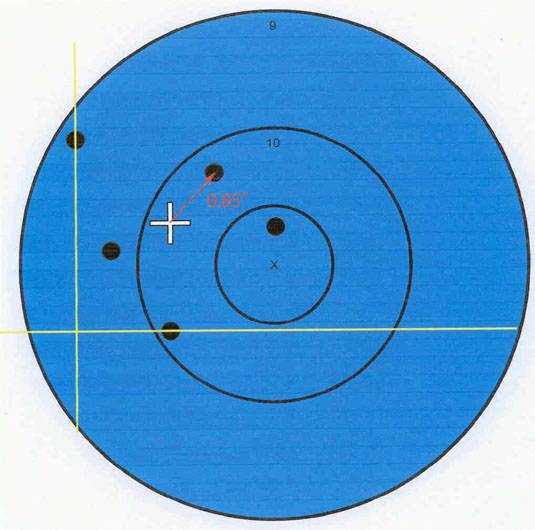 Now measure the distance from the center of the group to the center of each of the rest of the shots in the group. Add the measurements of all the radii together and then divide by the total number of shots in the group (5). 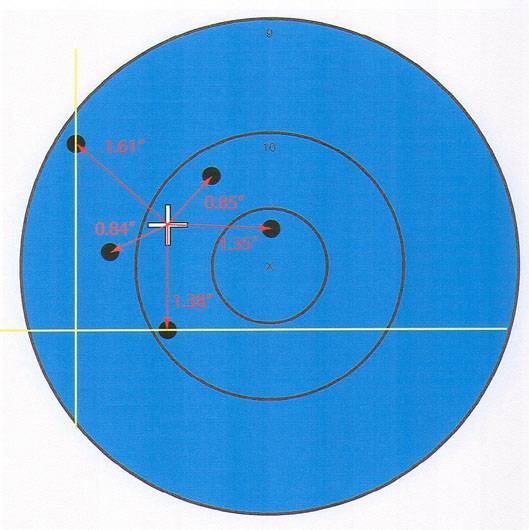 0.85” + 1.35” + 1.38” + 0.84” + 1.61” = 6.03” Divide by 5 to get 1.21”. This is the mean radius (or average group radius) of the group! Using the mean radius measurement to scribe a circle around the center of the group gives you a graphic representation of the mean radius. This shows the average accuracy of all the shots in the group. This demonstrates why the mean radius is much more useful than the extreme spread in evaluating the radial dispersion of our rifles and ammunition. 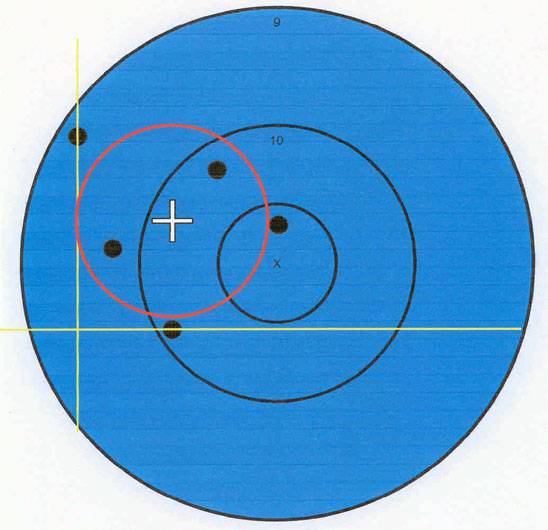 The table below will give you an idea of the relationship between the mean radius and extreme spread for 10-shot groups. 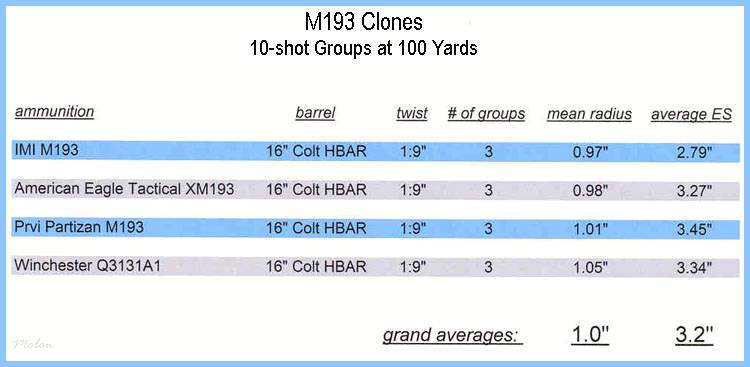 Here are some interesting quotes on the subject from old issues of American Rifleman. “Mean radius is the mean distance of bullet impacts from center of the test group. It is used in government ammunition acceptance because it takes account of every shot and comes close to maximizing the test information. While there is no exact relationship between this measure and the simpler and more convenient group diameter, the 10-shot group diameter averages slightly over 3 times the mean radius.” "These examples illustrate the sensitiveness of the extreme spread to number of shots in the group. Indeed, as the table indicates, the measures made to only the outside shots of the group, e.g. the extreme spread, are very sensitive to number of shots, while the measures made to all the shots, e.g. the mean radius are far less so. It may be added that the latter measures are also less variable in their representation of the group; they are more efficient. This explains why the target testing of U.S. military rifle ammunition is by mean radius." |
AR Sponsor