


AR Sponsor

[ARCHIVED THREAD] - DPM Recoil Reduction System vs. Hydraulic buffer EDIT: Armament LARB Mod 2 and 3 added to the test. (Page 3 of 4)
| Couldn't you measure dot bounce by just attaching a visible laser and video it? Use a target with rings, play back in slow motion and measure the distance the laser travels? Seems like this would allow others to experience what the shooter is seeing more then anything else. The closer to zero dot bounce the better. I could care less on felt recoil. Dot bounce! Just an idea. |
|
Quoted:
Couldn't you measure dot bounce by just attaching a visible laser and video it? Use a target with rings, play back in slow motion and measure the distance the laser travels? Seems like this would allow others to experience what the shooter is seeing more then anything else. The closer to zero dot bounce the better. I could care less on felt recoil. Dot bounce! Just an idea. |
|
Quoted:
Couldn't you measure dot bounce by just attaching a visible laser and video it? Use a target with rings, play back in slow motion and measure the distance the laser travels? Seems like this would allow others to experience what the shooter is seeing more then anything else. The closer to zero dot bounce the better. I could care less on felt recoil. Dot bounce! Just an idea. |
|
Quoted:
I have been running hydraulic buffers for years and FERFRANS bolt carrier that slows down rate of fire. Kynshot buffers are stiff but do work, I've documented this here: http://c3junkie.com/?page_id=430#hydraulic They Kynshot and Endinie are about 9lbs to compress I only like the Kynshot RB5007 and RB5005 which are in the 5lb range. Also regarding the Ferfrans, I posted about them here: https://www.ar15.com/forums/armory/Ferfrans-Bolt-Carrier/23-493014/ I had really high hopes for it but I find it to be too bouncy. Feels like the timing is off. Not just me either. When I tested it, I had another friend that has several machine guns try it also and he said it was, 'horrible'. I am considering testing the Ferfrans with the accelerometer. At this point, I think the smoothest is what I've already documented in the Ferfrans thread above and also on my site here: http://c3junkie.com/?page_id=654 We'll see if any of these other components surpasses what I have now. |
|
@amphibian
Between the Tubb springs, the 556 (AR15) and the 308 (AR10). They seem to be quite identical, except the 308 aids in stripping rounds for whatever reason (rough mags, dirty magazines, etc). I’m posting a link to your site detailing it, for everyone else reading this post. Is that true? Any downsides to using the 308 spring (over the 556)? |
|
As mentioned on my site:
Standard rifle open A2 (new) 9.1lb closed, 16.7lb openTubb Flatwire 10.5lb closed, 16.3lb open Tubb .308 Flatwire 13lb closed, 16.7lb open The 556 Tubb spring closely matches the force of a standard round rifle spring with an additional pound of force in the closed position. If you have weak ammo you may have issues running the 308 spring. The cyclic rate also goes up with the 308 vs 556 spring. |
|
Quoted:
As mentioned on my site: Standard rifle open A2 (new) 9.1lb closed, 16.7lb openTubb Flatwire 10.5lb closed, 16.3lb open Tubb .308 Flatwire 13lb closed, 16.7lb open The 556 Tubb spring closely matches the force of a standard round rifle spring with an additional pound of force in the closed position. If you have weak ammo you may have issues running the 308 spring. Thanks. |
|
Quoted: Also regarding the Ferfrans, I posted about them here: https://www.ar15.com/forums/armory/Ferfrans-Bolt-Carrier/23-493014/
I had really high hopes for it but I find it to be too bouncy. Feels like the timing is off. Not just me either. When I tested it, I had another friend that has several machine guns try it also and he said it was, 'horrible'. I am considering testing the Ferfrans with the accelerometer. At this point, I think the smoothest is what I've already documented in the Ferfrans thread above and also on my site here: http://c3junkie.com/?page_id=654 We'll see if any of these other components surpasses what I have now. |
|
Quoted:
That's an excellent idea. Perhaps aimed at a target with a grid square background? Quoted:
Quoted:
Couldn't you measure dot bounce by just attaching a visible laser and video it? Use a target with rings, play back in slow motion and measure the distance the laser travels? Seems like this would allow others to experience what the shooter is seeing more then anything else. The closer to zero dot bounce the better. I could care less on felt recoil. Dot bounce! Just an idea. 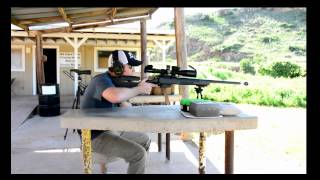 Staying On Target - PrecisionRifleBlog.com Muzzle Brake Tests |
|
Accelerometer is ready to go. I'll ship it out with the buffers, bumpers tomorrow. I had to cut apart the sled to make it all fit in the printed case. It's not the neatest install but the connections and components are secure. I hope it works reliably and holds together.
Attached File Attached File Attached File Attached File @Amphibian: The picatinny rail connector is printed plastic. I don't think fiber infused material was used so take care tightening it. Probably be best to save full auto testing 'till the end in case the mount or device is not up to the forces involved. If it breaks I have a metal rail adapter on the way. The battery should be good for 8 hours of run time. I added an iPhone compatible charging connector so it can be recharged overnight with any usb power adapter. Yellow charging light goes out when it is fully charged. No need to unplug the battery. Operation: Press the power button to begin recording. Red indicator light can be seen through battery connector window. Switch power off after each test. Each power on/off cycle writes a separate file. The time stamp (Pacific Time) of the files is off by about 7 minutes. There is plenty of room on the card so you don't have to delete files after the tests. Your log with the date/time of each test id's which data file. The files get very long quickly so switch on right before firing, switch off immediately after firing. (1,000 line entries per second.) Data values: X = recoil/return force, Y = muzzle flip/dip force (normally about 1g). Z (side to side) can be ignored. There is a 3ms lag period every few ms while the card is being written. Each test should consist of at least 3 shots so you will have a clean reading in case a shot is taken during the lag. microSD: Snap off the cover from the side opposite the rail clamp. Put the cover on long side first then snap the rail clamp side corners on. Not much room in there if you can't grab the card with fingertips push it back with a fingernail and let it fly out of the socket. The cover is flimsy, next one I have printed will be fiber reinforced. Orientation: Mount on left side handguard rail, battery side up. |
|
OK. As mentioned previously, I think I want to test a configuration that is clearly not as soft/smooth as another and see what the data looks like before testing all the permutations.
Regarding the lasers, it is typically too bright in FL to do anything with lasers unless it is about to get dark and you only have about an hour or so of time to that. I don't want to deal with that and I don't want to go dragging a bunch of shit out to some indoor range with people bothering me. So if someone else wants to deal with that, go for it. |
|
@amphibian Regarding the Kynshot buffers specifically the 5005. Is that 3.5 inch 308 one? The 9mm one is hard to find (5007), the 5005 is more common (with discount). Would you consider them to be interchangeable? Edit. Never mind. I found the data on your web page. It’s under the buffer page. |
|
amphibian, what about a green laser? They're typically brighter than red lasers. If you're interested, would be happy to fund a portion of a green laser.
OP, you have mad skills. I would really like a Countashot cartridge counter that counts up, then resets to zero on a mag change. Possible, no? |
|
I was fortunate to participate in the development of the L.A.R.B. and have spent a lot of my own money on them.
Put simply, they work. My favorites are the Titanium buffers with Tungsten weights. They were very limited production and expensive but totally worth it. One is being tested by DOE to this day, at my expense. The bumpers are in all my ARs that don't have L.A.R.B.s today. Nick knows his stuff. Enough said. |
|
Quoted:
OP, you have mad skills. I would really like a Countashot cartridge counter that counts up, then resets to zero on a mag change. Possible, no? Edit: Folks have been working on round counters for a while now. Examples:  Cobalt Kinetics AR Rifle-Mounted Round Counter (Shot Counter) Cobalt Kinetics responded to my inquiry: Me: Are you folks still working on the round counter for AR's? Them: Yes we are. A few versions in fact. They should be in final form and ready for release (pre-sale) at SHOT 2020.  [SHOT 2018] Radetec Digital Shot Counters  Bullet Counter 2.0 This one is interesting:  AR15 Ammo Counter (Prototype) |
|
Quoted: Me? I'm just the gopher.
Edit: Folks have been working on round counters for a while now. Examples:  https://www.youtube.com/watch?v=XxgsmZCkc7g https://www.youtube.com/watch?v=XxgsmZCkc7g
Cobalt Kinetics responded to my inquiry: Me: Are you folks still working on the round counter for AR's? Them: Yes we are. A few versions in fact. They should be in final form and ready for release (pre-sale) at SHOT 2020. https://www.youtube.com/watch?v=1NjxVQUhXQs
https://www.youtube.com/watch?v=cnx9yT5py8E
This one is interesting: https://www.youtube.com/watch?v=mAOIyYYTU1w |
|
Quoted: Leitner-Wise had the Countshot, and the Radetec undoubtedly works if you use their mags. I'd settle for just a simple count up from the last reload, and let me do the math, but the Cobalt Kinetics is pretty slick. The future is electronics on guns, from range-finding auto-adjusting optics, electronic triggers, RoF mechanisms, pressure gauges, chronometers, to round counters.  Tachyon V2 Showcase |
|
Quoted:
Those guys at CK are going to give me a heads up when they have something to show prior to SHOT 2020. I hope it works kinda like this rig you can buy now for airsoft: https://www.youtube.com/watch?v=KcSO-7h2SyY |
|
Update:
Amphibian performed a full day of testing which revealed we have technical issues to deal with before any solid conclusions can be made. He made some subjective conclusions to be shared later. Accelerometer code for max g force was too low so I'm reprogramming it from 8 g's max to 16 g's. I added a stronger mounting bracket since the other one loosened up on Amphibian and during my follow up tests. Amphibian is examining the camera footage to see what can be gleaned from the cutaway tube videos. He may need a faster camera. To be continued.... |

|
Thanks goes out to @CJofFL for helping me record video and data.
Sorry for the delay but as HDSledge mentioned, this didn't go as well as planned. I wanted to eliminate the 'human' factor as much as possible. I fired 4 shots for each test in semi auto and did it all from the lead sled. MK18 pictured below has no muzzle device attached to skew any results. 
We had initially did the videos at 480FPS and then when reviewing the video's noticed it wasn't fast enough and then increased to 1000FPS. Resolution is pretty crappy at 1000FPS and really need to go even faster. I'm on the fence about putting a bunch of videos up since I didn't redo everything at 1000FPS and to be fair would like to wait till I redo the ones I missed at 1000FPS.....for now, here is what the MK18 looked like with a standard 'milspec' configuration....H2 buffer and standard power spring (white sprinco), LC M855.  MK18 H2 buffer, White Sprinco Here is the same MK18 with A5, RB5007, 556 Tubb flat spring and LC M855. 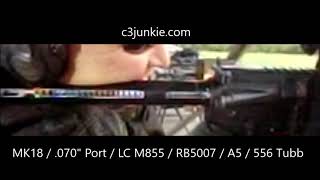 MK18, LC M855, A5 Tube, RB5007, 556 Tubb Flat Spring I know we were trying to focus on 5.56 and as HDSledge mentioned recoil peaks were exceeding 8G for 5.56 and so that data was worthless. However, it was like around 6G's for the 9mm CMMG RDB. Here is what the 8" CMMG RDB setup looked like: 
Here is what it looked like with the CMMG recommended buffer/spring configuration, running 115 Gr blazer, it would function fine when shoulder fired but would jam in the lead sled, only 2 rounds fired in the video below.  8" 9mm CMMG RDB factory config You can clearly see how much smoother my preferred setup is over the CMMG recommended configuration in the following videos. Here is a video of my preferred setup with a modified 5.45 bolt for suppressed usage only with my 147Gr reloads but I'm shooting 115 Gr Blazer unsuppressed here. What is interesting about this is that since it is for suppressed usage only, the BCG doesn't go back far enough to engage the BHO but functions 100% 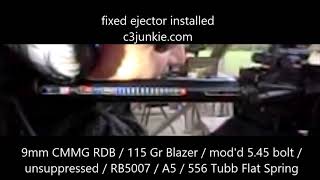 8" 9mm CMMG RDB, mod'd 5.45 bolt, UNsuppressed, fixed ejector RB5007 Lastly here is what the same setup above with my fixed ejector, modified 5.45 bolt, my 147Gr reloads and suppressed.  8" 9mm CMMG RDB, mod'd 5.45 bolt, suppressed, fixed ejector RB5007 |
|
Quoted:
...here is what the MK18 looked like with a standard 'milspec' configuration....H2 buffer and standard power spring (white sprinco), LC M855. https://youtu.be/4xCVdYAACCE Here is the same MK18 with A5, RB5007, 556 Tubb flat spring and LC M855. https://youtu.be/PpVBmvvqpAY Thanks to both of you for the work to try and do this. If you can get a better quality camera the results would definitely be interesting. |
|
Quoted: I remember in David Tubbs' video he explained his flat wire spring reduces the "wave effect" of the mil-spec spring bouncing back and forth after the BCG has returned forward and your video shows what looks like a reduced wave effect. That would logically reduce bolt bounce. Thanks to both of you for the work to try and do this. If you can get a better quality camera the results would definitely be interesting. At 1000FPS you can imagine there is a lot of dead space on the video that I have to crop out. I would only crop out what is really 'dead'...basically waiting for no movement and the spring to settle down. When I paired the same 556 Tubb flat spring with the Vltor A5H2, it took a long time to settle down:  MK18 A5 buffer tube, A5H2 buffer, 556 Tubb spring Again same 556 Tubb flat spring paired with the LARB Mod3 it also took a long time to settle down:  MK18, A5 Tube, 556 Tubb Flat spring LARB Mod3 buffer (A5 length) I think the hydraulic causes a slight delay before everything moves forward which helps to settle the spring down. |
|
Quoted:
So what's all this telling us? Afa the main goal of buffer comparison: I reprogrammed the accelerometer (with additional code from Eric at Ammolytics) to allow for 16g's max reading instead of 8g's (maxed out during first test runs). I'm testing it at the range tomorrow and will send back to Amphibian to redo tests of the buffers. The charted data should help confirm Amphibian's subjective conclusions about which buffer gives the best results. My limited test will be with Spike's Compressor 5.56 upper using a stock Spike's T-3 vs. Kynshot RB5005 .308 Hydraulic buffer. My goal is to make sure the charted data from the prototype accelerometer is useful for the second test run buffer comparison. Amphibian has already made some subjective conclusions about what works best buffer wise. The second round of testing with the updated accelerometer should give us hard data to support his subjective findings. It could have all gone perfectly first time out or as they say: "The best laid plans of mice and men often go astray..." |
|
Quoted:
So what's all this telling us? With my configuration you don't see the rifle push into my shoulder at all and very little forward movement when the BCG goes into battery. So you have the visual data and I was hoping the accelerometer would give us numbers to correlate what we see in the video and what I feel. As stated before the data was maxed out at 8G's for 5.56 and was worthless. Looking at the 9mm data, it looks like data wasn't written properly when I was running suppressed...(it shows less that 1G and only 1 round fired which can't be right). For the first 9mm test where 2 rounds were fired is displayed in the image below. Only 2 rounds were fired and it looks like it was also exceeding 8G's. The third spike must have been when it jammed??  Now here are the 4 rounds of 115 Gr with my setup, it appears that it never exceeded 8G's.  As posted before, there is a 'human factor' that may not translate in the accelerometer tests. Again, I would like to see what the accelerometer data looks like for a configuration that everyone agrees is rough vs a smooth setup and if the acclerometer data doesn't reflect that, then it isn't worth much......just looking at the data above, it looks like the accelerometer data is consistent for those (2) 9mm tests.....more testing is needed with a larger sample size to really know for sure. |
|
Quoted:
If you observe the 3 videos I posted of the 9mm CMMG RDB testing, you can clearly see that the CMMG RDB 'standard' recommended configuration is not as smooth as my configuration. With my configuration you don't see the rifle push into my shoulder at all and very little forward movement when the BCG goes into battery. So you have the visual data and I was hoping the accelerometer would give us numbers to correlate what we see in the video and what I feel. As stated before the data was maxed out at 8G's for 5.56 and was worthless. Looking at the 9mm data, it looks like data wasn't written properly when I was running suppressed...(it shows less that 1G and only 1 round fired which can't be right). For the first 9mm test where 2 rounds were fired is displayed in the image below. Only 2 rounds were fired and it looks like it was also exceeding 8G's. The third spike must have been when it jammed?? http://c3junkie.com/wp-content/uploads/2019/12/CMMG-Std-115Gr.png Now here are the 4 rounds of 115 Gr with my setup, it appears that it never exceeded 8G's. http://c3junkie.com/wp-content/uploads/2019/12/CMMG-Amphibian-115Gr-Unsuppressed.png As posted before, there is a 'human factor' that may not translate in the accelerometer tests. Again, I would like to see what the accelerometer data looks like for a configuration that everyone agrees is rough vs a smooth setup and if the acclerometer data doesn't reflect that, then it isn't worth much......just looking at the data above, it looks like the accelerometer data is consistent for those (2) 9mm tests.....more testing is needed with a larger sample size to really know for sure. Once you receive the updated accelerometer 4 tests will tell the tale: Baseline 5.56 system/stock buffer vs. DPM,LARB, Hydraulic. I will find out if 16 g's is high enough for the max tomorrow at the range. Can't go any higher without a change of hardware. |
|
Quoted:
Your setup with the modded bolt, hydraulic buffer, and flat wire spring is a big improvement over the stock CMMG RDB 9mm system. I'll drill down in the data and post a closer look at what is going on in those 2 datasets but it's obvious from the chart that your system beats the stock one hands down. Do you think the modded bolt plays a significant part or is it mostly the hydraulic buffer and flat wire spring? Going with the modified bolt 5.45 bolt was certainly noticeable when I started playing with it....watching the video clearly shows it. I recall posting here a few times that whenever I would fire the last round in the mag and the BHO would engage, I would be like, wow, there is like no recoil...and now if you look at the video you can see just that. The only real movement you see with my setup is when the BCG goes forward and if the BHO is engaged that doesn't happen so no movement. Again, this is why I'm in a believer that adding mass mass to the carrier for the 9mm CMMG RDB is not the best way to smooth it out as you want to minimize the reciprocating mass. I am going to do another video showing a straight blowback 9mm which I hate and recoils like crap. It will be interesting to see how it looks on video and what kind of numbers we get on the accelerometer.....may have to save that for last as it may exceed 16 G's and break the housing... 
|
|
Quoted:
It all helps. I know there are several people out there running my recommended, A5 / RB50007 and 556 Tubb Flat spring but as discussed on my site, I felt that the MP5 was still smoother, you could definitely tell when adding a suppressor. Adding a can boosts the cyclic rate around 60RPM which is a lot for a SMG IMHO. Going with the modified bolt 5.45 bolt was certainly noticeable when I started playing with it....watching the video clearly shows it. I recall posting here a few times that whenever I would fire the last round in the mag and the BHO would engage, I would be like, wow, there is like no recoil...and now if you look at the video you can see just that. The only real movement you see with my setup is when the BCG goes forward and if the BHO is engaged that doesn't happen so no movement. Again, this is why I'm in a believer that adding mass mass to the carrier for the 9mm CMMG RDB is not the best way to smooth it out as you want to minimize the reciprocating mass. I am going to do another video showing a straight blowback 9mm which I hate and recoils like crap. It will be interesting to see how it looks on video and what kind of numbers we get on the accelerometer.....may have to save that for last as it may exceed 16 G's and break the housing...
|
|
The tweaked accelerometer is on the way back to Amphibian tomorrow. I went out to the range to test the new max g's coding. Here are charts of averaged data recorded with the Kynshot RB5005 .308 Hydraulic Buffer vs. Spikes T3. 3 test runs of 4 shots each for each buffer. When I was tuning my Spike's Multi-Cal rig the hydraulic buffer definitely felt smoother and made it easier to get back on target but the T3 was a very close second place. When he gets the accelerometer back Amphibian will test 10 shots each with DPM RRS, LARB, Kynshot Hydraulic (RB5007?). Data sets will be compared to Amphibian's baseline system equipped with an H2 buffer. Can't wait to hear his subjective opinion on the buffers. The data is good for close calls and to confirm his subjective conclusions, plus others can look at the charts and see for themselves which is better at managing recoil. The charts show that initial recoil from the Kynshot hydraulic buffer is slightly lower but it wins hands down for smoothing out the impulse faster than the T3. 80ms point is the bolt returning to battery for the next shot. Attached File Attached File To keep it simple I omitted the Y axis (muzzle rise force) but it is also smoother with the RB5005. |
|
Quoted:
The tweaked accelerometer is on the way back to Amphibian tomorrow. I went out to the range to test the new max g's coding. Here are charts of averaged data recorded with the Kynshot RB5005 .308 Hydraulic Buffer vs. Spikes T3. 3 test runs of 4 shots each for each buffer. When I was tuning my Spike's Multi-Cal rig the hydraulic buffer definitely felt smoother and made it easier to get back on target but the T3 was a very close second place. When he gets the accelerometer back Amphibian will test 10 shots each with DPM RRS, LARB, Kynshot Hydraulic (RB5007?). Data sets will be compared to Amphibian's baseline system equipped with an H2 buffer. Can't wait to hear his subjective opinion on the buffers. The data is good for close calls and to confirm his subjective conclusions, plus others can look at the charts and see for themselves which is better at managing recoil. The charts show that initial recoil from the Kynshot hydraulic buffer is slightly lower but it wins hands down for smoothing out the impulse faster than the T3. 80ms point is the bolt returning to battery for the next shot. https://www.AR15.Com/media/mediaFiles/374164/Spikes_Compressor_556_Kynshot_RB5005_png-1183008.JPG https://www.AR15.Com/media/mediaFiles/374164/Spikes_Compressor_556_Spikes_T3_png-1183009.JPG To keep it simple I omitted the Y axis (muzzle rise force) but it is also smoother with the RB5005. I don't want to waste an entire day again and then find out we have something go wrong with the data again. I still think doing 10 shots each is excessive but it is what it is. I am planning to do 10 shots from the lead sled with the following configurations: 1. Standard milspec config - H2 buffer and white sprinco spring2. H2 buffer and 556 Tubb spring - to see if we can pick up any difference with the spring 3. H2 buffer w/ EAB tip and 556 Tubb 4. LARB w/ 556 Tubb 5. DPM w/ 556 Tubb 6. RB5005 w/ 556 Tubb Then fire all the above from the shoulder in 10 shot strings full auto and record the cyclic rate and hopefully get a feel for each one. Will probably bring out at least (2) M16's to do quick side by side testing. HDSledge, so looking at the graph, I'm still confused why we see so much 'negative' G's. We are looking at the recoil (front/back) movement right? If so, the graphs seem to indicate -12 or -13 G's going what forward? Before the shot which peaks out at around 18G's or so? Or do I have that backwards? The shot is what is negative 12 or 13G's and then the rifle is going forward 18G's or so?? Either way I find it hard to believe you have so much force going forward vs rearward.....I would think we would just see the 18 or so G's going and then go back to zero not negative. I've also reached out to MantisX, they are going to send me their X10 for testing. I am going to mount it on the same side as the Ammolytics and see what we get out of it as well. They did tell me this over email, "The issue is that the consumer-grade accelerometers that you (and we) are using saturate under the acceleration forces induced by the firearm. The accelerometer we have in the X10 is good up to 16G, but in the shot process it saturates in both directions, making that data useless as a means of measuring rearward recoil. The data we provide is based on the gyroscope pitch and yaw values, quantifying muzzle rize, recovery time, and muzzle trace along with the width and angle of that recoil pattern. We use the accelerometer data for analyzing where the actual shot occurred. Bottom line: the current X10 won't give you rearward recoil, but we are messing around with a 200G sensor to better analyze rearward recoil for purposes such as these. We're using it for internal purposes and haven't commercialized anything yet, but are considering doing so in the future." I then asked them: So no rearward recoil, but could it return valid data for muzzle rise? Yes, the muzzle rise data is valid. I'm also thinking that we may be able to do some comparisons using the CMMG RDB since we are seeing under 16G's with the hydraulics....we do see over that with the standard buffer and spring that CMMG recommends which already confirms what we (I) already know. I know several you have offered to send me some cash for ammo but how about getting my account upgraded so I can embed Youtube videos? I think that would be helpful. |
|
Quoted:
HDSledge, so looking at the graph, I'm still confused why we see so much 'negative' G's. We are looking at the recoil (front/back) movement right? If so, the graphs seem to indicate -12 or -13 G's going what forward? Before the shot which peaks out at around 18G's or so? Or do I have that backwards? The shot is what is negative 12 or 13G's and then the rifle is going forward 18G's or so?? Either way I find it hard to believe you have so much force going forward vs rearward.....I would think we would just see the 18 or so G's going and then go back to zero not negative. The X axis forces are horizontal along the barrel. The device reads acceleration which is converted into G's. So the charts are a visual representation of acceleration. To the rear is recorded as negative G's, toward the muzzle is recorded as positive G's. When the shot is fired the first impulse is backwards = negative G forces. Some of that is canceled out by the buffer mass and dampened by the spring as they interact with the bolt. So the first rearward impulse is a smaller value. Almost immediately the shoulder or whatever is holding the stock reacts with positive G force towards the muzzle, reversing the motion while the buffer and bolt begin forward travel. In every test on my system I see the same phenomenon of first impulse being smaller than return impulse. I suspect the reason a shot doesn't record G's and then go to zero is that there is back and forth fluctuation as the shoulder (or sled), buffer, and bolt all exchange forces while moving. It's like a guitar string being plucked, the string goes back and forth until it settles back to no motion. When the bolt goes back into battery and stops moving it transfers its' energy to the chamber area and there is an impulse forward = positive G's and then backward for negative G's. That part of the chart is the easiest to understand. To sum it up: Due to the buffer mass and spring dampening recoil there is initially less motion/acceleration to the rear. Of course I could be totally wrong on my interpretation. I hope we can eventually get a good look at the interactions within the cutaway tube. How the bolt, buffer, and spring interact with each other could answer a lot of questions about the exchange of forces during a shot. There is a lot going on in there in a fraction of a second. |
|
@Amphibian, if you’d like the help please reach out when you go as I’d like to go if I’m able.
In my opinion, 10 rounds seems excessive, but I’ll defer to you experts. The graphs don’t look right to me either, so I’m not sure what to make of them. I’d be concerned about the rigidity of the device in general and especially with the rail mount to device housing allowing play. It got loose last time. They should look more like these... https://precisionrifleblog.com/2015/07/01/muzzle-brakes-recoil-primer-test-equipment-rifles/ https://www.randywakeman.com/ShotgunRecoil.htm |
|
Quoted:
I'm still relatively new to reading the data but here is my take on the charts: The X axis forces are horizontal along the barrel. The device reads acceleration which is converted into G's. So the charts are a visual representation of acceleration. To the rear is recorded as negative G's, toward the muzzle is recorded as positive G's. When the shot is fired the first impulse is backwards = negative G forces. Some of that is canceled out by the buffer mass and dampened by the spring as they interact with the bolt. So the first rearward impulse is a smaller value. Almost immediately the shoulder or whatever is holding the stock reacts with positive G force towards the muzzle, reversing the motion while the buffer and bolt begin forward travel. In every test on my system I see the same phenomenon of first impulse being smaller than return impulse. The reason a shot doesn't record G's and then go to zero is that there is back and forth fluctuation as the shoulder (or sled), buffer, and bolt all exchange forces while moving. It's like a guitar string being plucked, the string goes back and forth until it settles back to no motion. When the bolt goes back into battery and stops moving it transfers its' energy to the chamber area and there is an impulse forward = positive G's and then backward for negative G's. That part of the chart is the easiest to understand. To sum it up: Due to the buffer mass and spring dampening recoil there is initially less motion/acceleration to the rear. Of course I could be totally wrong on my interpretation. I hope we can eventually get a good look at the interactions within the cutaway tube. How the bolt, buffer, and spring interact with each other could answer a lot of questions about the exchange of forces during a shot. There is a lot going on in there in a fraction of a second. |
|
Quoted:
@Amphibian, if you’d like the help please reach out when you go as I’d like to go if I’m able. In my opinion, 10 rounds seems excessive, but I’ll defer to you experts. The graphs don’t look right to me either, so I’m not sure what to make of them. I’d be concerned about the rigidity of the device in general and especially with the rail mount to device housing allowing play. It got loose last time. They should look more like these... https://precisionrifleblog.com/2015/07/01/muzzle-brakes-recoil-primer-test-equipment-rifles/ https://www.randywakeman.com/ShotgunRecoil.htm I understand the confusion over the charts. Keep in mind that the charts noted above are derived from devices which measure recoil forces in foot pounds. The Ammolytics accelerometer device records acceleration which is converted into G forces based on earth's gravity at 1G at rest in the Y axis, 0G in X/Z axis. They are different methodologies. Either method allows for a valid relative comparison of the effects of the different buffers but the Ammolytics accelerometer device apparently yields much more detail re. the exchanges of energy by buffer/spring/bolt interaction over the time period. For example you can clearly see the event in the timeline when the bolt returns to battery (at 80 ms) in both examples. I am certain that the Ammolytics accelerometer mount/enclosure and my shoulder fire test yielded some trash data from vibration. The sled may yield much less fluctuation. The Mantis device the OEM is sending to Amphibian also uses an accelerometer with a 16G max limit as the basis for the data collection. They use a spider chart (I think) instead of a linear time chart. Will be interesting to see how the charts compare since Amphibian will be mounting both for the tests. Unfortunately their device saturates along the X axis so we can only use the Y axis data (muzzle rise force). If someone can find a source for the device mentioned above that would be great. Then we could use both methodologies to draw conclusions. Re. @Amphibian comment: "So based on that, the data is saying that there is higher acceleration (G forces) with the gun moving forward than rearward....that doesn't make sense to me." Hey it is confusing to me too. I didn't expect that result. My read is that the buffer and spring slow the acceleration rearward more than the forward return force from shoulder fire. Maybe the data will look different with a sled. I've asked Eric at Ammolytics for his take on the confusing readings since the device technology and measurement of recoil is new to me. |
|
Eric schooled me about why the initial impulse (A) is smaller than the second one (B) in the cropped T3 chart I sent him:
"The accelerometer is sensitive enough to detect the hammer/firing pin moving FORWARD on my precision bolt gun. The hammer will cause more forward acceleration than you think and it happens right before the primer ignites and fires the round. A is forward acceleration from the hammer/firing pin/etc and B is recoil from the round being fired." I assumed the first impulse was the recoil, wrong assumption. He suggested charting data from just the hammer fall with no round in the chamber to illustrate it. I uploaded Eric's tweaked code to increase max G but also to increase sensitivity to maximum so we are charting a lot more data detail than the averaged/rounded curves of typical recoil charts. Check out Eric's page entry, most of which is over my head (note that his example is not data from firing an AR with all its reciprocating parts but a precision bolt rifle so no fluctuations.): Recoil Acceleration Attached File |
|
Quoted: Merry Christmas to us. Please log off & back in. Let me see if the embedding works....I just uploaded another vid to youtube. RB5000L buffer (the lightest hydraulic buffer to compress - marketed for 300 Blackout). I think it is interesting to watch how much delay this buffer causes. I'm going to have to do a full auto cyclic rate test on it.  MK18, RB5000L, 556 Tubb Spring |
|
Quoted:
Eric schooled me about why the initial impulse (A) is smaller than the second one (B) in the cropped T3 chart I sent him: "The accelerometer is sensitive enough to detect the hammer/firing pin moving FORWARD on my precision bolt gun. The hammer will cause more forward acceleration than you think and it happens right before the primer ignites and fires the round. A is forward acceleration from the hammer/firing pin/etc and B is recoil from the round being fired." I assumed the first impulse was the recoil, wrong assumption. He suggested charting data from just the hammer fall with no round in the chamber to illustrate it. I uploaded Eric's tweaked code to increase max G but also to increase sensitivity to maximum so we are charting a lot more data detail than the averaged/rounded curves of typical recoil charts. Check out Eric's page entry, most of which is over my head (note that his example is not data from firing an AR with all its reciprocating parts but a precision bolt rifle so no fluctuations.): Recoil Acceleration https://www.AR15.Com/media/mediaFiles/374164/Primary_Impulse_Neg_and_Pos_png-1184211.JPG So that should be easy to validate. When I get the accelerometer, I'll just mount it to the MK18 and dry fire it on the sled and we can look at the data. If it shows up as 12 or 13 G's....so be it. |
|
Quoted:
Yes, I thought about that too....but I thought that 12 or 13G's for just the hammer going forward didn't sound reasonable.... So that should be easy to validate. When I get the accelerometer, I'll just mount it to the MK18 and dry fire it on the sled and we can look at the data. If it shows up as 12 or 13 G's....so be it. Btw the slo-mo video of the cutaway tube is much better than I anticipated after speaking with you about it. |
|
Quoted:
Might be useful to shoot @ least one type of ammo in a bolt gun, just to get baseline data for the accelerometer. |
|
Quoted:Eric schooled me about why the initial impulse (A) is smaller than the second one (B) in the cropped T3 chart I sent him:... Looks to me like an oscillating or whipping back and forth. The charts on Eric’s page make sense, firing pin, recoil, then back to baseline. These don’t. The housing has a single mount in the middle (vs 2 mounts on the ends) that would, if there’s flex in the material or looseness in the mount (like last time), allow a oscillation or whip. I’m as anxious as everyone else, but thinking it would be worth taking a step back to figure this out before taking a step forward and spending the day getting questionable data. Edited to add: I looked at Eric’s site and notice his accelerometer circuit board appears to be mounted on BOTH ends with bolts into threads on the scope mount. Whereas this one is shaped like half of a barbell made of plastic attached in the middle. Not being critical, just trying to wrap my head around the charts. |
|
Quoted: Did he say anything about the rest of the pulses? Looks to me like an oscillating or whipping back and forth. The charts on Eric’s page make sense, firing pin, recoil, then back to baseline. These don’t. The housing has a single mount in the middle (vs 2 mounts on the ends) that would, if there’s flex in the material or looseness in the mount (like last time), allow a oscillation or whip. I’m as anxious as everyone else, but thinking it would be worth taking a step back to figure this out before taking a step forward and spending the day getting questionable data. Edited to add: I looked at Eric’s site and notice his accelerometer circuit board appears to be mounted on BOTH ends with bolts into threads on the scope mount. Whereas this one is shaped like half of a barbell made of plastic attached in the middle. Not being critical, just trying to wrap my head around the charts. EDIT: Eric at Ammolytics: Oscillations could be the enclosure, or just the firearm moving. Remember, it picks up everything. Don't get lost in the noise though! Just extract the curves that are clearly recoil from a shot and forget everything else. @Amphibian Eric also was sent a Mantis. "It's pretty nice but you don't get the data, so you'll have to rely on screenshots from their app." |
|
Quoted:
would be worth taking a step back to figure this out before taking a step forward and spending the day getting questionable data. Quoted: @Amphibian Eric also was sent a Mantis. "It's pretty nice but you don't get the data, so you'll have to rely on screenshots from their app." I was also thinking instead of doing a bolt action, with my gas block, I can just kill the gas completely so it won't cycle. That way we can see what the data looks like with only the hammer dropping and the recoil without the action cycling....this would all be on the MK18 as well so not changing they way the acclerometer mounts or guns etc... |
|
Quoted:
+1, I want to do some dry fire testing and analyze that first. That is great! I haven't heard back from Mantis so hopefully they are still sending me one for testing. I was also thinking instead of doing a bolt action, with my gas block, I can just kill the gas completely so it won't cycle. That way we can see what the data looks like with only the hammer dropping and the recoil without the action cycling....this would all be on the MK18 as well so not changing they way the acclerometer mounts or guns etc... Remember that the Mantis device supposedly saturates on the X axis, the one we need data from. By the way I have 2 SeeAll Tritium sights on the way from the OEM. One with a crosshair and one with a delta triangle. They are interesting so I will send them around to a couple testers to give them a workout. The old design in the first post was pretty clunky but the new Mk2 looks good. Thread started by another member is here: SeeAll Tritium Sight |
[ARCHIVED THREAD] - DPM Recoil Reduction System vs. Hydraulic buffer EDIT: Armament LARB Mod 2 and 3 added to the test. (Page 3 of 4)
AR Sponsor
Join the Community
Your next conversation starts here.
Create your free account to join discussions, share your experience, save topics, and connect with the AR15.COM community.
- Join discussions
- Follow topics and replies
- Connect with fellow enthusiasts
Already a member? Sign in
Stay informed by subscribing to our Newsletter