Posted: 12/12/2025 5:41:30 PM EDT
 Les (Jim) Fischer BigJimFish Written: Dec 12, 2025 Table of Contents: - Introduction - Unboxing, Look, and Feel - Software - How second gen doppler radar chronographs work and firmware updates - Accuracy - Notes on field use - Summary, Conclusion, and yet more Garmin Xero comparisons 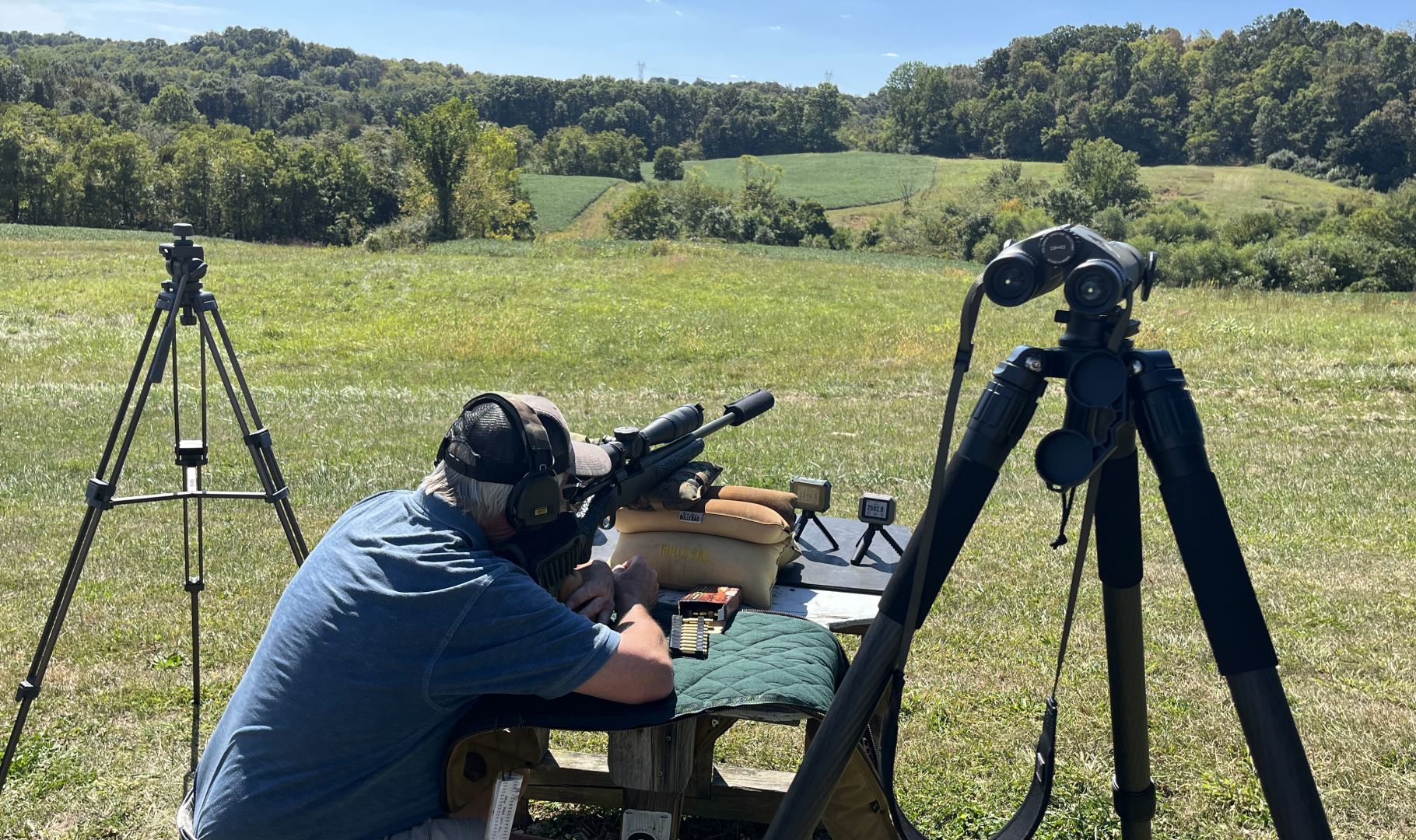 Getting some chrono data from my pops shooting some steel with his .308 as well as trying out the Vecronix Vector X binos with Calypso AB live wind feed for the first time. I’m buying him a bipod for Christmas so he quits piling bags up to the sky. Introduction: It doesn’t seem like it’s been ten years since Athlon optics was founded, but it has been and, in that time, the company has grown from one of many scrappy optics startup brands at the time to a major player in the industry. Over that span, it has earned an excellent reputation for market responsiveness, value, high quality control standards, and ease of warranty service. The three Athlon rifle scopes I have reviewed over the years had flawless mechanical testing results and were excellent optical performers at the price, and all are still in use today. Since the time of those reviews, Athlon has greatly expanded its line of optics as well as branched into other adjacent products categories, including shooting tripods and the Athlon Rangecraft Velocity PRO radar chronograph I will be reviewing here. There was not much turnaround time between the press product announcement landing in my e-mail during ShotShow and my requesting one of these chronographs for testing. The draw of this new Athlon chrono is obvious. It looks almost exactly like a Garmin Xero but costs substantially less and it has an extra button, a slightly bigger screen, and comes with a nice case. The question on everybody’s mind was just as obvious: Will it perform like the Garmin? Full disclosure: The Athlon Rangecraft Velocity PRO radar chronograph used in this review was provided to me by Athlon at no cost for the purpose of the review. The Garmin Xero C1 used was purchased by me at a discount from Garmin for the purposes of that review and because I very much wanted to step up from the Oehler I was using at the time. Neither company provided any compensation or promise of future patronage to SnipersHide or to me personally in exchange for doing these reviews. I have full editorial control of the contents of both reviews. Both companies received a draft for comment prior to publication. Unboxing, Look, and Feel This case is exactly what I was imagining when complaining that the Garmin Xero came with no case at all. It’s not hard to get this right. These little zippered cases made of vacuum formed plastic with fabric sewn over it do such a nice job of protecting sensitive electronic things and they just can’t cost that much given my $40 Chinese bore scope came in one. The Athlon case is excellent. It fits the chrono, metal tripod for the bench, charging cable, and manual. It protects them all nicely in your range bag as well as in the original shipping box if UPS gets a hold of it. 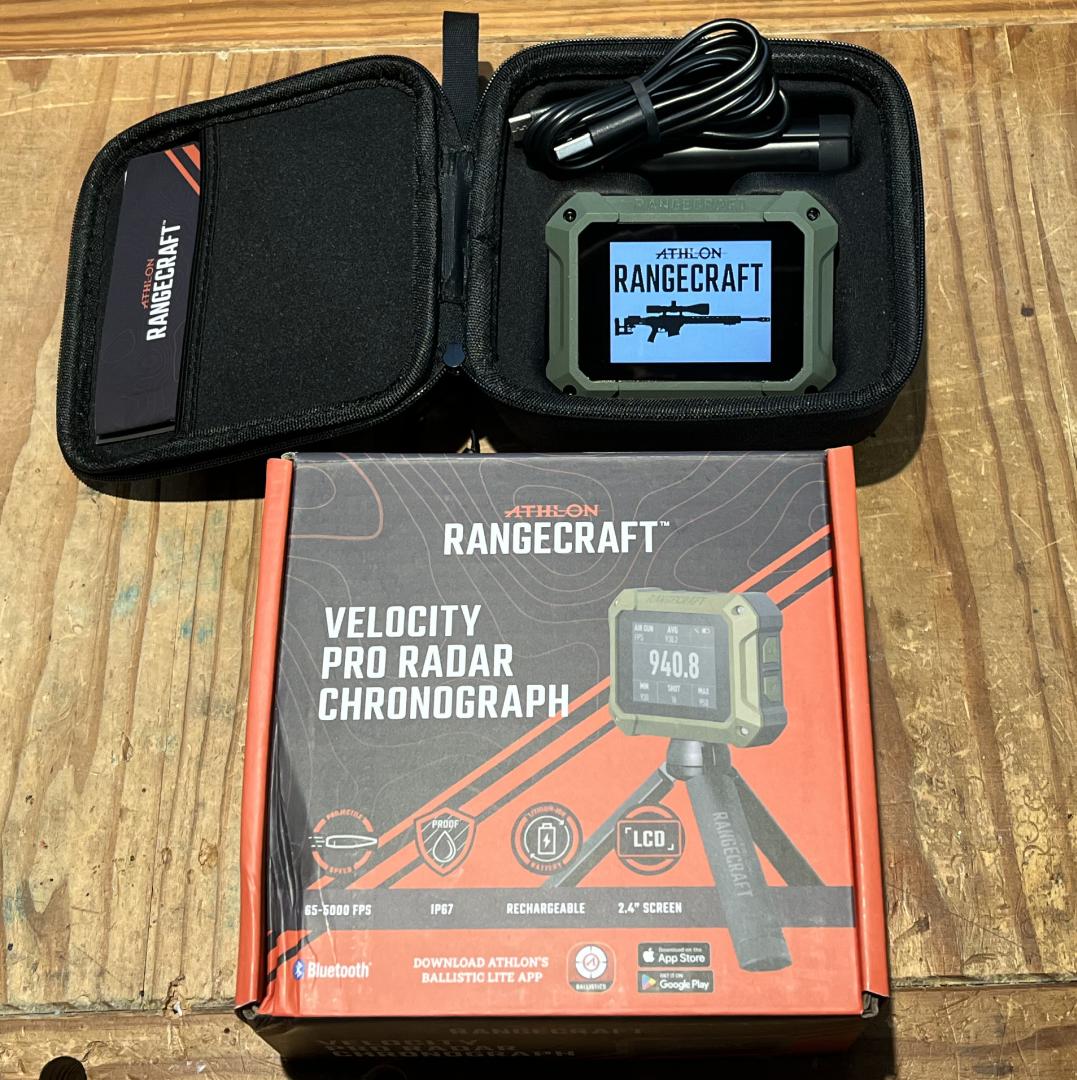 Athlon Rangecraft Velocity PRO radar chronograph unboxing picture. That shipping box took a shot during its journey, but the case kept the chrono safe. The chronograph itself is slightly larger than the Garmin, sports a correspondingly larger screen, and has more buttons. In practice, the biggest advantage to all of this is that you have an instant delete button for any shots that you might pick up from a neighbor’s lane, though, in practice, picking up neighboring lane shots was not actually a problem. Unfortunately, along with copying desirable features, Athlon also copied the integrated flat pack battery from its competitors. When this eventually reaches its natural end of life, it would be very difficult (and risky!) for a user to replace. Although the chronograph body is secured with a gasket and not glue, the battery inside is glued to the back of the screen and it would be tricky to try to remove, just as it is on the Garmin. Given that 18650 and 14500 battery standards exist, are commonly available, and easily fit in this device’s footprint, the designers could have chosen one of those and put it in a molded screw top battery compartment instead of the flat pack battery glued to the screen. I think we all expect our chronographs to last longer than the 5-10 years of a lithium ion battery and we would also like them to be easily serviceable. As is, you can power the device with an external USB-C battery pack. I expect this is what most users will do when the battery reaches the end of its service life. You can also use an external USB-C battery pack if the primary battery is simply exhausted. The claimed battery life is 6 hours on a charge, by the way, and this is about what I experienced in my use. 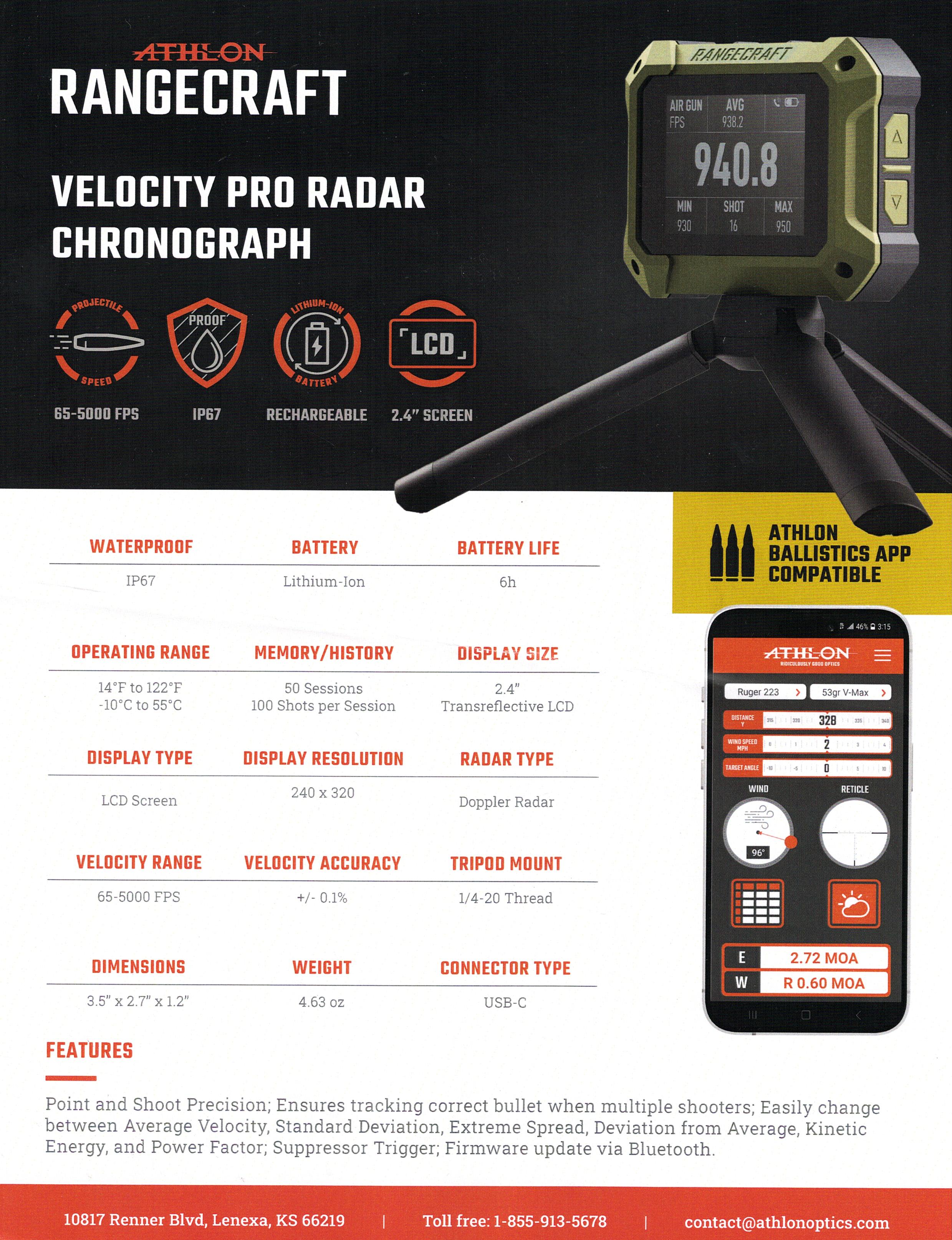 Athlon Rangecraft Velocity PRO radar chronograph specifications Navigating the menu system within the Athlon chrono is quite easy using the three top and two side buttons. You can easily look though previous strings shot by shot or view the summary with average, SD, low and high, ES, and other values. You can also delete individual shots in previous strings, though you cannot add to previous strings. I find this unfortunate, as I would like the ability to shoot other rifles while letting one cool and to be able to restart strings so all the data can be easily put together at the time of capture instead of having to be reassembled in Excel later. I don’t have any other complaints about the menu. It is simple, intuitive, and I haven’t thought of any other features I would find helpful that were not already present. Software The bar for success for an app in the gun industry is not very high. Those of you who have read many of my past reviews on electronic devices know well that the smart phone apps associated with these products have often been bug-filled and sometimes even incapable of performing their basic functions. The Garmin app, for instance, is supposed to be able to update the firmware in their chrono but was never able to do this for me. I instead had to utilize a separate PC-based application and ended up wishing I hadn’t. The Garmin was also supposed to automatically download and store range sessions. It struggles with this in that it only downloads a few sessions each time it is restarted instead of grabbing them all. In contrast, the Athlon application had no problem either updating firmware or downloading all range sessions. I recall reading that it had some issues in the initial weeks, but by the time I tried it out, I found no problems. Interestingly, it turns out these problems were actually the result of server load. A lot of people bought these chronos and used them while connected to the app live. This was more server load than they were ready for and the resulting malfunction lead to the chronographs temporarily freezing up. This was fixed pretty quickly as, unlike the vast majority of gun companies, Athlon actually has software developers in house. This is why they can tweak and update their software to add features and fix problems as quickly and often as they do. 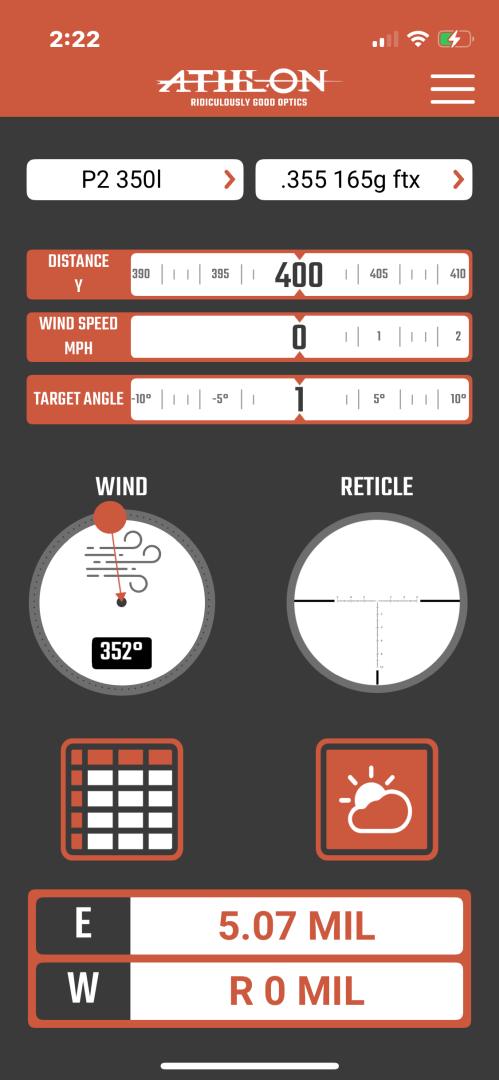 The Athlon ballistics app home page where a range can be entered and the ballistic solution output. The Athlon app aspires to a good deal more than basic chronograph data storage and firmware update functionality. In fact, it is fundamentally a ballistics app and then has the added functionality for the chronograph added to what was a pre-existing ballistic calculator app. The ballistics app works similarly to what you might expect. You create rifle profiles and underneath those you create secondary ammunition profiles. You must be brief in naming your profiles, however, as you are allowed very few characters. Currently, you actually create or edit these new profiles and sub-profiles only from the main app screen and not the tab for profile management. I found this a little counterintuitive. That profile management tab appears to exist only to offer the single function of deletion of a rifle profile or ammunition sub-profile. As a result of my confusion, Athlon plans on changing this in the future to also offer creation and editing of profiles on the profile management tab in addition to the home screen. There is another, more unique way to update the velocity of a round in a profile. You can update the velocity directly from a chronograph session. That is a pretty neat function and is found on the page for the chronograph session you want to update a profile to. This tying of ammunition to profile also allows for chronograph sessions to be sorted in the app by profile. This can be helpful if you have a ton of sessions from multiple rifles. Another function that the ballistics application has that is not very common is that, if you have an Athlon reticle, you can specify it in the app and the app will display an image of the reticle with the ballistic solution resolved for the data you have entered. I don’t know how many people will be helped by this, as you have to have a certain level of understanding to enter your data correctly and, at such level, you can probably also read your reticle, but it looks neat and in the stress of a field situation it might perhaps keep you from messing up some math on a second focal plane reticle or something. 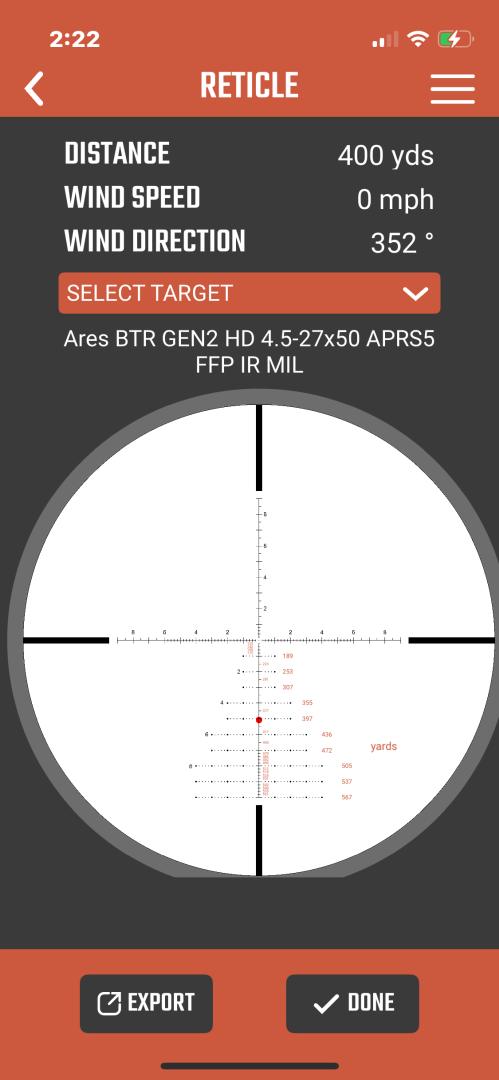 Athlon reticle page showing a shot solution. The origin of the chronograph data storage function as an add-on to the original ballistics application is quite apparent when you go looking for your chronograph data. It is accessible under the tab Connect device > Velocity Pro radar > Manage. This might feel like you’re trying to connect to the device when you are instead looking over old data. Indeed, the process is basically the same. You can look at your old data just fine without even connecting to the device. You can also send the data to your computer by e-mailing it in .xlsx format. Currently no other formats, such as CSV, are offered. 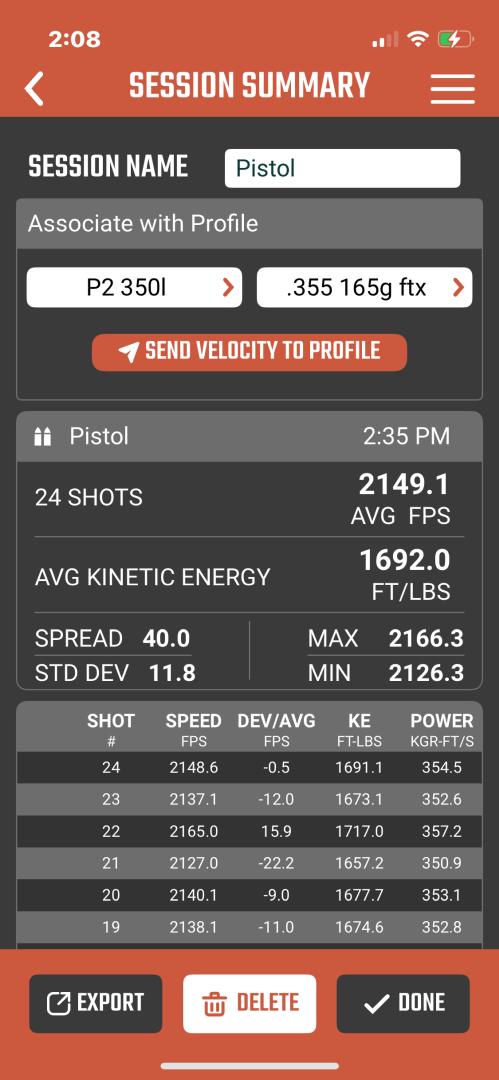 Athlon shot session page for load I am currently using most in the Pure Precision 350L rifle. In addition to these functions, the Athlon ballistics app also includes an interface for Athlon thermal products, as well as an Athlon videos section. Overall, my take is that the Athlon ballistics app is a bit clunky, sometimes counterintuitive with regard to organization, and could use a few features (like more export formats and the ability to view and edit profiles). However, not only does it carry out its basic functions without failing, it also offers a lot of additional uses, so it’s well ahead of most apps in the industry. How second gen Doppler radar chronographs work and firmware updates We might as well call the Athlon Rangecraft Velocity PRO radar chronograph and similar products such as the Garmin Xero C1 and LabRadar LX second-generation ‘radar chronographs’. They operate significantly differently than things like the original LabRadar unit that first brought doppler radar technology to the retail customer space. All of these units operate based on doppler radar, meaning they fire out radar pulses at a known frequency to bounce off of the back end of the fast moving bullet and they measure the difference between the frequency of the returning pulse and the one emitted to determine the projectile velocity. The second-generation units vary in their operation by being much lower energy, always on, and having a very wide cone of radar emission. In practice, this means that you do not have to have a trigger (such as noise or recoil) to inform the radar when to measure, as it is measuring constantly. This helps with smaller or less noisy guns or when at a range where lots of noisy stuff is happening that could set off your chrono. It’s a huge advantage, as triggering a shot read on a first gen radar chronograph was a common failure point. The lower energy use of a second gen chronograph allows this always-on operation to be possible and, conversely, the always-on function allows for the lower energy, as the chrono can measure the projectile much closer to the radar unit because there is no trigger delay. The wide cone of measurement also means that the radar unit does not have to be lined up perfectly, but also means that the unit must analyze and decide which shots are coming from adjacent lanes and which are from the user. This is important, as the approximately 30 degree radar cone the Athlon is putting out means it easily sees a couple lanes over. Incidentally, second generation units can also pick up the radar readings for other nearby units, but they will detect this and employ frequency hopping to avoid conflicts, at least I know that the Athlon and Garmin units can. 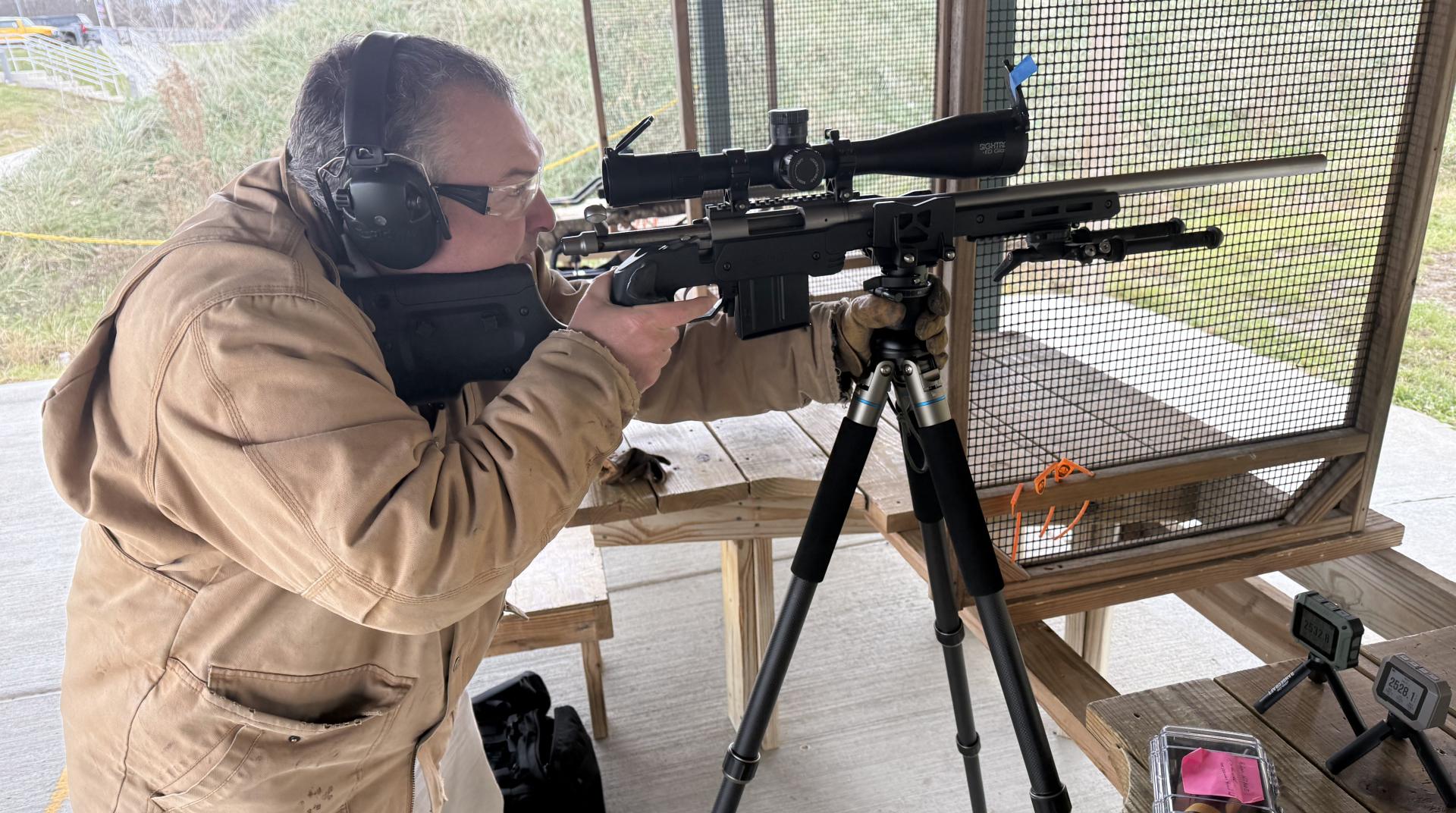 Shooting my now restomod 5R .308 from the early SnipersHide days with Sightron S6 scope in Hawkins rings, MDT XRS stock, and Bix n Andy trigger off a Field Optics research tripod a little too far from the chronographs for these firmware versions. Both picked up some, but not all, shots. As a consequence of this second generation technology, the firmware is very important and changes to it can result in very significantly different real world behavior. This was apparent when I updated my Garmin from its launch firmware to firmware 3.27. That first range day with side-by-side Athlon and Garmin radar chronos featured that Garmin firmware and the Athlon with 1.40.61. This was a pretty terrible update for the Garmin. It commonly missed my shots with both handgun and rifle while somehow picking up a lot of shots from adjacent lanes. Its function picking up shots was far worse than it had behaved out of the box with its original firmware. This was superbly great timing for Athlon and not so much for Garmin. When I updated the Garmin to 3.32, it seems to have fixed the issues introduced sometime between launch and 3.27. Mine is working well again and the internet is no longer blowing up with others who had the same complaints. In addition to the filtering of which shots to record and which not to, firmware updates can also tweak the velocity read by the chronograph. Athlon did this with their archery profile on one of the updates and Garmin may have as well at some point this Spring. What all of this means is that firmware changes to these second generation radar chronographs are not just about features. They can be meaningful to the core function of the device as well. Accuracy 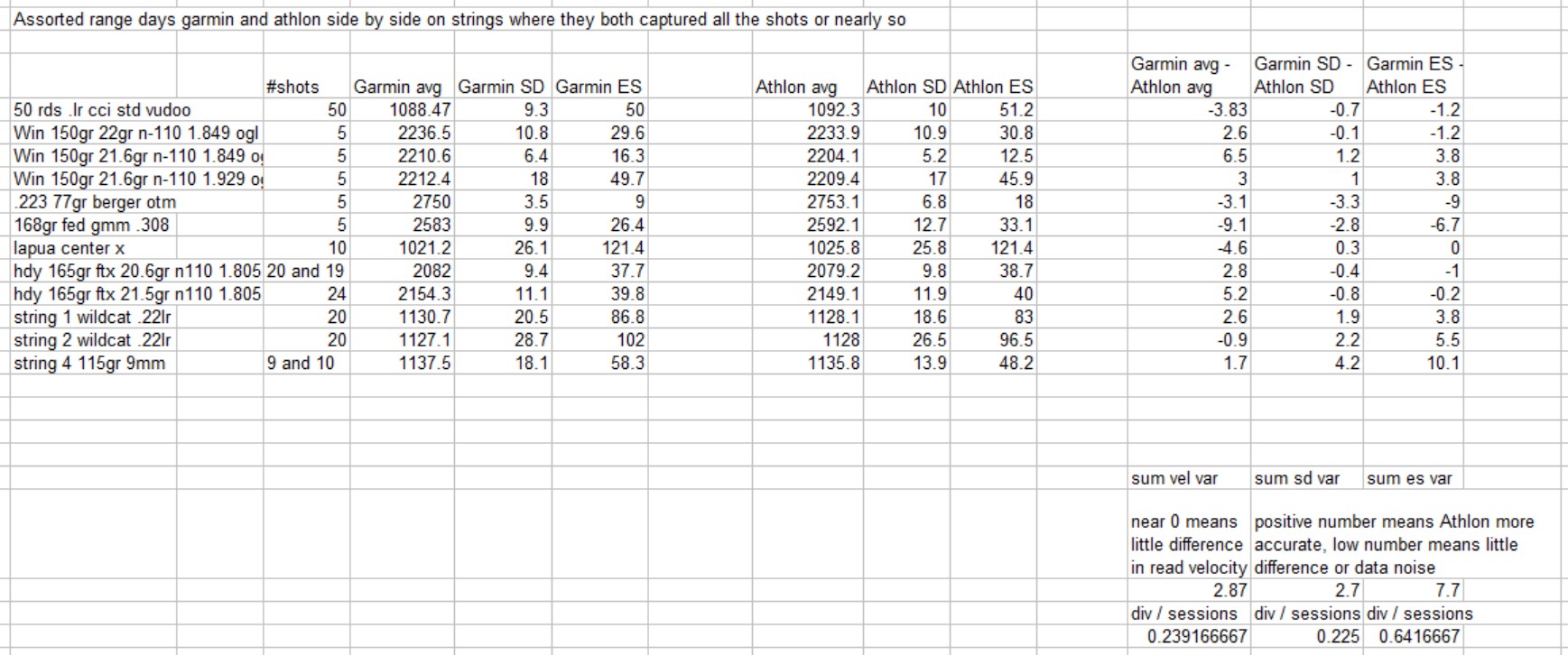 Side by side velocity, SD, and ES data for the Athlon Rangecraft Velocity PRO and Garmin Xero C1 radar chronographs Over the past few months, I have collected a good deal of side-by-side data with both the Athlon and Garmin chronographs. Unfortunately, most of this cannot be compared exactly side-by-side usually because one or both of the chronographs missed some shots in the group. I did leave one larger group each in the data where each chrono had dropped one shot because, with the larger group sizes, this is pretty minor. Occasionally, the Athlon also threw the first round of a 350L series by 100fps for reasons I have never solved. On one occasion, all shots in a string were offset by ~20fps between the Athlon and the Garmin. Many users that have both chronographs note this behavior and believe it was more common around the time of the Athlon release than it is now. This may have been caused by firmware updates or it may have always been due to chronograph positioning and thus never been very meaningful. What was left of total data sets on side-by-side sessions after the cull is the groups in the above chart with a variety of different cartridges, taken with a variety of different firmware editions and taken on many different days. I have done a little simple math comparing the average velocity reading, the SD, and the ES between the Garmin and Athlon chronographs for each group. My idea was that if one chronograph reads consistently higher than the other, the difference in average velocity will add up to a positive or negative number (depending on which chrono reads faster) higher than the typical difference for a string. This was not the case. As such, on average, I do not think one chrono has the tendency for higher velocity readings than the other. Similarly, when adding up the SD and ES values recorded, I did not get a big number. In these cases, the number was greater than the average difference between the chronos on an individual string, but it was still within the range of strings and thus I don’t think it represents a trend either. In other words, when looking at a wide range of common cartridges, I don’t think there is a substantial difference between either the accuracy or the precision of Athlon or Garmin radar chronographs. This does not mean that with more and larger groups and with more examples of each company’s product, a winner would not emerge, just that the winner would likely not win by much. I also suspect both of these products are objectively very good, as they are spitting out a 10fps or better SD for a 50rd string of CCI .22lr. That is a very low number without much room for error stacking large inaccuracies on the part of the measurement devices. I have also noticed that after zeroing at 100, my first round shots at long distance targets calculated with applied ballistics using velocity data from these chronos are landing on the water line indicating they must be getting the velocity right. Come to think of it, I don’t think I have trued a single profile since using these second-generation radar chronograps and I have probably done at least 5 new profiles. That was not the case with my previous light gate chronograph.  I paid $17 for a brick of this ammo ~2008. It averages .491” groups at 50yds outside in the wind and has a 9.3fps velocity SD. What would you pay for ammo that shoots this well now, I wonder? Do not forget what has been taken from us and never believe a word you are told about inflation. Notes on field use In addition to having the handy metal tripod that seems pretty resistant to blowing over on your bench, the standard ¼” tripod mounting stud on the Athlon chrono easily fits larger tripods allowing you to position the chrono near whatever rifle position you are firing from. I have even considered attaching the chrono directly to the rifle stock on my .22lr or heavy .223, as many others have done. While this is not recommended or warranted by Athlon and I have not tested it, many report good results especially when using heavy competition rifles with light recoiling cartridges that don’t impart too much shock to the chronograph. It is also worth noting that some users have noted slight velocity shifts when rifle mounted. I think they were claiming around 5fps if my memory serves. I have run the Athlon now with a wide variety of ammunition, including .22lr, .223, .308, 6.5cm, 350L, and 9mm. I have run it sitting next to the rifle on a bench in the recommended 4-10” window, sitting a little further than that on the bench, at the handgun range on the table below the muzzle at least two feet, and on a bench next to the tripod I was shooting off probably three feet away. I have used silencers, muzzle breaks, and simple, bare muzzles. I have also run it with people in directly adjacent firing lanes on a number of occasions. I think I have only had it once pick up a neighboring handgun shot and never a neighboring rifle. Athlon’s published spec is 48” on this and they appear to have gotten that worked out well. Similarly, outside of the one bad firmware update, the Garmin has also done equally well with excluding neighboring shots. Keep in mind that these chronographs absolutely see a lot of these shots. In some cases, on the Athlon, you might even see it pop the analyzing screen and not record the resulting shot if it decides that the shot was probably not from the right shooter. Now, about that chronograph placement: it’s a big deal. First off, if the chronograph is far from the muzzle, it will read velocities considerably different than the correct muzzle velocity. These readings might even be 100 or so fps off in extreme cases. This is because the radar frequency shift is not the same if the shot is coming across at an angle to the radar unit’s positioning. As such, you want to position these chronographs consistently and to recommendations where possible. That being said, the Athlon is a little more finicky about its positioning than the Garmin when it comes to registering shots. Sometimes the Athlon just doesn’t like its position when I think it should and it is in the proper window. Athlon expects the most likely explanation for this is interference from muzzle blast. In practice, what it means is that occasionally, on some rifles, it’s just not going to like your first attempt at placement and you will need to move it and try again. I would love to say I found a pattern for this, but it only happened a few times and so I didn’t. What I can say is that if it picks up a first shot from a position that is within or near the recommended position, it doesn’t drop subsequent shots. This doesn’t hold for shooting off a tripod three feet away at the edge of range, those remain intermittent, but it does seem to be true for shots where the chrono is near the gun and muzzle blast interference is the issue. Possibly related to muzzle blast is also the oddball 100fps first shot issue I had intermittently with just the 350L. What happened is that, on four strings, not all on the same day or with the same ammunition, the first shot of a string registered about 100fps lower than other shots and than the Garmin. These measurements were clearly off and I do not know the cause or if there was any significance to all the shots being the first shot or all reading lower than their true velocity. Lastly, it is also worth mentioning here that the Athlon chronograph processes its shots much faster than the Garmin and you therefore can fire faster without dropping shots. The difference is pretty substantial with the Athlon, allowing about twice the rate of fire as the Garmin. You can pretty easily outshoot the speed of the Garmin with a semi-automatic firearm, so this is not a moot point. You can still exceed the Athlon speed if doing double tap drills, but I don’t think you would do so in a situation where you are aiming every shot.  See the Athlon Rangecraft Velocity PRO hiding in the foreground? Yeah, I had forgotten about it and left it on when I moved to fire the Proof barreled Pure Precision 350L rifle with Leupold Mark4 HD scope from the bench to the tripod. It actually caught most of the shots I fired off the bipod. Summary, Conclusion, and yet more Garmin Xero comparisons Without question, second generation doppler radar chronographs have tremendously changed the way we collect velocity data and the frequency with which we do so. In the days of light gate chronographs, which is what I used until last year, you had to go down range to set up your chrono. This was time consuming and sensitive enough that it was very difficult if not impossible to do so in a public range setting. If I wanted to take data on a new ammunition or load, I really had to go to the further, more expensive, more private range to do so easily and, realistically, it would take hours of extra time to set up and move around the chrono between different targets through multiple test loads. I also had to lug around the guitar-sized case. The whole apparatus was so wobbly on its tripod that any wind was a non-starter, and let’s not forget how bitchy it got if it didn’t like the sun’s position. It was also pretty easy to shoot the chrono on accident and my brother did so regularly every year or two. In recent years, the arrival on the market of the Magnetospeed and first generation LabRadar chronos were significantly easier to use than the legacy light gate technology, but each came with pretty significant downsides, such as failure to read .22lr reliably or at all, effects on barrel harmonics, fragility, or difficulty in triggering the radar reading. As such, I had never parted with the dough for the partial upgrade. The Athlon Rangecraft Velocity PRO and its competitors changed my calculus on this. They are now the size of a deck of cards, set up in less than a minute, and do not have any downsides relative to prior technologies. They have transformed the way I take data and how much data I take. I now have data from every range session instead of from very few, which has been very meaningful in diagnosing ammunition problems and making decisions.  My remarkably cumbersome Oehler P35 taking some measurements for the PurePrecision Crux 6.5CM review a few years back. The Athlon Rangecraft Velocity PRO stands out from its Garmin competition by having better, more reliable software, measuring shots faster, allowing for more rapid fire, having far better accessories, including a nice case, and being less expensive. It was so much less expensive than its primary competitor at launch that Garmin appears to have dropped its street price by $100 to be closer to the Athlon. Despite its still higher price, I did not find the Garmin unit to be either more accurate or more precise. My data did not indicate a substantial difference between the two competitors in average measured velocity or in SD or ES values, indicating they are very similar. In my testing, the Athlon did a sporadic ~100fps misread of the first shot in a series happened only when I was shooting 350L that may be related to muzzle blast, but that I don’t have a definitive answer for but that the Garmin never experianced. When it comes to picking up the user’s shots reliably, outside of a bad firmware version from Garmin, I found the Garmin to be better at picking up all of your shots than the Athlon. Occasionally, possibly due to muzzle blast interference, the Athlon unit just didn’t like a positioning that was inside of the recommended parameters and I had to move it and try again. Both units were equally excellent at excluding shots from neighboring lanes. Outside of the price and accessories, There really aren’t a lot of differences in these chronographs’ function. The Athlon reads shots substantially faster than the Garmin, while the Garmin is a little more forgiving on placement than the Athlon and is physically slightly smaller. They are remarkably similar in function and design. Both even have a stupid glued-in internal battery that really isn’t user serviceable instead of using an easily replaceable rechargeable size with exactly the same chemistry, such as an 18650 or 14500.  Here is a nice through the Leupold Mark4 HD 4.5-18x50mm scope shot with the Athlon Rangecraft Velocity Pro on one side the the Garmin Xero C1 on the other. It almost looks artsy playing with depth of field to create a striking composition. Software wise, Athlon has much better and less buggy software and it includes a ballistic calculator. There were a few menu choices that I found a little clunky to use, but never failed in any of its core functions and has the fun feature where you can update an ammunition profile with your measured velocity with a button push instead of by typing it in - as that would take more button pushes. The Garmin software is buggy but does allow a few more export formats for those of us who still use Excel 2003 like a based boss and don’t have .xlsx format. As with the software, the accessories that Athlon supplies are clearly superior to the Garmin. The tripod is metal and heavy enough to be unlikely to blow over and the nice, padded zipper case is what both should have come in. Overall, the Athlon Rangecraft Velocity PRO radar chronograph is a big win. It has brought down the price of an excellent second generation doppler radar chronograph by $200 with minor advantages and disadvantages relative to its predecessor and main competitor. |