


Posted: 11/10/2017 12:22:10 AM EDT
[Last Edit: Jupiter7200][Edited]
|
We all want to make an antenna that will use a minimum of wire / occupied space, yet work as many bands as possible. One way is to make a simple dipole, or rather, a number of dipoles, one for each band. But if we do this, we are now complicating things, lots of coax, antenna switches, lots of wire, the back yard will look like a spider web.
We can put multiple dipoles in parallel, feed them with one piece of coax, no switches, switching will be automatic! This is known as a "fan dipole". Still, there is a lot of wire hung about. A 40 m center fed dipole will work 15 meters with a tuner. It will be slightly off from being exactly 3 x the fundamental frequency due to end effects, but will be close enough that a tuner will let it work both bands. A 40 m center fed dipole will not work 20 m or 10 m. OK, 40 and 15 m from one dipole... doing a little better, but not good enough. We want more bands!!! Attached File An 80 m center fed dipole will work 30 m and 17 m, and 12 m with a little assist from a tuner (odd numbered harmonics). I said 80 m, not 75. It must be tuned low in the 80 m band, down around 3.500 to 3.550 mhz so that the harmonics will coincide with the nearest ham band. 3.5 mhz x 1 = 3.5 mhz. 3.5 mhz x 3 = 10.5 mhz - close enough to tune the 30 m band. 3.5 mhz x 5 = 17.5 mhz - close enough to tune the 17 m band. etc. Attached File Center fed dipoles will only work the odd numbered harmonics. But if we make a fan dipole with 80 m and 40 m segments, we then have 80, 30, 17 m (and 12 m) and 40 and 15 m. That gives us 6 ham bands with two dipoles in parallel. Then we can fill in with a third pair for the all important 20 meter band. Now we have 80, 40, 30, 20, 17, 15, 12 meters from just three pairs of elements in our fan dipole! Not bad at all! Still, that's a lot of wire in the back yard. (Helpful hint... you still need a tuner to work 75 meters, and get the other bands just right.) For the same overall length of wire, an offset center fed dipole, aka OCFD or "Windom" (sic), will work both even and odd numbered harmonics... but which ones depends on the "split", that is, just where along the span of wire the feedpoint is located. Attached File At the antinode, the center of the 80 m dipole, the impedance is approximately 50 ohms. The impedance at the ends, where no current can flow, approaches infinity. Would you not agree that somewhere between the center and either end we might find a point that is about 200 ohms? That point would be about 1/3 of the way from either end, and if we use a 4:1 current balun at that point we will present 50 ohms back to the transmitter. I present to you, The OFFSET CENTER Fed Dipole! A 40 meter OCFD is 66' overall length, same as a 40 m center fed dipole. But the split would be something like 22' + 44' (33% feedpoint), or 25' + 41' (38%). This OCFD will work 40, 20, and 10 m bands. The 33% or 1/3 - 2/3 split will have great difficulty, very high impedance on the 15 m band. This is because for that frequency, 21 mhz, the 66' length is working as three half-wavelengths. There are three antinodes distributed along the 66' of wire. An antinode is a point where there is maximum current and minimum voltage, and minimum impedance (Ohm's law). Attached File But there are also four nodes... points where there is minimum current and maximum voltage, and thus near infinite impedance. Those points are at each end, and one at 22' and another at 44' along the wire. You can't drive the antenna at those points, and for the same reason that you can't drive a 40 m center fed dipole to work the 20 m band... there is a node directly in the middle where the feedpoint is located. So, a little problem... the 66' overall length 40 m OCFD with 1/3 - 2/3 split (33%) will not work the 15 m band, nor will the 80 m version work 30 m and 15 m. The feedpoint is directly on a node for those bands. But by moving the feedpoint over one way or the other off that 1/3 node we can again drive those 3 x harmonics. This will change the impedance for other bands, and a band may be "lost" or maybe just higher impedance. YOU STILL NEED A TUNER. Other splits to try, for the 80 m OCFD, try 38' + 94' (29% feedpoint) or 50' + 82' (38% feedpoint). For the 40 m OCFD, try the 25' + 41' (38% feedpoint). You may also be interested in these threads: Let's Make a Dipole https://www.ar15.com/forums/outdoors/Let-s-Make-a-Dipole/22-690847/ and Let's Make an OCFD https://www.ar15.com/forums/outdoors/Let-s-Make-an-OCFD/22-690848/ |


| Open wire or ladder line feed of a dipole is the simplest antenna. Elements can be added if you want more control over a favored direction. A plus is that you only have to get the wire close in length to get a lower impedance feed as long as the feed line is one of the good lengths. |

|
For a portable station, you can't beat an OCFD.
But for a non-temp antenna, it is best to just hang extra wire for multiple dipoles in a fan. Anytime you use a tuner, you incur losses. Wire is cheap. A true resonant antenna with a low SWR is very efficient. If the SWR is higher, you get reflected power. If you use a tuner instead of a higher SWR, you get losses in the C/L circuit of the tuner and unless the tuner is at the antenna, the coax has RF on it. You can reduce the RF by using a balun but the mear fact that the LC circuit ( in the tuner ) is in the shack means that RF is in the shack. There is no way to avoid it. This is my educated opinion. I might be wrong, but right now I don't think so. The bigger the SWR you have to correct with a tuner, the bigger the loses and the more RF is in the shack. When you use a tuner in the shack, the tuner,the coax and the antenna all become the tuned antenna. For portable ops, this IMO is a decent compromise compared to having many multiple antennas. For a home shack, it is a waste unless you live on a small plot, in a condo or in an apartment and are limited in ability to string multiple wires which makes the compromise and the losses better than no ops on those bands. |
Mach
_______________________________________
Most of my posting is from my phone. Hence the fat thumb spelling errors.
Drain the swamp
.
_______________________________________
Most of my posting is from my phone. Hence the fat thumb spelling errors.
Drain the swamp
.

| Also, don't discount the signal pattern that results from a long antenna used on multiple bands. Just because the antenna/balun provides a reasonable SWR does not mean that it's actually putting signal where you need it. As the antenna becomes longer than 1 1/4 wavelength, the signal pattern starts to become very "lobed" along with nulls, which becomes pretty dramatic when you get up to 10 meters. I have heard many also say that their 80m OCFD tunes up great on 6 meters but that the band is completely useless - no, but the signal pattern of an 80m dipole used on 6 meters makes it pretty useless. |
This is...a clue - Pat_Rogers
I'm not adequately aluminumized for this thread. - gonzo_beyondo
CO, FL, MI, SC, OR - Please lobby your legislators to end discrimination against non-resident CCW permit holders
I'm not adequately aluminumized for this thread. - gonzo_beyondo
CO, FL, MI, SC, OR - Please lobby your legislators to end discrimination against non-resident CCW permit holders

|
OCFD is a great antenna, but still, there's nothing magic about resonance. It is a great way to get a simple system that doesn't require much if any matching (if you're ok with not being able to work the entirety of every band), but it's all part of the tradeoffs that go with system design.
Losses in an decent unun and / or tuner are typically less than a dB. Given that often one must use a tuner to hit other portions of the bands where the antenna is not resonant anyway, then it really makes little difference in system loss whether we tune a 2.5 SWR at a band edge of a "resonant" system, or a 7:1 SWR in a non-resonant system. An issue that makes FAAAaaaaarrr more difference in signal strength is polarization - low horizontal antennas perform poorly (for DX) compared to vertical polarization. This is why DX chaser's antennas of choice are Verticals or Inverted-L's on those low bands.... |
.
A is A......An armed society is a polite society......Have you Choked Your Feedline Today?
.
A is A......An armed society is a polite society......Have you Choked Your Feedline Today?
.
|
I'm not opposed to using a tuner at all. I would like an antenna to be at least tunable to a desired
frequency. Losses in tuners and coax is greater at higher frequencies. Thus my observation about OCFD's, if must have high SWR in a band on a multi-band antenna, it would be best if that high SWR band is a lower frequency band in order to minimize those losses. I'm not worried about performance on 10 m or 6 m. Those bands work better with a dedicated antenna. And dedicated antennas for those bands are small and compact. A halfwave dipole for 6 m is about 9' span. A halfwave dipole for 10 m is just under 17' span. But 1/4 wave verticals are probably better choices for those bands. But if I can get 80-40-20 m from an OCFD, or even just 40-20 m for a portable antenna, I'm happy. The simplicity of a 66' OCFD for an emergency antenna makes it an excellent choice. But radiation patterns and lobing are an important consideration. |
Joined:
Jul 2024
Posts:
184
EE: 0% (0)
 NC, USA
The big problem with "center fed" vs "feed it wherever fed" Is what happens when you connect the feedline. Unless you keep the feedline in what is called the "neutral plane" of a dipole, you will couple "common mode" into it, and there is nothing you can do to stop it. The neutral plane of a regulation dipole is in the middle at a right angle. Put the feedline at the end of the dipole, and your feedline is now "hot" with rf, as a consequence of being where it is in the rf field. A "choke" won't help, because the common mode is not conducted into the wire, its coupled into it, "past the choke " so to speak. Now, this "common mode" in and of itself is not a issue, but sometimes this rf gets into things it shouldn't, and you will have a devil of a time getting rid of it. My advice, is to pick a antenna system that "plays well" together. The center fed halfwave dipole, full wavelength loop, and quarter wave vertical where the feedline runs straight down from the radials are 3 simple, basic antennas that almost always work just like the textbook first time every time. My opinion, worth every penny you paid  Rege |

|
Originally Posted By Mach: For a portable station, you can't beat an OCFD. But for a non-temp antenna, it is best to just hang extra wire for multiple dipoles in a fan. Anytime you use a tuner, you incur losses. Wire is cheap. A true resonant antenna with a low SWR is very efficient. If the SWR is higher, you get reflected power. If you use a tuner instead of a higher SWR, you get losses in the C/L circuit of the tuner and unless the tuner is at the antenna, the coax has RF on it. You can reduce the RF by using a balun but the mear fact that the LC circuit ( in the tuner ) is in the shack means that RF is in the shack. There is no way to avoid it. This is my educated opinion. I might be wrong, but right now I don't think so. The bigger the SWR you have to correct with a tuner, the bigger the loses and the more RF is in the shack. When you use a tuner in the shack, the tuner,the coax and the antenna all become the tuned antenna. For portable ops, this IMO is a decent compromise compared to having many multiple antennas. For a home shack, it is a waste unless you live on a small plot, in a condo or in an apartment and are limited in ability to string multiple wires which makes the compromise and the losses better than no ops on those bands. I love my eBay (Tim Ortiz) OCFD 80-10 for portable when I have the space. DX POTA all day long and I don’t have to change antennas for the local 40/80m nets in the evening. It’s a banger. I should buy a spare. |

|
Originally Posted By Asheville-Hippy: The big problem with "center fed" vs "feed it wherever fed" Is what happens when you connect the feedline. Unless you keep the feedline in what is called the "neutral plane" of a dipole, you will couple "common mode" into it, and there is nothing you can do to stop it. The neutral plane of a regulation dipole is in the middle at a right angle. Put the feedline at the end of the dipole, and your feedline is now "hot" with rf, as a consequence of being where it is in the rf field. A "choke" won't help, because the common mode is not conducted into the wire, its coupled into it, "past the choke " so to speak. Now, this "common mode" in and of itself is not a issue, but sometimes this rf gets into things it shouldn't, and you will have a devil of a time getting rid of it. My advice, is to pick a antenna system that "plays well" together. The center fed halfwave dipole, full wavelength loop, and quarter wave vertical where the feedline runs straight down from the radials are 3 simple, basic antennas that almost always work just like the textbook first time every time. My opinion, worth every penny you paid Rege 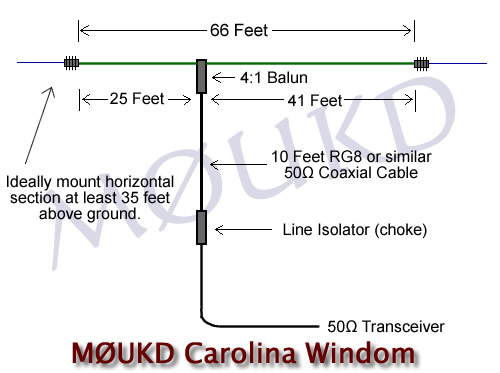 |
|
Originally Posted By DarkLordVader: I have seen these common mode devils. Sometimes they would make the mouse dance on my computer. The topic equates OCFD with Windom but there are differences. The windom has the 10' vertical radiator between the feed point and choke. Its a radiator, and not a feed line due to all the action described above. Converting my OCFD PVC air core to a windom like the diagram below calmed many of the devils. https://m0ukd.com/static/homebrew/carolina_windom/Diagram.jpg Yes, and I don't use the term "Windom" for an OCFD. The original Windom was offset feed, but with a single wire connected to a single wire half wavelength antenna 1/3 of the way from one end. Single wire, not coax, and no other type of feeder. |