


DGRVP-Q&A: Air campaign, hybrid warfare, nuclear weapons, lessons for modern warfare (Page 15 of 60)

|
Lot of interesting topics around AI. Sounds like Elon may be in the lead with the Memphis cluster of 200K GPUs. DeepSeek, China, OpenAI, NVIDIA, xAI, TSMC, Stargate, and AI Megaclusters | Lex Fridman Podcast #459  DeepSeek, China, OpenAI, NVIDIA, xAI, TSMC, Stargate, and AI Megaclusters | Lex Fridman Podcast #459 OUTLINE: 0:00 - Introduction 3:33 - DeepSeek-R1 and DeepSeek-V3 25:07 - Low cost of training 51:25 - DeepSeek compute cluster 58:57 - Export controls on GPUs to China 1:09:16 - AGI timeline 1:18:41 - China's manufacturing capacity 1:26:36 - Cold war with China 1:31:05 - TSMC and Taiwan 1:54:44 - Best GPUs for AI 2:09:36 - Why DeepSeek is so cheap 2:22:55 - Espionage 2:31:57 - Censorship 2:44:52 - Andrej Karpathy and magic of RL 2:55:23 - OpenAI o3-mini vs DeepSeek r1 3:14:31 - NVIDIA 3:18:58 - GPU smuggling 3:25:36 - DeepSeek training on OpenAI data 3:36:04 - AI megaclusters 4:11:26 - Who wins the race to AGI? 4:21:39 - AI agents 4:30:21 - Programming and AI 4:37:49 - Open source 4:47:01 - Stargate 4:54:30 - Future of AI |
|
Some interesting information in the video. Historical Scientific Instruments  Historical Scientific Instruments 00:00 - Automatic Telephone: Almon Strowger, 1888 03:53 - Phonograph: Thomas Edison, 1877 09:33 - Laser: Ted Maiman, 1960 18:54 - Ammonia: Frtiz Haber/Carl Bosch, 1909 31:51 - Transatlantic Cable: Cyrus Field, Oliver Heaviside, 1858 43:50 - Quack Medicine, 1920s & 1930s 48:15 - High Tech Fraud: John Keely, 1872 |
|
Some I've heard of, but the spot wielding aluminum would have been handy back in the day. Unusual Shop Tips  Unusual Shop Tips |
|
He has some very nice stuff in his home workshop..... Dan Gelbart Workshop Tour HD  Dan Gelbart Workshop Tour HD |
|
Some interesting topics he touches on. Dan Gelbart Presentation 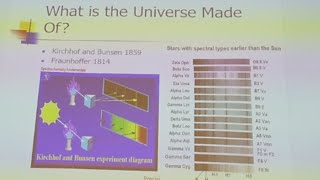 2021 Nov.25 - Dan Gelbart |
|
Interesting video on 3D metal printing. Prototyping - Metal 3D Printing  Prototyping - Metal 3D Printing |
|
Entire playlist on prototyping by Dan Gelbart. Lots of interesting things in the playlist. Building Prototypes Dan Gelbart https://www.youtube.com/playlist?list=PLSGA1wWSdWaTXNhz_YkoPADUUmF1L5x2F |
|
Interesting presentation on the evolution of language. The Evolution of Language: From Speech to Culture | Gifford Lectures 2019 | Prof Mark Pagel | Pt 1  The Evolution of Language: From Speech to Culture | Gifford Lectures 2019 | Prof Mark Pagel | Pt 1 'Wired for Culture: the origins of the human social mind, or why humans occupied the world' - The Gifford Lectures 2019 Lecture 1: 'The evolution of language: from speech to culture' All animals communicate, but language is uniquely human. In this talk, Mark Pagel will show how human languages evolve very much like biological species and even adapt to their hosts – human speakers. He will discuss when language emerged, whether Neanderthals and other hominins were capable of speech, and ask the question of why only humans seem to have language. Professor Pagel will show how language has been more important to human success than have our genes, and that many of our genetic traits exist because of language. Finally, we will explore why are there so many languages and what does the future hold for them. Dates: 23, 24, 28, 29 October 2019 Location: Sir Charles Wilson Lecture Theatre, University of Glasgow Mark Pagel is a Fellow of the Royal Society and Professor of Evolutionary Biology at Reading University in the UK. He is best known for his work on building statistical models to examine the evolutionary processes imprinted in animal and human behavior, from genomics to the emergence of complex systems – to language and culture. He is the Editor-in-Chief of the award-winning Oxford Encyclopedia of Evolution and co-author of The Comparative Method in Evolutionary Biology which is regarded as a classic in the field. He is widely published in Nature and Science. His book 'Wired for Culture: Origins of the Human Social Mind' was one of the Guardian newspaper’s best science books of 2012. |
|
Part 2 in the lecture series. Interesting theory that he is presenting. The Evolution of Creativity | Gifford Lectures 2019 | Prof Mark Pagel | Pt 2  The Evolution of Creativity | Gifford Lectures 2019 | Prof Mark Pagel | Pt 2 'Wired for Culture: the origins of the human social mind, or why humans occupied the world' - The Gifford Lectures 2019 Lecture 2: The evolution of creativity: you’re not as clever as you think Human societies are unique among animals for their ability to accumulate knowledge and technologies. It is why we are able to build soaring cathedrals, smart-phones and driverless cars, while our close genetic cousins the chimpanzees live life on the forest floor as they have for millions of years. Why this difference? The usual answer is that we are smarter than the other animals, and we can just figure things out. But it turns out that we are far less clever than we like to think, and most of us never invent anything, much less understand how the things around us work. Even something as simple as a pencil combines many technologies. How, then, have we accumulated knowledge and technology while no other species has, and what can we do to promote innovation in the future? Dates: 23, 24, 28, 29 October 2019 Location: Sir Charles Wilson Lecture Theatre, University of Glasgow Mark Pagel is a Fellow of the Royal Society and Professor of Evolutionary Biology at Reading University in the UK. He is best known for his work on building statistical models to examine the evolutionary processes imprinted in animal and human behavior, from genomics to the emergence of complex systems – to language and culture. He is the Editor-in-Chief of the award-winning Oxford Encyclopedia of Evolution and co-author of The Comparative Method in Evolutionary Biology which is regarded as a classic in the field. He is widely published in Nature and Science. His book 'Wired for Culture: Origins of the Human Social Mind' was one of the Guardian newspaper’s best science books of 2012. |
|
Part 3 of the series. Human Tribalism: A Curse of Our Evolutionary Past? | Gifford Lectures 2019 | Prof Mark Pagel | Pt 3  Human Tribalism: A Curse of Our Evolutionary Past? | Gifford Lectures 2019 | Prof Mark Pagel | Pt 3 'Wired for Culture: the origins of the human social mind, or why humans occupied the world' - The Gifford Lectures 2019 Lecture 3: Human tribalism – a curse of our evolutionary past? Humans spent the first 95% of their evolutionary history living in small tribal societies, only beginning 10,000 years ago to live in larger groups. Today, we routinely live and work among others in our millions. And yet this poses a dilemma. Nothing in our evolutionary past prepared us to live in these large groups, so how do we explain the enormous social groupings of the modern world and how can they be made to work given our ancient tribal instincts? Surprisingly, the answer lies in our tribal nature itself. Dates: 23, 24, 28, 29 October 2019 Location: Sir Charles Wilson Lecture Theatre, University of Glasgow Mark Pagel is a Fellow of the Royal Society and Professor of Evolutionary Biology at Reading University in the UK. He is best known for his work on building statistical models to examine the evolutionary processes imprinted in animal and human behavior, from genomics to the emergence of complex systems – to language and culture. He is the Editor-in-Chief of the award-winning Oxford Encyclopedia of Evolution and co-author of The Comparative Method in Evolutionary Biology which is regarded as a classic in the field. He is widely published in Nature and Science. His book 'Wired for Culture: Origins of the Human Social Mind' was one of the Guardian newspaper’s best science books of 2012. |
|
Final part of his presentation. The End of Anthropology? | Gifford Lectures 2019 | Prof Mark Pagel | Pt 4  The End of Anthropology? | Gifford Lectures 2019 | Prof Mark Pagel | Pt 4 'Wired for Culture: the origins of the human social mind, or why humans occupied the world' - The Gifford Lectures 2019 Lecture 4: The end of Anthropology? What does the future hold for the world’s languages and cultures? The existence of easy high-speed travel, unprecedented levels of migration, and globalisation in the form of 24-hour worldwide media and social media are bringing about a rapid blending of the world’s peoples, their societies and their languages. Already over 50% of the world’s population lives in cities, and the numbers are rising. Are we still evolving, and what will our cities, languages and cultures look like in 50-100 years? Dates: 23, 24, 28, 29 October 2019 Location: Sir Charles Wilson Lecture Theatre, University of Glasgow Mark Pagel is a Fellow of the Royal Society and Professor of Evolutionary Biology at Reading University in the UK. He is best known for his work on building statistical models to examine the evolutionary processes imprinted in animal and human behavior, from genomics to the emergence of complex systems – to language and culture. He is the Editor-in-Chief of the award-winning Oxford Encyclopedia of Evolution and co-author of The Comparative Method in Evolutionary Biology which is regarded as a classic in the field. He is widely published in Nature and Science. His book 'Wired for Culture: Origins of the Human Social Mind' was one of the Guardian newspaper’s best science books of 2012. |
|
Presentation on the chemistry of the origins of life. Nick Lane: The electrical origins of life 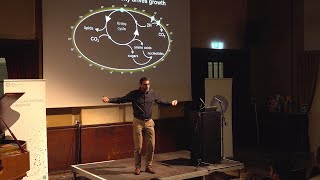 Nick Lane: The electrical origins of life 01:13 🌐 Understanding the origin of life remains a challenge, even with a hypothetical time machine. 04:38 ⚡ Energy, metabolism, and genetic information are key themes in understanding life's origin. 05:33 🔧 Energy in cells involves breaking down glucose, generating a charge across membranes, and producing the universal energy currency ATP. 09:15 🔄 Metabolism involves conserved processes like the Krebs cycle, generating universal precursors for life. 10:34 🧬 The genetic code's non-random patterns suggest direct interactions between amino acids and encoding bases, offering insights into life's origins. 22:58 🌊 Proto-cells in hydrothermal vents: Nick Lane discusses the potential formation of proto-cells in hydrothermal vents, emphasizing the role of iron-sulfur minerals in driving reactions between hydrogen and CO2 to produce lipids and amino acids. 24:05 🔄 Continuous flow in protocell formation: The process of proto-cell formation involves the combination of the hydrothermal vent structure with a continuous flow of reactants. Protons need to cross membranes, and a continuous flow is crucial for sustained reactions. 25:17 🧬 Progression to RNA world: Nick Lane proposes a simple hypothesis that, if the formation progresses to nucleotides, it can lead to an RNA world within growing proto-cells, involving the synthesis of amino acids, peptides, and the beginnings of protein function. 32:42 🧪 pH gradient-driven CO2 fixation: Experiments demonstrate the feasibility of pH gradients across a barrier in driving CO2 fixation, turning gases into the core molecules of life, showcasing a proof of concept for a key step in the proposed origin of life. 36:21 🌌 Stable proto-cells in harsh conditions: The formation of stable proto-cells with a Bayer membrane in hydrothermal vent conditions at high temperatures and varying pH levels has been achieved in the laboratory, providing insights into the potential stability of early life forms. 44:35 🔍 Conditions resembling alkaline hydrothermal vents can spontaneously produce uracil, indicating potential prebiotic chemistry. 45:02 🧬 ATP, a crucial energy currency, can be produced prebiotically with water, feric ion catalyst, and acetyl phosphate, showcasing its universal viability. 47:49 🧬 A correlation exists between amino acids and the distance from CO2 fixation, suggesting direct interactions between amino acids and their encoding bases. 51:17 🧲 Molecular dynamic simulations demonstrate interactions between amino acids and bases, supporting the idea of a pattern in the genetic code. 52:53 🌐 Proton gradients, electromagnetic fields, and electrostatic fields on bacterial cell membranes may provide real-time integrated feedback, serving as a basis for a rudimentary form of bacterial consciousness.atile pho |
|
Interesting theory around drastic climate change being a possible driver of human evolution. Chris Campisano PhD—Climate change and human evolution  Lucy 50 Monthly Lecture Series—Chris Campisano PhD Global and regional climate change is one of the primary culprits used to explain the changes we see in the early hominin fossil and archaeological record. But what exactly controls large-scale climate patterns, and how are they manifested in particular regions of eastern Africa where our ancestors lived? Primarily using data from drill-core records near hominin sites, Chris Campisano will discuss how we extract climatic and environmental signals from the sedimentary record, what changes we see (and what we don’t), and how they may relate to critical intervals in human evolutionary history. |
|
Another interesting discussion around the movement of modern humans out of Africa. Curtis Marean—The Great Human Diaspora  Lucy 50 Monthly Lecture Series—Curtis Marean PhD |
|
Talk from Svante Paabo on hominid's DNA. Some interesting stuff towards the end about Covid and Neanderthals. Archaic Genomics—Svante Pääbo Lecture at the ASU Institute of Human Origins  Archaic Genomics—Svante Pääbo Lecture at the ASU Institute of Human Origins Svante Pääbo, Director of the Max-Planck Institute for Evolutionary Anthropology in Leipzig, Germany, developed techniques that allow DNA sequences from archaeological and paleontological remains to be determined. This has allowed the genomes of extinct organisms and ancient humans, animals, and pathogens to be studied. His research group has determined high-quality genome sequences from Neanderthals and discovered Denisovans, a previously unknown hominin group in Asia. He has shown that both Neanderthals and Denisovans contributed DNA to present-day humans and that these contributions have physiological and medical consequences today. Pääbo also works on the comparative and functional genomics of modern and archaic humans and apes, particularly the evolution of features that may underlie aspects of traits specific to humans. In 2022, he received the Nobel Prize in Physiology or Medicine. Pääbo is also an Adjunct Professor at the Okinawa Institute of Science and Technology, Japan. |
|
Short presentation around the paleo diet and Lucy. Lucy50 Symposium—The Impact of Lucy on Human Origins Science—Jessica Thompson  Lucy50 Symposium—The Impact of Lucy on Human Origins Science—Jessica Thompson |
|
Anne Stone PhD - What does ancient DNA tell us about human adaption  Lucy 50 Monthly Lecture Series—Anne Stone PhD |
|
Interesting video on the Nuraghe (may have been part of the Sea Peoples). The Mysterious Nuraghe of Bronze Age Sardinia  The Mysterious Nuraghe of Bronze Age Sardinia |
|
Interesting video on the Archimedes Palimpsest https://en.wikipedia.org/wiki/Archimedes_Palimpsest The $2 Million Lost Book of Archimedes  The $2 Million Lost Book of Archimedes Chapters: 00:00 - Intro 01:35 - The Method (The Basics) 08:18 - Archimedes 10:33 - The Dark Ages 12:48 - Brilliant 14:02 - The Method (Parabola) 20:37 - The Scribe 21:31 - Renaissance 26:35 - Discovered 29:33 - Lost 31:51 - Found 35:46 - New Discoveries |
|
Short video around Einstein. The Childhood Proof That Led Einstein to Reshape the Universe  The Childhood Proof That Led Einstein to Reshape the Universe |
|
Remember hearing of the problem back in college. Did Archimedes Write a Problem That Took 2,200 Years to Solve?  Did Archimedes Write a Problem That Took 2,200 Years to Solve? 00:00 - Intro 00:51 - Part I: The Bulls 02:36 - Part II: The Cows 04:31 - Part III: The White and the Black Bulls 05:38 - Part IV: The Yellow and the Dappled Bulls 07:33 - History of Pell Equations 09:12 - Path to a Solution 10:36 - Archimedes |
|
Short video on Aristarchus and his measurements of the Sun/Earth/Moon. The Ancient Mathematician Who Measured the Sun  The Ancient Mathematician Who Measured the Sun Chapters: 00:00 - Intro 01:03 - 1) The Half Moon 04:41 - 2) The Solar Eclipse 07:24 - 3) The Dime Experiment 09:00 - 4) The Lunar Eclipse 13:24 - Heliocentrism 16:10 - Eratosthenes 18:19 - Copernicus 19:45 - The Universe |
|
This will be a big thing if they can get the bugs worked out. How Ultra-Efficient CO2 Turbines Are The Future of Energy  How Ultra-Efficient CO2 Turbines Are The Future of Energy Chapters: 00:00 Intro 01:26 What is sCO2? 03:53 sCO2 Turbine Design 06:55 Turbine Efficiency 10:32 Real World Limitations 11:39 Current Projects |
|
Interesting discussion You're Not Smarter Than a Caveman - How Did We Get So Clever? - David Deutsch  You're Not Smarter Than a Caveman - How Did We Get So Clever? - David Deutsch 0:00 – Are Humans More Intelligent Now Than in the Past? 09:33 – What Happened to Kickstart Exponential Growth? 11:45 – The Acceleration of Exponential Growth (continued) 22:24 – When was ‘The Enlightenment’ and How Did it Happen? 39:25 – The Defining Feature of the Enlightenment 45:32 – Our Theory of Education is Completely Wrong 59:39 – What is the Difference Between Knowledge and Belief? 01:24:19 – Does Science Explain Anything? Or Just Describe Things? |
|
Interesting presentation on human migration. Lots of interesting maps and pictures presented throughout the presentation. The Five Million Year Odyssey - Dr. Peter Bellwood  The Five Million Year Odyssey - Dr. Peter Bellwood |
|
Interesting presentation. Dates on human habitation of the Americas keep getting pushed back. Oldest Human Artifacts from the Rimrock Draw Rockshelter, Oregon - Dr Patrick O'Grady Univ of Oregon  Oldest Human Artifacts from the Rimrock Draw Rockshelter, Oregon - Dr Patrick O'Grady Univ of Oregon Oldest Human Artifacts (18,000 year old) with Camel teeth and extinct bison blood from the Rimrock Draw Rockshelter, Oregon By Dr. Patrick O’Grady, Anthropology, University of Oregon Archaeologists just concluded their 2023 field school season at Rimrock Draw Rock Shelter, Eastern Oregon, continuing to push back North America’s timeline through recovery of stone tools and megafauna dating back to 18,000 years ago. Discoveries, in lower layers, include platelets of camel teeth fragments (camels originally evolved in North America and eventually migrated to the Old World). The teeth found at the site were from Camclops, which was native to North America until it became extinct about 11,000 years ago at the end of the last Ice Age. Below the teeth an orange chalcedony stone tool was found with extinct Bison antiquuis blood found on it during lab analyses using residue analysis (a bison twice as large as todays bison/buffalo!). This tool represents the oldest stone artifact in North America at the present, dating to be 18,000-years-old. |
|
Another presentation on Rimrock Draw. Few new slides compared to the above video. Evidence for 18 ka Human Occupation at Rimrock Draw Rockshelter, Harney County, Oregon 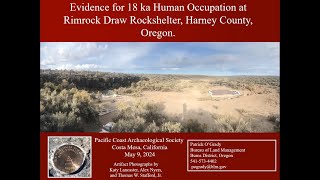 Evidence for 18 ka Human Occupation at Rimrock Draw Rockshelter, Harney County, Oregon Evidence for 18 ka Human Occupation at Rimrock Draw Rockshelter, Harney County, Oregon Dr. Patrick O'Grady Bureau of Land Management, Burns District, Oregon Rimrock Draw Rockshelter (35HA3855) is a small and shallow rockshelter located in Harney County, Oregon at the north edge of the Great Basin. Situated in wide-open sagebrush steppe country, the location looks much like a thousand other nearby places where one might expect to find stone tools dating from the mid- to late-Holocene. However, the archaeological record at this site ends around 7,000 years ago, shortly after the cataclysmic eruption that formed Crater Lake from Mount Mazama, and human occupation of the site begins much earlier. Dates of 18,000 to 17,000 years before present have been obtained through high precision Accelerator Mass Spectrometry radiocarbon assays (AMS14C) on Camelops and Bison tooth enamel fragments collected from deeply buried archaeological deposits. The teeth are associated with stone tools and chipping debris indicating human contemporaneity at the site. Other evidence suggests that several genera of Pleistocene herbivores were butchered and consumed there. This presentation will include an overview of fieldwork at the rockshelter to contextualize the provenience of the dated enamel fragments. Dr. Patrick O'Grady earned his BS, MS, and Ph.D. from the University of Oregon and worked for their Museum of Natural and Cultural History from 2005 until 2023. Before that, he worked for the Oregon Department of Transportation as a highway archaeologist. He is currently the District Archaeologist and Tribal Liaison for the Burns District Bureau of Land Management in southeastern Oregon where much of his research has been centered. Dr. O’Grady’s focus over the years has been on hunter-gatherer adaptations, Paleoamerican archaeology, geophysical field applications, and zooarchaeology, including the development of a substantial comparative osteological collection for the University of Oregon. Presented to the Pacific Coast Archaeological Society (PCAS) on May 9, 2024. |
|
Interesting theory. Not sure I buy it though. Building the Cheops pyramid. New theory  Building the Cheops pyramid. New theory 00:00 Building the Cheops pyramid. New theory 00:47 Versions of construction 03:42 Khufu pyramid 05:16 ALL THE FUN STARTS HERE!!! 07:09 Construction of the pyramids 15:44 Pit and ramp 23:30 Hypothesis 28:43 The key element 40:04 Conclusions |
|
Documentary on Les Davis and Montana archaeology sites. 13,000 Years Ago in Montana / Search For the First Montanans - Full Movie  13,000 Years Ago in Montana / Search For the First Montanans - Full Movie |
|
Interesting documentary on some underwater archaeology in Florida. Finding the First Floridians: Underwater Archeologists Uncover Florida’s Prehistory  Finding the First Floridians: Underwater Archeologists Uncover Florida’s Prehistory FULL DOCUMENTARY |

|
Originally Posted By DaGoose: Interesting documentary on some underwater archaeology in Florida. Finding the First Floridians: Underwater Archeologists Uncover Florida’s Prehistory  https://www.youtube.com/watch?v=qpoeErU1fVo https://www.youtube.com/watch?v=qpoeErU1fVoWith all the stuff being found in the Everglades, it's scary to think how much archaeological history was paved over and lost to make room for Miami. |
The person who complains most, and is the most critical of others has the most to hide.
All truth passes through three stages. First, it is ridiculed. Second, it is violently opposed. Third, it is accepted as being self-evident.
All truth passes through three stages. First, it is ridiculed. Second, it is violently opposed. Third, it is accepted as being self-evident.
|
Couple of interesting videos on using colliding blocks to calculate pi. There's more to those colliding blocks that compute pi  Why colliding blocks compute pi 0:00 - Intro 0:48 - Recap, the surprise pi 3:58 - The game plan 5:31 - How to analyze the blocks 14:59 - The geometry puzzle 20:05 - Small angle approximations 25:00 - The value of pure puzzles We calculated pi with colliding blocks  We calculated pi with colliding blocks |
|
Interesting video on Dirichelt's theorem. Why do prime numbers make these spirals? | Dirichlet’s theorem and pi approximations  Why do prime numbers make these spirals? | Dirichlet’s theorem and pi approximations 0:00 - The spiral mystery 3:35 - Non-prime spirals 6:10 - Residue classes 7:20 - Why the galactic spirals 9:30 - Euler’s totient function 10:28 - The larger scale 14:45 - Dirichlet’s theorem 20:26 - Why care? |
|
Good presentation/discussion around the Cosmic Distance ladder and how it was solved historially. Terence Tao on how we measure the cosmos | The Distance Ladder Part 1  Terence Tao on the cosmic distance ladder 0:00 - About Terence Tao and the Distance Ladder 2:02 - Earth 8:07 - Moon 11:15 - Sun 15:45 - Heliocentrism in Antiquity 18:27 - Kepler’s genius 27:16 - Where this leaves us How to measure the universe | The Cosmic Distance Ladder Part 2  Terence Tao continuing history’s cleverest cosmological measurements 0:00 - Intro 1:04 - Distance to Venus 7:30 - Speed of light 10:08 - Nearby stars 13:20 - The Milky Way 18:14 - Nearby Galaxies 19:44 - Distant Galaxies 22:42 - Lingering mysteries Full Presentation with slides RIA Hamilton Lecture 2020 - Professor Terence Tao  RIA Hamilton Lecture 2020 - Professor Terence Tao |
|
Lots of mathematics/physics related videos in this channel that may be of interest. https://www.youtube.com/@3blue1brown/videos |
|
Good documentary on the 2006 IMO American team Hard Problems The Road to the World's Toughest Math Contest  Hard Problems The Road to the World's Toughest Math Contest |
|
Podcast of the Herculaneum scrolls. I've posted some other videos that covered it in this thread. How Ancient Herculaneum Scrolls Are Being Deciphered | Dr. Brent Seales  How Ancient Herculaneum Scrolls Are Being Deciphered | Dr. Brent Seales 0:00:03 – You have fallen into Event Horizon. John is joined today by Brent Seales 0:07:01 – Seales discusses the beginning of his work with digital restoration 0:14:10 – The Herculaneum scrolls: their history. 0:22:02 – The virtual unwrapping process. 0:29:45 – The role of AI in deciphering the Herculaneum scrolls and how the Vesuvius Challenge brought together global talent... 0:36:28 – What it means to access lost texts, and why these discoveries matter... 0:43:59 – Hopes for fully reading the scrolls, and why the Villa of the Papyri still holds more secrets... |
|
Podcast on the recently released article on K2-18b with one of the paper's authors. JWST Found Hints of Biological Activity at K2-18b with Dr. Nikku Madhusudhan  JWST Found Hints of Biological Activity at K2-18b with Dr. Nikku Madhusudhan 0:00 Intro and Dr. Nikku Madhusudhan bio 2:33 Habitable Zone and Size of K2-18b 5:09 Importance of Hydrogen-Rich Atmospheres 7:43 Ocean Worlds Atmospheres 10:16 Mini-Neptune Hypothesis Critique 12:50 Potential Habitability of Detected Molecules 15:22 Significance of 3-Sigma Detection of DMDS and DMS 17:56 How JWST Transit Observations Work 20:32 Developing a Robust Data Pipeline 23:05 Chemical Composition and Molecule Identification 25:37 Confirming the Presence of DMDS and DMS 28:13 Interpreting Biosignature Signals 30:46 Abiotic Production Issues 33:20 Early Earth Analog and Biosignature Implications 35:51 Biological Activity Levels Compared to Earth 38:22 Forming Life on Hycean Worlds 41:00 Open Questions About Life Formation 43:30 Stellar Activity of Red Dwarfs 46:06 Hydrogen-Rich Atmosphere Composition 48:36 Methane and CO2 as Potential Biosignatures 51:09 Strategy for Confirming 5-Sigma Detection 53:41 Discussing Abiotic and Comet-Based Arguments 56:15 Evaluating Abiotic Explanations Critically 58:47 Conclusion and Importance for Observational Astrobiology |
|
Forgot to add that they have their own web page with a lot of things on it that may be of interest. https://hycean.group.cam.ac.uk/ |
|
Presentation of the findings by Professor Nikku Madhusudhan Strongest hints yet of biological activity outside the solar system  Strongest hints yet of biological activity outside the solar system Astronomers have detected the most promising signs yet of a possible biosignature outside the solar system, although they remain cautious. Using data from the James Webb Space Telescope (JWST), the astronomers, led by the University of Cambridge, have detected the chemical fingerprints of dimethyl sulfide (DMS) and/or dimethyl disulfide (DMDS), in the atmosphere of the exoplanet K2-18b, which orbits its star in the habitable zone. On Earth, DMS and DMDS are only produced by life, primarily microbial life such as marine phytoplankton. While an unknown chemical process may be the source of these molecules in K2-18b’s atmosphere, the results are the strongest evidence yet that life may exist on a planet outside our solar system. In this special seminar, lead author Professor Nikku Madhusudhan will discuss the new findings. |
|
Interesting presentation on a different method of computing that may low the power consumption. Neuromorphic computing - with Johan Mentink  Neuromorphic computing - with Johan Mentink |
|
Good presentation on using the JWST on exoplanet atmospheres. New Worlds: Analyzing the Atmospheres of Exoplanets with the James Webb Space Telescope  New Worlds: Analyzing the Atmospheres of Exoplanets with the James Webb Space Telescope Prof. Jonathan Fortney (U. of California, Santa Cruz) Apr. 9, 2025 Over 6000 planets have now been found around other stars, but we only have information about what their atmospheres are like for a few dozen. NASA's powerful James Webb Space Telescope (JWST), which features a 20-foot mirror in space, is currently being used to understand atmospheres. Prof. Fortney explains how we can look for atmospheres around rocky planets the size of the Earth, and how his group and others are already measuring the abundances of molecules like water, methane, ammonia, and carbon dioxide, in larger planets, of sizes similar to Neptune and Jupiter. And he tells us what astronomers are looking forward to in the next year or two with JWST. |
|
Discussion around intelligent design and the origin of life. Does Science Disprove God? | Dr. Brian Miller  Does Science Disprove God? | Dr. Brian Miller |
|
Presentations around the Vesuvius Challenge. The Vesuvius Challenge: Resurrecting a Library of Ancient Scrolls  The Vesuvius Challenge: Resurrecting a Library of Ancient Scrolls |
|
Presentation on dugout canoes from US and Canada. The Archaeology of Dugout Canoes - Dr. Sissel Schroeder  The Archaeology of Dugout Canoes - Dr. Sissel Schroeder |
|
Good presentation on climate change Daniel Britt - Orbits and Ice Ages: The History of Climate  Daniel Britt - Orbits and Ice Ages: The History of Climate |
|
Short video on the BB5 (Busy Beaver) problem and it being solved. Amateurs Solve a Famous Computer Science Problem On Discord  Busy Beaver: The Hardest Game in Computer Science 00:00 What is the Busy Beaver problem? 01:05 How does a Turing machine work? 02:35 Programs that halt versus getting stuck in endless loops: the Halting Problem 04:38 How to play the Busy Beaver game 05:26 BB(1), BB(2), BB(3), BB(4) solutions 06:38 The Busy Beaver Challenge tackles BB(5) 07:31 The history of the search for BB(5) 08:10 The Busy Beaver Challenge methodology 08:48 Coding 'deciders'' to shorten the list of contenders 09:49 Mysterious contributor confirms BB(5) solution 10:09 Coq proof of BB(5) 10:54 Is BB(6) solvable? Article: https://www.quantamagazine.org/amateur-mathematicians-find-fifth-busy-beaver-turing-machine-20240702/ Website: Busy Beaver Challenge website Papers: The Busy Beaver Frontier On Non-Computable Functions The determination of the value of Rado’s noncomputable function $\Sigma (k)$ for four-state Turing machines |
|
Interesting discussion around some examples of possible cannibalism versus other possible reasons of cut marks. Were We Cannibals? Fact Vs Fiction ~ with PROFESSOR MICHAEL PANTE  Were We Cannibals? Fact Vs Fiction ~ with PROFESSOR MICHAEL PANTE 0:00 START 01:32 Michael's background 02:37 The Krapina Neanderthal site 15:01 Ritual behavior vs cannibalism 24:00 Olduvai Gorge discovery 33:18 3D scanning & cut-marks 48:42 Future projects |
|
Discussion around China. Jeffrey Wasserstrom: China, Xi Jinping, Trade War, Taiwan, Hong Kong, Mao | Lex Fridman Podcast #466  Jeffrey Wasserstrom: China, Xi Jinping, Trade War, Taiwan, Hong Kong, Mao | Lex Fridman Podcast #466 0:00 - Introduction 0:16 - Xi Jinping and Mao Zedong 3:45 - Confucius 11:15 - Education 19:21 - Tiananmen Square 30:36 - Tank Man 40:36 - Censorship 1:16:33 - Xi Jinping 1:34:41 - Donald Trump 1:38:34 - Trade war 1:51:23 - Taiwan 2:01:36 - Protests in Hong Kong 2:33:55 - Mao Zedong 2:55:36 - Future of China |
|
Interesting discussion around the fall of Rome. Why Rome Actually Fell: Plagues, Slavery, & Ice Age – Kyle Harper  Why Rome actually fell: plagues, slavery, & ice age — Kyle Harper (00:00:00) - Plague's impact on Rome's collapse (00:07:08) - Rome’s little Ice Age (00:12:35) - Why did progress stall in Rome’s Golden Age? (00:24:39) - Slavery in Rome (00:37:06) - Was agriculture a mistake? (00:48:26) - Disease’s impact on cognitive function (01:00:30) - Plague in India and Central Asia (01:06:00) - The next pandemic (01:17:32) - How Kyle uses LLMs (01:19:35) - De-extinction of lost species |