


AR Sponsor

Which Lube Protects the Best? (Pics) Updated in OP (Page 3 of 4)



 ...
...

|
Great job and great thread!
I have been meaning to do this exact test using many of the lubes I have on hand. I'm also going to do a freeze test as soon as the winter gives me a night of below zero weather. It's not looking good so I may have to settle for my freezer. I can get my rust test going as soon as I find some cheep clean steel. Anyone have any ideas what I can test on that I can buy locally? Here are my oils to be tested: 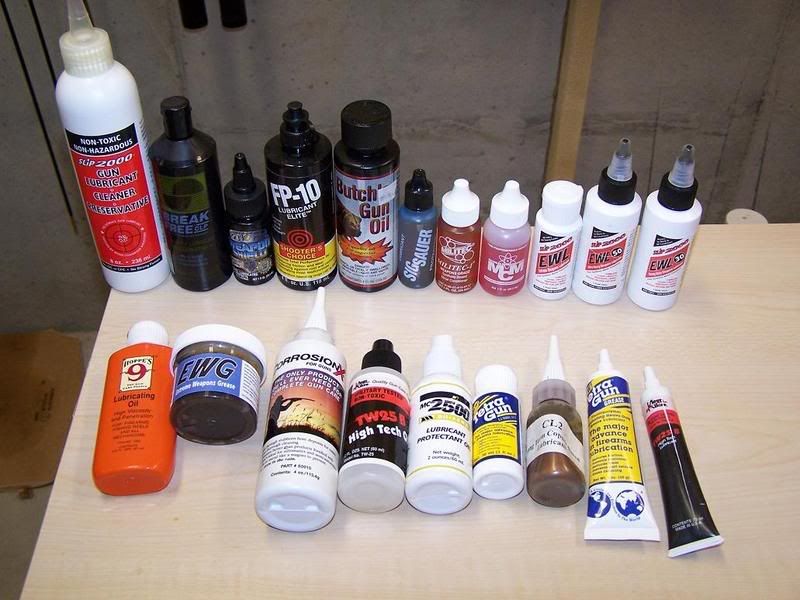
|

|
Originally Posted By SkagSig40:
I can get my rust test going as soon as I find some cheep clean steel. Anyone have any ideas what I can test on that I can buy locally? home desperate... 16 ga 18" x 12" plate is cheap. to the OP.. Nice job man. CLP never let me down from jungles of Central America to the Desert... it just works. |
"When basic morality and legal principle give you a green light to shoot the fucker, it's probably a good idea to shoot the fucker." By John_Wayne777:
|
I am also always looking for the next best lubricant/protectant. I saw on our local news (Lansing, MI) tonight a company called Top Duck Products http://www.topduckproducts.com/ that makes a product called Gunzilla. It looks good, so I ordered a bottle of it. Has anyone used this product?
Really liked the tests SoCalTrojanSoldier did though. Thanks for the time you took doing the test! |

|
Originally Posted By Wayward_Texan: Originally Posted By SkagSig40: I can get my rust test going as soon as I find some cheep clean steel. Anyone have any ideas what I can test on that I can buy locally? home desperate... 16 ga 18" x 12" plate is cheap. to the OP.. Nice job man. CLP never let me down from jungles of Central America to the Desert... it just works. That's exactly what I used, but from Lowes, it was 16 ga 6" x 18". I picked up four more plates for further testing. I'm interested to see some reproducibility by someone else. $9.00/plate. |
|
Anyone ever use Clenzoil? I saw the guys at Cabela's using it to wipe down their $10K+ guns down and have been trying it out. They claim they never get any rust on their guns with all of the handling. Heck, I saw a guy the other day eating from a bag of potato chips, put the bag down, open up a cabinet and pick up a $5K O/U. Made me shudder...
SoCalTrojan, I've got a little Clenzoil left in a bottle if you'd like to try it out I could send it to you? Just e-mail me your address. Thanks. |
I'm not fast ...but I'm slow!
|
I agree, I'd love to see WeaponShield included as well as it has seemed to be an improvement over BreakFree CLP. You can email the owner for a free sample to include in the test. In fact, he send out a free sample needler oiler to anybody who requests one. This is what I did and found it to be an improvement over CLP in a number of areas. I just don't know how it performs with rust prevention though!
Here is his email gcfennell at steelshieldtech dot com |

|
Originally Posted By ucrt:
Anyone ever use Clenzoil? I saw the guys at Cabela's using it to wipe down their $10K+ guns down and have been trying it out. They claim they never get any rust on their guns with all of the handling. Heck, I saw a guy the other day eating from a bag of potato chips, put the bag down, open up a cabinet and pick up a $5K O/U. Made me shudder... SoCalTrojan, I've got a little Clenzoil left in a bottle if you'd like to try it out I could send it to you? Just e-mail me your address. Thanks. I use it to wipe down all mine after cleaning. Even my flintlocks. I use other lubes on the internals. |
|
Originally Posted By JakeATW:
Originally Posted By ucrt:
Anyone ever use Clenzoil? I saw the guys at Cabela's using it to wipe down their $10K+ guns down and have been trying it out. They claim they never get any rust on their guns with all of the handling. Heck, I saw a guy the other day eating from a bag of potato chips, put the bag down, open up a cabinet and pick up a $5K O/U. Made me shudder... SoCalTrojan, I've got a little Clenzoil left in a bottle if you'd like to try it out I could send it to you? Just e-mail me your address. Thanks. I use it to wipe down all mine after cleaning. Even my flintlocks. I use other lubes on the internals. ++++++++++++++++++++++++++++++++++++ I haven't met anyone that has used Clenzoil before ... it must limited to where you can get it? SoCalTrojan said he'll use Clenzoil in the next trial, so we'll see how good it is. |
I'm not fast ...but I'm slow!
|
Originally Posted By ucrt:
Originally Posted By JakeATW:
Originally Posted By ucrt:
Anyone ever use Clenzoil? I saw the guys at Cabela's using it to wipe down their $10K+ guns down and have been trying it out. They claim they never get any rust on their guns with all of the handling. Heck, I saw a guy the other day eating from a bag of potato chips, put the bag down, open up a cabinet and pick up a $5K O/U. Made me shudder... SoCalTrojan, I've got a little Clenzoil left in a bottle if you'd like to try it out I could send it to you? Just e-mail me your address. Thanks. I use it to wipe down all mine after cleaning. Even my flintlocks. I use other lubes on the internals. When I was in the Tool and Die trade we had large containers of Clenzoil at the plant. We used it to keep the machine tables and other critical fixtures from rusting. I brought some home and have been using ever since as a wipe for my weapons. ++++++++++++++++++++++++++++++++++++ I haven't met anyone that has used Clenzoil before ... it must limited to where you can get it? SoCalTrojan said he'll use Clenzoil in the next trial, so we'll see how good it is. |

|
To your point about finding out the lubrication properties, here's the equation:
Fr = μN where: Fr is the resistive force of friction μ is the coefficient of friction for the two surfaces (Greek letter "mu") N is the normal or perpendicular force pushing the two objects together μN is μ times N Fr and N are measured in units of force, which are pounds or newtons. μ is a number between 0 (zero) and ∞ (infinity). According to the CRC Handbook of Physical Quantities, the coefficient of friction for steel on steel is 0.78, so if you made doublets of each piece, coated them both with oil and measured the force required to slide one across the other, you could calculate the coefficient of friction for each type of lubricant. Since there is no area component to the equation, it doesn't matter what size you make the two pieces, but for ease of the experiment, I would make them all the same size. I would put a hole in one end of one piece, attach a fish scale to it, and then pull the scale. Read the weight off the scale when the attached piece starts moving and you've got N. Multiply it by 0.78 and now you have your coefficient of friction, and your answer to which lube lubricates the best! |
|
Originally Posted By Beldavius:
To your point about finding out the lubrication properties, here's the equation: Fr = μN where: Fr is the resistive force of friction μ is the coefficient of friction for the two surfaces (Greek letter "mu") N is the normal or perpendicular force pushing the two objects together μN is μ times N Fr and N are measured in units of force, which are pounds or newtons. μ is a number between 0 (zero) and ∞ (infinity). According to the CRC Handbook of Physical Quantities, the coefficient of friction for steel on steel is 0.78, so if you made doublets of each piece, coated them both with oil and measured the force required to slide one across the other, you could calculate the coefficient of friction for each type of lubricant. Since there is no area component to the equation, it doesn't matter what size you make the two pieces, but for ease of the experiment, I would make them all the same size. I would put a hole in one end of one piece, attach a fish scale to it, and then pull the scale. Read the weight off the scale when the attached piece starts moving and you've got N. Multiply it by 0.78 and now you have your coefficient of friction, and your answer to which lube lubricates the best! ++++++++++++++++++++++++++++++++++++++++++++++ Wouldn't temperature play an important role in real life? One lube might be better than another at room temperature but up the temperature several hundred degrees and the coefficient would be meaningless? Then, throw in a little carbon, water, etc. ... But...I agree that it might be a good starting point. Isn't there some kind of lubricity standard that an lube oil company would (should) have to publish?? |
I'm not fast ...but I'm slow!
|
Originally Posted By ucrt:
Originally Posted By Beldavius:
To your point about finding out the lubrication properties, here's the equation: Fr = μN where: Fr is the resistive force of friction μ is the coefficient of friction for the two surfaces (Greek letter "mu") N is the normal or perpendicular force pushing the two objects together μN is μ times N Fr and N are measured in units of force, which are pounds or newtons. μ is a number between 0 (zero) and ∞ (infinity). According to the CRC Handbook of Physical Quantities, the coefficient of friction for steel on steel is 0.78, so if you made doublets of each piece, coated them both with oil and measured the force required to slide one across the other, you could calculate the coefficient of friction for each type of lubricant. Since there is no area component to the equation, it doesn't matter what size you make the two pieces, but for ease of the experiment, I would make them all the same size. I would put a hole in one end of one piece, attach a fish scale to it, and then pull the scale. Read the weight off the scale when the attached piece starts moving and you've got N. Multiply it by 0.78 and now you have your coefficient of friction, and your answer to which lube lubricates the best! ++++++++++++++++++++++++++++++++++++++++++++++ Wouldn't temperature play an important role in real life? One lube might be better than another at room temperature but up the temperature several hundred degrees and the coefficient would be meaningless? Then, throw in a little carbon, water, etc. ... But...I agree that it might be a good starting point. Isn't there some kind of lubricity standard that an lube oil company would (should) have to publish?? Temperature wouldn't change the equation, per se, in that it wouldn't actually change the coefficient of friction between the two materials. However as you pointed out, it could change the viscosities of the lubricants and therefore will likely change the value of N. Were I setting up the experiment, I would do three temperature conditions, cold, RT and hot, however that will drastically increase the sample (9 lubes x 3 temperatures x 2 plates for each = 54 plates) and time investment and you'll never be able to absolutely recreate the conditions seen in the weapon. |

|
Originally Posted By MastaMarksman:
Great test. Weird how BF CLP acts different from a different dispencer!? But you forgot the best of all! Corrosion X. -Masta While Corrosion X is an excellent rust prevent, it most certainly is not the best "CLP" ... |
Poznai Sebia ... Know Yourself
|
Originally Posted By airgunner:
Interesting thread but not surprising. Every time I've see a thread like this, BF CLP always wins the rust test. BUT... Before people starting throwing out their old stuff and running out to buy BF CLP, keep one thing in mind... this test only demonstrates the "P" part of CLP - i.e. Rust prevention and that is only one aspect of why we use CLP on our weapons. I myself am not too worried about rust, at least not on my AR's. For one I'm a civilian so my weapons don't spends days\weeks\months outdoors at a time. I take them out, I use them, bring them home, clean them and lube them. On top of that, AR's have protective coatings on just about every part so even without any type of protectant, It's not likely your AR is going to rust up in your safe. YMMV but my house is climate controlled and I have never had anything in the house rust… lubed, coated or not. What I'm more concerned with is the "L" part of CLP lube. It's a pretty well documented fact that AR's need to be properly lubed to run reliably. When I clean, lube and store my weapons it’s with the thought that at anytime I may need to grab one of those weapons to defend my family. That means they need to be cleaned, lubed and ready to go. That is where my issue with BF CLP comes from. If I lube my weapon with BF CLP and put it in the safe, within a week or so, the weapon is almost bone dry. I’m sure some of it’s still there and from a “P” perspective, it’s still working but from an “L” perspective, almost nothing. I see that same thing when I go shooting. I’ll lube up right before I leave the house but after a couple of mags at the range, there is almost no trace of the CLP left. I started using Slip 2000 CLP (EWR) about 1-2 years ago and have found it to be a much better “C” and “L”. If I lube using Slip CLP and check my weapon 2 weeks later, it’s still “wet” and I see the same thing at the range. 4-5 mags later and you can still clearly see the lube. That is why I made the switch to Slip 2000. Just to be clear before I get jumped on… Obviously YMMV and I’m not saying that BF CLP is crap. I know it’s been used for decades and I used it myself for years. I’m just saying that for me and my uses, Slip 2000 is better for the reasons I listed. Because of it superior rust protection, I still use BF CLP on most of my tools in the garage  My thoughts exactly,lubrication is what I am concerned about.This test does not have any lubrication value. |
|
Originally Posted By KEITH555: Originally Posted By airgunner: Interesting thread but not surprising. Every time I've see a thread like this, BF CLP always wins the rust test. BUT... Before people starting throwing out their old stuff and running out to buy BF CLP, keep one thing in mind... this test only demonstrates the "P" part of CLP - i.e. Rust prevention and that is only one aspect of why we use CLP on our weapons. I myself am not too worried about rust, at least not on my AR's. For one I'm a civilian so my weapons don't spends days\weeks\months outdoors at a time. I take them out, I use them, bring them home, clean them and lube them. On top of that, AR's have protective coatings on just about every part so even without any type of protectant, It's not likely your AR is going to rust up in your safe. YMMV but my house is climate controlled and I have never had anything in the house rust… lubed, coated or not. What I'm more concerned with is the "L" part of CLP lube. It's a pretty well documented fact that AR's need to be properly lubed to run reliably. When I clean, lube and store my weapons it’s with the thought that at anytime I may need to grab one of those weapons to defend my family. That means they need to be cleaned, lubed and ready to go. That is where my issue with BF CLP comes from. If I lube my weapon with BF CLP and put it in the safe, within a week or so, the weapon is almost bone dry. I’m sure some of it’s still there and from a “P” perspective, it’s still working but from an “L” perspective, almost nothing. I see that same thing when I go shooting. I’ll lube up right before I leave the house but after a couple of mags at the range, there is almost no trace of the CLP left. I started using Slip 2000 CLP (EWR) about 1-2 years ago and have found it to be a much better “C” and “L”. If I lube using Slip CLP and check my weapon 2 weeks later, it’s still “wet” and I see the same thing at the range. 4-5 mags later and you can still clearly see the lube. That is why I made the switch to Slip 2000. Just to be clear before I get jumped on… Obviously YMMV and I’m not saying that BF CLP is crap. I know it’s been used for decades and I used it myself for years. I’m just saying that for me and my uses, Slip 2000 is better for the reasons I listed. Because of it superior rust protection, I still use BF CLP on most of my tools in the garage My thoughts exactly,lubrication is what I am concerned about.This test does not have any lubrication value. Keith555 and Airgunner, Thanks for looking but this was not a test about the lubricating properties of the materials. This was purely to see which protected the best, and this was a very unscientific backyard study. Keith as you know we live in a very humid region in particular the summer months. Old_Town and myself are currently running more products to see which protects the best. I'll have to leave the lubricating tests to others with access to the right equipment. |
|
Originally Posted By SoCalTrojanSoldier:
Originally Posted By KEITH555:
Originally Posted By airgunner:
Interesting thread but not surprising. Every time I've see a thread like this, BF CLP always wins the rust test. BUT... Before people starting throwing out their old stuff and running out to buy BF CLP, keep one thing in mind... this test only demonstrates the "P" part of CLP - i.e. Rust prevention and that is only one aspect of why we use CLP on our weapons. I myself am not too worried about rust, at least not on my AR's. For one I'm a civilian so my weapons don't spends days\weeks\months outdoors at a time. I take them out, I use them, bring them home, clean them and lube them. On top of that, AR's have protective coatings on just about every part so even without any type of protectant, It's not likely your AR is going to rust up in your safe. YMMV but my house is climate controlled and I have never had anything in the house rust… lubed, coated or not. What I'm more concerned with is the "L" part of CLP lube. It's a pretty well documented fact that AR's need to be properly lubed to run reliably. When I clean, lube and store my weapons it’s with the thought that at anytime I may need to grab one of those weapons to defend my family. That means they need to be cleaned, lubed and ready to go. That is where my issue with BF CLP comes from. If I lube my weapon with BF CLP and put it in the safe, within a week or so, the weapon is almost bone dry. I’m sure some of it’s still there and from a “P” perspective, it’s still working but from an “L” perspective, almost nothing. I see that same thing when I go shooting. I’ll lube up right before I leave the house but after a couple of mags at the range, there is almost no trace of the CLP left. I started using Slip 2000 CLP (EWR) about 1-2 years ago and have found it to be a much better “C” and “L”. If I lube using Slip CLP and check my weapon 2 weeks later, it’s still “wet” and I see the same thing at the range. 4-5 mags later and you can still clearly see the lube. That is why I made the switch to Slip 2000. Just to be clear before I get jumped on… Obviously YMMV and I’m not saying that BF CLP is crap. I know it’s been used for decades and I used it myself for years. I’m just saying that for me and my uses, Slip 2000 is better for the reasons I listed. Because of it superior rust protection, I still use BF CLP on most of my tools in the garage My thoughts exactly,lubrication is what I am concerned about.This test does not have any lubrication value. Keith555 and Airgunner, Thanks for looking but this was not a test about the lubricating properties of the materials. This was purely to see which protected the best, and this was a very unscientific backyard study. Keith as you know we live in a very humid region in particular the summer months. Old_Town and myself are currently running more products to see which protects the best. I'll have to leave the lubricating tests to others with access to the right equipment. SOCAL,I should have explained my comment a little further. I totally understand You did this test for rust protection,not lubrication,a awesome test at that.I was just ranting off,because I am totally in to the best lubrication for my weapons. Good work 
|
|
KUDOS to the OP. I understand that this was just a backyard test about PROTECTION] and after reading every post in this thread, it obviously got us all thinking about protection and lube. Obviously this wasn't as scientific as we would like, but it was definitly "real world" and got us discussing the issue. Thank you for your efforts.
|

What?.....Who?........A F---ing democrat??????????
Joined:
Jan 2009
Posts:
3186
EE: 100% (8)
 IN, USA
|
Originally Posted By turdferguson:
High temp wheel bearing grease is the best gun lube. CLP is great for protecting your bore though. As I bought some Lubriplate for my "new" M1 Garand I am going to try that grease as a lube in my AR, Glock and 1911. |

|
Originally Posted By USMC223:
While in the Corps serving as an Armorer 90% of the time our small arms were protected by CLP. We had gallons of the stuff, literally. Battle tested and time proven. Hate all you want it is good stuff. I do love the Birchwood Casey Sheath for certain apps. To the OP, cool test. 100% agree. Every small arm in my armory is only cleaned by breakfree CLP. i can pull one out that looks bone dry and put hundreds of rounds through it without malfunction 1 and no extra lube period. you guys must be doing something wrong. the only thing that breakfree doesnt do is remove copper. the military doesnt have an authorized copper remover. damn hazmat rules. |
|
I thought I'd post this for SoCalTrojanSoldier: He just finished and posted a "Part 2" for his Lube Tests.
It is at this Link: Which Lube Protects Best? Part 2 (Pics) |
"During times of universal deceit, telling the truth becomes a revolutionary act." - George Orwell
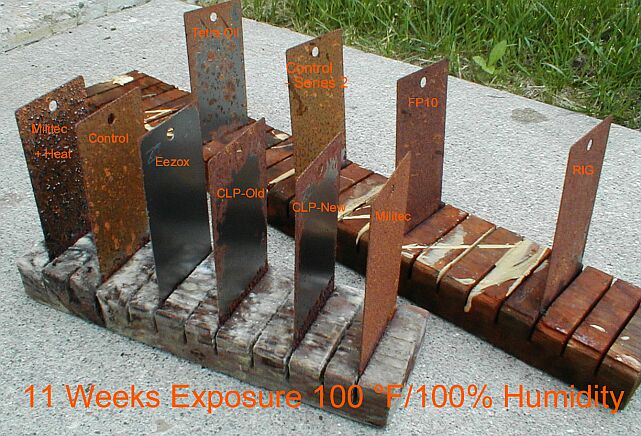

| Part 2 is done: http://www.ar15.com/forums/topic.html?b=3&f=7&t=502758 |
|
For Blued Guns Tetra Gun, Militec, Break Free CLP, Break Free Collector, Outers Metal Seal, G96 Complete Gun Treatment, and RIG Universal Grease. All are excellent in stopping rust.
Stainless Steel guns Tetra Gun, Reminton gun oil and Birchwood Casey Barricade (aka Gun Sheath). |
|
New update for indoor test in OP of test #2 at 5+ months: http://www.ar15.com/forums/topic.html?b=3&f=7&t=502758&page=1 |
|
I wanted to reply for a couple resons. one, to keep this out of the archives but more so because this test is what convinced me to try the slip2000 and I couldn't be happier. It's not easy to find and I did hear bad reviews from people who ordered it directly from the company but I don't think I'll ever switch. I'm using this currently on my AR as well as a pair of Beretta PX4's and this stuff just never dries up like CLP and some others do.
Thanks for all the work on the testing. |


The only way to reform people is to kill them.
Joined:
Nov 2009
Posts:
3185
EE: 100% (4)
AZ, USA
| I found this in the search the other day. great info and makes you question the "official" test you see. Like TW25B, I have a PDF of there test they passed and one that was relevant was the corrosion test. They had 500 plus hours in a 5% salt fog with no rust or corrosion. It lasted 4 days on this test, what is that 404 hours short of there claim.... |
<If you can see the big picture then you are not focusing on your front sight>
<Superior gear will not make up for lack of skill or training>
<Superior gear will not make up for lack of skill or training>

The only way to reform people is to kill them.
Joined:
Nov 2009
Posts:
3188
EE: 100% (4)
AZ, USA
|
Originally Posted By Pacodutaco:
I can safely say my RemOil is going byebye. I have been using it for years and it obviously sucks the most kind of like their .22lr ammo. Great post! It works for cleaning stuff off
|
<If you can see the big picture then you are not focusing on your front sight>
<Superior gear will not make up for lack of skill or training>
<Superior gear will not make up for lack of skill or training>


The only way to reform people is to kill them.
Joined:
Nov 2009
Posts:
3189
EE: 100% (4)
AZ, USA
|
Yeah, I am gonna switch out for BF CLP. I've finally been converted from Rem Oil and TW25B. Neither have done me wrong but after seeing these corrosion test I like the BF CLP due to it being cheap and coming in an aerosol form and a drip from.
One shop had Slip EWL but it was like 2 or 3 oz for like $12 bucks or more.... Another shop had Slip 2000 for $7 but I like the variety that BF CLP gives and cost the same. |
<If you can see the big picture then you are not focusing on your front sight>
<Superior gear will not make up for lack of skill or training>
<Superior gear will not make up for lack of skill or training>
Which Lube Protects the Best? (Pics) Updated in OP (Page 3 of 4)
AR Sponsor