


Posted: 7/27/2026 8:35:54 AM EDT
[Last Edit: Vaquero][Edited]
|
Attached File I get together with a couple of good dudes once a month to do some structured pistol training. It is specifically based around John Hearnes ideas here: https://blog.krtraining.com/relative-performance-measurement/ Attached File The idea being that you only need to get to a certain level to be competent in a defensive encounter, and the effort to get better requires so much effort that your time is better spent elsewhere. I strongly agree that chasing a GM (or even A) class is going to be a waste of time - unless you just want to do better in USPSA ( and smoke your homies that you compete with). Or a sub second draw. Or a 3 second El Presidente. There is simply too much to worry about if you are trying to be a defensive minded person. Medical, grappling, and fitness all have demands for our precious time. I found these targets which are very useful for these standards. They have the casino drill, FAST drill, and FBI qual targets on one sheet. The targets in the pic were used for FAST, doubles, reload drills, and Casino drills. Shipping for 20 targets is as much as the targets, but it gave me a link to buy a pack with free shipping. They did come folded, which explains the creases. https://gunfun.com/shop/txt/ |

Joined:
Sep 2022
Posts:
3129
EE: 0% (0)
 USA
USA
|
Probably worth noting that different drills test different things. I've heard Lee Weems talk about how he classifies differently depending on which IDPA classifier he runs, as different classifiers play to different strengths and weaknesses. Say I am strong on fundamentals of marksmanship and had no problem scoring a 266/300 on the FBI Bullseye Pistol Qualification with irons the first time, but took several tries to get 6.6 seconds on the FAST. 6.6 seconds on FAST was enough to outdo Kyle Morgan, so I'm gonna say that is plenty good enough  The F.A.S.T Drill w/ Former Delta Force Operator Kyle Morgan I guess John can chime in if that was why he lists several different drills in his chart. |
per aspera ad astra
First, this is the current version of "The Chart" for discussion purposes.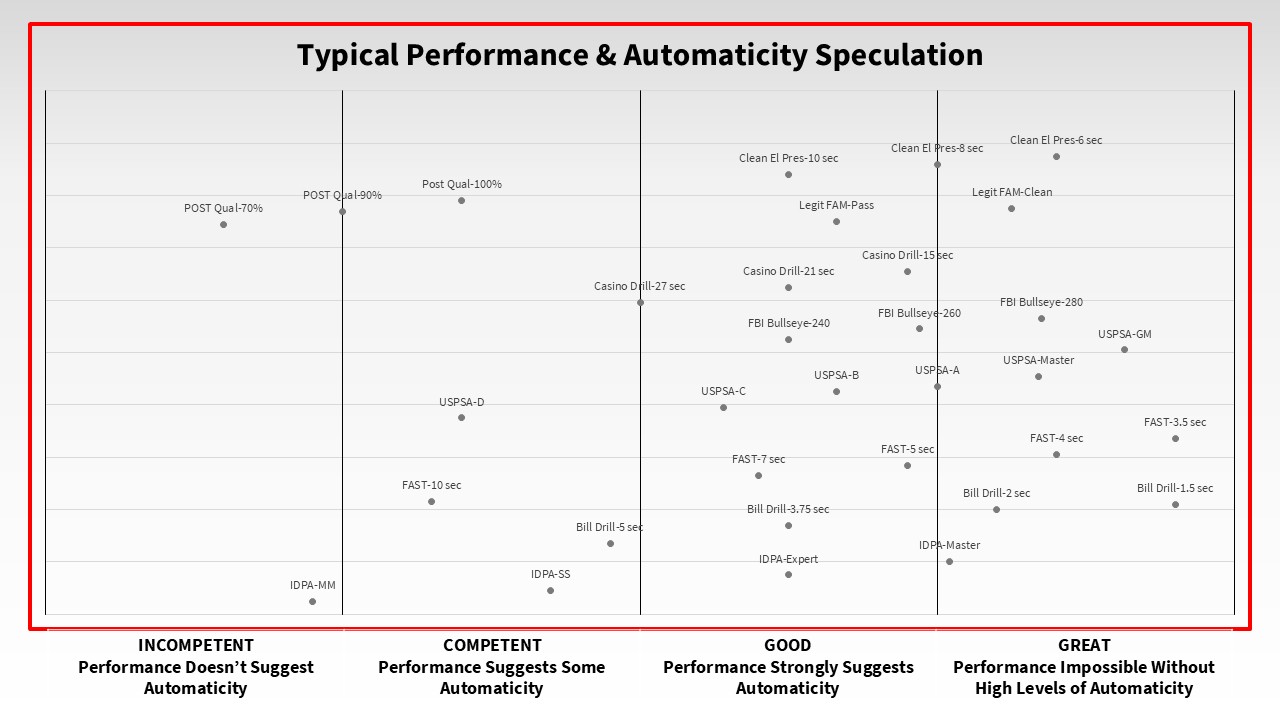 I wanted different drills because there are different areas to consider automaticity. For instance, the FBI Instructor course tends to measure automaticity in the fundamentals of marksmanship without regards for any aspects of weapons manipulations. The FAST tests several skills but most importantly, the ability to sequence through those skills which is more reflective of how "owned" the skills are. |
| The chart was not developed using laboratory quality measures of automaticity. It's been in development in consultation with a bunch of smart folks since 2013. It has been revised over the years to reflect the most accurate understanding I possess. I've also been fortunate enough to have this work reviewed by a PhD who wrote is dissertation on automaticity. |
|
Thanks John! Regarding the FAM Qual, I have not seen at actual official copy of the qualification. The above article lists the FBI-QIT-97 as the target, with scoring as follows: The targets are scored as follows: Hits in the inner bottle count five points. Hits outside the inner bottle, but within the outer bottle count two points. But I have seen other scoring descriptions with anything within the bottle being 5 points and anything on the line as 2 points... which is a much easier standard. Was there a specific choice of FAM Qual scoring for your chart? |
per aspera ad astra
|
The FAM qual is one of the least understood COF's out there. I've watched a bunch of YouTube videos of people "passing" the qual but none of them are shooting the qual. The FAM is shot on a very specific target. It's the top 21" of an FBI Q with a small "wine bottle" in the center. The "wine bottle" is only 4" wide at the base and 3" wide at the top with a height of roughly 15". Hits in the bottle are five points and hits out are only two points. Any line break is scored at the next lowest level. This effectively makes the "wine bottle" even smaller with an effective width of only 3.3" for a 9mm. You need 135/150 points to pass. This means you can only let five rounds "leak" into the 2 point zone or else you fail. This makes this a fairly high precision drill with reasonable but absolute time limits for shots. I have a way to jury rig a proper target if you can get an FBI Q. Mark off the top 21" and attach the scoring zone from my web site. It's not perfect but it's pretty damn close. Website: https://twopillarstraining.com/files/ 
|
|
https://ar15.com/forums/Handguns/-ARCHIVED-THREAD-Fed-Air-Marshal-Qualification-FAMQ-2024-AR15-com-edition/4-212390/ We did this a while back, and yes, much discussion on targets & scoring parameters. My first entry, with the USPSA type silhouette we agreed on is post #34 on page 1. Then I do another run on post #4 on page 3, using the proper FBI target, along with applying various scoring parameters. That FBI QIT 97 is difficult, but that's a good thing, a stringent standard to strive for. I made a template for that target, and use it alot. So good to see you in here Mr. Hearne. Never seen that chart, glad to see it posted. Happy to say I fit in the back half of the 3rd section. Not great, not terrible, as we say! |
|
Since we've got John here to discuss, I was curious what thoughts were on this: The dominant approach to skill acquisition has long held that becoming skilled involves developing internal memory structures such as motor programs, muscle memory, or proceduralized knowledge that allow an ideal technique to be repeated with little variation and minimal conscious attention (Fitts & Posner, 1967). In this view, skill is defined by consistency and automaticity. Once the correct technique is learned, it can be executed reliably without conscious control. This perspective has supported many of the training methods described earlier, including strict repetition of prescribed techniques to eliminate unwanted variation, task decomposition that removes skills from their operational context, and the decoupling of perception and action. These methods create training environments that are orderly, predictable, and easy to standardize, but they differ substantially from the conditions officers face in the field. A target on a range does not move unpredictably, does not shoot back, and is not intermixed with innocent bystanders. Research on transfer helps explain why this matters. When the practiced task closely resembles the operational task, often referred to as near transfer, training reliably improves performance in that same context (Schmidt & Young, 1987). As discussed earlier, practicing on the range makes officers better range shooters. However, when there is a large separation between practice and operational performance in terms of physical demands, perceptual information, time pressure, and psychological stress, far transfer is weak or absent. Under these conditions, little if any improvement carries over to real encounters. More recently, an alternative account of skill acquisition, known as ecological dynamics, has been proposed (Davids et al., 2008; Gray, 2021). In this framework, skill is not defined as the ability to retrieve and execute an ideal technique from memory. Instead, skill is understood as the ability to establish functional relationships between the performer and the environment in order to achieve a goal under specific conditions. Rather than repeating the same movement pattern on every attempt, skilled performers adapt their actions to the constraints they are facing. As a result, performance is characterized by functional variability, with small adjustments from one execution to the next that allow outcomes to remain effective. From this perspective, becoming skilled is best understood as becoming an adaptable movement problem solver. Learning is not about eliminating variation, but about shaping it so that performance remains effective across changing situations. This view has direct implications for how police training should be designed. Several practical principles for training follow from ecological dynamics (Otte et al., 2021): 1. Train the way you perform. Training should be representative of the environments in which officers are expected to operate. This includes the perceptual information available, the actions required under realistic time and space constraints, and the decision-making demands of the situation. Reducing the distance between training and operations increases the likelihood that learning will transfer. 2. Maintain perception–action coupling. Actions such as drawing or firing a firearm should be guided by the same types of perceptual information officers will encounter in the field, such as the movement and behavior of another person, rather than artificial cues like a static bullseye. This principle also applies to situations in which perceptual information indicates that no action is required, reinforcing that decision-making is inseparable from skilled performance. 3. Promote repetition without repetition. Training should vary conditions of practice so that officers learn to achieve the same outcome goals by adapting their movements to different situations. The objective is not to reproduce identical techniques, but to develop flexible performance that remains effective as conditions change. 4. Treat the trainee as the problem solver. Rather than prescribing ideal techniques, instructors design environments that require learners to adapt their movements to meet situational demands. Learning occurs through exploration and adjustment, not by copying a model. The transfer problem in police training: From training hours to operational readiness With firearms I strongly suspect that automaticity would have meaningful transfer to the real world. If an action is trained and ingrained it should be possible to execute the "Action" component of the OODA loop more efficiently with automaticity, but I think the authors have excellent points regarding representative training, maintaining "perception-action coupling" and making trainees make good decisions, aka "problem solvers". You can't just train the action of shooting and expect good results. The action of shooting is only some of the answer. You have to train the entire OODA loop. Observe Orient Decide Act. Proper Actions can vary substantially with the situation and even if the answer is shooting you have to get through Observe Orient Decide efficiently and effectively to get there. |
per aspera ad astra
|
First, this is a deep, deep subject that isn't being resolved any time soon. Second, I think the sides are talking past each other and straw manning the other side. There are also legit training deficiencies that make it easier to attack the skills acquisition people. I explain it like this - there is skill building and skill application. If all you do is refine skills with no context, you quickly hit the end of the benefits. Using basketball as an analogy - it does limited good to practice your shots from a bunch of different position. Yes, as your hit percentage goes up, that is useful. The problem is that those skills are only practical when they take place within the context of a game. It's not just the ability to make a shot, it's the ability to know when the conditions are right to make that shot. The ecological dynamics folks appear to be oblivious to why certain motor skills are performed very specifically. My favorite example is the draw stroke. I teach the four-step combative draw stroke as refined by Craig Douglas. Each of those steps places the hands/gun in very specific places for very specific reasons - mostly not shooting yourself. If you just tell folks to draw the gun in whatever way they like, you lose all of those benefits. What I'd say is ideal is to build the relevant skills to the point of automaticity. Then work on applying those skills in less predictable environments. For instance, you can practice the closed motor skill of a stationary handgun presentation until you can do it in the mythical 1.0 second. However, if you don't train when carry out that draw stroke, you're doing yourself a disservice. Whether it's force-on-force, video simulators, or VR, work on applying the skills. There is a certain minimal level of raw skills that you need to be able to perform and there's no getting around the work needed to develop them. |
|
Originally Posted By ajp3jeh: First, this is a deep, deep subject that isn't being resolved any time soon. Second, I think the sides are talking past each other and straw manning the other side. There are also legit training deficiencies that make it easier to attack the skills acquisition people. I explain it like this - there is skill building and skill application. If all you do is refine skills with no context, you quickly hit the end of the benefits. Using basketball as an analogy - it does limited good to practice your shots from a bunch of different position. Yes, as your hit percentage goes up, that is useful. The problem is that those skills are only practical when they take place within the context of a game. It's not just the ability to make a shot, it's the ability to know when the conditions are right to make that shot. The ecological dynamics folks appear to be oblivious to why certain motor skills are performed very specifically. My favorite example is the draw stroke. I teach the four-step combative draw stroke as refined by Craig Douglas. Each of those steps places the hands/gun in very specific places for very specific reasons - mostly not shooting yourself. If you just tell folks to draw the gun in whatever way they like, you lose all of those benefits. What I'd say is ideal is to build the relevant skills to the point of automaticity. Then work on applying those skills in less predictable environments. For instance, you can practice the closed motor skill of a stationary handgun presentation until you can do it in the mythical 1.0 second. However, if you don't train when carry out that draw stroke, you're doing yourself a disservice. Whether it's force-on-force, video simulators, or VR, work on applying the skills. There is a certain minimal level of raw skills that you need to be able to perform and there's no getting around the work needed to develop them.  Shooting a service caliber handgun accurately and reliably takes a lot of practice. And gun handling like Craig Douglas/Shivworks teaches is the result of many years of development against live opponents. I use Craig's drawstroke as well. Discarding it and other important techniques would force students to re-invent the wheel This is one way to think about the problem: Attached File Attached File Skills are a vital component. And you have to know what your skill level is to make an appropriate decision. But skill with firearms are only some of the answer. Combatives skills are some of the answer. Skill with OC spray is some of the answer, etc |
per aspera ad astra

|
Good topic. Good conversation. Good point re: the distinction between (1) skill building and (2) skill application. But sometimes I think we can get a bit lost in the effort to optimize TTP's with far too much emphasis on the minutiae. What we are attempting to achieve, is basically reducing any "tolerance stack" in the process which typically puts an overarching effort on issues that are time-based (e. g. the mythical sub 1.0 second presentation, etc.). Not that they aren't important, but to me it seems to become somewhat counterproductive with regard to pure mechanics. When do we begin to reach a point of diminishing returns with respect to how much time we can spend on the range and how much money we can spend on ammo in terms of skill building? There is a third subset which is composure (cool under fire). It is an intangible that cannot be taught and that we can only marginally achieve through FoF. Craig Douglas deserves a great amount of credit for the TTP's he has developed and evolved over the years but how many of his classes ($$$$$) would one have to attend until one's confidence in their "skill application" begins to translate into "composure" on the street? The most profound perspective on lethal threat encounters I've ever heard came from J. D. Potynski as he was narrating a trailer for a training video. I'm paraphrasing because I couldn't capture the text word-for-word. "Guns, shooting, tactics, CQB, (etc.) is just a form, but when I really whittle it down, it's decision making, and dealing with stress and fear, and being able to make the right decision in a complex, chaotic situation, a decision that most often, is between bad and worse. There is no right answer." |
Best Regards,
TonyF
Training Forum Moderator
"No such thing as tough. There's trained and untrained. Which one are you?" (Denzel Washington -- Man on Fire)
TonyF
Training Forum Moderator
"No such thing as tough. There's trained and untrained. Which one are you?" (Denzel Washington -- Man on Fire)
|
Like Pat Rogere said, gun fighting isn't about shooting, it's about problem solving with a gun. I think most of us focus on developing shooting and related skill to a point of automaticity, so we can use that brain that's "up here" to asses, and make decisions. Of course FOF and complex scenario-based training is a next step, beyond developing fundamentals. |
|
There is a third subset which is composure (cool under fire). It is an intangible that cannot be taught and that we can only marginally achieve through FoF. Craig Douglas deserves a great amount of credit for the TTP's he has developed and evolved over the years but how many of his classes ($$$$$) would one have to attend until one's confidence in their "skill application" begins to translate into "composure" on the street For sure, coolness is the most nebulous concept and the most difficult to intentionally train. I think that there is some genetic component - probably in personality, and in particular trait neuroticism. Those who go through life more anxious (which is partially genetically controlled) are more likely to freeze and more likely to struggle to perform under stress/strain. With that said, you there are many activities that you can engage in that will make it more likely you'll be able to perform. There is no single "thing" you can do but doing as many of the following shunts the odds your way. 
|
|
That's pure gold John! In BNOC they taught us that people who are habitually calm do better in combat. The type of people who are no fun at parties perform better under the stress of combat. From my experience I'd guess emergency medicine is similar. Habitually calm people seem to perform better under that stress as well. When training Army combat medics we would create as much noise & chaos as possible while the medic practiced their skills. I would take my best soldiers rock climbing. Great for team building as well. |
per aspera ad astra
|
Originally Posted By ajp3jeh: For sure, coolness is the most nebulous concept and the most difficult to intentionally train. I think that there is some genetic component - probably in personality, and in particular trait neuroticism. Those who go through life more anxious (which is partially genetically controlled) are more likely to freeze and more likely to struggle to perform under stress/strain. With that said, you there are many activities that you can engage in that will make it more likely you'll be able to perform. There is no single "thing" you can do but doing as many of the following shunts the odds your way. Originally Posted By ajp3jeh: There is a third subset which is composure (cool under fire). It is an intangible that cannot be taught and that we can only marginally achieve through FoF. Craig Douglas deserves a great amount of credit for the TTP's he has developed and evolved over the years but how many of his classes ($$$$$) would one have to attend until one's confidence in their "skill application" begins to translate into "composure" on the street For sure, coolness is the most nebulous concept and the most difficult to intentionally train. I think that there is some genetic component - probably in personality, and in particular trait neuroticism. Those who go through life more anxious (which is partially genetically controlled) are more likely to freeze and more likely to struggle to perform under stress/strain. With that said, you there are many activities that you can engage in that will make it more likely you'll be able to perform. There is no single "thing" you can do but doing as many of the following shunts the odds your way. Nothing to disagree with but it does tend to affirm my point about how much time (skill building) and money (for ammo, etc.) a typical civilian can afford to devote to the cause given these are perishable skills. To the extent we can, absolutely. But especially in regard to parents who may be rearing several children, I would opine that achieving and maintaining the highest degree of an all-encompassing level of skill (weapons + basic H2H) is a statistical improbability for most outside of being a member of an elite military or LE unit let alone the application thereof. I'm not in any way suggesting that it is an exercise in futility, and I would advise everyone to attend as many and diverse classes as they can afford because any level of "skill-knowledge-experience" is exceedingly better than none. But to truly attain a "second-nature" level of "skill-application-composure" is a lifestyle few can afford or can devote the commensurate amount of time required. To keep the discussion grounded, most civilians are not going to face highly trained threats which underscores the ideal that any amount of training will likely place one at an advantage. |
Best Regards,
TonyF
Training Forum Moderator
"No such thing as tough. There's trained and untrained. Which one are you?" (Denzel Washington -- Man on Fire)
TonyF
Training Forum Moderator
"No such thing as tough. There's trained and untrained. Which one are you?" (Denzel Washington -- Man on Fire)
|
It is a long running debate about the time and money involved in proper training. COL Rex Applegate was well aware of the issue back in WW2 and developed his system according to the limits they had in the day. One ARFCOM member posted this a few years back regarding modern training round counts: SOF: Maybe 3-5K per year depending on deployment cycles and PMT evolutions. Varies by organization. SEALs will do a pretty good work up prior to Float (deployment) as will SF but everyone is so busy and there are so many tasks to accomplish during work ups that some things might get dropped. CT forces: Old rule of thumb used to be 30-50K per year but again, deployments take their toll. There still are requirements though that have to be met prior to assuming the role of their primary mission. CT Support (Ranger): IDK, Maybe 3-5K of pistol depending on internal and farmed out training evolutions. Ranger's bread and butter is a MG anyways. They will fuck some folks up. Important to remember that the majority of the time a pistol is the secondary. That being said 70-80% of firearms training will be spent on pistol because it's such a perishable skill. It only takes a few range sessions to get back to 95% but takes another couple weeks to get to where you should be if that's your job. As for LE, it's pretty bad. HRT and some big city SRTs are analgous to .MIL CT forces, especially HRT, in terms of pistol craft. The rest are pretty embarrising. Even full time teams struggle to get ammo allocations that would be required to be imo "proficient" with a pistol. Certain units do but honestly there is so much shit to do and so little time that pistol training, and rightfully so, takes a back seat to most of it. A lot of the guys are getting some form of advanced firearms training such a specialized unit run or SWTG type stuff but after that it's pretty hard to dedicate significant training time exclusively to pistol work unless you have a hard METL task and a specified mission. If so, then yes. If not....maybe. Some leaders will emphasize pistol craft but just remember that's there's no free lunch. You have to give something up to get something. Another ARFCOM member has a Presidents Hundred tab and indicated that 90% of his training is dryfire. My firearms training system leverages airsoft and .22LR in addition to dryfire which dramatically cuts the ammo budget and range time required to reach CT levels. Instead of burning 50K rounds/year you can get that down to a few thousand service caliber rounds per year and easily hit CSAT standards. I spend more time on fitness than shooting. |
per aspera ad astra
|
Originally Posted By R_S: It is a long running debate about the time and money involved in proper training. COL Rex Applegate was well aware of the issue back in WW2 and developed his system according to the limits they had in the day. One ARFCOM member posted this a few years back regarding modern training round counts: Another ARFCOM member has a Presidents Hundred tab and indicated that 90% of his training is dryfire. My firearms training system leverages airsoft and .22LR in addition to dryfire which dramatically cuts the ammo budget and range time required to reach CT levels. Instead of burning 50K rounds/year you can get that down to a few thousand service caliber rounds per year and easily hit CSAT standards. I spend more time on fitness than shooting. All valid points. But what about people who are getting up there in age? The 60-something with failing eyesight, reflexes not what they were when they were younger, bad knees (flexibility and mobility)? Many people will simply not be physically able to do some of the things in the "do as many as you can list". Don't get me wrong. The items on Mr. Hearne's list are a solid, broad-based regimen. But some people, the father with three young children who are involved in all manner of time-consuming after-school activities, or the elderly who will find some of the items on the list simply physically impractical to perform, may not be able to avail themselves of the benefits for one reason or another. The title, "do as many as you can", is self-evident and with that I guess my question is, how do we as instructors "expose - enlighten - contextualize - personalize" such a well-balanced concept without discouraging those who may not be able to fully avail themselves for one reason or another? |
Best Regards,
TonyF
Training Forum Moderator
"No such thing as tough. There's trained and untrained. Which one are you?" (Denzel Washington -- Man on Fire)
TonyF
Training Forum Moderator
"No such thing as tough. There's trained and untrained. Which one are you?" (Denzel Washington -- Man on Fire)
|
Originally Posted By TonyF: All valid points. But what about people who are getting up there in age? The 60-something with failing eyesight, reflexes not what they were when they were younger, bad knees (flexibility and mobility)? Many people will simply not be physically able to do some of the things in the "do as many as you can list". Don't get me wrong. The items on Mr. Hearne's list are a solid, broad-based regimen. But some people, the father with three young children who are involved in all manner of time-consuming after-school activities, or the elderly who will find some of the items on the list simply physically impractical to perform, may not be able to avail themselves of the benefits for one reason or another. The title, "do as many as you can", is self-evident and with that I guess my question is, how do we as instructors "expose - enlighten - contextualize - personalize" such a well-balanced concept without discouraging those who may not be able to fully avail themselves for one reason or another? I imagine that doing BJJ, FoF with marking cartridges, and "high risk activities" is not going to be likely for 60+ year old crowd. Some activities are not for everybody. But a buddy of mine trained BJJ with his 3 young boys. It was good exercise for all four of them in addition to building skill. I also do BJJ training with my younger cousins and they love it. We practice together. Kids love airsoft too. It can be pretty surprising to some how well you can teach the young to shoot leveraging off airsoft. Its also entertainment for them. Kids don't have to be a barrier to training. |
per aspera ad astra
|
Simunitions, UTMs, etc are expensive and can be difficult to get. The idea of using non-firing weapons for Force-on-Force has been around for a long while, but wooden guns are not all that realistic. Paintball and airsoft are not bad, but not for everyone. I think laser pistols like the SIRT Training Pistol have lowered the barriers to entry of quality Force-on-Force training. You can holster and use laser pistols like the real thing and they do provide an indication of hits without the pain penalty that so many avoid. And laser guns don't require protection or create a mess like marking cartridges and some of the of the other options, so your training environment can be more realistic. |
per aspera ad astra
Join the Community
Your next conversation starts here.
Create your free account to join discussions, share your experience, save topics, and connect with the AR15.COM community.
- Join discussions
- Follow topics and replies
- Connect with fellow enthusiasts
Already a member? Sign in
Stay informed by subscribing to our Newsletter