


Armory Sponsor

Posted: 11/9/2009 10:13:31 AM EDT
|
I am having a FTE about 40% of the time with a relatively new STG-58. I don't think it has 300 rounds through it and I bought it new.
I thought I had found the problem after my last trip to the range, a gummed up extractor spring. I cleaned it and thought I was good to go. Epic fail on my part.... It did change the way the cases were hanging up however. Prior to cleaning the extractor the cases would Stove Pipe as the bolt closed, neck out 99% of the time. Yesterday the number of FTE was about the same but they were Stove Piping maybe 5% of the time and the rest of they were flipping around 180 degrees, neck to the bolt causing the jam. It almost looks like the case was fed backwards out of the mag. Changing the gas setting only seems to effect the landing location of the ejected brass on the rounds that do cycle properly. I have also cleaned and lubed the recoil spring with no help to the problem. Hand cycling the action is smooth without noticeable hangups or undue stiffness. Frustrating to say the least, add the ruined brass and its starting to get pricey as well. The necks are trashed as the bolt slams home. Any thoughts or suggestions would be greatly appreciated. For what it is worth these are my own handloads that were tickled with a scale so I know the powder load is consistent shot to shot. Nothing special 147 Gr FMJ, Winchester brass, WLR, Varget powder at about 43gr. I don't have my loading log in front of me so the charge weight is from memory. |
|
I'd clean EVERYTHING first.
Piston, tube, chamber... everything. If the extractor was gummed up, other parts might be too. If it is new, some manufactures leave oil or residue on parts for preservation. I've seen it on my AR chambers which in turn caused short cycling. While you disassemble things to clean them look for any defects of rough spots that should be smooth. Look for burs or machining marks that might need to be smoothed. If you notice anything weird let us know. Just my 2 cents. |
|
Yes, that was my first action. I have detail stripped everything short of the FCG which I cant see having anything to do with a FTE. The only thing I found was the gummed extractor spring.
I stripped it again when I got home yesterday and found nothing out of the ordinary...Starting to wonder if a weak recoil spring could be the cause which is just a SWAG based on the lack of anything else obvious. |
|
Yeah that's on the list to try as well and I would be the first to blame the ammo, except.
1st It's not constant. It runs fine for 3 or 4 rounds then jams once or twice then runs fine again for a few rounds. When I loaded the last batch of ammo I was very careful to get all the powder charges within 1/10th grain. Same box of primers, projectiles and all Winchester brass. Brass was all trimmed to the same length prior to loading and seated to with in a couple of thousands. They were essentially identical. One would assume that if it runs the ammo just fine part of the time the ammo is most likely not the issue. 2nd It happens regardless of gas port setting. This is one of the big selling point with a FAL it should eat just about anything. I know the gas port is working because when it runs right and I adjust the gas port it changes the spot where the ejected brass lands. From almost wide open or fully shut it runs just fine part of the time. Still going to try a both of factory ammo however. |
| Try this: loading one round in the mag at a time, back off the gas until it will not lock open on the mag. Go up until it does, then go up one or two clicks from there. You may have to spin the gas ring back a complete turn around to do this, but that's ok. If it is over gassed, the bolt will move so fast that the empty can't get out of the way in time. This is especially prevalent with the sand cut bolt carrier, as it has less friction in the receiver. |
|
Quoted:
As was said ––––––––––––––––––––––––––––––––––––- Test firearm with known factory ammo. Then go from there... You can't trouble-shoot the firearm until you remove the biggest variable with the most potential for problems –––– "reloaded ammo"... As I said before I am planning on it....BUT I still stand by the ammo as not being the problem. IMHO people blame reloaded ammo for any and everything, I would be willing to put my hand loads against any factory load. In the case of a Garand most factory ammo has the potential to damage the Op-rod so factory ain't always best. While I don't claim to be an expert or infallible I have been reloading for 25+ years and currently reload for several gas operated guns including an AR, Garand and a M1A. I have witnessed a fair amount of reload related issues while working up those loads and have a idea of what to look for. In this case I paid particular care to the last batch. I loaded to insure they are all from the same lot of powder and primers, the powder charge was within 1/10th grain, same brand cases prepped in an identical fashion, same batch of projectiles seated in an identical fashion. Like I stated earlier it will run 3-4 rounds then burp then run a few more before the next burp. It does this regardless of gas setting, the location of the ejected brass is all that changes. The Garand and M1A can be very picky for exact powder charges since the gas system is not adjustable. This is not my first FAL and the adjustable gas port makes them super forgiving on the ammo used. I think its fair to tentatively rule out the ammo. |
|
Quoted:
Try this: loading one round in the mag at a time, back off the gas until it will not lock open on the mag. Go up until it does, then go up one or two clicks from there. You may have to spin the gas ring back a complete turn around to do this, but that's ok. If it is over gassed, the bolt will move so fast that the empty can't get out of the way in time. This is especially prevalent with the sand cut bolt carrier, as it has less friction in the receiver. I did try this the first time out prior to finding the gummed extractor spring but failed to follow the procedure this last trip. I'm headed back to the range this coming weekend and will try again. This could also imitate a weak recoil spring which is my best guess at this point. |
|
Thinking out loud here but could you please confirm which FTE your having?
IE: Failure to EXTRACT or Failure to EJECT.. If EJECT sometimes the face of the ejector needs to be tuned just a bit.. Sometimes just trueing the face with a sharp file is all that's needed... 

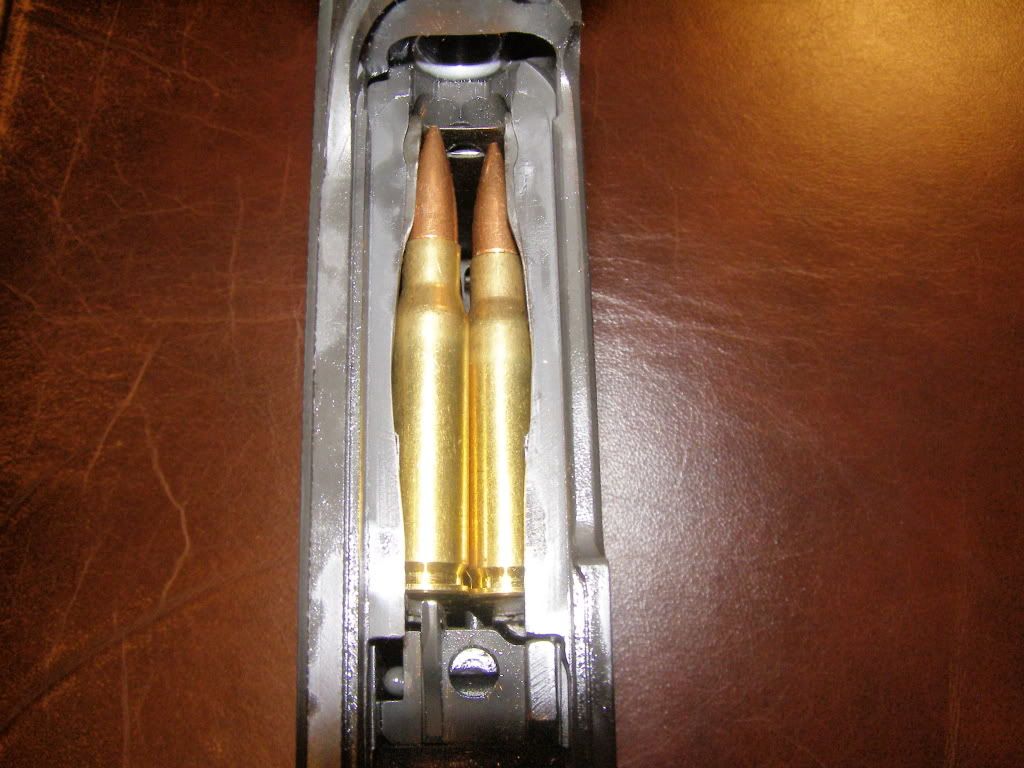
More info here.. http://community-1.webtv.net/ggiilliiee/FALRIFLEEJECTOR/index.html |
|
Comments on FAL Rifle Gas Regulation
Letter Re: Comments on FAL Rifle Gas Regulation Mr. Rawles: These sage comments on FN FAL gas adjustment from my friend and colleague, John Krupa, Director of Training for DSA [an American maker of FN FAL clone rifles. The following is re-posted with the permission of DSA]: "Not knowing that one can control gas-flow on this weapon has led to countless customer-service calls to DSA, complaining that the rifle 'doesn't work.' The following is laid out in great detail in the Owners's Manual, of course, but we are happy to explain to each owner how the gas-regulator works and then walk them through correct gas-regulator adjustment. Invariably, when we're finished, like a miracle, the rifle suddenly runs fine! (1) The gas vent is directly behind the base of the front sight. We start the process with the gas-regulator set to the full-open position, which is # 7 on the gas-regulator dial. The vent-hole will be visibly open all the way. Next, we start to close off the gas-regulator vent by turning the dial clockwise two clicks, which will place it at # 6. You will now see that the vent hole is partially occluded. From here, we can start our live-fire, function testing. (2) Charge a magazine with a single round of ammunition. Insert the magazine into the rifle and chamber the round. Holding the rifle in a normal, standing position (bench-resting is not recommended) aim into the impact area and fire one round. When the bolt fails to lock back, [we can conclude that] not enough gas is driving the piston into the bolt group for a complete cycle of operation. So, close the gas regulator another, single click, which will put it at 5 1/2, and then repeat the one-shot drill. Continue to close off the gas-regulator, a click at a time, until consistent (three in a row) bolt-lock is achieved (3) When the bolt thus consistently locks to the rear after firing a single round, insert a magazine charged with five rounds, load the rifle, and fire all five in rapid succession. Once again, the bolt needs to unfailingly lock to the rear as the last round is fired. (4) Once your rifle passes the 'five-round test,' close the gas-regulator two more clicks! The gas regulator is now 'set.' Just about all rifles we issue for student use have a final set at 4 to 4 . That is pretty standard. (5) When the rifle gets hot, dry, and dirty, and starts short-cycling, you can use the gas-regulator dial to quickly make incremental increases in gas pressure, instantly restoring the rifle to normal functioning. I don't recommend closing the gas-regulator completely, as you suggested in your last Quip, unless absolutely necessary. What concerns me is not excessive wear-and-tear on the rifle. The DSA/FAL is a robust, military rifle that is designed for heavy use in hostile environments. It will take whatever you can give it! Nor is my concern with accuracy. Practical accuracy is unaffected by gas-regulator adjustments. Nor is my concern with recoil attenuation. Soft recoil is nice, but we can all handle recoil. The real problem is with case-extraction that is so violent it may result in cases being literally pulled apart as the bolt moves to the rear. The front half of the case may thus be left in the chamber, resulting in a stoppage that cannot be corrected in the short term. With regard to ammunition: Ammunition quality is all over the map! Ammunition from dubious sources, reloads for example, typically exhibit inconsistent head-space and inconsistent pressure. DSA, of course, recommends against the use of such poor-quality ammunition, except in exigent circumstances." Comment: John Krupa is the resident expert, and I will surely defer to his judgment on this issue, and my advice to FAL owners is that they adhere to his, foregoing instructions. The thorny issue is, of course, "exigent circumstances!" When I have my FAL, some magazines, and a supply of ammunition about which I know little, and I've been invited to participate in a fight that is starting immediately, best bet is to begin with a rifle whose gas-regulator is closed off. I'll put up with recoil, and I'll take my chances with case-separation, just as long as I can be assured my rifle will complete each cycle of operation. Conversely, when I know what ammunition I'm going to feed it, and I have time to go through the foregoing gas-regulator adjustment routine, and a range where I can do the mandatory live-fire, I will surely tune my weapon to maximum advantage. No contestation there. Of all dubious ammunition, the most suspect is reloads. Cases that have been reloaded multiple times are stretched, weakened, and thin in spots. They are the ones most prone to case-separation, described above, and inspection may not be helpful. From the outside, one can seldom tell if a case wall is dangerously thin. "Once-fired-reloads" is a commonly-used platitude, but how can anyone really know how many times a particular case has been reloaded? Reloads are thus not recommended for use in any autoloading rifle. - John |
| I believe the gas port hole is about .1 inches. Double check that number to make sure, then get a drill bit that size and run it through the port, it should fit through into the barrel axis. You might be blocked up. If so, drill it out (or feed it lots of fiber LOL). |
|
I have your solution. If this works contact me to let me know it did. I might not check back here.
You mentioned it hand cycles just fine, and that tells me something. You're gas piston may be expiriencing too much resistance. To test this remove topcover and bolt. Then remove the gas plug and the piston. REMOVE spring from piston. Now with the buttstock end on the ground, drop your (non springed) piston back into its hole. Does it drop all the way into the boltless receiver? If it binds up instead of dropping all the way down, you just found your problem. Iits either one of two things.. Gas piston bent or out of spec diameter. Or. your barrels timing needs to be looked at (shit aint lined up). Try this BEFORE you go enlarging gas holes, or changing ammo. Takes 2 minutes. |
|
Quoted:
I have your solution. If this works contact me to let me know it did. I might not check back here. You mentioned it hand cycles just fine, and that tells me something. You're gas piston may be expiriencing too much resistance. To test this remove topcover and bolt. Then remove the gas plug and the piston. REMOVE spring from piston. Now with the buttstock end on the ground, drop your (non springed) piston back into its hole. Does it drop all the way into the boltless receiver? If it binds up instead of dropping all the way down, you just found your problem. Iits either one of two things.. Gas piston bent or out of spec diameter. Or. your barrels timing needs to be looked at (shit aint lined up). Try this BEFORE you go enlarging gas holes, or changing ammo. Takes 2 minutes. I will check this again tonight but I dont think the piston is binding....It was on my short list of things to check when this started. I also bought a pack of SA surplus from AIM just to rule out my ammo. My shooting spot is under a couple of feet of snow right now so I have not been back to test fire yet. |
|
Quoted:
Comment: John Krupa is the resident expert, and I will surely defer to his judgment on this issue, and my advice to FAL owners is that they adhere to his, foregoing instructions. The thorny issue is, of course, "exigent circumstances!" When I have my FAL, some magazines, and a supply of ammunition about which I know little, and I've been invited to participate in a fight that is starting immediately, best bet is to begin with a rifle whose gas-regulator is closed off. I'll put up with recoil, and I'll take my chances with case-separation, just as long as I can be assured my rifle will complete each cycle of operation. Conversely, when I know what ammunition I'm going to feed it, and I have time to go through the foregoing gas-regulator adjustment routine, and a range where I can do the mandatory live-fire, I will surely tune my weapon to maximum advantage. No contestation there. - John Tried this and it still does not eject the case even close to 100%. The empty cases are ending up primer to the chamber and holding the bolt open. |
|
I didn't see anyone else ask or see you post your bbl length. Is it standard 21" or has it been cut down? I'm asking cause on mine I cut the bbl down to 16" and had the same problem. I eventually had to open up the gas port. I drilled it out to .118" and it now it runs good set on 5. If you decide to drill it out, don't go over .120". Check out FAL Files. Lots of good info there.
Among the most common symptoms of FTF/FTE (failure to feed, failure to extract) are the following: 1. Bolt riding over the cartridge either causing a jam or missing the cartridge altogether 2. New cartridge only partially chambers, spent casing extracts and may or may not eject 3. New cartridge jamming against back of receiver 4. No apparent movement of bolt or carrier regardless of gas setting 5. Partial extraction of spent casing regardless of gas setting, casing jams hard in chamber 6. Gas tube blows out of gas block 7. I've done all the stuff to get more gas but my FAL STILL won't cycle properly. 8. Bolt closes easily on headspace guage but will not chamber round. Jams up tight. FIRST, have you checked and made sure that your extractor hasn't broken? I will deal with them in order. Before you do anything, ensure that the rifle is assembled correctly and there are no broken parts. 1. Bolt riding over the cartridge – This is a FTF problem and can almost always be traced to three common problems. a. First, check to see if the magazine is being held in the mag well tightly. If it is loose, your problem is most likely a mag catch that is too short. The solution is to replace it with one with an extended mag catch. Tapco offers extended mag catches for about $10. Alternately you could weld a small bead on the end. In either case you will have to “file to fit” for a good tight hold. b. Second, take the bolt and carrier out and remove the dust cover and close the rifle. Insert a mag with at least two cartridges into the mag well. Now look at the mag from the top of the receiver to see if the mag looks like it is symmetrically positioned in the well, especially near the front. Most often it is well used mags that have this problem which will manifest itself as a FTF from one side of the mag or the other. Also, check the mag for a weak spring. In either case. Get a new mag and throw this one away. (Yes, you can replace a weak spring if you have another bad mag laying around but at $10 each for new mags, it is hardly worth it.) c. Third, look for long fairly deep scratches in the cases of cartridges that have jammed. This is usually caused by sharp edges on the feed plate at the top of the mag well and more often on cartridges that feed from the left than the right. Polish the edges of the feed plate with 400 grit wet or dry or finer. 2. New cartridge only partially chambers, spent casing extracts and may or may not eject a. If the spent casing eject reliably, check to see if the bolt carrier moves easily in the rails. Imbel GL (gear logo) receivers are well made but a common problem is that the receiver rail is directly beneath some of the lettering stampings and occasionally gets distorted from an over zealous machine operator. Gunplumber suggests taking a small bastard file and gently but firmly filing the “hump” off. b. If you have an aftermarket HTS (hammer, trigger, sear) combo installed, remove and replace them with the pieces that were provided with the kit for troubleshooting. Century is not known for tight adherence to tolerances and their HTS will often cause FTF problems because they drag on the bottom of the bolt or carrier. c. Make sure that the recoil tube is straight and undamaged and that the spring and recoil plunger are lightly greased. A small amount of grease will not cause the rifle to lock up. d. Check for weak recoil spring. R&R as necessary. e. Perform gas checks in Number 4. c, d, e, f, and i. 3. New cartridge jamming against back of receiver a. This is most common with Century receivers. I have bad news, there is a problem with the design of the feed ramps that cannot be fixed easily. Polish the feed ramps with a felt tip and rouge on a Dremel and it may fix it. Others have suggested MIG welding or brazing a small ramp and Dremeling it to shape. Proceed at your own discretion. b. This can also be a problem caused by a slightly out of spec barrel. The barrel around the chamber cut should have a bevel about 1/8" wide. You can widen it slightly with a small file and polish it with fine sandpaper and then a felt tip and rouge on a dremel. 4. No apparent movement of bolt or carrier regardless of gas setting a. Check that the gas plug is in the “A” position. b. You DID remember to put the gas piston back in, didn’t you? c. Check to make sure the gas tube is pinned in place and has not rotated. Ideally, the exhaust ports in the gas tube should be at 8 o’clock and 4 o’clock but if they are at 10 and 2, it will not affect operation. d. Ensure that the gas port is not obstructed. e. Check that gas piston is not undersized or worn. Proper diameter is between 0.429” and 0.431”. f. Excess leakage around gas tube, see No. 6 g. Check that the bolt carrier “rat tail” is straight and in the recoil plunger detent and not jammed against the back of the lower receiver when closed. h. Take the gas piston spring out and roll the piston on a flat surface to check for straightness. Reinstall the gas piston with the bolt and carrier removed. The piston should fall freely through the gas cylinder and gas nut. If not check gas tube and gas nut for roundness and damage. i. Check for cracked gas block. j. Make sure you haven't put a metric gas plug in an inch gas block. A metric gas plug is about 3/16" longer than the inch plug. The gas plugs are not interchangeable. 5. Partial extraction of spent casing regardless of gas setting, casing jams hard in chamber a. This is most often a problem of not enough gas. What is REALLY happening is that the spent casing is going back a small distance and then being pushed back forward into the chamber and shares solutions with No. 4. c, d, e, and f above. b. Check that the gas piston moves freely. See 4. h above. c. Check that carrier moves freely. See 2. a, b, and c above. 6. Gas tube blows out of gas block. This is a common problem in the G1 kits and the solution is both simple and cheap. a. First, clean the thread of the gas block and gas cylinder and spread a small amout of solder flux on the threads. b. Install and pin the gas tube with the exhaust ports at 4 and 8 o’clock on the rifle as if you are preparing to shoot it without the gas piston or spring installed. c. Using Mapp gas, heat the threaded area and apply silver solder (preferably high temp silver solder because it is stronger) until it flows into the joint. d. After the area cools, clean the excess flux off the area (some flux is acid based) and you may file the high spots off the solder with a small file if your solder job isn’t too pretty or interferes with the gas regulator. e. With a Dremel cut off wheel, cut the gas tube off about 2 inches from the back of the tube (the end closest to the receiver) and discard it. Use sandpaper to smooth the end off. 7. I've done all the stuff to get more gas but my FAL STILL won't cycle properly a. Okay, one more trick to get more bleed gas. Remove the gas plug, piston, spring and tube. put a 1/4" wooden dowel down the barrel. b. Starting with a #41 or so drill bit insert it BY HAND through the bleed hole in the gas block and use it to determine the size of the gas port hole in your barrel. c. Once you have determined the approximate diameter of your gas port hole, take the next larger drill bit and use it to ream the hole out. Keep the drill speed slow and use plenty of cutting fluid and you will be less likely to break your drill bit off in the hole. d. Test the function of the rifle once you have gone up a couple of sizes. You should see some improvement. You can increase the size of the hole up to about 0.125" untill you get enough gas for proper operation. 8. Bolt closes easily on headspace guage but will not chamber round. Jams up tight. a. Does a cartridge fit into the chamber when you feed it by hand? No. Clean chamber thoroughly. Ensure cartridge is in spec. Lastly, you may need to ream the chamber slightly. Yes. It could be the top rear edge of the bolt binding up against the top inside of the carrier. Put a piece of Playdoh or some other putty on the inside top rear of the bolt carrier and then put the bolt in the carrier. Put them both in the receiver and try to push it closed with a cartride in the bolt until it binds. Pull the bolt and carrier out and observe the Playdoh. Is it pinched all the way to the carrier? If so, file a small amount off the top rear of the bolt until it clears. http://www.falfiles.com/forums/show...threadid=108077 |
Armory Sponsor