


Armory Sponsor

Posted: 5/16/2015 12:36:38 AM EDT
|
Help me diagnose my ejection problem please......
This is my set-up..... 10.5" SBR 5.56 running an AAC suppressor. Unknown barrel manufacture ( the upper started out as a Radial Arms build) Has a carbine length gas system. I have a Seekins adjustable gas block, an M16 BCG, Spikes T2 buffer and a Tubbs flat wire spring. Every item listed was brand new before today's range trip. My ammo is bulk Federal .223 55gr. I took the rifle out today to get the gas block tuned. With the gas block turned all the way down ( opened 1/16" of a turn from bottoming out ) my brass ejects 12:00 - 1:00 just in front of the rifle and is very weak. The bolt will still lock back on an empty mag. If I turn the gas block up just the slightest bit more, I get ejection 1:00 - 2:00 and is a bit stronger. Bolt still locks back on an empty mag. At this point it doesn't matter how much more I turn it up, it still ejects 1:00 - 2:00 but the brass will fly out 4-5 feet in from of the rifle. I checked the brass and I see no dents or extractor marks. Its my thought that I need to either get a heavier buffer or get a Wolfe extra power buffer spring or both. I'm just looking for a few opinions before I drop the cash on these new items. Any input would greatly be appreciated. Thanks! |
|
What is your "ejection problem"? It seems to be working just fine.
What are you currently running for a buffer and spring? A standard, Sprinco Blue (or equivalent) with an H or H2 will work; a Sprinco Red and H3 usually works. A lot of the guys in the CQBR/Mk18 thread are running Blue/H2. |
|
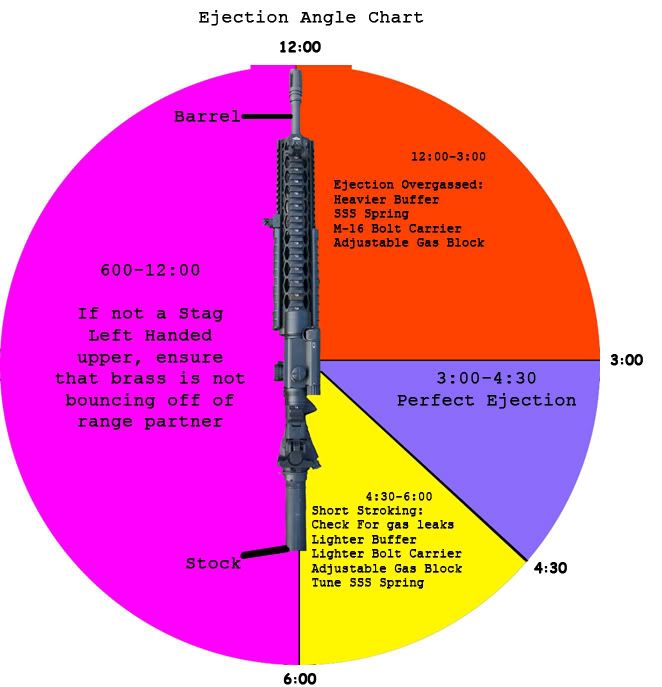
My understanding is that normal ejection is from a 3:00 to 4:30 position. Anything from a 12:00 to 3:00 usually indicates an over grassed situation.
My question is since I'm already running an adjustable gas block turned all the way down will increasing the buffer weight and/or spring weight give me a "normal" ejection position? Or, should I be looking elsewhere for a problem? This is my first SBR with a silencer so maybe the over gassing is the norm and there isn't really anyway to resolve it? |
|
Get this diagram pinned at the top of this forum. Nice work.
|
|
Quoted:
Sorry for asking a question guys. Next time ill just refer to some pictures. Thanks for the help. I honestly wasn't be sarcastic. I think this diagram would be helpful to many people who are running suppressed and having cycling issues. I don't have any experience with your gas block or the flat spring. Do you have other spring/buffer combos you could try just to see if anything changes? Try again to crank your gas all the way down. Then test three rounds, one click up, test three rounds, etc. |
|
I've seen that picture and agree, its useful information. My problem is I already have everything installed that it suggest to help solve over gassing issues.
I have an adjustable gas block (turned all the way down, any lower and it would shut the gas off completely) I have the heavy M16 BCG I have a heavy buffer (Spikes T2) I have the Tubbs flat wire spring (10% increase over a standard carbine spring) My questions was mainly for those who have ran across a similar situation.......Do you think a heavier buffer and/or a heavier rated spring would result in any better ejection? I would prefer not to spend the cash on items that may not give me any better results than what I have now. If the consensus was that yes, it would help then I have no problem dropping the cash on them. I just didn't want to start blindly buying parts without some information form other real world situations. Yes, I've done my share of internet searches (and on ARFCOM) to find the information myself before I asked in this post. Everything I've found thus far have been people who do not have the items that I have. The basic answers are always "Get an adjustable gas block" or " Get a H2 buffer" Which I already have installed. The other part to my question was is this 1:00 -2:00 ejection the "norm" for suppressed SBR's? Am I chasing a result that doesn't exist? |
|
Honestly, the only thing I can think of is that your adjustable gas block isn't working as designed. You are doing everything right.
What ammo do you run? Quoted:
I've seen that picture and agree, its useful information. My problem is I already have everything installed that it suggest to help solve over gassing issues. I have an adjustable gas block (turned all the way down, any lower and it would shut the gas off completely) I have the heavy M16 BCG I have a heavy buffer (Spikes T2) I have the Tubbs flat wire spring (10% increase over a standard carbine spring) My questions was mainly for those who have ran across a similar situation.......Do you think a heavier buffer and/or a heavier rated spring would result in any better ejection? I would prefer not to spend the cash on items that may not give me any better results than what I have now. If the consensus was that yes, it would help then I have no problem dropping the cash on them. I just didn't want to start blindly buying parts without some information form other real world situations. Yes, I've done my share of internet searches (and on ARFCOM) to find the information myself before I asked in this post. Everything I've found thus far have been people who do not have the items that I have. The basic answers are always "Get an adjustable gas block" or " Get a H2 buffer" Which I already have installed. The other part to my question was is this 1:00 -2:00 ejection the "norm" for suppressed SBR's? Am I chasing a result that doesn't exist? |
|
I have a 10.3", adj gas block (machined myself, but very similer to the Govnah), H3 buffer of my own design, Colt carbine spring (std issue) and a SF Socom RC can.... and run lots of Federal bulk .223 ammo. I can adjust my gas block to have the ejection pattern pretty much from 1 to 5 o'clock, depending on which size port I line up.
I would think that with your setup the logical step would be to go with a heavier buffer or a heavier spring.......... Oh........just remembered............I do have the "enhanced" extractor spring/o-ring installed also. edit: running an M16 carrier, like you. |
|
^^ what he said.
You said you tried everything, but look the st-t2 buffer is not the miracle buffer. I prefer the h3 myself but I don't let my rifle run too dirty for too long, I clean after each range day. Anyway try an h2 and h3 and see what happens. And make sure the gas block is working properly, again it doesn't hurt to have a few different buffers on hand. ETA: the t2 is not an h2. It's weight is between an h and h2. |
|
Quoted:
My understanding is that normal ejection is from a 3:00 to 4:30 position. Anything from a 12:00 to 3:00 usually indicates an over grassed situation. My question is since I'm already running an adjustable gas block turned all the way down will increasing the buffer weight and/or spring weight give me a "normal" ejection position? Or, should I be looking elsewhere for a problem? This is my first SBR with a silencer so maybe the over gassing is the norm and there isn't really anyway to resolve it? Well, sort of and sort of not; normal is subjective. If the brass is coming out of the gun, regardless of clock position, it's "OK". I wouldn't get too wrapped around the axle with clock position as attempting to "tune" ejection position is a relatively complex endeavor with many variables you haven't even touched upon in your post. Per Armalite Tech Pub 34: "Armalite seeks an ejection pattern between 1:00 and 3:00, and inspects for this characteristic during inspection. Obviously, the carrier’s opening velocity is subject to differences in ammunition. Springs can take a set over time, and the ejection pattern eventually shifts toward 5:00. This is normal, and readily adjusted by extractor spring replacement and ejector spring timing. The extractor spring and plunger can be changed during routine cleaning. The ejector spring can be replaced if ejection is too far to the rear, or tuned by shortening it a coil at a time if ejection is too far to the front. Tuned ejector springs will be between a minimum of .950 and a maximum of 1.015 inch long." Note that they "tune" to 1:00-3:00. Also note that this publication was for the AR-10 (so don't use the cited ejector spring lengths) since Armalite was receiving more complaints about the AR-10 since the heavier .308 cases are more likely to mar things like the ejection port and (herp derp) brass deflector. |
|
Quoted:
The "ejection pattern diagram" is complete internet Bull Shit! If the rifle functions reliably, the ejection pattern doesn't matter! I agree. If you don't like where your brass is going that's a preference, not a problem. What your looking for is reliability. |
|
Quoted:
The "ejection pattern diagram" is complete internet Bull Shit! If the rifle functions reliably, the ejection pattern doesn't matter! This. I have a Seekins 10.5" upper with their adjustable gas block. It ejects about 2 o'clock 1/8 turn out from where it just starts to lock back on empty. According to the chart it's not right and I should spend money to fix it. Brass comes out 100% of the time. It locks back on Tula/Wolf/PPU/M193. It's sure not over gassed. Posted Via AR15.Com Mobile |
|
Having a 1 o'clock ejection pattern is a SYMPTOM of overgassing but is not 100% accurate. If someone is coughing that doesn't mean that person has the flu does it? Of course not, however if someone is confirmed to be having the flu then coughing is to be expected. Likewise, 100% of the time when I encounter a 556/223 AR/M16 that IS overgassed, it WILL eject at the 1 o'clock area while a properly gassed AR will eject more around the 3:30 - 4:30 area. Just like seen in the video below. Crane spec's out .070 for the 10.3" MK18, M855 and H2 buffer and it runs at 830 RPM and clearly ejects around the 4 o'clock area. While running a suppressor at the same .070" port it is overgassed and clearly ejects around the 1 o'clock area. How do we know we know it is overgassed? You can clearly see an increase of almost 200 RPM faster in the cyclic rate and all the gas blowing out of the ejection area and in your face. You can also feel the increase in recoil when overgassed. Running a .049" port brings the full auto ROF back down to where it should be, lack of gas being thrown out of the ejection port, ejection back in the 4 o'clock area and a much smoother recoil impulse. Ignoring the ejection pattern in what is clearly overgassed wouldn't be very observant for troubleshooting POSSIBLE issues. Just like when someone is coughing you start asking if they are sick and start backing away...that is same observant analysis.  I mentioned 556/223 earlier because ejection pattern is less of an indicator in 300 BLK from what I've seen due to the different case geometry and where the cases impact the case deflector on the upper receiver. |
|
Quoted:
I agree. If you don't like where your brass is going that's a preference, not a problem. What your looking for is reliability. Quoted:
Quoted:
The "ejection pattern diagram" is complete internet Bull Shit! If the rifle functions reliably, the ejection pattern doesn't matter! I agree. If you don't like where your brass is going that's a preference, not a problem. What your looking for is reliability. I agree with this. I don't put a lot of stock in that chart. If the gun works, it works. Having said that, if you really want to make improvements, my advice would be to switch to an A5 system with an A5H2 or A5H3 buffer, but this is more expensive than just changing buffers and springs. |
|
Thank you to everyone for the help thus far.
I forgot a had an extra power Wolfe spring on one of my other AR's and swapped it into the AR in question. I seen no change in the current ejection condition. At this point I seriously question whether or not a heavier buffer may change anything. With some further testing, as long as the rifle cycles and ejects reliably, I may just leave things alone. |
|
Quoted:
Thank you to everyone for the help thus far. I forgot a had an extra power Wolfe spring on one of my other AR's and swapped it into the AR in question. I seen no change in the current ejection condition. At this point I seriously question whether or not a heavier buffer may change anything. With some further testing, as long as the rifle cycles and ejects reliably, I may just leave things alone. You're putting too much stock into that ejection chart. The chart wasn't designed for setups like yours with 10" barrel and a carbine buffer (with corresponding very short dwell times). With your setup you need more force to get the brass out while the chamber pressure is still high. Try using that chart with a 14.5" carbine or 16" middy and you'd have more luck. Tune for reliability and don't worry where your brass goes. Your goal is reliability, not ejection direction (which is just a diagnostic guideline for people with normal ARs to diagnose problems). If you're ripping the rims off cases, or are getting other symptoms of over gassing then use your adj gas block, otherwise just shoot it until you prove to yourself that it's trustworthy and reliable (or not). |
Armory Sponsor